Wendover's Spirit Airlines Verdict: A Merger Was Not a Guaranteed Rescue
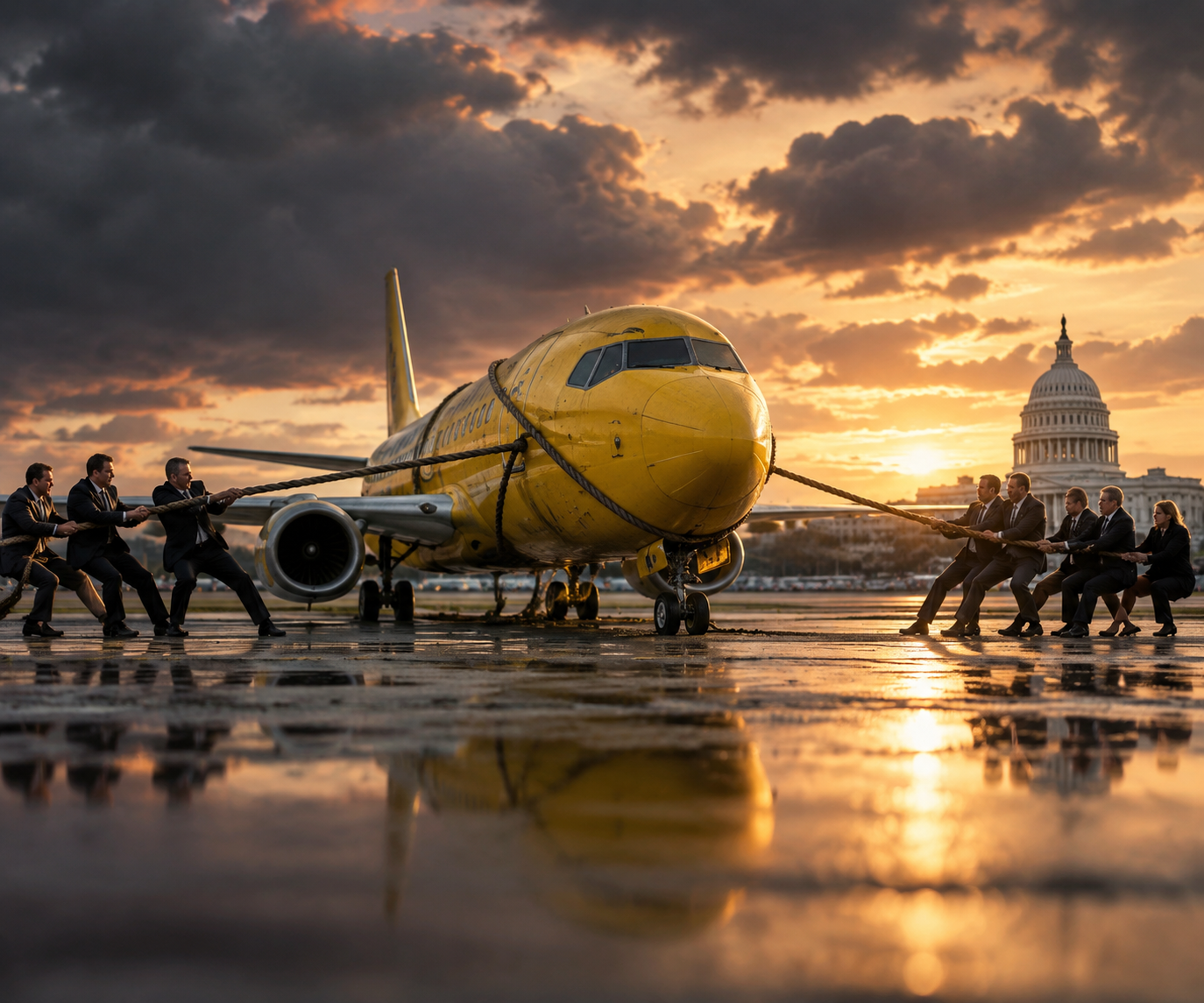
Wendover Productions makes a consequential mistake in its account of Spirit Airlines' collapse: it turns the airline's eventual failure into evidence that the Biden administration should have allowed JetBlue to acquire it. The video calls that alternative outcome “fairly uncontroversial.” It wasn't. Spirit was financially distressed, but the proposed acquisition carried substantial risks for consumers, JetBlue itself, and the survival of Spirit's independent low-fare business.
The distinction matters. A company can fail after regulators block an acquisition without proving that the acquisition would have saved it. Wendover has a compelling story about a dying airline, but its most politically consequential conclusion is considerably less convincing than its storytelling.
1. The Court Considered Spirit's Financial Distress. It Did Not Ignore It.
Wendover presents the blocked acquisition as a missed opportunity to save Spirit. Yet the financial evidence available when the court made its decision was already severe.
By January 2024, Spirit had not been profitable since 2019 and had accumulated nearly $2 billion in net losses since the pandemic. Management anticipated another $467 million loss in 2023. Pratt & Whitney engine problems had grounded 12 aircraft, while Spirit had abandoned 70 routes in 2022 and another 40 during the first half of 2023.
These facts appear in the federal court's January 16, 2024, Findings of Fact and Conclusions of Law. They were not discovered retrospectively. They were presented during the merger trial.
But the airlines also advanced a failing-company argument: that Spirit's financial condition made the acquisition preferable to the alternative of losing the airline altogether.
The court rejected that defense under the applicable legal test. It required evidence of a grave probability of business failure, dim or nonexistent prospects for bankruptcy reorganization, and the absence of another available purchaser.
Spirit's executives testified that the airline had a long-term profitability plan. The judge also observed that “JetBlue is also far from the only available purchaser.”
That finding matters. Financial distress is not automatically proof that a company is beyond restructuring or that its acquisition by a particular competitor is the only reasonable outcome.
Spirit subsequently entered bankruptcy, emerged in March 2025, and filed for bankruptcy protection again in August 2025. Its eventual failure demonstrates how serious its problems were. It does not establish that the court's January 2024 assessment was unreasonable.
2. JetBlue Was Not Going to Preserve Spirit as an Independent Competitor
Wendover acknowledges that JetBlue intended to absorb Spirit into its own operating model. But it does not give sufficient weight to what that meant for consumers.
The court established that the proposed $3.8 billion acquisition would eliminate Spirit as an independent competitor. JetBlue intended to retrofit Spirit's aircraft to its own configuration, reducing total seating capacity across Spirit's fleet by approximately 11%.
The process was expected to take four to five years.
More importantly, JetBlue intended to charge its higher average fares rather than maintain Spirit's exceptionally cheap pricing.
This was not simply a larger Spirit with better marketing. It was the removal of one competitive model and its replacement by another.
The court also examined the financial consequences for JetBlue itself. The acquisition required approximately $3.5 billion in additional borrowing while taking on nearly $4 billion of Spirit debt. The judge estimated that JetBlue's debt-to-capital ratio could rise to between 83% and 111%, compared with its historical target of 30% to 40%.
Wendover argues that the combination could have created a stronger competitor to Delta, American, and United. That argument has merit. Indeed, the court explicitly recognized that the combined airline could exert greater competitive pressure on the major carriers.
But the court also found that Spirit's presence reduced competing airlines' fares by approximately 7% to 11% when it entered a market.
Replacing Spirit's capacity would not have been easy. The court estimated that other ultra-low-cost carriers could need five years to replace its capacity nationally and more than 15 years to replace its capacity specifically on Spirit's routes.
The judge ultimately concluded that the merger would substantially lessen competition in at least some relevant markets.
Wendover acknowledges the consumer-harm argument but largely treats it as secondary to the possibility of creating a stronger airline.
That is an editorial choice, not an established economic conclusion.
3. The Hundreds of Millions of Dollars Were Not Spirit's Money
There is a particularly important financial detail in Wendover's account.
After the merger collapsed, the video says:
“Spirit was right back to where it started, yet with hundreds of millions of dollars of cash and two years wasted.”
This description is misleading.
JetBlue's SEC disclosures distinguish between payments to Spirit shareholders and payments to Spirit itself.
During the merger agreement, JetBlue paid approximately $425 million in prepayments directly to holders of Spirit shares.
That money went to shareholders. It was not a $425 million cash reserve available to Spirit Airlines to finance its operations.
Separately, JetBlue paid Spirit a $69 million termination fee and a $25 million reimbursement relating to Frontier transaction costs.
These are materially different financial arrangements.
The distinction matters because the video uses the apparent hundreds of millions in cash to describe Spirit's position after the failed acquisition. It gives readers the wrong impression of how much money actually entered the airline.
The airline was not sitting on the $425 million shareholder prepayment as an operating rescue fund.
Source: JetBlue's 2025 SEC Form 10-K, disclosure on termination of the Spirit merger.
4. The Final Collapse Had More Moving Parts Than an Oil-Price Shock
Wendover correctly identifies the 2026 fuel-price explosion as the immediate trigger for Spirit's shutdown. But its explanation omits several important developments that materially change the story.
On March 13, 2026, Spirit announced a restructuring support agreement with significant creditor groups.
The proposed plan was ambitious:
- Reduce the fleet to approximately 76–80 aircraft.
- Reduce debt and lease obligations from approximately $7.4 billion to $2 billion.
- Concentrate on stronger markets, including Fort Lauderdale, Orlando, Detroit and New York.
- Expand Spirit First and Premium Economy seating.
- Target emergence from Chapter 11 by early summer.
This was not an approved guarantee of survival. The plan remained subject to bankruptcy court approval and other conditions, and Spirit acknowledged that work with additional stakeholders remained.
Nevertheless, it was a concrete restructuring proposal, not simply investors preparing to liquidate the airline.
Source: Spirit's March 13, 2026 restructuring announcement.
Then came the fuel shock.
Spirit's restructuring projections assumed 2026 fuel costs of approximately $2.24 per gallon. By the end of April, prices had reached approximately $4.51.
Reuters reported that JPMorgan estimated sustained high fuel prices could add approximately $360 million in costs and push Spirit's projected operating margin from 0.5% to approximately negative 20%.
Spirit had also not engaged in fuel-derivative activity since 2015, leaving it without an active fuel-hedging program.
The shock was genuine and severe. But it struck an airline already struggling with debt, weak leisure demand, excess industry capacity and limited liquidity.
5. The Government Actually Tried to Rescue Spirit. Its Creditors Would Not Accept the Proposed Terms.
Perhaps the most important missing development is what happened immediately before the shutdown.
The Trump administration considered providing Spirit with $500 million in government-backed financing in exchange for warrants that could give the government as much as 90% of the airline's equity.
The proposal would also have placed the government ahead of existing creditors in the repayment structure.
The negotiations encountered resistance.
Bloomberg reported that a lender group including Citadel objected to terms that would substantially impair its claims and recoveries. CBS News reported that Citadel submitted a counterproposal that the government rejected, while Ares Management and Cyrus Capital also opposed the proposed government arrangement.
The parties could not agree on the financing terms.
Sources: Bloomberg Law, April 29, 2026; CBS News, April 29, 2026.
On May 2, Spirit announced its orderly wind-down.
CEO Dave Davis stated that the March restructuring agreement had offered a path to continuing operations, but that the sustained increase in fuel prices had made additional liquidity essential. Spirit needed hundreds of millions of dollars that it could neither access nor procure.
The company's own statement identified both higher fuel prices and the absence of additional funding.
Source: Spirit's official May 2 shutdown announcement.
This is a more revealing ending than the video's simplified account.
Spirit did not merely encounter expensive fuel and surrender. It had a restructuring proposal, a creditor dispute, a proposed federal financing arrangement and competing demands over who would control and recover the money.
The final rescue failed because the financing could not be agreed upon.
That distinction matters when assigning responsibility.
6. Even the Daily-Loss Figures Need Better Accounting
Wendover presents Spirit's deterioration through daily figures: approximately $1.2 million in cash burn in 2023, $3.4 million in 2024 and $7.5 million in financial losses in 2025.
The problem is that the terminology changes without explaining the difference.
Spirit's 2025 SEC filing separates its financial results into predecessor and successor accounting periods following its emergence from bankruptcy.
It reports $2.19 billion in reorganization expenses during the successor period, including approximately $2.149 billion in aircraft lease termination charges.
Its reported operating cash outflows were $706.6 million during the successor period and $223.7 million during the preceding 2025 period.
That is approximately $930 million in operating cash used across the two periods.
The $7.5 million daily figure is consistent with averaging the combined accounting net loss across the calendar year. It is not the same as daily operating cash burn.
This does not make Spirit's financial crisis less serious. It means the video's progression from cash burn to accounting losses is not a directly comparable financial series.
A video built around financial collapse should make that distinction explicit.
7. The Political Conclusion Is Stronger Than the Evidence
The video repeatedly frames Spirit's demise through competing political narratives: the Biden administration's antitrust intervention and the Trump administration's war with Iran.
Both events mattered.
But the actual history is less convenient.
Spirit had lost its profitability years before the merger dispute. Its competitive advantage was weakening, its aircraft problems were expensive, and its balance sheet deteriorated through successive restructurings.
The JetBlue acquisition offered a possible alternative, but it was not a guaranteed rescue. The acquisition would have eliminated Spirit's independent low-fare model, introduced substantial financial leverage and potentially increased fares for consumers dependent on Spirit.
The later fuel shock then destroyed the prospects of a separate restructuring.
Wendover also discloses Ground News as a sponsor and describes a partnership dating to 2023. That commercial relationship deserves transparency, but there is no evidence in the material establishing that the sponsor influenced the video's conclusions. I will not turn a disclosed sponsorship into an unsupported allegation.
Closing Verdict: A Plausible Counterfactual Is Not Proof
Spirit Airlines deserved a serious examination of its financial collapse. Its employees, passengers and the communities it served deserved better than a political blame game.
Wendover's strongest argument is that blocking JetBlue removed a possible route to preserving Spirit's operations and employment. That possibility should not be dismissed.
But the video goes much further. It treats the airline's eventual disappearance as evidence that the merger should have been approved, without establishing that the acquisition would have preserved jobs, protected consumers or produced a financially sustainable combined airline.
It overlooks the court's actual findings, misrepresents the destination of $425 million in merger-related payments, underplays JetBlue's financial exposure and leaves out the final restructuring and federal rescue negotiations.
The central question is not whether Spirit might have survived under JetBlue. It might have.
The question is whether that outcome would have been better for consumers, workers and the airline industry than the alternative.
Wendover has not established that it would.
Calling the answer “fairly uncontroversial” does not make the evidence stronger. It merely makes the conclusion sound more certain than the facts allow.
Spirit's collapse is a tragedy. It is not a verdict on the wisdom of every decision that preceded it.
References
- The Problem With Spirit Airlines' Business Model — Wendover Productions. Original video. The work under examination and the source of the original claims.
- Findings of Fact and Conclusions of Law — U.S. District Court, District of Massachusetts, January 16, 2024. Official court document. Establishes Spirit's financial condition, the failing-firm argument, JetBlue's debt exposure, consumer harm and the court's actual reasoning.
- JetBlue Airways Corporation, 2025 Form 10-K — U.S. Securities and Exchange Commission, February 2026. SEC filing. Distinguishes the $425 million paid to Spirit shareholders from the termination and reimbursement payments made to Spirit.
- Spirit Aviation Holdings, 2025 Form 10-K — SEC, March 16, 2026. SEC filing. Documents bankruptcy, financial results, operating cash flows, reorganization charges and fuel exposure.
- Spirit Airlines Announces Restructuring Support Agreement and Plan of Reorganization — Spirit Airlines, March 13, 2026. Company announcement. Establishes the proposed fleet reduction, debt restructuring and premium-product strategy before the final shutdown.
- Fuel Surge Threatens Spirit Airlines Bankruptcy Exit, Raises Liquidation Risk — Reuters, April 16, 2026. Reuters report. Quantifies the fuel-price shock and its projected effect on Spirit's already fragile finances.
- Some Spirit Lenders Balk as US Rescue Talks Hit Impasse — Bloomberg Law, April 29, 2026. Bloomberg Law report. Documents creditor resistance to the proposed $500 million government financing arrangement.
- Spirit Airlines Shuts Down, Industry's First Iran War Casualty — Reuters, May 2, 2026. Reuters report. Establishes the failed rescue negotiations, fuel-price shock and immediate circumstances of Spirit's shutdown.
- Spirit Airlines Begins Orderly Wind-Down of Operations — Spirit Airlines, May 2, 2026. Official announcement. Provides the CEO's explanation of the failed restructuring, additional liquidity requirements and final decision to cease operations.
Separate verified facts from interpretationTighten the evidence-heavy middle sectionsClarify the merger counterfactual