Wendover’s Guyana Story Skips the Contract That Decides Who Gets the Oil Money
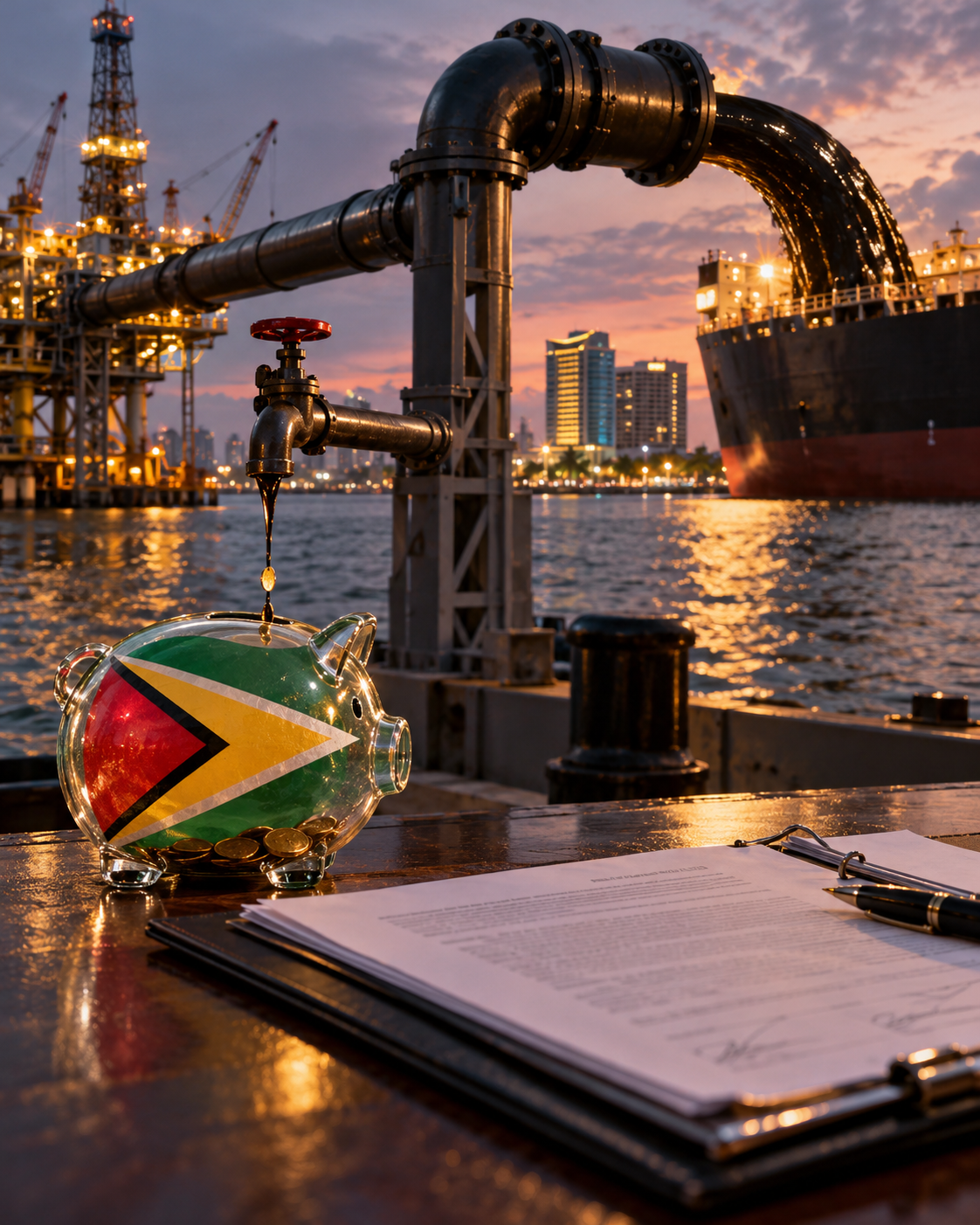
Wendover Productions gets one thing right: discovering oil does not guarantee national prosperity. But its assessment of Guyana's early economic management is considerably more reassuring than the evidence deserves.
The video praises a sovereign wealth fund, parliamentary oversight and ambitious infrastructure spending as signs that Guyana is avoiding the resource curse. Yet it never properly examines the contract determining how much oil revenue reaches the government, the unresolved audits determining how much money oil companies can recover, or the political decisions determining how quickly national savings can be spent.
These are not peripheral details. They are the financial and institutional machinery on which the entire story depends.
The video itself acknowledges that Guyana has not yet passed its most difficult tests. That qualification is important. But warning that the future is uncertain does not excuse presenting early safeguards as evidence of particularly intelligent management without examining whether they actually work.
The 50% profit-sharing figure hides the government's actual share
The video says:
"with 50% of profits going to the government"
Technically correct. Financially incomplete.
Guyana's 2016 Production Sharing Agreement with ExxonMobil, Hess and CNOOC allows the consortium to recover eligible project costs from up to 75% of monthly production. These barrels are classified as cost oil. Only the remaining production becomes profit oil, which is divided equally between the government and the consortium.
Guyana also receives a 2% royalty.
Under the maximum cost-recovery arrangement, that produces an initial government share of approximately 14.5% of total oil revenues: 12.5% from profit oil and 2% from royalties.
This is not 50% of the oil revenue. It is 50% of what remains after the permitted costs have been recovered.
The distinction matters enormously when billions of dollars in exploration, development and operating expenses are involved.
The 2019 joint World Bank–IMF debt sustainability analysis explicitly calculated the initial government share at 14.5%.
To be fair, this is not necessarily the permanent share. As recoverable costs decline, more production becomes profit oil and Guyana receives more. The IMF's October 2026 assessment also recognizes this increasing government share as cost-recovery outflows decline.
But the video never explains the actual contractual mechanism in sufficient detail for viewers to understand what Guyana receives, what Exxon recovers, and when that balance changes.
There is another important omission: the agreement's tax arrangements. Article 15.4 provides for the government to pay the contractors' assessed income and corporation taxes on their behalf, with the relevant amount accounted for through the government's share of profit oil. Guyana's own Ministry of Natural Resources subsequently described the Stabroek agreement's corporate tax rate as zero.
The government has since introduced a considerably more demanding model agreement for future petroleum concessions: 10% royalty, 10% corporate tax and a 65% cost-recovery ceiling, compared with the Stabroek agreement's 2% royalty, effectively zero corporate tax and 75% cost recovery.
That comparison comes from the government's own June 2025 explanation of the Stabroek agreement.
The question is obvious: if Guyana considers substantially better terms appropriate for future oil developments, why does the video present the existing arrangement without explaining how much less favorable it is?
Guyana had more bargaining power than the video explains
The Stabroek agreement was signed on June 27, 2016, approximately one year after ExxonMobil's first major Liza discovery.
This matters because the government was no longer negotiating with a company exploring an entirely unproven petroleum basin.
Guyana had acquired considerable bargaining power.
Its own government acknowledged this in November 2021. An official statement explained that the country's negotiating position had improved significantly following the 2015 discovery, but the previous administration had failed to use that advantage.
In April 2024, Attorney General Anil Nandlall went further. He said no expert advice or industry consulting services had been placed on record in connection with the negotiations. He also criticized the absence of public consultation and said the agreement's terms were not ideal.
These are statements from Guyana's current government, not independent findings about the former administration's motives. Nevertheless, they establish that the contract's negotiating history remains a serious institutional concern.
There is also a practical obstacle to correcting it.
Article 32 of the agreement prevents the government from requiring unilateral renegotiation or changing the contractual terms without the contractors' prior written consent. It also protects the consortium against certain new fiscal obligations that would materially increase its economic burden.
The current government has consequently maintained that it will honor the agreement and concentrate on improving contract administration rather than attempting unilateral renegotiation.
The 2016 agreement itself makes these restrictions explicit.
This changes the central question. Guyana cannot simply decide tomorrow that Exxon should pay substantially more under the existing agreement. Its ability to protect public revenue depends heavily on accurate cost verification, contract enforcement and competent administration.
Those are precisely the subjects the video should have investigated more closely.
The oil-cost audits remain unresolved
The video describes Guyana's sovereign wealth fund as a public mechanism that allows citizens to monitor petroleum wealth and reduce corruption.
But a transparent fund cannot independently establish whether an oil company's claimed expenses are legitimate.
That requires auditing the costs.
And Guyana has had substantial unresolved disagreements over those costs.
An independent IHS Markit audit covering 1999–2017 identified approximately US$214.4 million in costs that the government had reasonable grounds to dispute, plus associated overhead adjustments. The disputed amount represented approximately 12.8% of the cumulative cost-recovery balance at the end of 2017.
A second audit examined US$7.2 billion in expenses from 2018–2020. The government did not accept US$65.1 million of those submissions.
A third audit, covering 2021–2023, was subsequently completed and submitted to the government for review.
These figures are documented in the government's published audit reports and its official audit-status update.
There is an important distinction here: disputed expenses are not proven fraudulent expenses. The government has a formal dispute-resolution process, including a sole-expert mechanism under the agreement.
But the October 2026 IMF assessment reported that none of the three audits had been resolved, with approximately US$280 million in unresolved balances through 2020.
That is a serious problem.
Every accepted recoverable expense affects the amount of oil available for profit sharing. Unresolved costs therefore affect the timing and amount of government revenue.
The video praises Guyana's transparency arrangements but never confronts the fact that the verification process responsible for checking one of its largest sources of future public revenue remains unfinished.
A public fund cannot substitute for an effective audit.
The sovereign wealth fund is real, but its safeguards are not permanent
Guyana deserves credit for establishing its Natural Resource Fund.
The original fund was established under the 2019 legislation, which was replaced by the Natural Resource Fund Act 2021. The newer legislation introduced a board structure, an oversight committee and parliamentary approval for withdrawals.
These are meaningful institutional arrangements.
However, the video describes the fund as a national investment portfolio directed toward economic diversification. That description gives a somewhat misleading impression of what the fund was actually doing.
According to its 2024 annual report, the board mandated that the fund's resources remain in overnight deposits at the Federal Reserve Bank of New York. This was a conservative cash-management decision, not an investment programme financing Guyanese businesses and industries directly.
The fund earned approximately US$141 million in interest during 2024. Its withdrawals were transferred into the Consolidated Fund and then used through the national budget.
There is nothing inherently wrong with keeping public savings in safe, liquid deposits. But holding oil wealth and investing in economic diversification are two different activities.
More importantly, Guyana changed its withdrawal rules in 2024.
The revised formula substantially increased the amount of oil revenue that could be transferred into the national budget in the short term.
The IMF illustrated the scale of the change: if the fund received US$5 billion in a preceding year, the maximum permitted transfer under the revised formula would be US$4.2 billion, compared with US$1.35 billion under the previous formula.
Parliamentary approval remained necessary. But the legal ceiling itself had become considerably more permissive.
The IMF's 2025 assessment explains the change and its implications for savings and capital spending.
The IMF did not conclude that the revised rules made Guyana financially unsustainable. It still projected substantial long-term savings accumulation. Nevertheless, the change represented a deliberate shift toward allowing more petroleum revenue to be spent sooner.
The video does not adequately examine that decision.
The 2024 budget figure also needs correcting
There is a specific timing problem in the video's account of the 2024 budget.
It says approximately 29% of the US$5.5 billion budget was covered by four scheduled and executed transfers from the Natural Resource Fund.
But 29% corresponds to approximately US$1.59 billion.
The Natural Resource Fund's subsequent annual report records five withdrawals totalling approximately US$1.586 billion during 2024.
The first four transfers, completed by October 1, totalled US$1.15 billion. The fifth transfer, approximately US$436 million, occurred on December 16.
Wendover published its video on November 14, 2024.
Therefore, at publication, the four completed transfers represented approximately 21% of the US$5.5 billion budget, not 29%. The 29% figure corresponds to the eventual full-year withdrawal, including the transfer made after the video was published.
The 2024 Natural Resource Fund Annual Report records the five transactions and their dates.
This is not a minor accounting distinction. The video presents a final annual outcome as though the entire amount had already been transferred.
Georgetown's boom is not proof of economic diversification
The video spends considerable time showing the visible transformation of Georgetown.
New hotels, international restaurants, Starbucks, foreign airlines and technology businesses are presented as evidence of a rapidly expanding economy.
They are evidence of increased demand. They are not, by themselves, evidence of a diversified economy.
Many of these businesses exist because the petroleum industry has brought foreign workers, contractors, investors and spending into Guyana.
A hotel room occupied by an oil executive is not the same thing as a new export industry capable of supporting the country independently of petroleum.
The distinction becomes clearer in the IMF's October 2026 assessment.
In 2025, oil production, associated services and exploration accounted for approximately three-quarters of Guyana's GDP. Oil represented around 90% of exports and approximately half of central government revenue.
The IMF also recognizes strong non-oil growth and the benefits of public investment. This is genuine progress, not something to dismiss.
But Guyana remains heavily dependent on petroleum.
The video understands the theory of economic diversification. What it does not establish is how much diversification has actually occurred, how many sustainable jobs are being created outside oil, or whether the new economic activity can survive a prolonged decline in petroleum demand.
Even the gas-to-energy project, which the video presents as potentially transformative, deserves more scrutiny.
The IMF's 2026 assessment specifically calls for greater transparency regarding the project's full costs and future repayment obligations, including payments to ExxonMobil for gas and pipeline services and obligations associated with US EXIM Bank financing.
The video mentions construction delays. It does not adequately investigate the longer-term financial obligations attached to the project.
An infrastructure project can deliver genuine public benefits and still be an expensive investment requiring careful financial scrutiny.
The sponsored bias check is not a fact check
The video also includes a substantial sponsored segment for Ground News.
The sponsorship is disclosed, and there is no evidence that the sponsor dictated the video's editorial conclusions.
However, the narrator describes using the platform's political-leaning classifications and comparisons of left-wing and right-wing coverage to gain confidence in his reporting about Venezuela.
That is a useful way to identify differences in media framing.
It is not a method of establishing whether the underlying claims are true.
If politically different publications repeat the same claim, that does not necessarily mean they have independently verified it. They may simply be repeating the same original source.
Ground News can help identify coverage patterns and potential bias. It cannot replace examination of original documents, independent evidence and the reliability of the underlying reporting.
The distinction matters particularly in a video dealing with a politically sensitive territorial dispute.
The verdict: Guyana's safeguards have not yet earned the confidence placed in them
Guyana has made extraordinary economic progress. Its oil discoveries are real, its public savings are substantial, and its infrastructure investments have the potential to improve living standards.
The IMF itself recognizes the benefits of prudent oil-revenue accumulation and public investment.
This is not an argument that Guyana has failed.
It is an argument that the video gives too much credit to institutional safeguards without examining their actual performance.
The 2016 petroleum agreement determines how the oil wealth is divided. The cost-recovery audits determine whether the expenses behind that division are legitimate. The Natural Resource Fund determines how much wealth is saved and how much is spent. Parliament can approve withdrawals, but it can also change the rules governing them.
And the country's continuing dependence on petroleum demonstrates how much work remains before diversification can be considered a success.
Wendover correctly identifies the resource curse as Guyana's greatest long-term danger. But it spends too little time examining the mechanisms through which that danger could actually materialize.
The most important question is not whether Guyana is building hotels, roads and power plants.
It is whether Guyana can accurately account for its oil wealth, enforce the agreements it signed, resolve disputed costs, control public spending and build an economy that can survive without petroleum.
Until those questions receive convincing answers, Guyana's success story remains unfinished.
The oil is there. The money is arriving. The safeguards still have something to prove.
References
- The World's Fastest Growing Economy — Wendover Productions (November 14, 2024). Original video. The work under examination, including its account of the oil-sharing arrangement, the Natural Resource Fund and the sponsor segment.
- Petroleum Agreement between Guyana and Esso, Nexen and Hess (June 27, 2016). Government of Guyana — Agreement. The original contractual provisions establish the cost-recovery ceiling, profit-sharing arrangement, tax mechanism and restrictions on renegotiation.
- Guyana: Joint World Bank–IMF Debt Sustainability Analysis (September 2019). World Bank / IMF. Calculates Guyana's initial government share at 14.5% of total oil revenue.
- Stabroek Block Oil Contract Not Up for Renegotiation (November 27, 2021). Department of Public Information, Guyana. The government acknowledges that Guyana had greater bargaining power after the 2015 discovery and explains the contractual restrictions on unilateral renegotiation.
- Government Committed to Maximising Benefits for Guyanese Despite Lopsided Exxon Contract (April 14, 2024). Department of Public Information, Guyana. Attorney General Nandlall's account of the absence of recorded expert advice, public consultation and the government's contractual constraints.
- Guyana Gets Higher Returns Than Oil Companies from Stabroek Block (June 25, 2025). Department of Public Information, Guyana. The government's explanation of the existing 2% royalty and 75% cost-recovery terms, alongside its improved fiscal terms for future petroleum agreements.
- IHS Markit Final Audit Report: Stabroek Block, 1999–2017 (April 15, 2024). Petroleum Management Programme. Establishes the US$214.4 million in disputed expenses and associated overhead adjustments.
- Update on Status of Stabroek Block Cost Recovery and Verification of Profit Oil Audits. Ministry of Natural Resources. Documents the second audit's US$65.1 million disputed expenses and the status of the three audit processes.
- Guyana: 2025 Article IV Consultation (2025). International Monetary Fund. Quantifies the 2024 change in Natural Resource Fund withdrawal limits and its consequences for the country's savings and investment path.
- Natural Resource Fund Annual Report 2024 (presented March 2025). Government of Guyana / Parliament. Records the fund's investment mandate, Federal Reserve deposits, interest earnings and five actual withdrawal transactions during 2024.
- Guyana: 2026 Article IV Consultation (October 8, 2026). International Monetary Fund. Provides the latest assessment of petroleum dependence, unresolved cost audits, public investment oversight and the financial obligations of the Gas-to-Energy project.
petroleum.gov.gy+11