Wendover's Volkswagen Story Gets the Crisis Right—and the Explanation Wrong
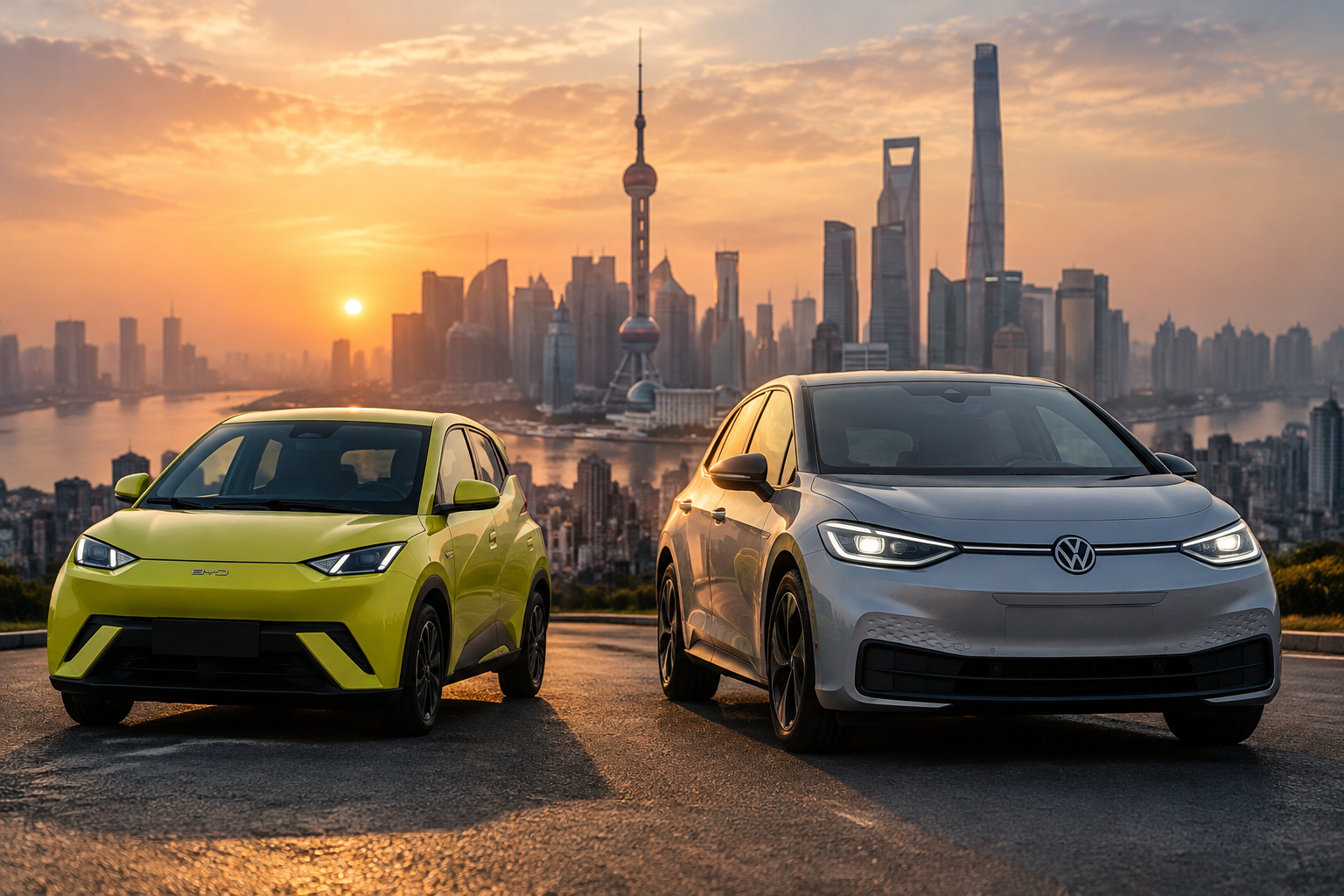
Wendover Productions' January 2025 video, Volkswagen's China Problem, presents a compelling diagnosis: Chinese government support accelerated the electric-vehicle revolution, BYD built better and cheaper cars, Volkswagen's software division failed, and the German automotive giant began losing its grip on the world's largest car market.
The crisis is real. The explanation is considerably less convincing.
Wendover builds its case using a government-subsidy estimate without adequately explaining its limitations, a misleading comparison between two different classes of vehicles, an imprecise definition of BYD's position against Tesla, and anecdotal evidence about software that is never connected convincingly to lost customers.
Most importantly, it reduces a transformation of China's entire automotive industry to a relatively simple story about BYD beating Volkswagen at technology.
That is an entertaining explanation. It is not a sufficiently rigorous diagnosis.
$230 billion is an estimate, not a government cheque
The video states that China provided approximately $230 billion in support to its electric-vehicle industry between 2009 and 2023.
The figure comes from Scott Kennedy's research at the Center for Strategic and International Studies (CSIS). It is a legitimate estimate, but its methodology deserves considerably more attention than Wendover gives it.
The estimate combines five categories: consumer purchase rebates, sales-tax exemptions, infrastructure funding, research and development programmes, and government procurement. It is not simply a record of money transferred directly to automotive manufacturers.
There is an especially important qualification. For 2023, CSIS estimated sales-tax exemptions at $39.6 billion, while China's State Tax Administration reported $17.2 billion. Using the government's reported figure instead would reduce CSIS's estimated total support for that year from $45.3 billion to $22.9 billion.
CSIS acknowledges this discrepancy and explains that its calculations rely on assumptions because comprehensive historical government data is unavailable. It also argues that its overall estimate may be conservative because other forms of support are excluded.
These qualifications do not establish that Chinese subsidies were insignificant. They establish that $230.9 billion is a modelled estimate with substantial methodological uncertainty.
Wendover gives viewers the impressive headline number without explaining the difference between direct subsidies, tax revenue forgone and other forms of industrial support.
That distinction matters when the number is used to explain the competitive advantage of an entire national industry.
The Seagull is not Volkswagen's equivalent
The video's most memorable comparison is between Volkswagen's ID.3 and BYD's Seagull.
The argument is straightforward: Volkswagen sells an electric car for approximately $23,000, while BYD offers a vehicle with broadly comparable range for approximately $11,800.
The problem is that these are not equivalent vehicles.
The 2024 Volkswagen ID.3 measures 4,261 mm in length, has five seats, a 125 kW motor and a 2,765 mm wheelbase. The 2024 BYD Seagull measures 3,780 mm, has four seats, a 55 kW motor and a 2,500 mm wheelbase.
The Seagull is 481 mm shorter and has substantially less motor power. Its smaller size and reduced passenger capacity are important parts of its lower price.
Both vehicles' quoted ranges use China's CLTC testing cycle, so the range comparison itself is reasonably consistent. The problem is what the comparison implies about overall value.
A much smaller city-oriented electric car costing half as much as a larger family hatchback does not establish that an equivalent vehicle costs half as much.
BYD's ability to manufacture an affordable small electric car is genuinely impressive. But the Seagull comparison does not establish that Volkswagen has lost a direct price competition between equivalent products.
Wendover needed a proper comparison of vehicle classes, equipment, battery sizes, power, passenger capacity and actual transaction prices.
Instead, it selects the most dramatic price difference and lets the reader draw a broader conclusion.
BYD's position against Tesla needs a definition
Wendover describes BYD as the world's largest electric-vehicle manufacturer, having overtaken Tesla.
There is an important distinction missing from that statement: battery-electric vehicles and plug-in hybrids are not the same product category.
BYD's own December 2024 production and sales announcement reported 4.27 million new-energy vehicles sold during the year. However, 2.485 million were plug-in hybrids, while 1.765 million were battery-electric passenger vehicles.
Plug-in hybrids therefore represented approximately 58.5% of BYD's passenger new-energy vehicle sales.
Tesla, which sells battery-electric vehicles rather than plug-in hybrids, delivered 1.789 million vehicles in 2024.
BYD actually produced slightly more battery-electric vehicles than Tesla that year, approximately 1.778 million against 1.773 million. But Tesla still sold more pure battery-electric vehicles.
So the statement that BYD overtook Tesla is defensible when referring to production volume, but not when referring to annual battery-electric vehicle sales. Counting plug-in hybrids makes the difference considerably larger.
This is not an insignificant technical distinction. It changes the story of what BYD actually accomplished.
The video discusses the electric-vehicle revolution as though it were one unified market. Yet a substantial portion of BYD's success came from plug-in hybrids, a category with different customer requirements and competitive dynamics.
BYD's official 2024 production and sales announcement | Tesla's 2024 delivery announcement
Volkswagen's problem is bigger than CARIAD
The video spends considerable time explaining Volkswagen's software difficulties.
There is substance here. CARIAD struggled with development delays, unfinished software, vehicle recalls and the simultaneous development of multiple software platforms.
But the video makes an important leap.
It describes Volkswagen's software as inferior and argues that the everyday ownership experience of its electric vehicles is worse than that of competitors.
Its own wording is revealing:
"the day-to-day experience of owning a VW EV is reportedly just worse"
Reportedly is doing considerable work.
The video provides examples of software problems, but does not establish how much those problems contributed to lost Chinese sales. It offers no systematic comparison of customer satisfaction, software reliability, defect rates or the reasons Chinese buyers abandoned Volkswagen.
A software failure can damage a vehicle's reputation. It does not automatically explain a company's loss of market leadership.
Consider the scale of the market transformation.
According to data from China's Association of Automobile Manufacturers reported by Caixin, domestic Chinese brands increased their share of passenger-car sales from 38.4% in 2020 to 68.7% in the first four months of 2025. New-energy vehicles accounted for 48.9% of passenger-car sales during that period.
This was not simply BYD becoming better than Volkswagen. An entire domestic automotive industry was gaining ground.
Geely, SAIC, Chery and other manufacturers were part of the transformation. Their competitiveness involved pricing, manufacturing scale, supply chains, vehicle development speed and local consumer preferences, alongside software.
Volkswagen's own 2025 annual report makes the problem even clearer.
Its deliveries in China fell 8% to approximately 2.69 million vehicles, even though the overall passenger-car market expanded slightly. More strikingly, its battery-electric deliveries in China fell 44.3% to 115,453 vehicles.
Globally, Volkswagen Group's battery-electric deliveries increased 32% during 2025.
That difference is revealing. Volkswagen was capable of increasing electric-vehicle deliveries elsewhere while suffering a major decline in China.
The problem cannot adequately be described as a general inability to manufacture electric vehicles or a software subsidiary making mistakes. It is also a failure to compete effectively in a rapidly changing local market.
The profit decline is real, but the accounting matters
Wendover says Volkswagen's Chinese earnings have fallen approximately 50% from their 2015 peak.
The broad claim is supported by Volkswagen's own reporting.
Its proportionate operating result from Chinese joint ventures was €5.214 billion in 2015 and €2.621 billion in 2023.
But these are earnings attributable to Volkswagen's interests in Chinese joint ventures. They are not the same thing as Volkswagen Group's consolidated operating profit.
Volkswagen accounts for these Chinese businesses using the equity method. Their operating results are not included directly in the Group's consolidated operating result; Volkswagen recognises its proportionate share through its financial result.
That accounting distinction should have been made clear.
And the subsequent figures make the situation considerably worse.
Volkswagen's 2025 financial reporting put the share of operating result generated by its equity-accounted Chinese companies at just €958 million, compared with €1.742 billion in 2024.
The decline continued well beyond the video's 50% figure.
Reuters reported in June 2026 that Volkswagen's profits in China had fallen by more than 80% over the preceding decade, while the company had slipped from first to third among automakers in China.
There is another important omission: Volkswagen's institutional structure.
Reuters describes a conglomerate employing more than 657,000 people, with powerful unions, a complicated network of divisions and joint ventures, and voting control concentrated in the Porsche and Piëch families.
Investors have argued that this structure makes the company difficult to reform.
That does not prove governance caused Volkswagen's Chinese decline. But it is essential context when examining why a giant manufacturer struggled to reorganise itself around a rapidly changing market.
CARIAD's failures are part of the story. They are not the whole story.
Volkswagen Annual Report 2016 | Volkswagen Annual Report 2023 | Volkswagen 2025 financial results | Reuters, June 30, 2026
The German factory story was already out of date
There is also a straightforward publication-date problem.
Wendover's video was published on January 21, 2025. It describes Volkswagen's potential German factory closures, strikes and internal conflict as an unfolding crisis.
But Volkswagen and IG Metall had reached an agreement on December 20, 2024, a month before the video appeared.
The agreement ruled out German plant closures and established employment protection through 2030. It nevertheless included a substantial restructuring programme:
- More than 35,000 positions to be reduced across German locations by 2030.
- Manufacturing capacity reduced by 734,000 vehicles.
- More than €15 billion in annual savings targeted over the medium term.
This was not a victory without costs. Thousands of jobs were still scheduled to disappear through the restructuring process.
But the distinction matters. The threatened German factory closures had been negotiated away before the video was published.
The separate closure of Audi's Brussels factory was real. The German situation, however, had already changed.
Wendover retained the dramatic threat without updating viewers on the agreement that resolved it.
Volkswagen's December 20 agreement | IG Metall's negotiation outcome
Volkswagen has already changed its software strategy
The video's software narrative also needs updating.
Volkswagen originally wanted to develop a common software architecture across its brands. Its subsequent Chinese strategy has become more locally focused.
In January 2026, Volkswagen announced that its China Electronic Architecture had entered series production. The company said the architecture had been developed, tested and produced entirely in China, reaching production just 18 months after the project began.
On October 29, 2026, Volkswagen Group China unveiled VEGA, an integrated in-house technology stack covering vehicle platforms, electronic architecture and driver-assistance systems.
The company also announced an AI testing tool called C-Brain, claiming it could reduce certain feature-testing processes from as much as three days to two or three hours.
These are company announcements, not independent evidence that Volkswagen has regained technological leadership. But they demonstrate that the response has evolved beyond the original CARIAD strategy and the Rivian partnership.
The financial results remain troubling. CARIAD recorded an operating loss of €2.18 billion in 2025, despite an improvement from the previous year.
And on October 29, 2026, Reuters reported that Volkswagen had suffered a €5.9 billion operating loss in the third quarter, driven by €8 billion in one-off charges, including a Porsche-related writedown, alongside weakness in China. Its Anhui joint venture remained loss-making, with management targeting break-even only by 2030.
Volkswagen is still fighting for its future. But the relevant question is no longer simply whether CARIAD can build software.
It is whether Volkswagen can build competitive products quickly enough, at the right cost, for customers whose expectations are increasingly set by Chinese manufacturers.
Volkswagen's CEA production announcement, January 28, 2026 | Volkswagen Group China's VEGA announcement, October 29, 2026 | Reuters, October 29, 2026
The verdict: A compelling story is not necessarily a complete explanation
Wendover identifies a genuine automotive-industry crisis. Volkswagen's historic Chinese advantage has deteriorated, its joint-venture earnings have collapsed, and domestic manufacturers have fundamentally changed the competitive landscape.
But the video makes its explanation too neat.
It treats a complex industrial transformation as a combination of subsidies, BYD's superior products and Volkswagen's software failures. It does not adequately distinguish different types of government support, different classes of electric vehicles, different definitions of market leadership or the institutional constraints facing Volkswagen itself.
Most importantly, it never establishes how much of Volkswagen's Chinese decline can actually be attributed to software.
The stronger explanation is structural. Volkswagen built its Chinese success around established brands, joint ventures, manufacturing scale and combustion-engine vehicles. The market moved towards locally developed electrified vehicles, new technology, faster product cycles and increasingly competitive domestic manufacturers.
Volkswagen failed to adapt quickly enough.
CARIAD is an important chapter in that failure, not the entire explanation.
A company that once benefited enormously from China's transformation is now struggling to compete in the industry that transformation created. That is a far more consequential story than a German manufacturer discovering that its software is not very good.
Wendover has the outline of that story. It has not done enough to establish the full argument.
References
- Volkswagen's China Problem — Wendover Productions, January 21, 2025. The original video and the claims examined in this critique.
- The Chinese EV Dilemma: Subsidized Yet Striking — CSIS, Scott Kennedy, June 20, 2024, revised June 28, 2024. Establishes the $230.9 billion estimate and explains its methodology and data limitations.
- Volkswagen ID.3 2024 specifications — CarNewsChina. Provides the ID.3's Chinese-market price, dimensions, seating and performance specifications.
- BYD Seagull 2024 specifications — CarNewsChina. Provides the Seagull's corresponding specifications, allowing a direct examination of the vehicle comparison.
- Production and Sales Volume for December 2024 — BYD Company Limited, January 1, 2025. BYD's official stock-exchange announcement separates battery-electric and plug-in hybrid sales.
- Tesla Fourth Quarter 2024 Production, Deliveries & Deployments — Tesla Investor Relations, January 2, 2025. Establishes Tesla's 1,789,226 vehicle deliveries in 2024.
- Foreign Carmakers Tap Local Expertise to Regain China Market Share — Caixin Global, May 23, 2025. Reports the growth of domestic Chinese automotive brands and the increasing importance of local technology partnerships.
- Volkswagen Group China — Annual Report 2016, Volkswagen Group. Establishes the 2015 proportionate operating result of its Chinese joint ventures.
- Volkswagen Group China — Annual Report 2023, Volkswagen Group. Provides the corresponding 2023 joint-venture earnings and explains their equity-method accounting.
- Volkswagen Group Annual Report 2025 — Deliveries, Volkswagen Group. Establishes the 2025 Chinese delivery decline and the particularly severe fall in battery-electric deliveries.
- Agreement Reached: Volkswagen Positions Itself for the Future, Volkswagen Group, December 20, 2024. Records the agreement on German factory capacity, employment reductions and restructuring.
- Volkswagen Negotiation Outcome, IG Metall, December 2, 2024, updated February 17, 2025. Confirms that German plant closures were averted and employment protection was secured.
- Volkswagen's Crisis in Five Charts, Reuters, June 30, 2026. Documents the collapse in Chinese profits, declining market position and structural governance challenges.
- Volkswagen Group China Starts Production of Its First Locally Developed Zonal Electronic Architecture, Volkswagen Group, January 28, 2026. Establishes the launch of China's locally developed electronic architecture; performance claims remain company-reported.
- Volkswagen Group China Unveils First In-House Tech Stack, Volkswagen Group China, October 29, 2026. Documents the VEGA technology strategy and the company's claims about its new testing tools.
- Volkswagen Posts Deepest Loss Since Dieselgate on Porsche Writedown, China Woes, Reuters, October 29, 2026. Provides the latest reported financial results and details of continuing pressure in China.
Tighten the opening thesisSeparate factual corrections from interpretation