American Airlines Made Expensive Mistakes. Wendover Has Not Proved They Explain Its Financial Failure.
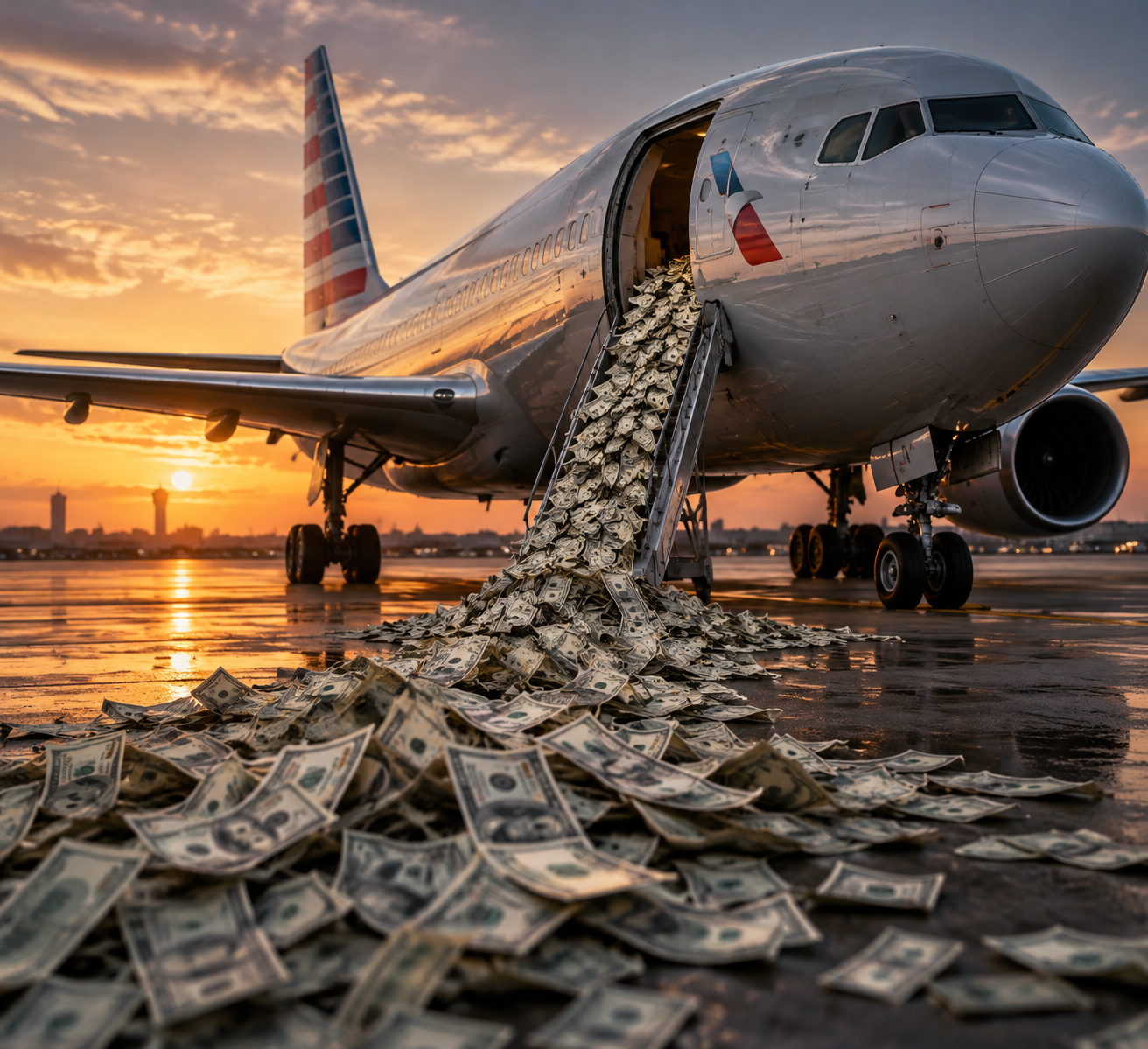
Wendover Productions makes a persuasive case that American Airlines repeatedly mismanaged its recovery from COVID-19. The fleet retirements, failed Seattle expansion, Austin overreach, collapsed JetBlue alliance and corporate distribution reversal are real strategic setbacks. But the episode makes a larger claim than its evidence establishes: that these decisions explain why American became so much less profitable than Delta and United.
That distinction matters. A company can make several expensive mistakes without those mistakes accounting for the entire financial gap. And when the argument is about billions of dollars, the difference between an observed loss, a management estimate and an independently established cause is not a technicality.
The $1.5 billion figure is less definitive than the video makes it sound
The corporate distribution disaster is real. American pushed travel agencies away from traditional Global Distribution Systems (GDS) toward New Distribution Capability (NDC), reduced its corporate sales support and restricted access to certain fares and loyalty benefits. It damaged relationships with customers who had historically generated valuable business.
But the $1.5 billion figure needs correcting. On July 25, 2024, CEO Robert Isom told investors that the strategy had produced a $750 million revenue impact during the first half of 2024, with a similar impact expected during the second half. That produced the widely reported $1.5 billion annual estimate. It was a projected revenue impact, not a separately audited calculation of the strategy's total historical losses.
Isom's own explanation was unusually candid:
"We over-indexed on directs."
He acknowledged that American needed to restore its relationships with travel management companies and corporate customers. (Travel Weekly, July 25, 2024)
There is another important distinction. Revenue is not profit. A $1.5 billion revenue shortfall does not automatically translate into $1.5 billion of lost earnings. The costs that would have been incurred to generate that revenue also matter.
The airline's subsequent SEC filing provides an additional qualification. American attributed its 2024 passenger revenue weakness to both its commercial initiatives and an oversupply of industry capacity during the first half of the year.
Its capacity increased 5.5%, while passenger yield fell 4.7%. Operating expenses increased 3.7%, compared with revenue growth of 2.7%. Operating income fell 13.9%.
Those are not minor details. They show that American was struggling with several interacting problems, not one disastrous sales policy. (American Airlines Group, 2024 Form 10-K)
Wendover has identified a genuine management failure. It has not established that this single initiative accounts for the financial damage attributed to it.
The subsequent financial results expose the missing explanation
The most revealing evidence arrived after the episode.
In its 2025 results announcement, American said it had successfully restored its historical share of indirect-channel revenue by the end of the year. In other words, the airline had substantially repaired the distribution problem that Wendover identified.
Yet American's financial performance remained extraordinarily weak.
In 2025, American Airlines Group reported just $111 million in GAAP net income on $54.6 billion in revenue. Delta reported approximately $5 billion in net income, while United reported $3.4 billion.
(American Airlines, 2025 results; Delta, 2025 results; United, 2025 results)
This is not proof that the distribution failure was unimportant. It is proof that repairing it was not enough.
American's 2025 annual filing identifies a much broader cost problem:
- Operating revenue increased just 0.8%.
- Operating expenses increased 3%.
- Salaries, wages and benefits increased $1.545 billion, or 9.6%, reaching $17.566 billion.
- Regional operating expenses increased $406 million, or 8.1%.
- Operating income fell from $2.614 billion to $1.467 billion.
American attributed the deterioration primarily to rising operating expenses, particularly labor, regional operations and other costs.
There were also exceptional circumstances: the January 2025 American Eagle Flight 5342 accident, weaker domestic demand during the first half of the year and a government shutdown that the company estimated cost approximately $325 million in fourth-quarter revenue.
These qualifications matter. They prevent us from pretending that every dollar of American's 2025 underperformance was another management blunder. (American Airlines Group, 2025 Form 10-K)
The debt burden is another missing piece
American's 2025 financial statements also show $1.716 billion in net interest expense and $1.277 billion in total non-operating expense.
The distinction between operating profit and net profit is essential here. American generated $1.467 billion in operating income, but after non-operating expenses and taxes, only $111 million remained as net income.
This is a substantial financial burden that a sequence of failed route experiments cannot adequately explain.
Debt does not explain a weak operating margin by itself. But any serious explanation of why American converts its operating performance into so little shareholder profit must examine its financing costs.
The episode does not adequately separate these different measures or investigate the contribution of American's balance sheet to its earnings disadvantage.
Some of the strategic failures are presented with more certainty than the evidence allows
The Seattle story illustrates the problem.
Wendover describes Alaska Airlines' acquisition of Hawaiian Airlines as a development that threatened to replace American's role in Seattle's international network.
There is a real strategic concern here. Hawaiian brought widebody aircraft and international capabilities into Alaska's business.
But the chronology is revealing. American's withdrawal from Seattle–London was reported on November 21, 2023. Alaska announced its Hawaiian acquisition on December 3, 2023.
The acquisition announcement therefore came after American had already removed its final Seattle international route from the schedule. It cannot, by itself, establish why American made that decision.
Furthermore, Alaska's own acquisition announcement identified Honolulu as a key hub for the combined airline. The proposed transfer of Hawaiian widebodies into a Seattle-based long-haul operation was not an established commitment in that announcement.
(Travel Weekly, November 21, 2023; Alaska Airlines, December 3, 2023)
There is also a more recent development. On September 29, 2026, American and Alaska announced their intention to expand their partnership by bringing Alaska into American's Atlantic and Pacific joint businesses, subject to regulatory approval.
That does not erase their competitive interests. It does, however, complicate the episode's portrayal of Alaska simply replacing American as an adversary. (Alaska Airlines, September 29, 2026)
The episode turns a complicated, evolving airline relationship into a relatively simple story of American losing and Alaska winning.
The Northeast Alliance ruling deserves a more accurate explanation
Wendover correctly reports that American and JetBlue lost their antitrust case and were forced to terminate the Northeast Alliance.
However, the explanation of the court's reasoning is overly compressed.
The First Circuit's November 2024 opinion affirmed specific findings that the airlines had stopped competing on overlapping routes, reduced capacity and frequencies in certain markets, and diminished consumer choice.
The court also found that the airlines had failed to establish reliable evidence of sufficient competitive benefits to justify the arrangement.
This was not simply a judge rejecting the idea that two weaker competitors could become stronger together. The court examined what the airlines actually did and the effects on competition.
(United States v. American Airlines Group Inc., First Circuit, November 8, 2024)
That distinction matters because the legal defeat was rooted in evidence of reduced competition, not merely a philosophical disagreement about how competition should work.
A fleet percentage is not an aircraft economics calculation
The episode also argues that American made its long-haul fleet too expensive by retiring too many older aircraft.
It gives a striking comparison: newer-generation widebodies reportedly represent 47% of American's long-haul fleet, against 32% at United and 37% at Delta.
The underlying economic argument is reasonable. Newer aircraft generally carry higher financing costs but can reduce fuel consumption. They must fly enough hours to justify their higher fixed costs.
But the percentages alone do not establish that American had the wrong fleet composition.
To demonstrate that conclusion, the analysis needs actual aircraft utilization, financing or lease costs, fuel savings, maintenance expenses and seasonal operating data. It also needs to establish what American would have earned by retaining its older aircraft rather than retiring them.
Without that comparison, 47% is an interesting fleet statistic, not proof of a financially incorrect fleet strategy.
The video explains the theory but does not complete the calculation.
The verdict: A convincing sequence of failures is not a financial autopsy
American Airlines unquestionably made consequential mistakes. Its corporate distribution strategy damaged valuable relationships, its expansion projects produced disappointing results, and its fleet decisions left it exposed during important periods of demand recovery.
Wendover deserves credit for assembling those developments into an understandable account.
But the episode repeatedly moves from a documented setback to a much larger conclusion without measuring the financial contribution of that setback. It does not adequately distinguish revenue from profit, operating margin from net income, or management decisions from industry conditions and inherited financial obligations.
The subsequent results make that omission impossible to ignore. American restored its historical indirect-channel revenue share and still finished 2025 with just $111 million in net income. Its labor costs, regional expenses, interest burden and broader operating structure remain substantial parts of the explanation.
Even the title is more dramatic than the literal financial record: American remained profitable in 2023 and 2024, and still reported a small profit in 2025.
My objection is not that Wendover criticizes American too harshly. It is that the episode mistakes a collection of expensive mistakes for a complete explanation of why the airline performs so poorly.
American's management deserves scrutiny. But a compelling story about bad decisions is not a substitute for proving what actually destroyed the profits.
References
1. Why American Airlines Stopped Making Money — Wendover Productions, original video. The primary work under examination, including its claims about fleet strategy, network expansion and corporate distribution.
2. Alienating travel agencies could cost American Airlines $1.5 billion, Robert Silk, Travel Weekly, July 25, 2024. Reports Robert Isom's $750 million first-half impact estimate and his expected second-half impact.
3. American Airlines Group 2024 Form 10-K, U.S. Securities and Exchange Commission, 2025. Provides audited financial results and identifies both commercial initiatives and industry capacity oversupply as factors affecting passenger revenue.
4. American Airlines Group 2025 Form 10-K, U.S. Securities and Exchange Commission, 2026. Establishes the airline's 2025 revenue, operating income, expenses, interest burden and management's explanation of its deteriorating earnings.
5. American Airlines reports fourth-quarter and full-year 2025 financial results, American Airlines Newsroom, 2026. Reports $111 million in GAAP net income and the company's claim that its historical indirect-channel revenue share had been restored.
6. Delta Air Lines announces December quarter and full-year 2025 financial results, Delta Investor Relations, January 13, 2026. Establishes Delta's $5 billion in GAAP net income and 9.2% operating margin.
7. United Airlines reports fourth-quarter and full-year 2025 results, United Airlines, January 20, 2026, filed with the SEC. Establishes United's $3.4 billion in GAAP net income and $4.3 billion in pretax earnings.
8. United States v. American Airlines Group Inc., No. 23-1802, U.S. Court of Appeals for the First Circuit, November 8, 2024. Provides the actual appellate reasoning and findings concerning reduced competition and consumer choice.
9. American Airlines quits Seattle–London route, Robert Silk, Travel Weekly, November 21, 2023. Establishes when American removed its final Seattle international route from its schedule.
10. Alaska Airlines and Hawaiian Airlines to Combine, Alaska Airlines, December 3, 2023. Establishes the acquisition announcement, transaction terms and Honolulu hub strategy.
11. American Airlines and Alaska Airlines announce plans for Alaska to join the Atlantic and Pacific Joint Businesses, Alaska Airlines, September 29, 2026. Documents the subsequent proposed expansion of the American–Alaska international partnership.