Botswana Captured the Diamond Wealth. Wendover Never Shows Who Shared It.
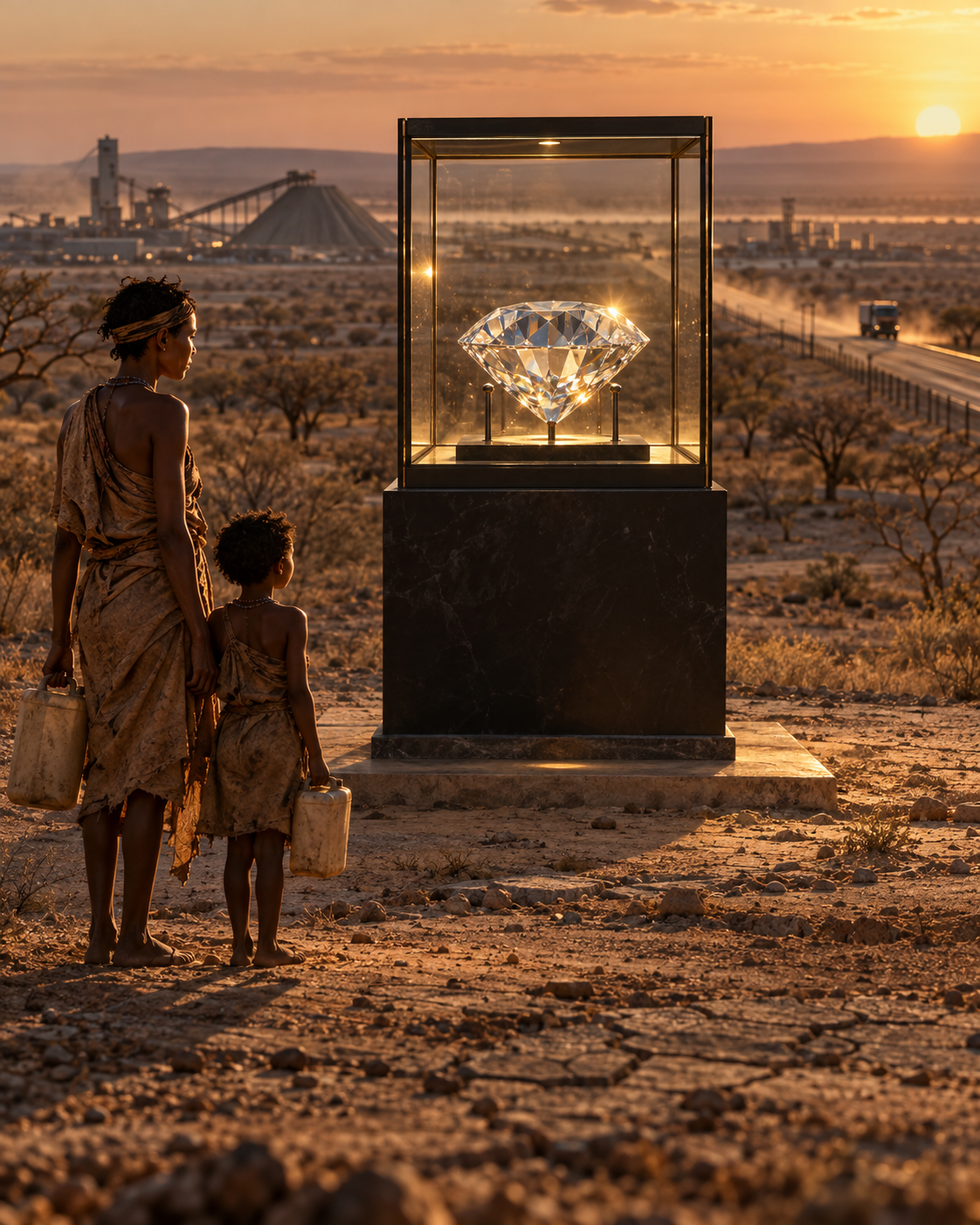
Wendover Productions tells a convincing story about how Botswana avoided the resource curse: its leaders established mineral ownership rules before diamonds were discovered, negotiated a 50% stake in Debswana, and invested mining revenue in roads, education, agriculture and healthcare.
The problem is what the documentary concludes from those achievements. It describes Botswana's development as comparatively equitable and its political foundations as inclusive. Yet it never seriously examines who was excluded from those institutions, how mineral wealth was distributed between communities, or why extraordinary national growth left so many people without meaningful economic opportunities.
Botswana's government successfully captured diamond wealth. That does not establish that Botswana's population shared it equitably. The distinction changes the entire story.
1. The government captured the diamonds. That is not the same as distributing the wealth.
The documentary repeats De Beers' estimate that approximately 80% of the money generated by Botswana's diamond mines remains inside the country. It presents this as evidence that Botswana converted mineral wealth into national prosperity.
The underlying achievement is real. International IDEA reports that De Beers estimates the Botswana government receives approximately 85% of the value of diamonds mined through its partnership and taxes and royalties. Another estimate puts government capture at 95% of available mineral rents between 1983 and 2014.
International IDEA+1
But these figures measure how much economic value the state captures, not how evenly citizens benefit.
Botswana centralizes mineral revenues in its national treasury and distributes them through national development plans. Unlike several other resource-producing countries, it has no specific legal requirement to allocate a portion of mining revenue to communities directly affected by extraction. Mining companies are also not generally required to finance local economic development. Corporate social responsibility remains largely voluntary, producing uneven benefits.
International IDEA
The problem extends to decision-making. International IDEA documents limited community participation in mineral governance, concerns about closed negotiations over mining contracts, and consultation processes that often amount to procedural exercises rather than meaningful influence. Some local officials lack information about commitments made between mining companies and national authorities.
International IDEA
This is a significant omission from the documentary.
The government can capture 85% of diamond value while communities near mining operations receive no guaranteed share of the revenue and have limited influence over decisions affecting their land.
National ownership is not the same as public ownership in practice.
The documentary treats the government's ability to collect money as evidence that the benefits were distributed fairly. It never establishes that conclusion.
2. The prosperity statistics conceal an enormous inequality problem
Wendover emphasizes Botswana's economic growth, infrastructure development, literacy improvements and public healthcare achievements. These are important developments, but they do not establish equitable prosperity.
Consider the distributional evidence.
The World Bank's latest available household-survey Gini figure for Botswana is 54.9, recorded in 2015. The figure is dated, but it demonstrates the scale of inequality in the latest available survey data.
Data
More recent evidence reinforces the problem. Botswana's 2025 National Human Development Report, prepared by UNDP, identifies a 30.4% loss in measured human development when inequality is accounted for. Its 2023 Human Development Index was 0.731, while its inequality-adjusted index was just 0.509.
UNDP
Employment is another major weakness.
- Approximately 38% of Botswana's youth labour force, defined as people aged 15–35, was unemployed in 2024.
- Among those aged 15–24, unemployment reached 48.4%.
- Young women, rural populations and people with lower educational attainment face particular disadvantages.
UNDP
The UNDP report identifies a structural problem with the economic model itself. Diamond mining generates enormous export and government revenue but relatively little employment because it is capital-intensive. The public sector's large presence also restricts private-sector growth, while employment opportunities remain concentrated in urban centres such as Gaborone and Francistown.
UNDP
This exposes a weakness in the documentary's treatment of education.
Botswana expanded schooling and improved literacy, but education alone cannot produce prosperity when the economy does not generate enough suitable jobs.
A country can finance schools with diamonds and still leave nearly half of its youngest working-age population unemployed.
The documentary measures what the government built, but gives insufficient attention to the economic opportunities people actually received.
3. The supposedly inclusive institutions excluded women
One of the documentary's most important arguments is that Botswana inherited democratic foundations from traditional Tswana governance.
It explains that chiefs were expected to consult adult male members of their communities, listen to grievances and respond to challenges to their leadership. It presents these arrangements as early foundations of inclusive institutions.
But the gender qualification deserves much more attention.
A 2026 peer-reviewed study published in History Compass, examining women in Botswana's history, documents that traditional kgotla meetings and political debates were restricted to men. Women and children were excluded, except when women participated directly in legal proceedings as plaintiffs, defendants or witnesses.
Chieftainship was also generally hereditary, and traditional society was deeply patriarchal. There were exceptional women leaders and influential queen mothers, but they did not change the general structure of participation.
compass.onlinelibrary.wiley.com
Wiley Online Library
This matters because the documentary uses these institutions to support a much broader argument about political inclusion.
Consultation among adult men is not the same as inclusive participation by an entire population.
The documentary actually mentions the male-only arrangement. Its failure is not that the detail is completely hidden; it is that the consequences are never examined.
The distinction should matter when a documentary uses traditional governance as evidence for the origins of a modern democratic success story.
4. The San communities expose a much more complicated history of inclusion
The documentary emphasizes that Botswana avoided the violent settler-colonial conflicts that shaped neighbouring South Africa and other parts of southern Africa.
That distinction is important, but it leaves out another history: the treatment of indigenous San communities within Botswana itself.
The Central Kalahari Game Reserve is ancestral land for some San communities. The government decided to relocate residents, with most relocations taking place between 1997 and 2001. In January 2002, it terminated basic services inside the reserve.
The dispute eventually reached Botswana's High Court.
In 2006, the court ruled that the eviction was unlawful. In 2011, the Court of Appeal recognized the applicants' right to use the Mothomelo borehole and establish additional wells.
Yet the United Nations Special Rapporteur's 2016 report found that the government had allowed the 243 applicants to return without providing assistance with water and sanitation. Some were given entry permits lasting only one month.
The same investigation documented serious water-access problems among other San communities. In one community, water tanks were sometimes empty for four or five consecutive days, forcing residents to travel approximately 20 kilometres to find water elsewhere.
Digital Library
This is not a minor historical disagreement. It concerns land, access to basic services, indigenous rights and the ability of marginalized communities to influence government decisions.
The unresolved diamond connection
There is an additional complication that deserves careful treatment.
The government maintained that the relocations were connected to conservation and the management of the reserve. Some San representatives and advocacy groups argued that diamond exploration was also involved.
The 2006 High Court judgment rejected the specific claim that residents had been relocated to make way for mining at Gope. The court found no active mining or preparations at the site during its investigation and accepted evidence that the deposit was then considered uneconomic.
SAFLII
However, the story did not end there.
In September 2014, Botswana's government officially opened the Ghaghoo diamond mine inside the Central Kalahari Game Reserve. The government reported that Gem Diamonds had acquired the project from Gope Exploration Company in 2007.
dailynews.gov.bw
A 2025 Critical Sociology research article by Jason C. Mueller argues that the wider campaign of San dispossession was likely connected to diamond reserves near and within the reserve. That is a scholarly interpretation, not an established judicial finding.
Jason C. Mueller, 2025
I would not claim that the 2014 mine proves why the government began relocating residents years earlier. It does not.
But the combination of ancestral land, relocation, mineral exploration, subsequent mining and unresolved rights makes this an important part of Botswana's resource-governance history.
The documentary's account of inclusive institutions is incomplete without examining the people whose land and livelihoods came into conflict with the national development strategy.
5. Six decades of political continuity deserve closer examination
The documentary presents Botswana's peaceful political development as evidence of institutional strength.
The Botswana Democratic Party governed continuously from independence in 1966 until its defeat in 2024. The peaceful transfer of power to Duma Boko's opposition coalition is an important demonstration that the electoral system could accommodate a change of government.
However, uninterrupted rule is not, by itself, proof of inclusive political participation.
Botswana's first-past-the-post electoral system and fragmented opposition helped maintain BDP dominance. An analysis published in African Affairs notes that in 2014 the BDP received 46.7% of the national vote but won 37 of the 57 directly elected parliamentary seats.
Oxford Academic
This does not establish that the elections were fraudulent. It does establish that the party's parliamentary dominance was not simply a reflection of overwhelming popular support.
The 2024 election provides important counterevidence to any suggestion that political competition was merely cosmetic. The opposition coalition won 36 of 61 elected seats, while the BDP fell to just four. The outgoing president conceded defeat, and power transferred peacefully.
Freedom House
Nevertheless, Freedom House's 2026 assessment continues to identify institutional concentration around the presidency, threats to media freedom and discrimination against the San and other groups.
Freedom House
The documentary acknowledges the long BDP rule and celebrates the peaceful transition, but does not investigate the distinction between electoral stability and equal political influence.
Those are related, but different, questions.
6. The 50/50 De Beers partnership does not tell the whole commercial story
The documentary emphasizes Botswana's 50% ownership of Debswana as one of the defining reasons its diamond wealth benefited the country.
That ownership arrangement is real. But ownership of the mining company and control over the sale of its diamonds are separate matters.
In February 2025, Botswana and De Beers signed a new ten-year sales agreement after seven years of negotiations.
The agreement provided for:
- Botswana's state-owned Okavango Diamond Company to sell 30% of Debswana's production during the first five years.
- Its share to rise to 40% during the following five years.
- A possible 50/50 sales arrangement if the agreement is extended for another five years.
- De Beers to receive a 25-year extension of its Botswana mining licences, through 2054.
AP News
This is not necessarily evidence of a bad agreement. Botswana negotiated a larger role in diamond sales.
But it demonstrates why the 50/50 ownership headline is insufficient. De Beers retained the larger sales channel for the first five years and secured mining rights extending decades into the future.
The documentary's description of the partnership does not adequately explain these commercial arrangements, even though the new agreement was signed well before the video was published in September 2026.
7. The economic warning is bigger than the documentary's proposed solutions
Wendover correctly identifies diamond dependence as Botswana's biggest economic vulnerability.
The subsequent economic figures show how serious that vulnerability became.
According to the World Bank, Botswana's economy contracted by 2.8% in 2024 and another 0.7% in 2025. Public debt increased from 22% of GDP in 2023 to nearly 40% in 2025.
World Bank
There are signs of recovery. The World Bank's October 2026 country assessment reports improving economic activity in the first quarter of 2026 and projects 3.4% growth for the year. However, diamond sales and exports remain weak, and household spending and investment have yet to regain momentum.
World Bank Group
The documentary identifies tourism, copper, critical minerals and solar energy as possible alternatives.
But naming potential industries is not the same as demonstrating that they can replace the employment, foreign exchange and government revenue generated by diamonds.
The UNDP's findings about capital-intensive mining, insufficient job creation and weak private-sector development make that distinction especially important.
Botswana needs more than new mineral discoveries. It needs an economy capable of creating opportunities for people who cannot all work in government or the diamond industry.
Verdict: A successful state is not automatically an inclusive society
Wendover provides a useful explanation of how Botswana avoided the familiar resource curse. Its account of advance mineral legislation, government ownership, revenue collection and public investment is supported by substantial historical evidence.
But the documentary makes a much larger claim than its evidence justifies.
It confuses successful government bargaining with equitable distribution, consultative institutions with universal participation, and economic growth with broadly shared prosperity.
The missing evidence is not obscure. It is found in Botswana's own inequality statistics, youth unemployment figures, mining-community arrangements, traditional gender restrictions and court records concerning San communities.
None of this erases the country's achievements. The peaceful transfer of power, the expansion of public education, the HIV/AIDS response and the government's ability to capture mineral revenues remain important parts of its history.
But a country's success cannot be measured solely by how much money its government collects or how many roads it builds.
It must also be measured by who has a voice, who has access to opportunity, who benefits from national resources and who bears the costs of development.
Botswana may have avoided the classic resource curse. Wendover has not established that it avoided the unequal distribution of resource wealth.
That is the difference between telling the story of a successful mining government and telling the story of an entire country.
References
1. Why Botswana Got So Wealthy — Wendover Productions, September 30, 2026. Original documentary and the claims examined in this critique.
2. Mineral Resource Governance in Botswana — International IDEA, Xichavo Alecia Ndlovu and Christopher Vandome. Examines government mineral revenue capture, transparency, local participation, mining agreements and indigenous rights.
3. 4th National Human Development Report: Summary — UNDP Botswana, 2025. Provides the inequality-adjusted development figures, youth unemployment data and analysis of Botswana's employment structure.
4. Gini Index: Botswana — World Bank. Provides the latest available household-survey Gini figure and its reference year.
5. A Survey of Women in Botswana History: Individual Pioneers, Institutions and Advocacy Movements From the Pre-Colonial Period to 2024 — History Compass, Christian John Makgala and Alinah Segobye, February 21, 2026. Documents women's exclusion from traditional kgotla political debates and the wider history of patriarchal institutions.
6. Report of the Special Rapporteur on the Human Right to Safe Drinking Water and Sanitation on His Mission to Botswana — United Nations Human Rights Council, July 13, 2016. Records San relocation history, court decisions and continuing problems with access to water and sanitation.
7. Sesana and Others v Attorney General (52/2002) [2006] BWHC 1 — High Court of Botswana, December 13, 2006. Provides the judicial findings concerning the Central Kalahari relocations and the disputed Gope mining allegation.
8. Khama Opens Ghaghoo Mine — Botswana DailyNews/BOPA, September 7, 2014. Official account of the opening of the diamond mine inside the Central Kalahari Game Reserve and its acquisition from Gope Exploration Company.
9. State Strategy, Diamond Mining, and Indigenous Dispossession in Botswana — Critical Sociology, Jason C. Mueller, first published online May 11, 2024; issue published 2025. Presents an academic argument connecting San dispossession with diamond reserves near and within the Central Kalahari Game Reserve; its interpretation should not be confused with the court's findings.
10. 2024 Botswana Elections and the Demise of the Botswana Democratic Party — African Affairs, 2026. Examines the BDP's prolonged electoral dominance and the role of first-past-the-post voting and opposition fragmentation.
11. Botswana: Freedom in the World 2026 — Freedom House, 2026. Documents the 2024 political transition alongside continuing concerns about institutional concentration, media freedom and discrimination.
12. Botswana Gets an Improved 10-Year Deal With De Beers — Associated Press, February 25, 2025. Details the revised diamond sales allocation and De Beers' extended mining licences.
13. Botswana Economic Update: Seizing the Moment — World Bank, 2026. Documents the 2024–2025 contractions, rising public debt and limited economic diversification.
14. Botswana Country Overview — World Bank, updated 2026. Provides the latest economic outlook, early recovery indicators and continuing development challenges.