The Budget Airline Collapse Has a Management Problem, Too
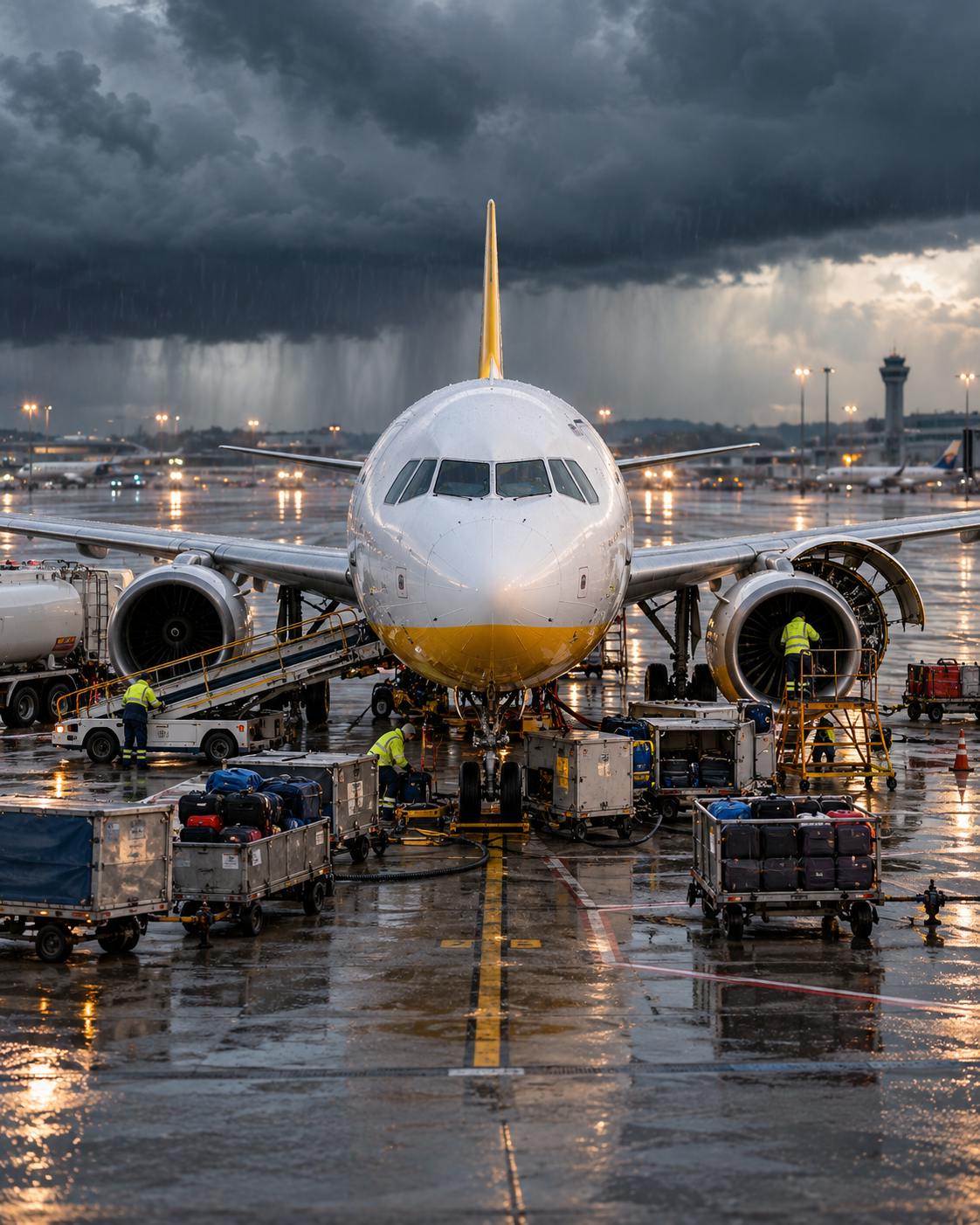
Wendover Productions makes a persuasive case that American budget airlines have been squeezed by fuel prices, weather, air traffic control shortages and defective aircraft engines. But its explanation leaves out an important part of the airlines' own financial disclosures: management decisions, pilot constraints, wage inflation and competitive pricing were also contributing to the collapse.
The problem is not that the external pressures are imaginary. It is that the video gives readers an incomplete account of who was responsible for the industry's deteriorating economics.
The revenue comparison hides the price war
The most revealing numbers were already available when the video was published on July 17, 2024. Spirit's February 2024 annual report showed that its revenue per available seat-mile fell 7.8% between 2022 and 2023, from 10.44 cents to 9.63 cents. More importantly, fare revenue per passenger flight segment fell 17%, from $63.85 to $53.01.
sec.gov
Spirit increased capacity by 14.6% while passenger traffic grew by 13.7%. Its load factor fell from 81.9% to 81.3%, and non-ticket revenue per passenger segment increased by just 0.9%. The additional seats were not generating enough additional revenue to compensate for falling fares.
This is exactly the competitive problem the video investigates and then largely dismisses.
Spirit's own management explicitly acknowledged that industry capacity increases had intensified competition and reduced average fares. The company was not simply being overwhelmed by competitors; it was participating in a market expansion that was depressing its own prices.
sec.gov+1
There is another important detail. Between 2022 and 2023, Spirit's average fuel price per gallon fell 15.8%, and its total aircraft fuel expense fell 5.6%. Yet adjusted operating costs excluding fuel increased 4.9%. The airline was still struggling as fuel became cheaper.
sec.gov
Spirit also warned investors that airline expenses are largely committed once a flight is scheduled. A relatively small change in passenger numbers or fares can therefore have a disproportionate effect on profitability. That makes the 17% decline in fare revenue considerably more important than the video's long-term comparison suggests.
sec.gov
The 45% cost explosion needs an accounting qualification
The video highlights Spirit's increase in cost per available seat-mile from 8.07 cents in 2021 to 11.67 cents in 2022, a 44.6% increase.
That calculation is correct. Its interpretation needs more care.
The 2021 figure included $377.7 million in special credits, principally federal pandemic payroll support. The 2022 figure included $420.2 million in special charges, including:
- $333.7 million in impairment charges associated with accelerating the retirement of 29 A319 aircraft.
- $47.2 million in legal and advisory fees connected with the Frontier and JetBlue merger transactions.
- $39.3 million in employee retention bonuses.
The change in special charges and credits alone increased reported costs by 1.80 cents per available seat-mile. That represents half of the entire 3.60-cent increase.
SEC+1
Spirit's adjusted CASM increased 19.3%, rather than 44.6%. Its adjusted CASM excluding fuel was essentially unchanged, at 6.74 cents in 2021 and 6.73 cents in 2022.
The adjusted measure is legitimate, but it excludes special charges, asset disposals and other items in addition to fuel. The video describes the result simply as operating costs excluding fuel. That leaves readers without an important distinction between recurring expenses and the consequences of fleet and corporate decisions.
Fuel inflation was absolutely real. Spirit's average fuel price per gallon increased 74.3% in 2022, and fuel consumption increased 21.2%, producing an additional $1.016 billion in fuel expense. But the 45% headline is not a clean measurement of recurring operating-cost inflation.
SEC
Spirit's own management identified the missing causes
Spirit's 2023 annual report contains an unusually direct explanation of what was going wrong:
In addition, the industry has experienced capacity increases, leading to increased competition in the markets we serve and resulting in a decrease on our average fares.
The same filing identifies pilot shortages, infrastructure constraints and wage inflation as reasons the airline could not achieve historical aircraft utilization.
Its salary, wage and benefits expenses increased by $365.6 million, or 29.2%, in 2023. Spirit attributed this partly to new collective bargaining agreements with pilots and flight attendants, ratified in January and April 2023, and a 16.4% increase in its pilot and flight attendant workforce. Aircraft rent also increased 35%, partly because Spirit added 29 operating leases.
SEC+1
These are not peripheral details. They are major components of the airline's cost structure.
The video also understates Spirit's recovery in aircraft utilization. It describes 10.8 hours as the 2023 peak, whereas Spirit's annual report records average daily utilization of 11.1 hours in 2023, compared with 10.7 in 2022. Utilization remained below historical levels, but it had improved by 3.7%.
SEC
The more serious management question concerns growth.
Reuters reported in November 2024 that Spirit had added more than $2 billion in debt between 2020 and 2023 while increasing capacity by an average of 27% over three years. Analysts had urged budget carriers to slow their expansion. Spirit continued pursuing growth while competitors were also adding leisure capacity. Its average passenger fare subsequently fell 19% during the first half of 2024.
Reuters
This is a different explanation from simply having too many uncontrollable external problems.
Spirit expanded its fleet, increased its financial obligations and competed aggressively for leisure passengers in an increasingly crowded market. When prices fell, the company had a substantial cost base and debt burden to support.
There was also a significant strategic alternative that the video never addresses: JetBlue's proposed $3.8 billion acquisition of Spirit.
A federal judge blocked the transaction on January 16, 2024, finding that it would harm competition and consumers. The airlines terminated their agreement on March 4, with JetBlue paying Spirit $69 million. The proposed acquisition was not a guaranteed solution to Spirit's problems, but it was a major corporate development that materially affected the airline's strategic options.
United States Department of Justice+2
The weather and controller arguments need better evidence
The FAA staffing problem is real.
A June 2023 Department of Transportation Inspector General audit found that 20 of 26 critical air traffic control facilities were staffed below 85% of their target levels. Miami Tower was at 66%, while New York TRACON was at 54%. This supports the video's argument that staffing shortages were affecting important aviation facilities.
oversight.gov
But the video does not establish how much those shortages contributed to Spirit's financial losses.
The FAA's May 2024 breakdown attributed 62% of flight delays in 2024 to weather, 19% to traffic volume, 17% to runway capacity and just 0.6% to air traffic controller staffing.
This is the FAA's own national attribution, not an independent analysis of Spirit's routes. It cannot establish that staffing was insignificant to Spirit, but it does make the video's emphasis on controller shortages difficult to evaluate without airline-specific figures.
Federal Aviation Administration
The hurricane statistic is more troubling.
The video claims that the average number of Category 4 or 5 hurricanes hitting the United States increased from approximately one annually in 2000 to more than two.
NOAA's historical records do not support that statement. Its direct-hit table records 26 Category 4 and four Category 5 hurricanes along the mainland US coastline between 1851 and 2024.
That is approximately 0.17 Category 4 or 5 landfalls per year across the entire historical record. NOAA separately estimates that approximately 0.6 major hurricanes, meaning Category 3 or higher, strike the US coastline annually.
The figure of 2.6 major hurricanes per year in NOAA's historical statistics refers to the entire Atlantic basin, not US landfalls. The video appears to confuse fundamentally different geographical and hurricane-category measurements.
NOAA/AOML
Severe weather genuinely disrupts airlines. But an incorrect hurricane statistic cannot establish how much more difficult it has become to operate Spirit's network.
The legacy airlines have a competitive advantage the video overlooks
A particularly important development in airline economics is the growth of revenue from co-branded credit cards and loyalty programmes.
A 2026 Government Accountability Office investigation examined 40 empirical studies, airline financial data and interviews with airlines, analysts and other industry stakeholders.
It identified two important competitive developments:
- Traditional airlines introduced basic-economy fares to compete directly with low-cost carriers.
- Large airlines increasingly use credit-card partnerships and loyalty programmes to generate revenue beyond ticket sales.
The second advantage is particularly important.
Delta's American Express relationship generated more than $8 billion in 2025. The GAO also cited an airline that reported $3.2 billion in credit-card revenue in 2024, helping cover operating expenses and support lower fares.
Smaller airlines generally cannot generate comparable revenue because their customer bases and rewards programmes are less attractive to banks and consumers.
GAO Files
This changes the competitive equation.
A major airline can sell a relatively cheap economy ticket, earn additional money through credit cards and loyalty programmes, and then sell premium seats, international travel and other services to the same customer base.
Spirit cannot reproduce that entire financial structure simply by flying aircraft more efficiently.
The GAO also found that ultra-low-cost airlines increased their domestic market share from 4% in 2007 to 13% in 2022, before that share remained broadly unchanged through 2024. Average inflation-adjusted domestic fares fell approximately 8% between 2022 and 2024.
The low-cost sector was not disappearing. Its expansion had stalled while competition became more difficult.
GAO Files+1
There is also a classification problem in the video's broad treatment of budget airlines. The GAO distinguishes low-cost airlines such as JetBlue and Southwest from ultra-low-cost carriers such as Spirit, Frontier and Allegiant. Their operating models and sources of revenue are not identical.
A failure at Spirit cannot automatically establish that the entire category is economically unviable.
Spirit's eventual collapse tells a more complicated story
Spirit ultimately ceased operations on May 2, 2026.
Its financial history is revealing:
- November 18, 2024: Spirit filed for Chapter 11 bankruptcy.
- March 12, 2025: It emerged from restructuring after approximately $795 million of debt was converted into equity and a $350 million equity investment was secured.
- August 29, 2025: It filed for Chapter 11 bankruptcy protection for a second time.
- May 2, 2026: It cancelled all flights and began an orderly wind-down.
PR Newswire+2
Spirit's final announcement explicitly identified the sudden, sustained increase in fuel prices as the immediate reason it could no longer continue. But management also said the airline required hundreds of millions of dollars in additional liquidity that it could not obtain.
That distinction matters. Fuel was the final blow to a company that had already undergone repeated financial restructurings and struggled to establish a sustainable operating position.
SEC
Meanwhile, other US low-cost operators continued to demonstrate that the business model was not universally impossible.
In the second quarter of 2026, Allegiant reported a standalone adjusted operating margin of 9%, despite a 73% increase in fuel cost per gallon. It had reduced capacity by 6.8% while increasing unit revenue by 24.6%.
Frontier reported $40 million in adjusted net income in the third quarter of 2026, alongside record revenue of approximately $1.4 billion.
Allegiant+1
These are not proof that every low-cost airline can succeed. They are proof that Spirit's failure cannot be used as a verdict on every American budget carrier.
Closing verdict
Wendover correctly identifies the fragility of the low-cost airline business model. High fuel prices, grounded aircraft and operational disruption can destroy the efficiencies on which these airlines depend.
But the video makes the external environment do too much explanatory work.
It overlooks Spirit's own disclosures about pilot shortages, wage inflation, aircraft leases, capacity expansion and falling fares. It uses a cost comparison distorted by pandemic-era accounting adjustments, understates the deterioration in passenger revenue and repeats an unsupported hurricane statistic.
Most importantly, it does not adequately investigate the decisions that left Spirit financially exposed.
The eventual shutdown of Spirit does not prove that American low-cost airlines cannot survive. It demonstrates what happens when an airline loses its cost advantage, expands into a difficult pricing environment, accumulates financial obligations and cannot raise enough money to withstand another shock.
Spirit did not simply run out of cheap fuel. It ran out of financial room to recover from its mistakes and the pressures it could not control.
References
1. Why Budget Airlines are Suddenly Failing — Wendover Productions, July 17, 2024. The original argument and financial comparisons examined in this critique.
2. Spirit Airlines 2022 Form 10-K — US Securities and Exchange Commission, February 2023. Establishes the reported CASM figures, pandemic payroll credits, aircraft impairment charges and merger-related expenses.
3. Spirit Airlines 2023 Form 10-K — US Securities and Exchange Commission, February 9, 2024. Provides Spirit's own explanations of pilot shortages, capacity expansion, falling fares, wage increases, aircraft utilization and operating costs.
4. FAA Faces Controller Staffing Challenges at Critical Facilities — Department of Transportation Inspector General, June 21, 2023. Documents serious controller staffing shortages, including the staffing levels at Miami Tower and New York TRACON.
5. FAA General Statements — Federal Aviation Administration, May 21, 2024 statement. Provides the FAA's breakdown of flight-delay causes, including its 0.6% attribution to controller staffing.
6. Hurricane FAQ — NOAA Atlantic Oceanographic and Meteorological Laboratory. Provides historical Atlantic hurricane statistics and US direct-landfall records that contradict the video's Category 4/5 landfall claim.
7. Spirit Airlines' Struggle to Navigate Post-Pandemic Trends Lands It in Bankruptcy — Reuters, November 19, 2024. Documents Spirit's debt-funded expansion, capacity growth, falling fares, premium-market ambitions and financial vulnerability.
8. District Court Decision Blocking JetBlue's Acquisition of Spirit — US Department of Justice, January 16, 2024. Establishes why the proposed $3.8 billion acquisition was blocked and the consumer-competition concerns behind the decision.
9. Airline Competition: Indicators Suggest Increased Competition in the Past Two Decades, but Lower-Cost Airlines Face Challenges — Government Accountability Office, June 25, 2026. Provides independent analysis of airline market shares, fares, basic-economy competition, credit-card revenue and the structural disadvantages facing smaller carriers.
10. Spirit Airlines Begins Orderly Wind-Down of Operations — Spirit Airlines, SEC filing, May 2, 2026. Records the company's final explanation for its closure, including the fuel-price shock and inability to secure additional liquidity.
11. Allegiant Second Quarter 2026 Financial Results — Allegiant, August 4, 2026. Demonstrates that a US ultra-low-cost operator could still achieve a 9% adjusted operating margin despite substantially higher fuel costs.
12. Frontier Airlines Third Quarter 2026 Financial Results — Frontier Airlines, October 28, 2026. Provides a contemporary counterexample to the claim that the US low-cost airline model is no longer commercially viable.