McDonald’s Is Learning What Each Market Will Pay. Wendover Missed the Real Power Struggle.
Wendover Productions makes a compelling argument: fast food is becoming more expensive not simply because ingredients and wages cost more, but because restaurant chains have learned to use technology, customer information and pricing strategy to extract more revenue.
The argument is substantially right. The investigation is not.
The video blends three different things—personalized menus, customer profiling and algorithmic price recommendations—without establishing where one ends and another begins. It invites viewers to imagine that McDonald's knows what an individual customer will pay and adjusts prices accordingly.
That is not what the available evidence establishes.
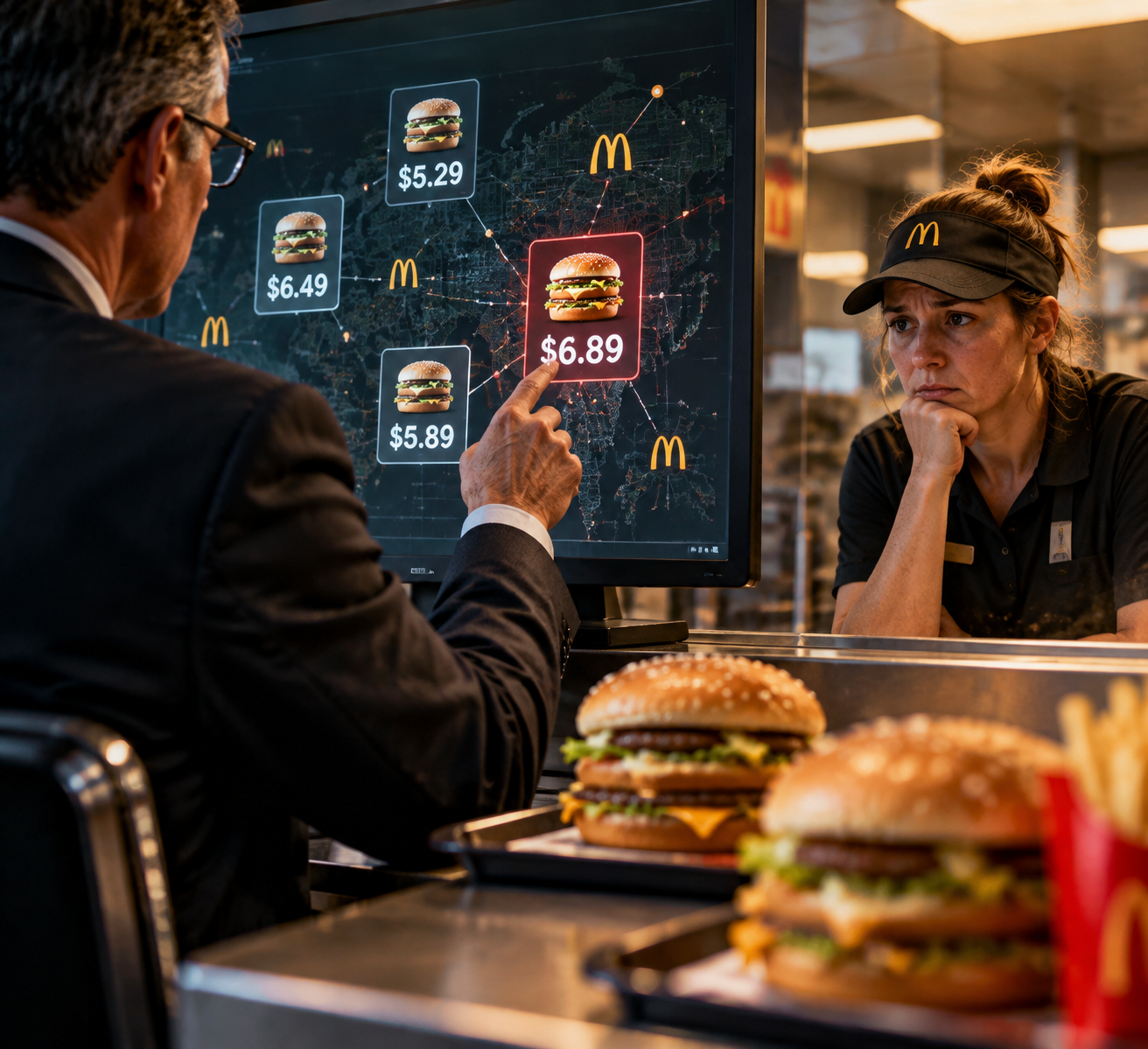
The more consequential story is that McDonald's has developed an algorithmic pricing system that estimates what customers in individual restaurant markets will tolerate, recommends prices to franchisees, and tracks whether those recommendations are followed.
The customer is not necessarily the person being individually priced. The franchisee may be the person being pressured.
1. Three Different Technologies Become One Story
The video makes McDonald's 2019 acquisition of Dynamic Yield central to its argument about personalized menus and pricing.
McDonald's original announcement described technology that could change digital menu displays according to the time of day, weather, restaurant traffic and popular products. It could also suggest additional items based on what a customer was already ordering.
That is sophisticated merchandising. It is not evidence of individualized menu pricing.
The distinction matters. Recommending fries to someone ordering a burger is not the same as charging that customer a higher price because an algorithm believes they can afford it.
There is another important omission: McDonald's sold Dynamic Yield to Mastercard in 2022. McDonald's remained a customer and continued integrating the technology into its ordering systems, but it no longer owned the company.
The technology survived the sale. The ownership did not.
McDonald's acquisition announcement, 2019 and Mastercard's completed acquisition announcement, 2022.
The video also discusses McDonald's collection of customer information. On this point, the underlying concern is legitimate.
McDonald's July 2026 privacy statement acknowledges collecting transaction information, including purchased products and prices, location information, device identifiers, customer preferences and inferred personal profiles. It explicitly permits using information to train algorithms, personalize experiences, conduct targeted marketing and analyze customer demand.
McDonald's Global Customer Privacy Statement.
But collecting information does not establish that the company uses an individual's purchase history to charge that individual a different menu price.
The narrator offers a hypothetical: someone regularly purchases a Big Mac for $6.10, stops when it rises to $6.49, and provides valuable information to the company.
Certainly. That is an example of measuring price sensitivity.
It is not evidence of individualized price discrimination.
The video never establishes that the company uses that particular customer's account to calculate that customer's personal Big Mac price. It leaves the distinction hanging in the air.
2. The Actual McDonald's Pricing Algorithm Is More Interesting
A September 29, 2026 Reuters investigation uncovered something the video did not properly identify: a separate AI-powered pricing engine.
Reuters reviewed screenshots of McDonald's pricing software and interviewed nine people with first-hand knowledge of the company's strategy.
The system analyzes millions of daily transactions across nearly 14,000 restaurants and generates recommended prices for individual locations.
It considers local customer price sensitivity, competing restaurant prices and other market conditions.
One example from Reuters is particularly revealing.
Two company-operated McDonald's restaurants in Fresno, California, approximately two miles apart, listed a Big Mac for $5.69 and $6.89 respectively.
That is a $1.20 difference, or approximately 21%.
Reuters could not establish that the pricing algorithm caused this particular difference. Nevertheless, the system is designed to recommend different prices across individual restaurant markets.
This is location-level pricing intelligence, not demonstrated person-by-person pricing.
Reuters investigation, September 29, updated October 7, 2026.
McDonald's responded on October 1, explicitly denying that AI determines individual customer prices or changes menu prices dynamically throughout the day.
The company says its software provides restaurant-specific recommendations and that franchisees retain the final decision.
That distinction is important, and McDonald's is entitled to make it.
But the company's explanation does not settle the more interesting question: how much freedom does a franchisee actually have to reject corporate recommendations?
3. The Franchisees Are the Missing Characters
This is where the story becomes considerably more interesting.
McDonald's is not simply a collection of restaurants controlled by one corporate office. Its 2025 annual report states that approximately 95% of its US restaurants are franchised.
The corporation has a substantial financial interest in those businesses.
In 2025, McDonald's reported $16.548 billion in revenue from franchised restaurants:
- $10.442 billion in rent.
- $6.018 billion in royalties.
- $88 million in initial fees.
Its conventional franchise agreements provide for continuing rent and royalties based on a percentage of sales, subject to minimum rent payments. Franchisees also carry substantial restaurant operating and occupancy responsibilities.
McDonald's 2025 Form 10-K, SEC filing.
This creates an important distinction between corporate revenue and individual restaurant profitability.
Headquarters collects rent and royalties. Franchisees must manage the costs of running their restaurants.
A pricing recommendation that improves systemwide sales may not necessarily improve the profit margin of every individual restaurant.
Reuters uncovered evidence of tension between these interests.
Five franchise owners described pressure to follow corporate pricing recommendations. A June 2026 franchisee document reviewed by Reuters recorded deviations from recommended prices.
In January 2026, McDonald's introduced a requirement that franchisees be "constructively engaging" with approved pricing consultants and tools.
CEO Chris Kempczinski subsequently acknowledged that pricing non-compliance could become part of franchisee business reviews.
Former franchisee Karen King told Reuters:
"You don't really have much of a choice anymore."
McDonald's maintains that the recommendations are not mandatory and that franchisees independently determine their prices.
That is the company's official position. The Reuters reporting establishes that some owners experience the relationship differently.
There is no established finding that McDonald's illegally coerced franchisees or coordinated prices among competitors. But the distinction between formal pricing authority and practical corporate influence deserves considerably more attention than it receives in the video.
The pricing portal itself warns franchisees that they may be competitors of one another and must comply with antitrust laws. Reuters reported that legal experts disagree about the extent of the resulting regulatory risk.
An algorithm recommending a price is one thing. A powerful franchisor monitoring whether independent operators follow that recommendation is another.
4. The $18 Big Mac Deserved a Much Better Investigation
The original video begins with the famous photograph of an almost $18 Big Mac meal in Darien, Connecticut.
It treats the photograph as a symbol of fast-food inflation and discusses the differences between corporate and franchisee pricing.
But subsequent reporting provides a much more interesting connection.
Reuters reported that Connecticut franchisee George Michell's lawsuit alleged that McDonald's pricing tools had recommended charging approximately $18 for a Big Mac meal sold at a turnpike location in 2023.
There is an important qualification: Reuters could not independently establish what the software recommended to Michell.
McDonald's disputes the franchisee's broader allegations concerning its treatment of him and his businesses.
The lawsuit concerns alleged discriminatory treatment and franchise disputes. It is not a judicial finding that McDonald's ordered the restaurant to charge $18.
Nevertheless, this is precisely the kind of connection the video should have investigated.
The original photograph generated public outrage. The subsequent reporting connected the same unusual price point to allegations about corporate pricing recommendations and franchisee relationships.
That is a substantially more informative story than simply showing an expensive burger.
5. In-N-Out Is a Good Comparison, Not Proof of the Explanation
The video contrasts In-N-Out's operating model with McDonald's.
Its comparison is useful. In-N-Out maintains a relatively simple menu, owns its restaurants, controls important parts of its supply chain and employs comparatively large teams.
The sales figures are also broadly supported by independent industry data.
Nation's Restaurant News, using Technomic's 2024 figures, reported average annual sales per location of approximately:
- In-N-Out: $5.8 million across 415 restaurants.
- McDonald's: $3.96 million across nearly 13,600 restaurants.
Source: Nation's Restaurant News, June 23, 2025.
But the video makes a leap from higher average sales to a conclusion about why In-N-Out can maintain its prices and wages.
Average sales are not profits.
The comparison does not establish how much In-N-Out saves through vertical integration, how much its labor costs represent as a percentage of sales, or whether its restaurant-level profit margins exceed those of McDonald's.
Nation's Restaurant News itself identifies other important factors influencing average sales, including location quality, menu simplicity, kitchen efficiency, brand recognition and premium pricing.
There is also a mathematical problem.
The video compares approximately $6 million in annual In-N-Out revenue with $4 million at McDonald's, then describes In-N-Out as generating 33% more business.
The difference is 50% relative to McDonald's, not 33%.
If the figures are used to compare revenue per operating hour, the gap becomes larger still, assuming the quoted operating hours are comparable.
The conclusion that In-N-Out's operating model deserves attention is reasonable. The conclusion that vertical integration explains its financial advantage has not been demonstrated.
6. Wendy's Was Not Quite the Dynamic-Pricing Example Presented
The video uses Wendy's as evidence of the industry's movement toward dynamic pricing.
There was a real controversy in February 2024.
Wendy's CEO discussed testing dynamic pricing and other digital menu features. The comments triggered public criticism and comparisons with Uber-style surge pricing.
But Wendy's subsequently clarified that it had no plans to raise prices when demand was highest.
Its stated purpose for digital menu boards was to change displayed offerings and make discounts and value promotions easier, particularly during slower periods.
Wendy's official clarification, February 27, 2024.
The video compresses a proposed technological capability, a controversial executive comment and the company's subsequent clarification into a single example.
That makes the industry appear closer to implementing surge pricing than the available evidence establishes.
Dynamic pricing remains a possibility. It should not be presented as an established restaurant practice simply because the technology exists.
Verdict: The Real Story Is Corporate Power, Not a Personalized Big Mac
Wendover gets the central economic insight right: fast-food prices are not determined by ingredient costs alone. Technology, marketing, customer behavior and corporate strategy influence what people buy and what they pay.
But the video does not adequately distinguish personalized recommendations from personalized pricing, or corporate recommendations from actual control over franchisee decisions.
Its most interesting subject is hiding in plain sight.
McDonald's has built systems capable of estimating what customers in individual markets will tolerate. It uses those systems to recommend prices to restaurants. Its corporate structure gives headquarters considerable influence over the independent businesses expected to follow those recommendations.
The unsettling question is not whether McDonald's knows that you personally will pay another 39 cents for a Big Mac.
It is whether a franchisee can realistically reject a corporate pricing recommendation when the company controls so much of the relationship, including renewals, future restaurant opportunities and business reviews.
The machine does not need to know your name to estimate what your neighborhood will pay.
And the person expected to implement its recommendation may not have as much freedom as the franchise agreement suggests.
That is the investigation worth doing. Wendover came close to it, then spent too much time looking at the menu board.
References
- Why Fast Food Got So Expensive — Wendover Productions, YouTube. Original video. The original argument and comparisons examined in this critique.
- McDonald's to Acquire Dynamic Yield — McDonald's, March 25, 2019. Original announcement. Establishes what the personalization technology was designed to do.
- Mastercard Strengthens Consumer Engagement Services With Close of Dynamic Yield Acquisition — Mastercard, April 4, 2022. Official announcement. Confirms the sale and McDonald's continued use of the technology.
- McDonald's Global Customer Privacy Statement — McDonald's, July 1, 2026. Privacy statement. Documents customer data collection and the company's stated uses of personal information.
- Inside McDonald's Push to Have AI Price Your Big Mac — Reuters, September 29, 2026, updated October 7. Investigative report. Provides the pricing-engine investigation, franchisee accounts, internal documentation and the important qualifications surrounding the $18 meal.
- Separating Fact from Fiction: AI Does Not Set Prices at McDonald's — McDonald's, October 1, 2026. Company response. Establishes the company's position on pricing recommendations, franchisee authority and individual customer pricing.
- McDonald's Corporation 2025 Form 10-K — U.S. Securities and Exchange Commission, 2026. SEC filing. Provides audited corporate disclosures on franchising, rental income, royalties and restaurant ownership.
- Here Are the Burger Chains With the Highest Average Unit Volumes — Nation's Restaurant News, June 23, 2025. Industry analysis. Supplies the Technomic-based In-N-Out and McDonald's sales comparisons and explains the limitations of average unit volume as a performance measure.
- Wendy's Digital News Update — Wendy's, February 27, 2024. Company clarification. Establishes that Wendy's denied plans to raise prices during peak demand and described off-peak promotions as an intended use of digital menus.
Tighten the opening thesisSeparate evidence from inferenceReduce repeated qualification paragraphs