Japan’s Railway Miracle Still Has a ¥15 Trillion Public Tab
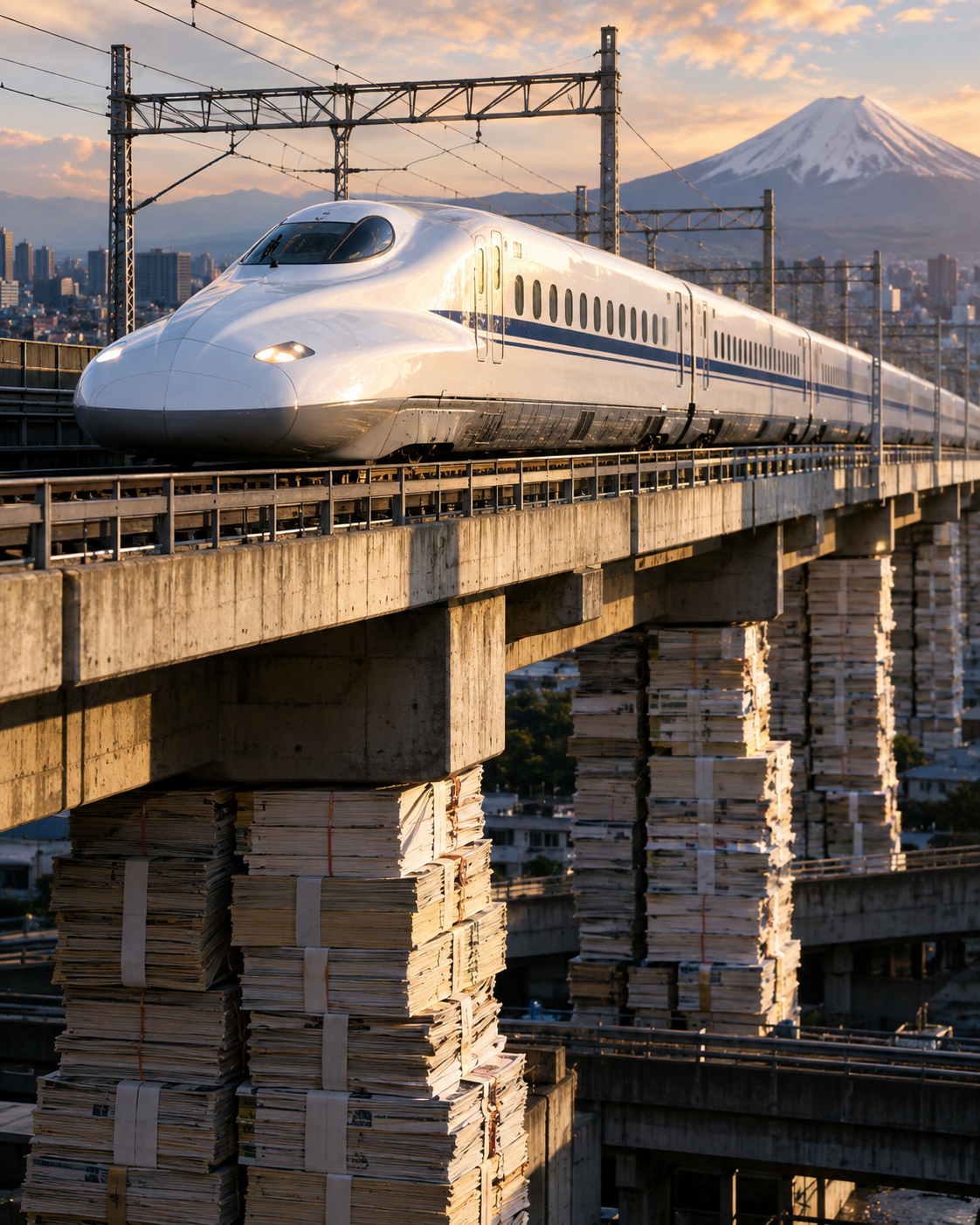
Japan's trains are extraordinary. Wendover Productions' explanation of how they became so is persuasive until the financial accounting reaches the government.
In Why Japanese Railways Win, the creator says Japanese taxpayers ultimately "paid off about $200 billion in liabilities" following the dissolution of the Japan National Railways Settlement Corporation. That description misses a crucial distinction: the government did not simply pay off the bill. It inherited the liabilities. At the end of fiscal 2024, approximately ¥14.95 trillion ($100 billion at roughly ¥150 per dollar) remained on the national government's books.
Japan's railway companies became substantially more efficient. But their commercial success cannot be understood by looking only at their operating accounts. Debt was transferred, infrastructure was publicly financed, loss-making routes were moved into different operating arrangements, and government support continues today.
The distinction between a successful railway business and a financially self-sufficient railway system is where Wendover's argument needs closer examination.
The debt was transferred, not eliminated
The 1987 restructuring began with approximately ¥37.1 trillion in long-term liabilities. This was not all ordinary borrowing by JNR. Japan's Board of Audit identifies ¥25.06 trillion in direct JNR debt, ¥4.45 trillion in railway construction debt, ¥640 billion in bridge construction debt, ¥1.27 trillion associated with management stabilization funds, and approximately ¥5.66 trillion in future obligations.
The liabilities were divided among the new organizations. The JNR Settlement Corporation inherited ¥25.5 trillion, the Shinkansen Holding Company received ¥5.7 trillion, and the JR companies inherited ¥5.9 trillion.
The settlement corporation was supposed to repay its obligations through the sale of land and shares in the newly created railway companies. That plan failed.
The government's own policy decisions contributed to the problem. In October 1987, competitive bidding for the settlement corporation's real estate was restricted because officials feared that selling large amounts of railway land would accelerate Japan's already soaring property prices. The subsequent collapse of the property market and weakness in the stock market further undermined the asset-sale strategy.
A 1994 World Bank study records that proceeds from asset sales failed to cover interest payments, allowing the settlement corporation's liabilities to grow rather than shrink.
By October 1998, the settlement corporation's remaining obligations had reached approximately ¥28.3 trillion. The final arrangement transferred ¥24.2 trillion to the national government, ¥4 trillion to the public railway construction agency, and approximately ¥200 billion to JR.
This was not a successful private-sector repayment of inherited debt. It was a substantial public assumption of financial liabilities.
The latest Ministry of Land, Infrastructure, Transport and Tourism figures make the continuing cost unmistakable: ¥14.9538 trillion of inherited JNR long-term debt remained in the government's general account at the end of fiscal 2024.
Wendover mentions the taxpayer burden, which deserves credit. But describing the liabilities as having been paid off gives readers the impression that the financial problem was resolved. It was not. Japan has spent decades managing and reducing a debt inherited from its former national railway.
Sources: Japan Railway Construction, Transport and Technology Agency (JRTT); Japan Board of Audit; MLIT's FY2024 debt report.
Privatization did not start the productivity revolution
Wendover presents the reduction of 90,000 employees and the subsequent productivity improvements as major achievements of the new JR companies. The improvements were real, but the timing complicates the explanation.
A 1994 World Bank study found that railway productivity had already begun improving substantially before the 1987 privatization. Employee reductions had started in the late 1970s, with the workforce declining by approximately 10% annually during the relevant period.
The study's figures are particularly revealing. Passenger-kilometres per employee increased by 79.3% between 1985 and 1989, compared with 37.4% between 1987 and 1991. Similar patterns appeared in other productivity measurements.
These periods overlap, so they do not independently establish how much improvement occurred before ownership changed. They do establish that the productivity transformation was already underway.
A separate 1996 academic study by Fumitoshi Mizutani and Kiyoshi Nakamura estimated the contribution of privatization to productivity growth at approximately 29%.
That is an important distinction. Privatization helped, but the entire productivity revolution cannot reasonably be attributed to the transfer of ownership in April 1987.
The strongest defense of Wendover's argument is that the new companies gained managerial freedom, improved service, and became more commercially disciplined. The World Bank's research supports that interpretation: passenger demand on the Honshu JR companies increased by 21% during the first five years following privatization, while their workforce fell by 11%.
I do not dispute the turnaround. I dispute the simplified causal story. Preparation, workforce rationalization, anticipated restructuring, economic growth, and subsequent management changes all contributed. A before-and-after comparison is not a complete explanation of which reform produced which result.
Sources: World Bank, Japanese National Railways Privatization Study II (1994); Mizutani and Nakamura, Effects of Japan National Railways' Privatization on Labor Productivity (1996).
Rural railway losses were also moved elsewhere
One of the video's arguments is that regional JR companies inherited both profitable and unprofitable routes, allowing busy urban lines to support less commercially attractive rural services.
That is part of the story. It is not the whole story.
Japan's Cabinet Office provides a revealing account of what happened to the local railway network.
In 1985, JNR had 142 local transport routes. Together, they represented no more than 4% of total transportation volume but generated more than ¥600 billion in losses, even after receiving ¥69.8 billion in special grants.
By 1990, 45 of those routes had been converted to bus transportation, while another 38 had been transferred to third-sector railway operations.
That means 83 of the original 142 routes, approximately 58%, had moved into a different transport or operating arrangement.
This does not mean all those communities lost their railway connections. Many continued receiving rail services through third-sector operators. But it does mean the post-privatization JR companies were not simply maintaining the entire inherited network through profits from busy routes.
Some of the most difficult services were transferred out of their operating structures.
That matters when evaluating the improvement in profitability. Reducing costs through better management is one achievement. Changing which organization carries the costs of serving an unprofitable region is another.
The video spends considerable time explaining how profitable and unprofitable lines were distributed between JR companies, but it does not adequately explain how many local services subsequently changed their operating arrangements.
Source: Cabinet Office, Economic and Fiscal White Paper 2005 — From Public Sector to Private Sector.
The bullet trains still depend on public infrastructure investment
The Hokkaido Shinkansen extension is presented as a potential opportunity to improve JR Hokkaido's financial position.
But who actually pays to build these new railway lines?
Under Japan's current Shinkansen construction system, the Japan Railway Construction, Transport and Technology Agency builds and owns the infrastructure before leasing it to the JR operator.
The financing arrangement is particularly important:
- Railway access charges contribute toward construction costs.
- The national government pays two-thirds of the remaining cost.
- Local governments pay the remaining one-third.
- The JR operator pays a lease charge limited to the financial benefit it receives from the new infrastructure.
The operating company does not bear the construction cost.
This is not the same ownership arrangement used for the original Shinkansen lines, which the JR companies subsequently purchased. It is the model used for newer publicly constructed extensions, including the Hokkaido project discussed in the video.
The distinction matters because the profitability of a railway operator is not the same as the profitability of the entire railway investment.
A company can earn revenue from operating a railway without having financed the infrastructure that makes those services possible.
There is nothing inherently wrong with this arrangement. Major transport infrastructure can justify public investment through benefits that cannot be captured in ticket revenue alone.
But it makes the description of Japanese railway success as a largely self-sufficient commercial achievement incomplete.
Sources: MLIT, Shinkansen Railway System; JRTT, Shinkansen Construction.
Government support did not end with privatization
Wendover discusses JR Hokkaido's financial difficulties and notes that government subsidies account for almost half its revenue. It also recognizes that JR Shikoku has struggled.
But the continuing financial relationship is larger than those observations suggest.
According to MLIT's February 2026 report, the public railway agency made ¥82.3 billion in support payments to JR Hokkaido, JR Shikoku and JR Freight during fiscal 2024.
The government's FY2026 railway budget continues the support framework through fiscal 2030. Its assistance includes grants, interest-free loans, capital contributions, interest subsidies, and support for major infrastructure renewal, including the Seikan Tunnel and Honshu–Shikoku Bridge.
The government also identifies specific multiyear assistance packages:
- JR Hokkaido: ¥109.2 billion for fiscal 2024–2026.
- JR Shikoku: ¥102.5 billion for fiscal 2021–2025.
- JR Freight: ¥19.3 billion for fiscal 2024–2026.
These are not all ordinary operating subsidies. They include financial and investment assistance, which is precisely why a simple comparison of operating subsidies before and after privatization cannot establish the total public cost.
JR Freight is particularly worth noting. The video discusses its creation as a nationwide freight operator but concentrates its later financial criticism on Hokkaido and Shikoku. Freight remains another recipient of continuing public assistance.
The four financially independent passenger companies are genuine achievements. They do not describe the financial condition of the entire former national railway system.
The real lesson is more complicated than privatization
Japan's railway transformation deserves serious recognition. Its companies improved productivity, increased service frequency, developed commercial businesses, and built a transport system that millions of people rely on.
But those achievements were not produced by private ownership alone.
They depended on a combination of managerial reform, public infrastructure, inherited assets, debt restructuring, the transfer of unprofitable services, and continuing government support.
The video acknowledges several of these factors. Its weakness is not that it ignores public investment altogether. It is that it does not follow the financial consequences far enough, particularly when describing the historic liabilities as paid off and presenting profitable railway companies as evidence of a largely self-sufficient system.
Japan did not simply privatize its railway and escape the cost of running it. It separated commercial operations from enormous historical liabilities, retained public responsibility for infrastructure development, and continues supporting companies that cannot sustain themselves independently.
That is a very different model from simply selling a national railway to private investors.
My verdict: Japan's railway system is a genuine operational success, but its privatization is not the clean financial success the story initially suggests. The achievement belongs to both commercial management and the public institutions that financed, reorganized, and continue supporting the network.
The trains are excellent. The public balance sheet is considerably less impressive.
References
- Why Japanese Railways Win — Wendover Productions. Original video. The work under review, including its claims about restructuring, productivity, real estate, debt, and public investment.
- Processing of JNR Long-term Debt and Business Income/Expenditure Structure — JRTT. Official record. Documents the original ¥37.1 trillion liability allocation and the eventual transfer of ¥24.2 trillion to the national government.
- Japan National Railways Settlement Corporation's Long-term Liabilities — Board of Audit of Japan, FY1996 Audit Report. Official audit. Breaks down the original liabilities, including direct JNR debt, public railway construction obligations, bridge debt, and future expenses.
- Report on Implementation of Measures under the JNR Settlement Corporation Debt Disposal Act, FY2024 — MLIT, February 13, 2026. Official report. Establishes the ¥14.9538 trillion remaining government debt balance and ¥82.3 billion in support payments to three JR companies during FY2024.
- Japanese National Railways Privatization Study II: Institutionalizing Major Policy Change and Examining Economic Implications — World Bank, December 1994. Full study. Examines productivity before and after restructuring, the debt settlement failure, land-sale restrictions, and the early financial performance of the JR companies.
- Effects of Japan National Railways' Privatization on Labor Productivity — Fumitoshi Mizutani and Kiyoshi Nakamura, Papers in Regional Science, 1996. Academic paper. Estimates the contribution of privatization to labor productivity growth at approximately 29%.
- Section 2: From Public Sector to Private Sector — Cabinet Office, Economic and Fiscal White Paper 2005. Official analysis. Documents the conversion of 83 loss-making local railway routes into bus or third-sector railway operations by 1990.
- Shinkansen Railway System — Ministry of Land, Infrastructure, Transport and Tourism. Official explanation. Explains the public construction, ownership, leasing, and national/local government financing arrangements for newer Shinkansen infrastructure.
- FY2026 Railway Bureau Budget Overview — MLIT, February 2026. Official budget document. Details continuing financial support to JR Hokkaido, JR Shikoku and JR Freight, including multiyear packages and the forms of assistance.
Clarify the opening debt distinctionReconcile the debt figures explicitly