IKEA's Flat-Pack Genius Stops Before the Forest and the Landfill
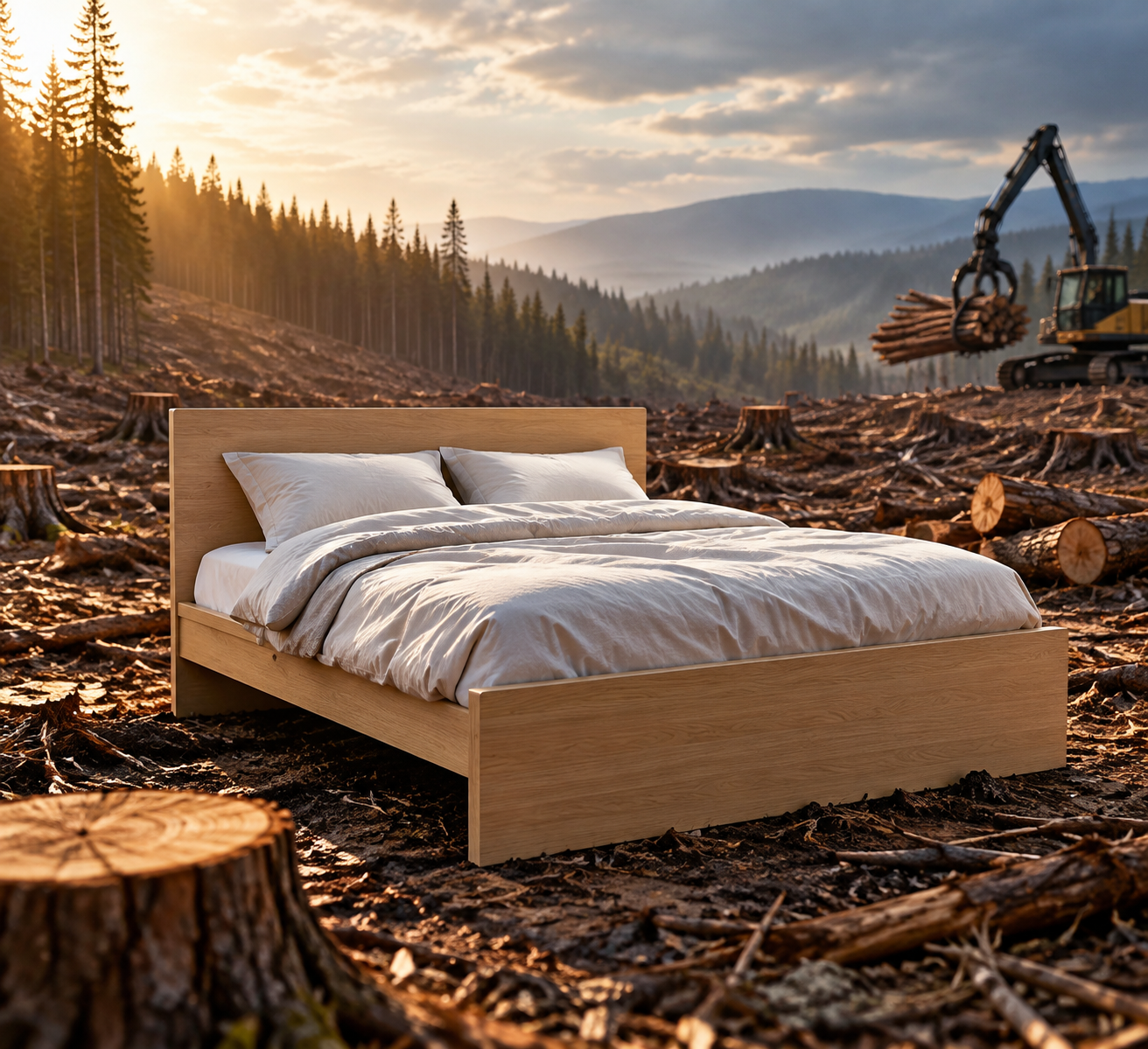
Wendover Productions explains IKEA's commercial success brilliantly: flat-pack furniture reduces transport costs, self-assembly transfers labour to customers, and enormous showrooms turn inconvenient shopping into an experience. But the episode makes a consequential mistake. It explains how IKEA reduces the cost of selling furniture without properly examining the environmental and material costs of producing, replacing, and disposing of it. Its closing assurance that IKEA has “addressed its missteps” is particularly weak when the company's own latest disclosures reveal how much remains unresolved.
Inter IKEA Group's FY25 sustainability statement reports that 81% of the wood and paper used to manufacture IKEA products came from virgin fibres, against 19% recycled fibres. The same statement acknowledges that accurate downstream waste data is limited and that a significant share of sold furniture probably ends up in landfills or is incinerated. These are not allegations from environmental campaigners. They are admissions in IKEA's own reporting. (Inter IKEA Group, FY25 Sustainability Statement).
inter.ikea.com+1
The recycled-content numbers are less impressive than the label
IKEA's FY25 report says 96.5% of its wood and paper was either FSC-certified or recycled. That sounds reassuring until the two categories are separated: 81% was virgin material and only 19% was recycled. At 14.7 million cubic metres of roundwood equivalent, that represents approximately 11.9 million cubic metres of virgin fibres and 2.8 million of recycled fibres. FSC certification does not turn newly harvested timber into recycled material.
inter.ikea.com+1
There is another important qualification. Inter IKEA's target is to achieve 90% recycled and renewable content across its home-furnishing range by 2030. Those are two different things. The company admits it cannot yet report progress against that target, and its formal FY25 disclosure says it has no biodiversity-specific targets in place.
inter.ikea.com+1
The reporting itself also deserves scrutiny. Inter IKEA says its FY25 sustainability statement was published voluntarily, does not yet meet all CSRD requirements, and has not been independently verified by a third-party assurance provider. This does not make its figures false, but it matters when a company uses those figures to support its environmental credentials.
More revealingly, Inter IKEA says it developed additional supplier requirements for forestry traceability during FY25, but the process for engaging suppliers and implementing those requirements was still scheduled for FY26. The company is still building the controls needed to establish where its raw materials originate. That is not the picture of a supply chain whose problems have simply been resolved.
inter.ikea.com+1
Illegal timber was more than an embarrassing historical footnote
The episode compresses IKEA's timber controversies into a passing reference to illegally sourced materials. The history is considerably more complicated.
In 2020, investigative organisation Earthsight reported that suppliers connected to IKEA's Ingolf dining chair and Terje folding chair had sourced illegally felled beech from Ukraine's Carpathian forests.
In 2021, Earthsight investigated Russian timber supplier Evgeny Bakurov. Its investigation alleged illegal logging and possible laundering of uncertified timber into FSC-certified supply chains. IKEA acknowledged doing business with Bakurov but maintained that the wood entering its own supply chain had been legally harvested.
earthsight.org.uk
IKEA subsequently stopped accepting wood from Bakurov's companies in spring 2021. It also announced a 30% increase in internal audits of high-risk supply chains, a 50% increase in third-party audits, at least 20% more unannounced supplier audits, and an immediate ban on sanitary-felled wood from the Russian Far East and Siberia.
Those were concrete corrective measures. They deserve acknowledgement. But they do not establish that the underlying certification and traceability weaknesses were eliminated.
earthsight.org.uk
The FSC itself acknowledged the problem. In its June 15, 2021 response to Earthsight, it admitted that partial certification in countries with weak law enforcement created risks to the integrity of its system. It also acknowledged that certification bodies sometimes overlook or miss non-compliance. Nine certificates in Ukraine had been suspended following sanitary logging during prohibited periods.
FSC certification is a meaningful safeguard. It is not an infallible guarantee that every tree, supplier, transaction, or finished product has been properly checked.
earthsight.org.uk
Wendover's statement that IKEA has addressed its missteps therefore needs qualification. The company took action, but the effectiveness of those actions requires continuing independent scrutiny.
Romania: the controversy was still alive in 2026
This is where the episode's reassuring conclusion becomes particularly difficult to defend.
In April 2024, Romanian environmental organisation Agent Green and the Bruno Manser Fund published IKEA smart outside, rotten inside, investigating forests owned by Ingka Investments or connected to IKEA's Romanian supply chain.
Their investigators initially examined 30 forest sites, then selected nine forest areas and three associated factories or timber deposits for detailed analysis. Seven forests were Ingka-owned; two were connected to IKEA suppliers. Selection considered logging volumes, satellite imagery, protected areas, possible old-growth forests, accessibility, and security risks.
The report documented more than 50 suspected violations of Romanian or EU legislation and alleged damaging forestry practices, including soil erosion, poor regeneration, and intensive logging in protected areas. It calculated that 1.04% of Ingka's total Romanian forest portfolio was under strict non-intervention protection and 8.25% under partial protection.
bmf.ch
These findings deserve investigation, but they must be represented accurately. The nine forests were deliberately selected for risk, not randomly sampled from the entire portfolio. The 50 findings were suspected violations, not 50 court convictions. The report is evidence of concerns at investigated sites, not proof that every IKEA-owned forest is being mismanaged.
There is also substantial counterevidence.
A public Soil Association Certification surveillance audit in June 2024 spent eight person-days on site. It reviewed forest operations, interviewed personnel and stakeholders, and inspected some locations mentioned in the NGO allegations. The certification body maintained the FSC certificate. It also recorded two open observations: insufficient evidence that the dispute-resolution procedure had been developed through appropriate engagement with affected stakeholders, and timber extraction over a watercourse. The Forest Guard had found no legal violation at the latter site, but the auditor considered the practice undesirable.
forestland.ingka-investments.ro
forestland.ingka-investments.ro+2
The audit also records that sanitary cuts caused the allowable harvesting volume to be exceeded in five production units over the relevant ten-year period. The Forest Guard had authorised the additional extraction, and planned regeneration fellings were stopped to compensate. This is not proof of illegal harvesting, but it demonstrates why an aggregate statement about harvesting below natural growth cannot settle every local forestry question.
The same audit illustrates another important distinction: natural regeneration is not necessarily the same as allowing an existing forest ecosystem to recover naturally. At one site, most of the taller natural regeneration of species outside the planned composition, mainly hornbeam, had been removed to favour oak. The auditor noted that retaining some of that growth might have protected oak seedlings during periods of summer heat.
forestland.ingka-investments.ro
forestland.ingka-investments.ro
The current Romanian FSC management certificate was issued on July 19, 2026, and is valid until July 18, 2031, subject to annual surveillance. That is meaningful evidence of continued independent certification. But the certificate itself contains an important limitation: it does not establish that any particular product supplied by Ingka is FSC-certified. Product-specific claims must appear on the relevant invoices and shipping documents.
forestland.ingka-investments.ro
forestland.ingka-investments.ro
The company's own conservation figures also require careful reading. Ingka reports that its Romanian conservation and protection areas totalled 14.4% of its forest area in 2025. However, its 11.1% of Representative Sample Areas can permit limited non-commercial activities, including conservation felling, sanitary logging, and tending operations of up to 10% of a stand's volume. Another 10.73% has been voluntarily placed under suspended intervention pending national strict-protection legislation. These categories overlap. The 14.4% headline therefore does not mean that 14.4% of the forest is under absolute no-intervention protection.
forestland.ingka-investments.ro
Ingka
The controversy did not disappear after the 2024 report. On August 2, 2026, Romanian publication HotNews interviewed Danish investigative journalist Tom Heinemann about his documentary IKEA Loves Wood, originally released in 2024 and subsequently distributed by Deutsche Welle.
Heinemann spent five years developing the film, financed by Danish public broadcaster DR and the Danish Film Institute. Working with Agent Green, he examined six Romanian forest areas and presented footage alleging intensive logging, damage to natural habitats, and possible problems in Natura 2000 areas.
Importantly, Heinemann explicitly stated that he had no evidence of corruption or corrupt behaviour by IKEA in Romania.
HotNews.ro
IKEA rejected the documentary's central allegations. Its response stated that:
- It owns approximately 50,400 hectares of Romanian forest, around 0.8% of the country's forest area.
- Approximately 3% of the wood used by IKEA comes from Romania.
- IKEA uses approximately 2% of Romania's annual timber harvest.
- Its harvesting remains below annual natural forest growth.
- Approximately 98% of regeneration is natural.
- Wood volume in its managed forests has increased by more than 1.2 million cubic metres since 2015.
- More than 220 hectares of degraded forest have been restored.
These are company-reported figures, not independent proof that every disputed site is being managed appropriately. But they are important counterarguments and should not be ignored.
HotNews.ro
The distinction matters: forest volume can increase while particular habitats or species suffer. Replanting trees and maintaining timber stocks do not automatically demonstrate that a diverse natural forest has been preserved.
Wendover published its video on August 25, 2026. The Romanian dispute and IKEA's detailed response had already been publicly reported three weeks earlier. The episode's assertion that IKEA had addressed its environmental missteps therefore deserved more than a passing sentence.
The corporate structure makes accountability harder to follow
The episode's description of IKEA's corporate organisation is too compressed to explain who controls what.
IKEA operates through a franchise structure involving separate corporate groups. Inter IKEA Systems is the worldwide franchisor and owner of the IKEA concept. Inter IKEA Group manages product-range development and supply. Ingka Group is the largest franchisee and operates the majority of IKEA retail locations.
Ingka Investments, within Ingka Group, owns the Romanian forest portfolio. It is not the same business responsible for developing and sourcing the worldwide IKEA product range.
inter.ikea.com+1
The distinction is significant. Inter IKEA's FY25 report says approximately 90% of the total IKEA product range comes from external suppliers, while IKEA Industry manufactures approximately 10%. The company's manufacturing and sourcing system is considerably more distributed than a simple description of production in Poland might suggest.
Ingka also reports that approximately 14% of the wood harvested from its global forest portfolio eventually returns to IKEA products through the open market. This means ownership of a forest does not automatically establish that its timber went into a particular IKEA product.
inter.ikea.com+1
The accountability question must therefore follow the actual chain:
- Who owns and manages the forest?
- Who authorises harvesting?
- Who purchases the timber?
- Which processors turn it into panels or components?
- Which suppliers manufacture the finished product?
- Can the final product's material claims be traced back to its actual origin?
A forest-management certificate alone cannot answer all six questions.
A clean biodiversity score can conceal a narrow definition
Ingka's separate FY25 sustainability report records zero forest sites with a negative biodiversity impact. That sounds conclusive, but the company defines a negative impact through non-conformities identified by third-party certification, and its metric covers sites overlapping or sharing boundaries with protected areas or key biodiversity areas.
assets.site.ingka.com+1
KPMG's limited assurance covers this metric, so it would be wrong to call the figure entirely unverified. But an independently assured count of certification non-conformities is not the same as an independent scientific measurement of species diversity, habitat condition, or ecological recovery across every forest. The metric establishes compliance with a defined reporting test, not the absence of environmental damage.
This distinction matters because the company's own forest-management audit recorded practices requiring attention, including extraction over a watercourse and removal of some naturally regenerated species to favour a planned tree composition. Those observations do not establish a breach, but they demonstrate why a zero-impact headline needs to be read alongside its underlying methodology.
forestland.ingka-investments.ro
forestland.ingka-investments.ro+1
The MALM bed is not a life-cycle study
Wendover uses the MALM bed frame to explain IKEA's material savings. The video acknowledges that newer construction is lighter and potentially less sturdy, adding that customers notice the compromise, but provides no comparative lifespan data, failure rates, or evidence showing how much sooner newer models need replacing.
IKEA's current US MALM listing describes particleboard and fibreboard construction, with a honeycomb paper core containing at least 70% recycled material. It also says the frame meets the safety, durability, and stability requirements of EN1725. That is meaningful evidence of product testing, but it does not establish that today's model lasts as long as earlier versions.
IKEA
IKEA does have practical repair and reuse programmes. Ingka reports buying back approximately 686,500 used IKEA products in FY25 and supplying 26.7 million free assembly parts to 2.3 million customers. These are worthwhile initiatives, but the report does not provide a denominator showing what proportion of all products sold return through these programmes.
assets.site.ingka.com+1
The distinction between operational recycling and product recycling is equally important. Ingka reports a 79% recycling rate for its operational waste, including waste from stores, logistics facilities, offices, and shopping centres. That is not a 79% recycling rate for furniture discarded by customers. Inter IKEA separately acknowledges that it has no adequate downstream waste metric beyond its circular fulfilment score and expects a significant share of sold furniture to end up in landfills or incinerators.
assets.site.ingka.com+1
This is the missing half of the MALM story. A cheaper, lighter bed is not automatically a better environmental outcome if it has a shorter useful life and eventually becomes waste. The video measures the efficiency of getting the product into the customer's home, not the full consequences of keeping it there and disposing of it.
The sponsorship question
The video ends with a disclosed Nebula sponsorship offering viewers a 50% subscription discount. Nothing in the supplied material establishes a financial relationship between Nebula and IKEA or demonstrates that the sponsorship influenced the IKEA analysis. There is no defensible basis for alleging an IKEA-related conflict of interest.
The verdict: IKEA's business model works. Its environmental case remains incomplete.
Wendover gets much of the commercial explanation right. Flat packing saves space, self-assembly reduces labour, local adaptation helps IKEA enter foreign markets, and its restaurants make inconvenient stores attractive destinations.
But operational efficiency is not proof of environmental responsibility.
The episode acknowledges illegal timber controversies, then moves directly to the conclusion that IKEA has addressed its mistakes. It never establishes whether its supply-chain controls are sufficient, whether forest management preserves biodiversity, whether lighter furniture lasts as long, or what happens to the millions of products eventually discarded.
The evidence does not establish that IKEA knowingly sold illegal timber or that the Romanian allegations amount to proven criminal wrongdoing. There is genuine counterevidence: corrective measures, independent certification, forest regeneration, conservation programmes, and growing repair and resale operations.
But there are also substantial unanswered questions, including virgin material consumption, incomplete supplier traceability, the absence of biodiversity-specific targets in Inter IKEA's FY25 reporting, and inadequate measurement of downstream furniture waste.
The next major test is the EU Deforestation Regulation. From December 30, 2026, its obligations apply to large and medium-sized operators placing covered products on the European market. They must establish that relevant products are legally produced and do not originate from recently deforested land or contribute to forest degradation. This creates a more demanding test of supply-chain accountability than simply displaying an FSC label.
Environment
Wendover explains why IKEA wins at the checkout. It does not establish what the full environmental bill looks like.
A $249 bed can be an excellent bargain. But an honest price tag is not an honest accounting of everything that went into making it.
References
1. Why the Ikea Business Model Wins — Wendover Productions, August 25, 2026. The original argument, including the MALM example, the treatment of timber controversies, and the closing endorsement.
2. Inter IKEA Group Sustainability Statement FY25 — Inter IKEA Group, 2026. Primary evidence for material consumption, recycled-content figures, supplier traceability, biodiversity targets, reporting limitations, and downstream waste.
3. Annual Summary and Sustainability Report FY25 — Ingka Group, 2026. Documents forest-management reporting, KPMG's limited assurance, biodiversity measurement methodology, buyback programmes, and spare-parts distribution.
4. Ikea's House of Horrors — Earthsight, 2021. Investigates the Bakurov timber controversy, alleged laundering, earlier Ukrainian sourcing problems, and IKEA's subsequent corrective actions.
5. How FSC addresses weak forest law enforcement in Russia — Forest Stewardship Council, June 15, 2021. FSC's own response acknowledges certification risks in countries with weak enforcement and explains its oversight limitations.
6. IKEA smart outside, rotten inside — Agent Green and Bruno Manser Fund, April 2024. The detailed Romanian forest investigation, including its site-selection methodology, protection calculations, and suspected violations.
7. Forest Management Evaluation Report, FSC-C131270 — Soil Association Certification, September 13, 2024. Independent audit findings, field inspections, certification decision, harvesting observations, and stakeholder concerns.
8. Romanian investigation into IKEA's forest management and the company's response — HotNews, August 2, 2026. Interviews filmmaker Tom Heinemann and publishes IKEA's detailed response to the Romanian forest allegations.
9. Conservation Measures — Ingka Investments Romania, 2026. Explains the 14.4% conservation figure, Representative Sample Areas, and the distinction between limited interventions and strict protection.
10. Forest Management Certificate, Ingka Investments Management SRL — Soil Association Certification, July 19, 2026. Establishes the current certification period and explicitly limits what the certificate proves about individual products.
11. Forestland Investments — Ingka Group, February 2026. Documents the global forest portfolio, conservation commitments, certification coverage, and the proportion of harvested wood returning to IKEA products.
12. MALM Bed Frame, Queen — IKEA US, current product listing. Provides the actual material composition, recycled honeycomb-paper content, price, and EN1725 testing statement.
13. Regulation on Deforestation-free Products — European Commission, updated 2026. Establishes the upcoming compliance requirements and application dates for operators placing covered wood products on the EU market.