What happened
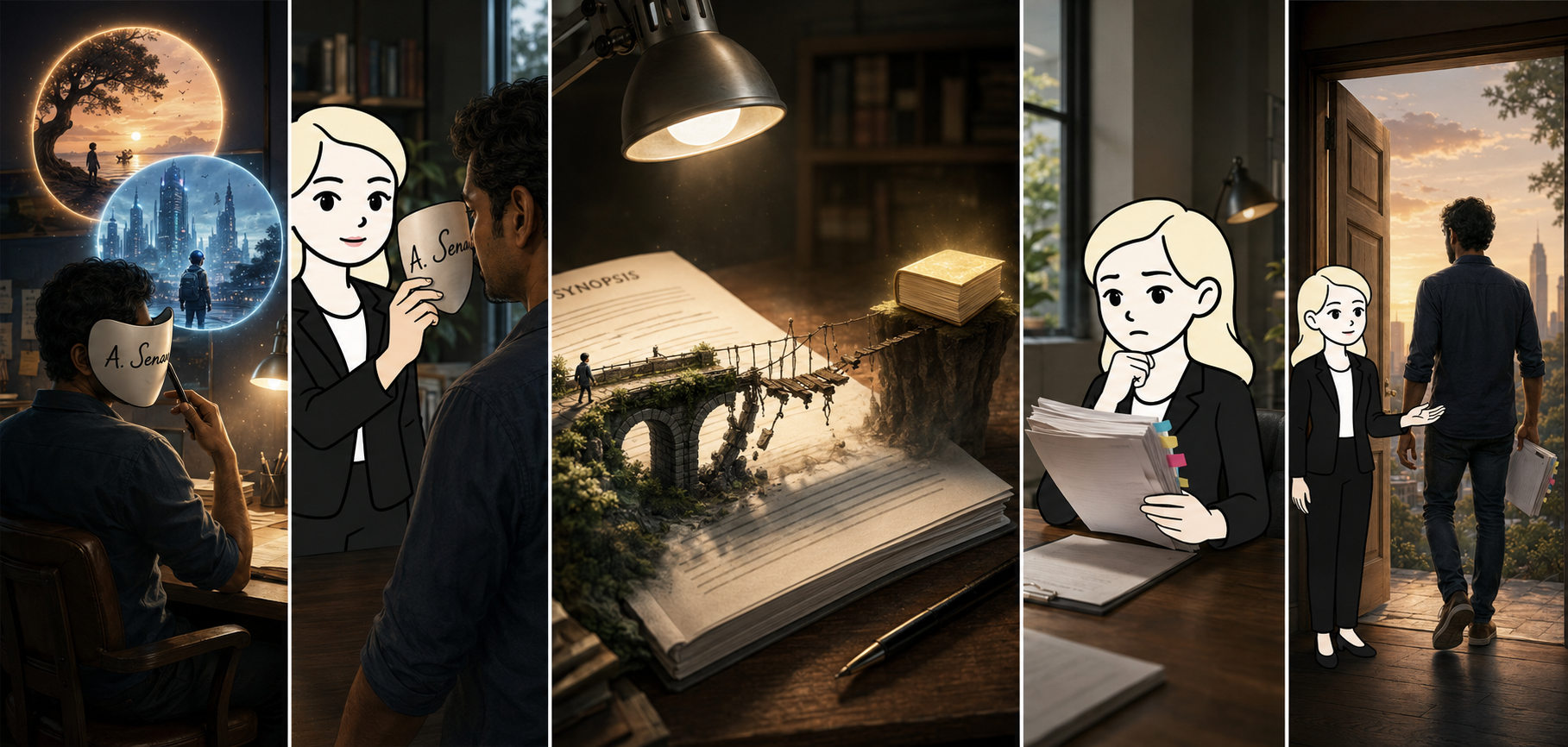
AngryPages liked two of his story ideas. The author disappeared for five weeks, returned under a pen name and then agreed to accountable credit. That solved the identity problem. It did not make the manuscript good enough. An author approached AngryPages about a digital-first publishing arrangement. There would be no upfront printing programme or fictional marketing budget. He would retain ownership of his work. AngryPages would help turn the right manuscript into a book, publish it and test whether readers wanted it. We liked the two stories he pitched. On 2 July 2026, AngryPages invited him to send a synopsis whenever he was ready. After five weeks of silence, a synopsis arrived under a pen name. We needed to resolve the identity issue before proceeding.
A publisher needs a person
AngryPages does not publish anonymous files. We create books, public records and commercial products. An author may earn money, grant publishing rights, approve translations, participate in sponsorships and write about real people. Somebody must stand behind that work. Who owns the manuscript? Who granted AngryPages permission to publish it? Who receives the author’s share? Who approves a new edition? Who answers if somebody else claims the work was stolen? A fictional identity cannot settle those questions. The author wanted AngryPages to carry the editorial, commercial and reputational risk while he appeared publicly through a name that did not clearly identify him. We did not accept that arrangement. You may hide from the reader elsewhere. You may not hide from your publisher.
Pen names are not inherently dishonest
Samuel Clemens wrote as Mark Twain. Eric Blair wrote as George Orwell. Literature would be poorer if every pen name had been treated as fraud. A pseudonym may protect an author from political danger, separate different kinds of writing or create a public identity readers remember more easily. AngryPages understands that. Our concern is accountability. The public-facing name may be designed. The human being behind it must still be known, verified and willing to stand behind the book. In this case, AngryPages required a complete manuscript, accountable credit, an author photograph, a biography and a plan for presenting and selling the work. The writer agreed to use a name built from his real initials. We could then continue evaluating the book.
AngryPages can market a name. It must work with a person.
A book does not end when the PDF is uploaded. If it succeeds, decisions follow. Readers may ask questions. A sponsor may want to participate. The author may request a translation, audiobook, animation or physical edition. Money must be attributed correctly. Rights must be granted by the person who actually owns them. If the book makes a harmful claim, AngryPages must know who supplied it. If somebody challenges the copyright, we must know who warranted ownership. If the author dies, disappears or changes his mind, there must be a real chain connecting the work to a real person. We need to be able to deal with the author behind the public name.
Five weeks of silence also told us something
The delay did not automatically disqualify him. Writers have jobs, families, illnesses and unfinished manuscripts. AngryPages does not expect every creative person to behave like a machine. But timing still communicates commitment. The author first discussed publishing terms with us on 25 June. We invited the synopsis on 2 July. It arrived on 3 August after weeks of silence. Around the same period, we had separately understood that he might not proceed at all. Then the submission appeared unexpectedly. A missed date is not automatically a legal contract violation. It is still evidence. Publishing requires answers, files, corrections and decisions. If an author disappears before the manuscript is accepted, the publisher has to ask what will happen when a cover needs approval, a reader finds an error or a commercial opportunity arrives with a deadline. We needed to know we could rely on him to follow through.
Following the rules does not earn publication
The author agreed to accountable credit quickly once AngryPages drew a hard line. That allowed us to continue evaluating the submission. Authors sometimes treat publishing requirements as a checklist: • Submit the synopsis. • Provide the name. • Accept the terms. • Send the photograph. • Write the biography. • Receive the book deal. That is not how editorial judgment works. Completing the administrative requirements gets the manuscript onto the desk. It does not make the manuscript competitive. We now knew who stood behind the work, but we still didn’t think it was good enough to publish.
The synopsis needed too much work
AngryPages studied what he sent. The concept was not worthless. We had already liked two of his early pitches. But a good premise is not a finished book. The synopsis required more editing and development than the project could justify. The process had already been uncertain. The manuscript was not competitive enough for our list, and AngryPages had active authors whose finished work required our time. Every weak project has an invisible cost. An hour spent rescuing one uncertain synopsis is an hour not spent improving a book that is nearly ready. A cover designed for a project that never settles is a cover not designed for an author who delivered. Translation, editing, formatting and promotion do not appear out of the air because AngryPages charges no upfront publishing fee. Somebody still performs the work. A publisher therefore chooses where its limited attention can create the most value. We chose to spend that time on our existing authors.
“Not good enough” is a complete answer
Publishers sometimes bury rejection beneath soft language. Not the right fit at this time. The list is currently full. We regret that circumstances prevent us from moving forward. Those phrases may be polite. They can also leave an author waiting for a door that is not going to reopen. AngryPages decided promptly. The synopsis was not competitive enough. It needed too much editing. The timing and process were unsuitable. Our existing authors came first. So we declined it. That allowed the writer to take his work somewhere else instead of spending another month trying to interpret false encouragement from us. We didn’t want to keep him waiting after we had decided.
He handled the refusal properly
There were no threats, alternate addresses, repeated emails or messages to Sacramento newsrooms. He didn’t keep demanding another decision. The writer accepted the refusal. He closed the correspondence himself. The author did not become a bad person because his synopsis failed. He did not become Trash because AngryPages chose another use for its resources.
Identity and quality are different gates
The pen name had been an obstacle. He resolved it, but cooperating with us didn’t improve the manuscript. AngryPages does not reward compliance by lowering its editorial standard. We do not publish a weak book to thank somebody for supplying his name. The writer deserves honest judgment. Readers deserve a competitive product. Our existing authors deserve the attention we promised them.
The decision
The author approached AngryPages on 25 June. We liked two pitches and invited a synopsis on 2 July. The synopsis arrived under a pen name on 3 August. By 5 August, the author had agreed to accountable credit based on his real identity. On 6 August, AngryPages declined the project. There was no fight or permanent ban. The author remained free to improve the work, self-publish it or take it to another publisher. The name issue was resolved. We declined the book because it wasn’t good enough.