-
Tony Hinchcliffe, stand-up comic and Kill Tony creator, is the central guest; his career links comedy, media power, politics and free speech. He replaces absent Chamath with All-In hosts Jason Calacanis, David Sacks and David Friedberg for roasts, live Kill Tony and Bestie Awards.
-
Kill Tony is a breakout franchise built through 12 years of iteration, not an overnight hit. It grew from Comedy Store open-mic experiments to three MSG sellouts, a four-special Netflix deal, and the #2 YouTube podcast behind Joe Rogan.
-
Tony’s success story is relentless persistence through poverty, not a hidden shortcut. He recalls $400 couch rent, later a $300 beanbag, sleeping in his car behind the Comedy Store, working until 2:30 a.m., and never wanting to quit.
-
Tony deliberately chose political risk, and he rejects the Trump-rally backlash as media distortion rather than a comedy failure. He says he joined Trump’s MSG rally partly to sway voters and defended the Puerto Rico controversy as consistent equal-opportunity roasting.
-
The strongest ideological bond is opposition to speech gatekeepers, especially when comedy is punished for crossing changing lines. They call comedy a free-speech test, contrast Netflix’s permissiveness with YouTube demonetization, and condemn European speech enforcement as dangerous.
-
Their clearest business thesis is that AI’s winners include dominant platforms and the physical workers building the boom. Alphabet was credited with rising from $2T to $4T while cloud grew 40%, and data-center trades with 25–30% wage gains.
-
Their business losers are powerful institutions seen as failing to adapt: universities, Apple, Warner Bros., and risk-averse movie studios. College-value sentiment was cited falling from +13 to −30, while Tony disclosed an independently financed film designed to preserve creative control.
-
Their year-end politics show broad anti-establishment alignment without full agreement. Political winners ranged from Democratic Socialists to crypto and David Sacks; losers included Europe, Stephen Miller and Gavin Newsom, while Jensen Huang and Nvidia led CEO praise.

All-In Podcast
Explore the collection
December 22, 2025
Scott Bessent: Fixing the Fed, Tariffs for National Security, Solving Affordability in 2026
-
Bessent says deficit reduction is now the administration’s central fiscal test, with deficit-to-GDP expected to fall from 6.8% to the mid-5s and a “3” targeted before Trump leaves office. He forecasts a $200–300 billion calendar-year fiscal contraction after the annual deficit narrowed from about $1.8 trillion to $1.78 trillion.
-
Tariffs are being used mainly as negotiating and national-security leverage, not as a permanent revenue stream. Bessent expects tariff income to fall as reshoring lifts domestic taxes, and said a Supreme Court loss on IEEPA would still leave Sections 301, 232 and 122 as alternative trade authorities.
-
Bessent explicitly said restoring Main Street affordability is a two-to-three-year project, not something the administration can deliver in one year. He distinguished falling inflation from still-high price levels, acknowledged households remain angry about accumulated costs, and argued that lower gasoline, rents and rising real incomes should improve conditions.
-
Bessent wants the next Fed chair to shrink the institution’s economic footprint and make policy more predictable, with extraordinary asset purchases reserved for genuine emergencies. He said the Fed is losing about $100 billion annually and that he interviewed 11 chair candidates, several of whom favor reducing the Fed’s role and guidance machinery.
-
Treasury’s deregulation push is aimed heavily at community banks because Bessent believes post-2008 rules made them “too small to succeed” and restricted Main Street credit. He said roughly half have disappeared since the financial crisis even though they still provide about 70% of agricultural and 40% of small-business lending.
-
The administration is deliberately taking equity stakes in a small group of strategic industries, framing the intervention as national-security policy rather than a broad embrace of state capitalism. Bessent said five to eight sectors require domestic or hemispheric capacity, citing semiconductors, pharmaceuticals, steel and shipbuilding.
-
Bessent expects a substantial household cash injection in early 2026 because new tax provisions are retroactive while most workers never adjusted withholding. He said many households could receive $1,000–$2,000 refunds, alongside tax breaks for tips, overtime, Social Security and interest on loans for American-made cars.
-
The administration sees “Trump accounts” as a long-term attempt to turn every American child into an equity owner, not merely another savings program. Each child would receive $1,000 at birth; families and employers can add money, the Dells pledged $6.25 billion, and Bessent said about 20 states may contribute.
December 19, 2025
Bernie Sanders Says Stop All AI, China's Breakthrough, Inflation Down, Golden Age in 2026?
-
The strongest labor evidence discussed does not yet support broad AI-driven unemployment. Vanguard data showed AI-exposed occupations growing jobs 1.7% versus 0.8% and wages 3.8% versus 0.7%, while Yale Budget Lab found no discernible labor-market disruption 33 months after ChatGPT.
-
Robotaxis are nevertheless already changing hiring decisions in major cities. Jason Calacanis said Uber CEO Dara Khosrowshahi told him Uber stopped recruiting drivers in Los Angeles and San Francisco where Waymo is widespread; Uber is also offering drivers data-labeling work after buying a labeling company.
-
A surprising funding chain has given organized AI critics substantial institutional reach. Sacks said Vitalik Buterin’s donated meme coins became roughly $600 million for the Future of Life Institute, which then funded journalism fellowships, academic grants and organizations opposing data centers.
-
Major AI companies appear to be preparing tangible public-benefit initiatives to counter political backlash. Chamath Palihapitiya said company leaders had “gotten the message,” were already working on multiple solutions and expected visible moves in the new year, with education at the top of the list.
-
Recent US employment weakness was concentrated in government payrolls rather than the private sector. From September through November, private employment rose 121,000 while government employment fell 162,000; Sacks additionally cited a 10.7% decline in the federal workforce during 2025, from 2.4 million to 2.15 million.
-
China’s semiconductor push is a systematic state-backed effort to eliminate lithography bottlenecks, not merely copy ASML. Friedberg described a roughly $48 billion Phase III fund targeting manufacturing choke points; Reuters said China’s EUV prototype had produced no working chips yet, while Friedberg predicted Huawei could deploy undisclosed Chinese lithography in 2026.
-
California’s proposed billionaire tax has become intertwined with real relocation decisions among the hosts and their peers. The episode said Sacks had already bought an Austin house, another host was using his agent, and a major Hollywood producer had moved to Texas and planned to make films there.
-
The episode closed with a report that Trump had just signed an order moving marijuana from Schedule I to Schedule III. The hosts treated the change as overdue, arguing that marijuana should not remain federally classified alongside drugs such as heroin.
December 12, 2025
Tucker Carlson: Rise of Nick Fuentes, Paramount vs Netflix, Anti-AI Sentiment, Hottest Takes
-
Sam Altman’s “code red” was a real strategic retreat: he told staff to stop side projects, including ads, and concentrate on making ChatGPT faster and better. Jason Calacanis said OpenAI’s share had fallen from 84% to 68% in a year, making focus a competitive necessity.
-
Google’s AI comeback was described as an organizational reversal, not merely a better model. The hosts credited Sergey Brin’s return, Demis Hassabis taking charge of all AI, and greater risk-taking, while Freeberg argued OpenAI had become defensive and overly cautious.
-
The biggest threat to OpenAI may be economic: cash-rich rivals can subsidize top models to attack its subscription base. Calacanis claimed 80% of OpenAI revenue came from $20 subscriptions and predicted Google and Meta would make comparable consumer AI free.
-
David Sacks said government service cost him heavily: he divested hundreds of millions of dollars and over 99% of positions that could conflict with his AI role. He said nearly 100 fund interests sold around 50% below fair value, and a blind trust was unavailable because his children are minors.
-
The sharpest factual dispute with the New York Times concerned a fact-check premise that Sacks dined with Nvidia’s CEO before changing chip-export policy. Sacks said schedule checks showed no such dinner occurred; he said the Times removed the dinner but retained the surrounding influence narrative.
-
The hosts also disputed claims that Sacks’s government role enriched All-In, saying their June event lost money despite costing more than $1 million. They said tickets were free, only two sponsors helped cover costs, and association with the Trump administration has made speakers harder to book.
-
The viral claim that a family needs $140,000 to escape poverty was not a defensible national figure. Chamath said it drew on a high-cost New York suburb; MIT’s calculator put a Lynchburg family near $93,000, while the meaningful benefit-cliff zone appeared around $45,000–$63,000.
-
California’s proposed 5% billionaire wealth tax prompted the hosts to say they were seriously considering leaving the state. They focused on illiquid-company valuations: the discussed deferral still meant five annual installments, reportedly at 5–7% interest, potentially forcing founders to raise cash against paper wealth.

-
OpenAI has shifted from expansion to defense as competitors erode its lead. Altman reportedly halted side projects to focus on ChatGPT, while the hosts cited OpenAI’s generative-AI traffic share falling from 84% to 68% in a year.
-
The bigger threat to OpenAI may be business-model compression, not simply model quality. One host said roughly 80% of revenue comes from $20 subscriptions and predicted Google and Meta will make top models free, while users increasingly split work across specialized AI products.
-
Google’s comeback was framed as an organizational reversal as much as a technical one. The hosts credited Sergey Brin’s return, Demis Hassabis gaining broader AI control, and Google accepting more product risk after years of fearing search cannibalization, while OpenAI has become more defensive under scrutiny.
-
Sacks says government service cost him heavily rather than enriching him. He said he divested hundreds of millions of dollars in technology positions, with his ethics letter documenting divestment of over 99% of potential AI conflicts and nearly 100 private funds sold at roughly 50% discounts.
-
The sharpest challenge to the New York Times story was a specific factual dispute over a supposed Sacks–Jensen Huang dinner. Sacks said calendar checks showed the dinner never happened, after which the Times deleted that detail from its draft while retaining the surrounding export-control theory.
-
The viral claim that a typical American family now needs $140,000 merely to avoid poverty did not survive scrutiny. Chamath said the figure relied on a high-cost New York-area example; the MIT calculator put a Lynchburg, Virginia family of four near $93,000, with the clearest benefit-cliff problem around $45,000–$63,000.
-
The California wealth-tax discussion exposed a practical problem for founders: taxes on illiquid private-company valuations can create cash bills before liquidity exists. The hosts described a proposed 5% billionaire levy with five-year installments around 5–7% interest, and one said the group was seriously considering leaving California.

-
Chamath Palihapitiya won the inaugural filmed All-In Bestie Invitational at the Venetian, while Phil Hellmuth was the first player eliminated. The deliberately absurd “five-minute turbo” format made the event more social spectacle than serious tournament.
-
Jason Koon said his career poker winnings had reached about $70 million. The hosts introduced him as one of the greatest cash players ever—and possibly the best current one—giving unusual weight to his views on poker strategy and tournament design.
-
The All-In group is seriously considering a premium tournament series built around player experience rather than punishing schedules. Pros criticized mainstream stops for treating players poorly and favored better venues, food, reasonable hours and two-day formats, believing players would pay for the upgrade.
-
Molly Bloom said she never played poker while running her games and had stayed out of the poker scene until this event. She added that the government takeover left her without much money to play, making the appearance a genuine return.
-
Alan Keating nearly fought another guest at Carbone, with the men threatening to take the dispute outside. The argument ended with an apology, and after they continued the night together, the group said they had become friends.
-
Chamath described a specific exploit against Hellmuth: he believes Hellmuth avoids three-street hands, so he deliberately compresses pots into two streets. His method was to check the flop and use a small turn bet, attempting to induce action while denying Hellmuth his preferred structure.
-
The table’s Stu Ungar stories portrayed a prodigy already dominating adult gamblers at 15, not merely a gifted later champion. They said mob-connected backers toured him through East Coast gin games while letting him keep about 10% of winnings; one player’s grandfather reportedly lost his money to Ungar.

-
Molly Bloom turned an accidental serving job into a high-stakes business in eight months, eventually raising the buy-in from $10,000 to $50,000 and making millions legally. At 23, her first night put her beside celebrities, an investment-bank chief, a famous politician and tech figures—and paid her $4,000 in tips.
-
Her real product was not poker but controlled access, trust and status. She rejected pros offering cash to join, cultivated relationships beyond the table, and in New York became the “bank” settling games herself; the resulting $250,000-buy-in table once held about $10 million.
-
The business exposed Bloom personally to losses that apparent wealth did not predict. She says a player who could afford to pay stiffed her for $250,000, forcing her to cover it, and she put bank employees on payroll to vet players because visible luxury often concealed weak finances.
-
After losing control of the Los Angeles game, Bloom rebuilt in New York at vastly higher stakes, where she says one player ultimately lost $100 million. Her former game had made her millions, but a player pushed for control, unfair advantages and a salaried figurehead role she refused.
-
Organized-crime pressure became physical: after Bloom refused a demand for a cut, a man broke into her apartment, put a gun in her mouth, beat her and threatened her family. Three or four days later, she saw a report of 125 mob-related arrests and never heard from them again.
-
Bloom’s downfall came from knowingly crossing the legal line, not from ignorance of it. She says greed and growing exposure led her to take a rake despite lawyers’ warnings; a federal informant entered the game, her assets were seized, and two years later 17 armed FBI agents arrested her.
-
Prosecutors offered Bloom her money back and deferred prosecution if she became an informant on billionaires, politicians and celebrities; she refused. She accepted responsibility, pled out, avoided prison after favorable character evidence, and emerged at 35 a convicted felon millions of dollars in debt.
-
Her comeback depended on monetizing the story without selling out the people in it. A book she says initially sold about 10 copies led, through relentless pursuit, to Aaron Sorkin and a film deal; she rejected a six- or seven-figure celebrity hit piece and only recently finished paying the government.
November 21, 2025
Epstein Files Fallout, Nvidia Risks, Burry's Bad Bet, Google's Breakthrough, Tether's Boom
-
Congress overwhelmingly moved to force release of the Epstein files, and Trump reversed course to sign the bill. The hosts said newly released emails showed Larry Summers was still seeking Epstein’s dating advice in 2019, followed by Summers leaving several public-facing roles and being put on leave from Harvard.
-
Jason Calacanis said he met Epstein about six times and recalled elite TED circles initially treating Epstein’s Florida case as a misunderstanding or setup. He described Epstein as embedded around scientists, universities and billionaire dinners long before the full scale of his conduct was widely understood.
-
Tether’s economics may be even more powerful than its stablecoin product: the hosts cited roughly 500 million users, 30 million new users per quarter and $183 billion of circulating USDT. About $135 billion was said to sit in Treasuries, giving Tether enormous interest income while users mainly receive dollar stability rather than yield.
-
The podcast rejected Michael Burry’s claim that big technology companies are materially inflating profits by stretching AI-chip depreciation lives. Friedberg argued older chips still generate revenue, GAAP permits depreciation over their useful life, and even moving Google from six-year to three-year depreciation would reduce profit by roughly 10–12%, not expose a hidden collapse.
-
Google’s AI position strengthened sharply rather than collapsing under ChatGPT pressure. The hosts cited Gemini 3 retaking benchmark leadership and Google’s chat share rising from roughly 8% to 16%, while arguing distribution through browsers, phones and operating systems could become more decisive than having one universally dominant model.
-
The clearest strategic risk identified for OpenAI was not model quality but trust from companies that may eventually compete with it. Calacanis argued startups may prefer Anthropic, DeepSeek or open-source models because OpenAI increasingly launches applications itself, making founders reluctant to give a potential future competitor their proprietary data.
-
Chamath Palihapitiya said his personal investing has produced better returns than his fund investing, but with far wider outcomes. Managing outside capital made him prioritize returning principal and accepting a safer 3–3.5x over a volatile 7x; investing his own money let him hold bigger risks, including a roughly $400 million loss on Relativity Space.
-
David Friedberg concluded that his venture-studio model was inferior to personally running the exceptional company when one finally appeared. After roughly $40 million of research spending produced breakthrough results at Ohalo, he became CEO and began winding his studio toward a holding company centered almost entirely on Ohalo, despite previously swearing off the job.
-
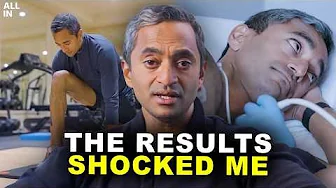
Chamath Palihapitiya’s preventive-health push is personal: his father died after years of alcoholism, diabetes and heart disease, while his apparently healthy friend Dave died unexpectedly of a heart attack. Dave’s widow urged his four closest friends to see cardiologists, turning a tragedy into a long-term screening habit.
-
A decade of cardiac imaging found a 370% increase in Palihapitiya’s plaque-related material even though his coronary calcium score remained zero. His cardiologist said the data placed him on an atherosclerosis trajectory that a conventional calcium score alone would not have exposed.
-
Palihapitiya decided to remain on statins after testing indicated his annual plaque-volume growth had slowed from roughly 24% to 10%. His doctor described that slowdown as consistent with larger studies, and Palihapitiya concluded the treatment had produced meaningful benefit despite online criticism.
-
Brain imaging found no worrying change or abnormality, easing Palihapitiya’s concern that long-term statin use might be harming his cognition. The unexpected finding was instead modest muscle loss, prompting him to make building muscle over the next decade a major goal before entering his 60s and 70s.
-
Despite the underlying plaque trend, Palihapitiya’s cardiologist estimated his near-term cardiac-event risk as extremely low and said waiting remained a reasonable option. The doctor predicted essentially no event over five years, possibly ten, while stressing that Palihapitiya’s unusually detailed longitudinal imaging gives him time to intervene.
-
Prenuvo says it has scanned about 150,000 people in five years and identified roughly 4,000 potentially life-saving diagnoses. The company combines custom MRI hardware, AI-enhanced imaging and more than 100 radiology and medical staff, illustrating how advanced screening is being packaged as routine preventive care for consumers.
-
Away from health, Palihapitiya described “drift” as the central danger inside ambitious early-stage companies and said a CEO’s job is to keep repeatedly restoring shared direction. His Toronto meetings with the 8090 team were deliberately in-person because he believes whiteboards and direct discussion create alignment that slides and Zoom cannot.

November 14, 2025
Home Affordability Crisis, Palantir's Advantage, Big Short on AI, H-1B Abuse, Solar Storm Hits Earth
-
Michael Burry said CNBC overstated his AI-related short position from roughly $9 million to $900 million. The panel traced the error to multiplying options by 100 shares, turning a modest trade into a market-moving headline two orders of magnitude larger.
-
Burry’s claim that hyperscalers inflate earnings by stretching server depreciation was challenged with evidence that old AI hardware remains heavily used. Google said seven- and eight-year-old TPUs still run at 100% utilization, supporting longer useful lives rather than the three-year schedules Burry’s argument implicitly favors.
-
Palantir trades at roughly 137 times sales, versus about 13 times for Microsoft, yet Chamath Palihapitiya argued its scarcity justifies part of the premium. He said Palantir lacks a clear substitute, making its customers harder to lose; he disclosed being a former Series B investor but said he no longer owns shares.
-
Chamath attended a White House dinner for financial leaders, after which Trump invited the group into the Oval Office to watch him sign the government-reopening bill. Attendees he identified included Bill Ackman and Steve Schwarzman, illustrating unusually direct access between major investors and the administration.
-
At that dinner, Trump asked the group for ideas on student debt, and Bill Ackman proposed making universities absorb the first roughly $20,000 of loan losses. The idea would force schools to bear financial risk when costly degrees fail borrowers, adding an underwriting discipline the current system largely lacks.
-
Howard Lutnick told the dinner that large overseas employers can game H-1B lotteries by filing applications for enormous pools of interchangeable workers. Chamath said the administration’s $100,000 visa fee, combined with stopping mass applications, could reserve the program for workers whose scarcity and economic value employers can genuinely demonstrate.
-
The U.S. housing lock-in has become severe: the average first-time buyer is now 40, up from 33 in 2021, while homeowners with 2–3% mortgages resist moving into 6–7% loans. FHFA director Bill Pulte said the agency is actively evaluating portable mortgages, which could let owners carry favorable financing to a new home.
-
Three major coronal mass ejections produced a G5 geomagnetic storm, with high-energy proton readings reportedly spiking about 1,000-fold within minutes. Major infrastructure survived, but polar flights were avoided and auroras reached as far south as Texas, underscoring how little warning exists before a truly destructive solar event.

November 7, 2025
Does OpenAI Need a Bailout? Mamdani Wins, Socialism Rising, Filibuster Nuclear Option
-
OpenAI’s $1.4 trillion headline is not a near-term cash bill: Brad Gerstner said it spans five or six years and estimated partners could bear roughly half. Altman expects revenue above $100 billion and says OpenAI will end the year at a $20 billion run rate, with expenses adjusted if growth disappoints.
-
Washington’s intended AI role is infrastructure and regulatory support, not rescuing OpenAI. David Sacks said no bailout or Solyndra-style loans had been discussed; Gerstner, who spoke with CFO Sarah Friar that morning, said she meant faster power and infrastructure buildout, not a government financing guarantee.
-
OpenAI and Anthropic are growing through different engines—and startups may trust Anthropic more. Gerstner said OpenAI is predominantly consumer-driven while Anthropic is more enterprise-led, and startups see Claude as less likely to invade their application businesses while OpenAI increasingly competes across the stack.
-
Altimeter has cut its market exposure from “extra large” to roughly medium/medium-small after the Nasdaq’s 40% rebound from April lows. Gerstner cited weakening lower-income consumers, credit-card delinquencies back near 2009 levels and emerging credit stress even while roughly 70% of companies beat earnings expectations.
-
The episode did not establish that AI is causing today’s layoffs, but it exposed a serious split over entry-level work. Calacanis cited 9.2% unemployment among 20–24-year-olds and startup evidence of AI replacing junior tasks; Sacks countered that white-collar employment remained stable and Amazon denied AI drove its cuts.
-
Affordability emerged as Republicans’ clearest political vulnerability. The cited polling had 63% saying Trump fell short on the economy, 65% on helping the middle class and 66% on inflation and living costs; even Gerstner said Republicans lost partly because opponents spoke more directly about affordability.
-
Mamdani’s New York victory was treated less as a socialist mandate than as a warning about a broken generational compact. He won 50.4%, while the discussion linked unaffordable housing and heavy student debt to young people lacking a stake in capitalism, pushing Chamath toward conditional student-loan forgiveness alongside wholesale underwriting reform.
-
Founder University has become an investment funnel that gets Jason Calacanis access before major accelerators do. Its Saudi program expanded from 25 to 60 teams, Japan comes next, and 5–10% progress to investment or acceleration; Calacanis cited early founders whose companies are now valued at $15 billion, $4 billion and $2 billion.
-
Emanuel says Endeavor’s decisive strategic shift was from representing valuable assets to owning them. PBR led to UFC, then UFC’s merger with WWE into TKO; after public markets failed to reward Endeavor’s conglomerate structure, the focused sports-entertainment company proved easier for investors to value.
-
TKO’s share price has roughly doubled from the level at which the UFC-WWE merger began. Emanuel said it merged near $100, fell to $79 and had just reached $200 after integrating PBR, On Location and IMG and completing major broadcast deals.
-
Emanuel’s main AI strategy is to bet on what AI cannot digitize: live human events. TKO and WME have internal AI programs, but Emanuel has raised about $2 billion for a new events company, arguing automation will create more leisure time and greater demand for real-world connection.
-
For major independent creators, Emanuel sees ownership—not advertising—as the biggest wealth opportunity. WME launched Talent Ventures roughly a decade ago as declining television ratings pushed brands toward equity and creator-led products; he expects podcasters to build owned businesses and potentially syndication-style talent networks.
-
Emanuel rejects the idea that YouTube is simply replacing Netflix for creators. He says the right platform depends on format, money and creative freedom, and he does not personally see independent YouTube production financing scaling yet, although WME’s dedicated YouTube and podcast division is successful.
-
Streaming buyouts have narrowed the path to the enormous fortunes once created by television syndication. Emanuel said successful creators can still earn tens of millions or more, but the $500 million–$600 million outcomes possible from repeatedly reselling hit shows are largely gone; Noah Hawley is his current example.
-
Emanuel still represents elite clients because agency access gives him strategic intelligence for TKO. Working with figures including Martin Scorsese, Dwayne Johnson, Mark Wahlberg and Peter Berg keeps him directly connected to YouTube, Amazon and Netflix, even though he no longer manages the agency’s day-to-day operations.
-
Emanuel says he visited Elon Musk’s robots specifically to explore staging a UFC robot-versus-robot fight. Their friendship began after Emanuel cold-called Musk and bought what he says was Tesla number 11; on the recent visit, he watched robots kicking and boxing and came away convinced the technology was nearing practical usefulness.
-
Humain began with a basic bottleneck: even Aramco needed roughly nine months to procure, clear and deploy AI infrastructure. Tariq Amin used that delay to argue Saudi Arabia needed domestic compute capacity rather than relying on overseas access.
-
Amin’s first meeting with Mohammed bin Salman quickly shifted from “AI brainstorming” to consolidating Saudi Arabia’s fragmented AI efforts. The resulting Humain concept placed infrastructure, models, applications and investments under one heavily funded company spanning the AI value chain.
-
Humain built an Arabic-first foundation model from scratch using proprietary Arabic data unavailable on the public internet, and its chat app became Saudi Arabia’s top App Store application. Amin says the deeper purpose was building internal full-stack capability, not claiming superiority over OpenAI or other frontier labs.
-
Amin says Humain’s bigger commercial bet is not its model but “Humain One,” an enterprise AI operating system scheduled for October. It aims to replace separate HR, finance and other software interfaces with intent-driven agents, while Amin says organizational culture—not technology—has been the hardest part of adoption.
-
Saudi Arabia’s real AI advantage is abundant future power, not subsidized electricity. Humain pays comparable tariffs to Google or AWS, but Amin believes Saudi generation capacity could make the country the world’s third-largest AI-infrastructure base after the United States and China.
-
Saudi Arabia’s decades-long scholarship strategy is now feeding its AI buildout with Western-trained nationals returning home. Amin says Humain alone employs about 40 PhD scientists, including graduates of Stanford, MIT, Harvard and Oxford, weakening the assumption that capital is available but local technical talent is not.
-
Humain deliberately aligned itself with the American technology ecosystem before President Trump’s Saudi visit, partnering with Nvidia, AMD, Groq and Qualcomm. Amin says the goal is deep U.S. integration and security compliance so Humain can be treated as a trusted supplier rather than pushed toward Chinese technology.
-
Humain’s Groq deployment is already functioning as an export business: roughly 19,000 chips serve users in 130 countries, with only about 5% of traffic coming from Saudi Arabia. Groq manages the cloud and U.S. compliance, while Humain participates in revenue—an early demonstration of Saudi energy and infrastructure being monetized globally as AI compute.
-
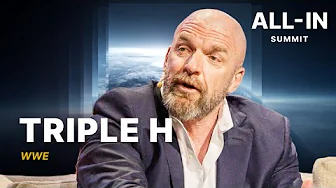
WWE is built around long-term story arcs, not around booking the best possible matches. Levesque said writers plan WrestleMania months ahead, structure protagonists and antagonists like a “Marvel Universe,” and Netflix’s Unreal is the first time cameras have entered the writers’ room and backstage production.
-
WWE exited the direct-to-consumer streaming arms race because it decided technology was not its core competence. Levesque said the WWE Network was once an early streaming rival to Netflix, but the company saw a looming “tech war,” moved to Peacock, and now distributes through Netflix and ESPN.
-
Digital is a funnel to WWE’s live business, not the destination. Levesque cited roughly one billion social followers and top-tier YouTube reach, while WWE produces about 500 live hours annually; recent Paris events drew 30,000-plus for a PLE and more than 20,000 for Raw.
-
WWE’s audience is far broader and more family-driven than its macho image implies. Levesque said more than half of attendees come with a child and 40% of the fan base is female, describing crowds where grandparents, parents and children follow different generations of wrestlers together.
-
The internet forced WWE to abandon many old-school fictional identities and build characters closer to performers’ real selves. Levesque said a Canadian playing a Russian villain could not survive instant fact-checking today; creative instead blurs reality and fiction so audiences cannot easily tell where the performer ends and the character begins.
-
WWE is recruiting its next generation from college athletics through NIL, but Levesque values charisma above raw athleticism. He said media skills are taught from day one and that the decisive trait is the innate ability to connect with people—the quality WWE is actually screening for.
-
Levesque acknowledged wrestling’s physical cost while arguing WWE’s safety systems have materially improved. He said “no one walks away unscathed,” but WWE now scans continually for physical and head injuries, unlike earlier eras; the performance goal is to make action look extremely violent without actually being so.
October 31, 2025
Elon Musk: OpenAI Betrayal, His Future at Tesla, and the Next Big Thing — Grokipedia
-
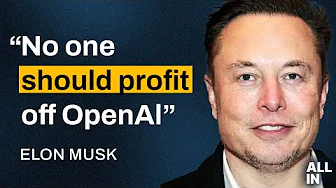
X is replacing legacy Twitter ranking rules with Grok reading the platform itself. Musk said bugs recently hid followed accounts and overfed interacted-with topics; Grok will initially read 10 million of roughly 100 million daily posts, later all of them, using about 50,000 H100s and powering semantic search.
-
Grokipedia was built by having Grok rewrite Wikipedia rather than by starting from a blank encyclopedia. Musk said a “truth-seeking” model reviewed the million most popular Wikipedia articles against the public web; he later texted Sundar Pichai after Google initially suggested Wikipedia instead.
-
Musk’s team found Twitter spending as if its largely empty headquarters were still full. One building was empty and the other about 5% occupied; lunches effectively cost about $400 each, while unused software included expensive pedestrian-traffic analytics for offices nobody used.
-
Musk said Tesla’s compensation vote is really about control over Optimus, not personal spending. He wants roughly 25% voting power—enough to influence robot safety while remaining removable—and said he will not build a “robot army” if activist shareholders could easily oust him.
-
Musk expects his OpenAI challenge to reach a jury in February or March, saying its founding bargain was abandoned. He said he conceived and named OpenAI, funded early rounds and recruited key staff, but deliberately created an open-source nonprofit whose founders were not supposed to benefit financially.
-
Tesla’s robotaxi challenge is shifting from autonomy toward operating a city-scale fleet. Musk expects monitor-free Austin rides by December, over 1,000 Bay Area cars and 500 around Austin by year-end, with Cybercab production starting in Q2 next year.
-
Musk sees Tesla’s future vehicle fleet as a distributed AI data center, not just transportation. He said 100 million Teslas with roughly one kilowatt of onboard inference each could provide about 100 gigawatts of compute, using existing power, cooling and Wi-Fi.
-
Musk puts serious climate risk roughly 50 years out, rejecting both denial and near-term catastrophe. He favors solar and batteries without subsidies, saying China’s 1.5-terawatt annual panel capacity could manufacture enough solar in about 18 months to roughly match U.S. electricity use after utilization losses.
October 30, 2025
Pete Buttigieg: The Left's Identity Crisis, Wealth Tax, 2024 Mistakes, Plans for 2028
-
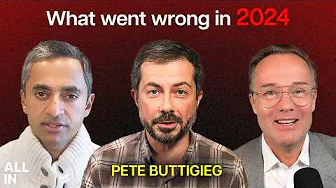
Buttigieg says Democrats have let identity politics become too central, weakening their ability to build a common economic message across groups. He described the party’s approach as a “salad bar” of separate constituencies and argued that heavily gerrymandered House districts reward primary-election purity over broader coalition-building.
-
He now says the Biden administration acted too slowly on the border and that earlier executive action might have changed the political outcome. Buttigieg noted that Biden’s late-term orders sharply reduced illegal crossings and said he favors making illegal entry difficult while expanding lawful immigration.
-
Buttigieg flatly rejects the idea that federal debt can keep rising without consequence, calling the current path unsustainable. He broke with Democrats who treated deficits casually, arguing that fiscal repair requires lower healthcare and drug costs, tighter spending discipline, and more revenue from wealthy taxpayers.
-
He agrees Washington needs a DOGE-style efficiency overhaul, but says the actual effort confused disruption with competent reform. Buttigieg cited erroneous public savings figures, resignation emails sent to scarce air-traffic controllers, and firings of nuclear-safety and bird-flu personnel who then had to be rehired.
-
The Biden EV-charger program was deliberately designed to look slow at first: states controlled deployment and federally funded chargers had to be made in America. Buttigieg said most installations were always expected in 2026–27, making early claims that billions had been spent on only a few chargers misleading.
-
Buttigieg says Biden’s disastrous 2024 debate, not private Cabinet knowledge, was the clear turning point in judging his fitness to continue. He said Biden himself ultimately decided whether to run, and now believes a rapid Democratic mini-primary might have produced another nominee or made Kamala Harris stronger.
-
He believes autonomous vehicles are already safer than human drivers in some cases and that government should do more to accelerate adoption. With roughly 100–150 people dying on U.S. roads daily, Buttigieg argued cautious regulation should protect public trust without treating continued human-driver deaths as an acceptable baseline.
-
Buttigieg’s biggest AI fear is not unemployment alone but a repeat of industrial automation: larger output paired with shattered livelihoods, identities, and political stability. He worries AI could concentrate wealth and power further unless policy spreads the gains, pointing to the Midwest’s automation-driven dislocation as a warning.
October 28, 2025
The Woman Who BEAT Maduro: Venezuela's Next Leader? Nobel Peace Prize Winner María Corina Machado
-
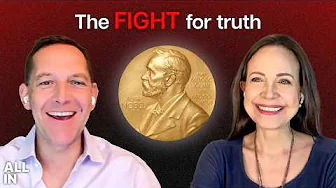
Machado says her citizen-run 2023 opposition primary drew more than 3 million voters and gave her 92%, after which the regime barred her from the presidential race. She transferred that mandate to little-known 74-year-old diplomat Edmundo González and campaigned by telling supporters that voting for him was effectively voting for her.
-
The opposition designed the 2024 election around proving the result, not merely winning it. Machado says more than 1 million volunteers, 130 covert processing sites, Starlink and digitized tally sheets produced published evidence within 24 hours, later audited by more than 20 independent technicians and universities.
-
Maduro’s post-election response was mass intimidation aimed at making ordinary political participation dangerous. Machado says 2,500 people were imprisoned within 24 hours, activists’ relatives were seized, and even posting her image could trigger detention; she says international bodies called the crackdown state terrorism and crimes against humanity.
-
Machado’s clearest near-term claim is that Maduro is at his weakest point ever, with defections and insiders contacting the opposition. She credits Trump’s enforcement pressure for changing the balance, says defectors can join a negotiated transition, and says her side already has plans for the first 100 hours and 100 days.
-
China’s relationship with Caracas has shifted from major lender toward debt collection, according to Machado. She says Venezuela became China’s largest debtor at more than $60 billion, but Beijing stopped new funding about seven years ago because of corruption and now mainly takes oil against outstanding debt.
-
Machado says Maduro’s succession was shaped directly by Cuba, not simply by internal Chavista politics. Her account is that Maduro was trained in Cuba and chosen because of his loyalty to the Castro regime, making Cuban influence central to how she understands the current Venezuelan power structure.
-
Machado’s confrontation with the regime became physically violent years before her current hiding. She says a Chavista legislator broke her nose in five pieces inside the National Assembly in 2013; after she took human-rights accusations against Maduro to the OAS in 2014, she was forcibly expelled from her seat.
-
Venezuela’s collapse was not caused by a lack of resource income; Machado’s account is that the oil windfall funded loyalty, patronage and corruption while living standards cratered. She cites estimates of more than $2 trillion lost over 26 years, 86% poverty and pensions below $1 a month.
October 27, 2025
Nobel Prize in Physics Winner: The Quantum Leap That Changed Everything - John Martinis
-
Martinis’s Nobel-winning graduate work showed that a macroscopic electrical circuit could behave quantum mechanically, not just individual atoms. Published in 1985–86, the experiment observed discrete energy levels and tunneling; its deeper importance emerged decades later when the same physics became a basis for superconducting qubits.
-
Richard Feynman’s talk on using quantum mechanics for computation changed Martinis’s career direction near the end of his thesis. Martinis watched Feynman get mobbed afterward and concluded the problem was deep, practical and worth a lifetime; he later went all-in on quantum computing.
-
Martinis left academia for Google because building a quantum computer required a stable team and resources universities could not easily sustain. Google supplied the money; in 2019 his group’s 53-qubit experiment produced a result far harder to emulate classically, though Martinis stresses it had no practical use.
-
Today’s superconducting machines are experimentally capable but still nowhere near general-purpose usefulness. Martinis puts current systems around 50–100 controllable qubits, while noise limits operations and error correction could push a machine capable of solving genuinely hard problems toward roughly one million qubits.
-
Martinis’s company is betting that quantum computing’s decisive bottleneck is manufacturing, not a sudden AI breakthrough. It is pursuing modern 300-mm semiconductor fabrication with industry partners; Martinis says AI may help modeling and error decoding, but clean hardware and precise control remain fundamental.
-
His commercial target is useful large-scale quantum computing in roughly eight to ten years, but he openly acknowledges that “ten years” has been predicted for years. His case for optimism rests on solving manufacturing bottlenecks so successful designs can scale rapidly rather than merely adding qubits incrementally.
-
Martinis thinks China is technically close enough that published results may understate how competitive it already is. Chinese teams reproduced Google’s supremacy work and appeared near parity soon after newer Google results; his concern that China may delay publication until Western disclosure is explicitly a worry, not an established fact.
-
The Nobel was not a complete surprise: Martinis had known for years that he and collaborators were being considered through Nobel symposiums. After several disappointing award mornings he stopped expecting it; this year his wife took the 3 a.m. call, let him sleep until 5:30, and reporters arrived at 6.

October 24, 2025
NBA Gambling Scandal, Billionaire Tax, Tesla's Future, Amazon Robots, AWS Outage, Dangerous AI Bias
-
SEIU’s California initiative would impose a one-time 5% tax on net worth above $1 billion, including private stock and real estate; speakers said Roth IRAs above $10 million also count. They expect constitutional challenges, but said 2026 retroactivity and no-liquidity-discount rules could push residents to leave before courts resolve them.
-
The FBI probe described in the episode involved 30 arrests and two separate NBA-linked cases, including an alleged mafia-rigged poker game. In the other case, Terry Rozier was accused of tipping friends to bet his rebound under before leaving injured; they allegedly made about $200,000.
-
Prediction markets were portrayed as becoming a financial-information layer, not merely gambling. Speakers said Polymarket had raised roughly $1–2 billion at a $9 billion valuation and was soon seeking $12–15 billion; they argued liquid markets surface insider information because informed trades immediately shift odds.
-
The AWS outage strengthened the case for multi-cloud: speakers said 2,000 companies and four million users were disrupted for 15–20 hours. AWS’s quoted $124 billion run rate was growing 17%, versus Microsoft’s 26% and Google Cloud’s 32%, giving rivals both momentum and a fresh sales argument.
-
Amazon’s leaked automation plan was not 600,000 layoffs; it was to avoid roughly 600,000 planned hires by 2033 while automating 75% of warehouse operations. The episode also cited internal “crisis” messaging favoring “cobots” and “co-workers” over “robots,” indicating Amazon is preparing for political backlash.
-
Tesla’s quarter mixed record $28 billion revenue with a 40% drop in operating profit, even as Musk framed the company around robotics. He tied his proposed trillion-dollar package to additional voting influence, saying he feared being ousted after building an “enormous robot army.”
-
Musk is personally concentrating Tesla’s next stack around AI5, Cybercab, Optimus and energy rather than treating them as side projects. He said he spent almost every weekend on AI5 and claimed up to 40× AI4 performance; the episode put Tesla Energy near $3.5 billion quarterly revenue at 30% operating margins.
-
The AI-bias debate ended on a narrower policy point than its rhetoric suggested: Sacks said the Trump order governs federal purchasing rather than banning private models. He said government would not procure “ideologically biased AI,” while criticizing state “algorithmic discrimination” rules as an indirect route to shaping model behavior.
-
In the 50–50 Senate, Chuck Schumer told Manchin after Democrats won Georgia that he could “probably have anything you want.” Manchin says Schumer assumed he would use his decisive vote to extract benefits for West Virginia, while Manchin saw the leverage as a responsibility to restrain the majority.
-
Manchin says he warned Biden that the $1.9 trillion American Rescue Plan, following roughly $3.2 trillion of pandemic stimulus, would fuel inflation. He recalls Biden responding that if Manchin killed his “effing bill” he would never speak to him again, an unusually direct account of their private confrontation.
-
The Build Back Better fight became a personal-security crisis for Manchin, not just a legislative dispute. He says Capitol Police escorted him because death threats named his children’s and grandchildren’s locations, and he separately claims some protesters surrounding his boat were recruited for $15 an hour.
-
Manchin rejects claims that he personally witnessed Biden’s mental decline, despite spending substantial time with him. He says their conversations remained good, but believed Ron Klain and a far-left staff often drove policy and failed to execute agreements Biden had made with him.
-
Schumer separated the bipartisan infrastructure bill from Build Back Better in exchange for Manchin voting to begin the BBB process. Manchin insists he never promised to support BBB itself, only to let negotiations proceed—a distinction central to later accusations that he had broken his word.
-
A 2013 bipartisan immigration bill passed the Senate with roughly 68 or 69 votes but never received a House vote. Manchin says Speaker John Boehner told him Eric Cantor’s primary defeat over alleged support for “amnesty” made Republicans unwilling to risk bringing the compromise to the floor.
-
After Biden withdrew in 2024, Manchin says he begged Democrats to hold a 30-day mini-primary and would have entered it himself. He says Biden’s near-immediate endorsement of Kamala Harris closed that possibility before competing Democrats could contest the party’s direction.
-
Manchin says Trump was far more personally engaged with him than Obama, confirming he spoke with Trump more in two years than during Obama’s eight. Their relationship survived Trump campaigning in West Virginia six times and, Manchin says, spending an extra $25 million to defeat him before inviting him to lunch a week later.
-
California Forever has raised more than $1 billion and assembled nearly 70,000 acres in Solano County—over 100 square miles—to build a new city and industrial hub. The holding is about five times Manhattan’s size and two-and-a-half times San Francisco’s, giving the project unusual room to combine housing, factories and waterfront industry.
-
The project’s first major industrial bet is the Solano Foundry, pitched as America’s largest advanced-manufacturing park and a way to reunite Silicon Valley R&D with production. Its argument is that U.S. manufacturing cannot match China through labor volume, so robotics and AI must raise output per worker while keeping factories close to Bay Area engineering talent.
-
Shipbuilding is being positioned as a national-security business, not a side project. California Forever says its 6.5 miles of deep-water waterfront could accommodate shipyards on the scale of major U.S. facilities, while giving the Navy and commercial builders badly needed West Coast repair and production capacity.
-
The strategic case for West Coast shipbuilding rests on the vulnerability of relying heavily on East Coast and Gulf yards during a Pacific conflict. Sramek argued that disruption of the Panama Canal could severely complicate moving ships between the Pacific and existing yards, making additional Pacific-side capacity materially important.
-
California Forever is not planning an industrial park with nearby suburbs; it wants a walkable city for as many as 400,000 people built around the industrial base. The residential model deliberately looks backward—traditional neighborhoods, public squares and children walking to school—even as the factories and shipyards are meant to use cutting-edge technology.
-
Sramek’s broader diagnosis is that California’s decline is largely self-inflicted because the state stopped building enough housing, infrastructure, energy and industrial space. California Forever is designed as a proof-by-construction response: rather than lobbying for abundance, it is trying to create one large place where housing, manufacturing and infrastructure can be built together.
-
The project’s real ambition is to make Solano County a new Bay Area production center, not merely a housing development. Sramek is betting that Northern California’s enduring advantage is its concentration of AI, robotics and engineering talent, and that giving those workers nearby factories and shipyards could restore part of the industrial ecosystem Silicon Valley once had.
-
Mark Benioff’s reported support for sending the National Guard into San Francisco was narrower than the headlines made it sound. The episode says he was discussing Dreamforce security and hundreds of off-duty police when asked about Guard troops, answering, “Sure, if they can be cops,” apparently in the event-security context.
-
San Francisco’s own figures described a city improving faster than its political narrative: crime was down 30% citywide and 40% downtown, with homicides at a 70-year low. The episode also cited the first net police gain in seven years, convention bookings up 50%, hotel bookings up 60%, and car break-ins at a 25-year low.
-
The US–China trade fight had moved to a strategic chokepoint: China announced controls on 12 of 17 critical rare-earth minerals, and Trump threatened an additional 100% tariff on Chinese imports. Treasury Secretary Scott Bessent said the confrontation had “substantially deescalated,” the tariff need not happen, and the Trump–Xi meeting remained on track.
-
The hosts agreed China’s rare-earth leverage is dangerous but split on the remedy: Friedberg favored deregulation and tax incentives, Sacks backed price floors, and Chamath a strategic reserve. Their concern was that Chinese subsidies and spot-market dumping can crash prices and destroy US project economics before private capital earns a return.
-
Friedberg argued America’s rare-earth weakness is an industrial-capability problem, not simply a lack of ore. He said US processing still relies on chemistry the country stopped advancing about 40 years ago, while newer automation, processing methods and geological mapping could reopen domestic production and identify far more deposits.
-
Chamath’s most concrete China insight was how Beijing turns national priorities into distributed capital allocation. He described Xi’s agenda cascading through the Politburo, provinces and prefectures, creating what he called roughly “300 VCs” competing to build favored sectors such as EVs, a system he linked to companies like BYD and Xiaomi.
-
AI infrastructure is already hitting a local-consent bottleneck: Chamath cited Google, Microsoft and Amazon data-center projects pulled or mothballed in Indiana, Wisconsin and near Tucson. Residents complained about electricity prices, water and noise; Chamath argued hyperscalers should use cash to offset local power bills or fund solar and storage.
-
The episode’s sharpest unresolved question is whether AI’s growth dividend will outrun labor displacement: Sacks cited growth of 3.8 percent and said 40% was AI-driven, with no evidence of widespread job loss. The counterargument pointed to Alphabet, Meta, Uber and Amazon remaining below peak headcount while developer unemployment is rising.
-
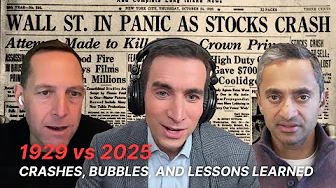
The 1929 boom was built on a new mass-credit system that turned ordinary Americans into leveraged stock buyers. After GM pioneered installment lending in 1919, Sears followed for appliances and National City extended it to stocks, with customers sometimes borrowing $10 for every $1 invested amid almost no underwriting, disclosure rules, or SEC.
-
The financial system itself was speculating with other people’s money, not merely serving reckless retail traders. Banks used depositor funds, corporations loaned balance-sheet cash into markets, and the Fed—aware of the danger—avoided forceful rate action, instead issuing a vague appeal to stop speculative lending that banks struggled to interpret.
-
Glass-Steagall emerged from bank rivalry and lobbying as well as public reform, complicating its later reputation as a clean consumer-protection law. Sorkin says Chase and Rockefeller interests pushed measures that weakened J.P. Morgan, while Carter Glass privately complained that bankers were taking over his bill.
-
The crash did not immediately produce Depression-era politics because many Americans initially believed the downturn would reverse. The market finished 1929 down about 17%, Hoovervilles appeared mainly by 1932, and the deeper rupture followed policy failures including tax increases, Smoot-Hawley tariffs, and the Fed’s refusal to flood the system.
-
Sorkin does not see today as a replay of 1929, but he sees leverage migrating to less transparent corners of the economy. Big AI companies are largely funding investment with cash, while real estate, energy infrastructure, and private credit carry more leverage; he also flagged potentially circular financing around major chip deals.
-
AI may be supporting far more of current U.S. growth than headline GDP makes obvious. The discussion cited estimates that data-center spending contributes roughly 100–200 basis points of GDP, while excluding the Magnificent Seven makes the broader economy look materially weaker—raising the stakes if AI investment slows.
-
The central regulatory conflict is no longer simply protection versus speculation, but protection versus access. Depression-era rules restricted private investments to wealthier “accredited” investors because they could supposedly absorb losses; today, excluded investors increasingly see those safeguards as barriers that reserve some of the best opportunities for the wealthy.
-
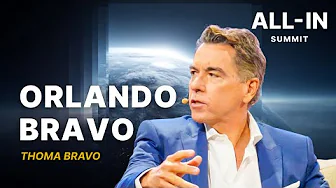
Bravo says Carl Thoma nearly fired him after his 1997–2000 mistakes; the second chance pushed him toward established software with recurring revenue, then unusually cheap. That niche evolved into growth-style buyouts, typically about 70% equity and 30% debt, where most returns now come from terminal-value appreciation rather than cash yield.
-
AI is already shrinking Thoma Bravo’s investable software universe, not merely creating upside. Bravo says many verticals are too disrupted or confusing to underwrite, even as long-time institutional investors still want consistency and predictability from the firm.
-
Scale is becoming Thoma Bravo’s harder problem: a $10 billion acquisition may need to become worth roughly $25 billion to generate the desired return. Bravo says an IPO exit can begin at a major disadvantage because the firm may buy at a 30% premium yet have to float at a discount.
-
Thoma Bravo’s $10.5 billion Boeing carve-out centers on Jeppesen, a flight-navigation business Bravo describes as indispensable to airlines; roughly 15 private-equity groups competed. The thesis is operational: lift margins from about 25% toward 50%+ by running it more like a software company.
-
Thoma Bravo often plans roughly 15% cost cuts at closing, then shifts attention to bookings growth and add-on acquisitions. Bravo’s model is to turn a 6–7× revenue purchase into an EBITDA-valued business by year four, ideally with 20% growth and 50% margins.
-
Thoma Bravo’s information edge often comes from following targets for years and already owning a competitor or partner before bidding. For the $12.5 billion Dayforce deal, partner Holden Spade first met the CEO in 2008, giving the firm a long history with the company before the transaction.
-
Despite managing $179 billion, Bravo says Thoma Bravo has no reason to go public because listing does not help it raise capital, buy companies, or improve them. Carl Thoma gave the firm to Bravo and his partners, and Bravo wants to repeat that succession model rather than cash out.
-
Bravo publicly endorsed Puerto Rican statehood for the first time in the conversation. He said statehood would be better for Puerto Rico if the United States allows it, noting that the pro-statehood party has grown while some commonwealth tax advantages have disappeared.
October 14, 2025
Bryan Johnson’s Best Health Hack: Lower Your RHR Before Sleep = Sleep Better and Live Longer
-
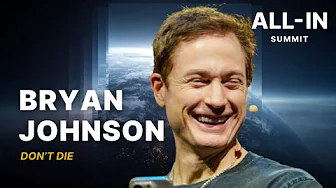
Bryan Johnson’s longevity project is built around measuring biological age organ by organ, then testing interventions against those biomarkers. At 47, he says his left ear tests at 64 after childhood gunfire and loud music, illustrating why he treats aging as many separate systems rather than one number.
-
Johnson says his most useful health target is resting heart rate immediately before sleep. He recommends establishing a baseline, trying to lower it roughly 10%, and finishing the last meal four hours before bedtime so digestion does not keep heart rate elevated.
-
His sleep protocol is strikingly simple compared with his reputation for extreme longevity routines. Stop screens an hour before bed, avoid caffeine from around noon, use warmer evening lighting, and create a wind-down routine such as walking, reading, breathing or meditation.
-
Johnson argues that sleep is the foundation of self-control, mood and performance, not time stolen from ambition. He says poor sleep weakens willpower and rejects startup culture’s idea that founders must “martyr” themselves, telling one founder that prioritizing sleep should make him better at work and relationships.
-
He is trying to turn health into a measurable competition rather than a vague identity. Johnson publishes his biomarkers, claims they are among the world’s best, and invites others to compete, framing longevity as a quantifiable “sport” built around slowing or reversing biological aging.
-
“Don’t die” is no longer merely Johnson’s personal health slogan; he presents it as a future ideology for humanity. He predicts that superintelligence will change humanity’s ideas about reality and argues that preserving existence could eventually become a principle comparable in cultural weight to democracy, capitalism or major religions.
October 13, 2025
Cathie Wood on How AI Can Double GDP, Bull Case for Bitcoin $1M, Elon’s Trillion-Dollar Pay Package
-
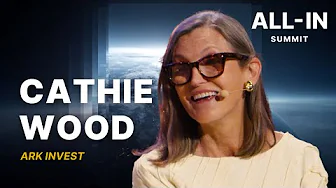
Cathie Wood’s core macro bet is that converging technologies could push U.S. real GDP growth toward 7% while driving inflation toward zero or below. ARK argues robotics, energy storage, AI, blockchain and multi-omic sequencing are entering simultaneous adoption curves, with Trump-era investment tax incentives potentially accelerating the shift.
-
ARK believes the biggest investment opportunity is no longer any single technology, but the convergence between them. Wood highlighted autonomous mobility as a near-term revenue engine combining robotics, batteries and AI, while calling AI-driven healthcare and gene editing the market’s most profoundly transformative and underpriced opportunity.
-
Wood expects capital to rotate away from the giant technology incumbents toward smaller disruptive innovators after years of extreme concentration. ARK’s five-year public-equity forecast originally implied roughly 50% annualized returns for disruptive innovation, which Wood said had fallen to about 40–45% after recent gains.
-
Wood clarified that ARK’s official Bitcoin bull case is $1.5 million, not the widely quoted $3.8 million figure. The higher number came from a portfolio-optimization exercise in which Bitcoin’s calculated optimal allocation reached 19%; personally, she tells her children to average into Bitcoin gradually rather than chase a target allocation.
-
Wood wants ordinary investors to gain broader access to private companies instead of being excluded primarily by wealth thresholds. She compared accreditation rules to barring people from driving because they lack sufficient net worth, favoring knowledge-based qualification while noting investors can legally gamble yet often cannot buy companies such as OpenAI.
-
ARK manages downturns by concentrating rather than retreating to cash or benchmarks. During bear markets it moves toward its highest-conviction companies using scores for management, execution, competitive barriers, product leadership, valuation and thesis risk; during bull markets it diversifies as IPOs and new opportunities return.
-
ARK’s five-year Tesla price target is $2,600, and Wood says the model assigns little value to humanoid robots. She views robotaxis and humanoids as products of the same robotics-battery-AI convergence and considers Elon Musk’s milestone-based compensation unusually effective because substantial rewards depend on achieving ambitious operating targets.
-
ARK itself is moving out of Delaware because Wood believes the state has become insufficiently predictable for corporations. Her complaint centers on Delaware courts overriding Tesla shareholder-approved compensation, which she sees as an unacceptable governance risk even though ARK says it is not acting as an activist investor.
October 10, 2025
Trump Brokers Gaza Peace Deal, National Guard in Chicago, OpenAI/AMD, AI Roundtripping, Gold Rally
-
The Israel-Hamas deal’s first phase pairs a ceasefire and full hostage release with unrestricted aid, 2,000 Palestinian prisoner releases, and an Israeli troop withdrawal. David Sacks’ key explanation was that Trump pressured both Netanyahu and Hamas, matching Aaron David Miller’s view that Washington acted less like “Israel’s lawyer” and more like a broker.
-
The episode’s sharpest immigration dispute was over tactics, not whether deportation should happen. Brad Gerstner said removals under Trump are roughly back to Clinton/Obama-era levels of 300,000–400,000 annually, while Jason Calacanis argued ICE’s expanded $30 billion budget implies roughly $100,000 per deportation and favors employer fines or self-deportation instead.
-
AMD effectively made OpenAI the validation customer for its AI comeback, offering warrants for up to 160 million shares—about 10% of AMD—in exchange for a six-gigawatt GPU commitment. Gerstner framed it as a “bet the farm”: Nvidia captured nearly all incremental AI data-center revenue since 2022, so AMD’s MI450 needs to prove competitive quickly.
-
AI’s next bottlenecks may be power and HBM memory rather than chip design itself. Palihapitiya said scarce inputs could shift bargaining power to suppliers, while the panel estimated a one-gigawatt data center costs roughly $50 billion—making the 10-gigawatt facilities OpenAI and xAI discuss potential $500 billion projects.
-
Nvidia’s biggest strategic risk is not training but inference, which Sacks estimated could become 99% of AI compute demand. Nvidia dominates training, but AMD, Google TPUs, Amazon Trainium, Groq, Cerebras, Huawei and custom ASICs could make inference more competitive if they can beat Nvidia on cost or performance per watt.
-
The panel’s best test for “round-tripping” was economic substance: investor-suppliers can finance customers without creating sham revenue if real downstream demand exists. Sacks and Gerstner argued Nvidia’s equity investments are small beside projected cash flow, while OpenAI is expected to exit the year above a $20 billion revenue run rate.
-
Gold’s surge above $4,000 was attributed less to one macro story than to new structural buyers. Palihapitiya pointed to Tether Gold, central banks and macro funds; Sacks added that China has increased reserves for 11 straight months to 74 million ounces as countries reduce exposure to dollar-based sanctions risk.
-
Polymarket moved from a $350 million valuation last year to a roughly $9 billion post-money valuation after ICE invested $2 billion and agreed to distribute its data globally. Palihapitiya’s larger point was that prediction markets may converge with sports betting and tokenized finance, turning more outcomes and assets into continuously traded markets.
October 9, 2025
Sequoia’s Roelof Botha: Why Venture Capital is Broken & How Great Companies Are Built
-
Roelof Botha argues venture capital is structurally overfunded: $150–200 billion invested annually would require more than $1 trillion in yearly exit value to earn acceptable returns. He estimates only about 20 companies per decade achieve exits above $1 billion, making broad venture exposure, in his words, “return-free risk.”
-
Sequoia’s Scout program turned founders’ private networks into one of its most successful sourcing engines. Jason Calacanis helped lead Sequoia toward Uber, Sam Altman toward Stripe, and Botha says the original Scout fund has returned roughly 26 times its capital.
-
Sequoia has deliberately refused to follow rivals into ever-larger funds and fee-driven expansion. Its seed, venture and growth funds remain roughly their size of five to seven years ago, while the firm is structured as a private partnership intended to pass between generations without partners buying or selling ownership.
-
Sequoia changed its structure because selling winners after IPO was destroying long-term value. Its Capital Fund can retain selected public-company shares; Botha says simply holding them has produced another $6.7 billion of gains in three and a half years that LPs likely would otherwise have missed.
-
Sequoia requires consensus for investments, meaning one partner can theoretically veto an entire deal. Botha recently opposed a stablecoin-related company alone, then explicitly withdrew his objection because the rest of the partnership was strongly positive—a mechanism that preserves dissent without making one person’s uncertainty absolute.
-
Sequoia separated from its China operation because the original premise of an increasingly integrated U.S.–China economy had broken down. Botha cited Chinese company formation falling from about 51,000 in 2018 to 1,200 in 2023, arguing regulatory uncertainty can suppress entrepreneurship even when entrepreneurial talent remains.
-
Sequoia now has roughly as many developers as investors and builds proprietary software to sharpen investment decisions rather than simply enlarging its operating staff. Partners can instantly retrieve prior meetings, hiring trends and team assessments, while internal AI summarizes business plans, evaluates teams and maps competitive alternatives.
-
Botha nearly quit venture capital in 2009 despite already having backed YouTube, overwhelmed by missed opportunities and investments going bad. Doug Leone appeared at his home on a Saturday with homemade pesto simply to support him; Botha later described Michael Moritz’s contrasting gift as imagination—the ability to see what an unfinished company might become.
-
YouTube’s creator economy is enormous, but its 45% advertising cut is increasingly optional for top creators. Neil Mohan said YouTube paid creators and media partners more than $70 billion in three years, while acknowledging major creators may be better off selling their own advertising.
-
YouTube now behaves more like television infrastructure than a social network. It has been America’s largest streaming platform for roughly two years and accounts for about 13–14% of television viewing, excluding all viewing on phones.
-
YouTube’s scale increasingly comes from both advertising and subscriptions. Mohan said roughly 2 billion people visit daily and YouTube Premium has about 125 million subscribers, although advertising remains the dominant source of creator payouts.
-
YouTube is deliberately rebuilding traditional television inside its own ecosystem rather than simply replacing it with creator videos. YouTube TV is being developed around sports and news, while “Primetime Channels” lets viewers buy traditional channels individually inside the main YouTube app.
-
Mohan said YouTube’s COVID-era misinformation policies are gone, but stopped short of admitting the platform’s approach was mistaken. He defended the restrictions as products of an extraordinary information environment and said YouTube’s rules must remain flexible as circumstances change.
-
Running YouTube globally requires continually compromising its free-expression principles against national law. Mohan described freedom of speech as YouTube’s starting position, but said enforcement inevitably combines global policies, country-specific legal requirements, automated systems and human judgment.
-
YouTube’s most consequential AI plan is not merely labeling synthetic videos but giving people control over AI copies of themselves. Mohan said YouTube is developing “likeness detection,” modeled on Content ID, so creators could potentially remove, permit or even claim monetization from videos using their face or voice.
-
YouTube expects AI-generated and human-made media to become too intertwined for “AI content” to be treated as a separate category. Its approach is therefore disclosure plus ordinary content rules: some generated videos receive AI labels, while policy enforcement depends on what the video contains rather than how it was produced.
October 8, 2025
Alibaba's Joe Tsai on US-China Rivalry, AI Future, Owning the Nets/Liberty, Caitlin Clark's Impact
-
Caitlin Clark transformed the WNBA’s economics, with Joe Tsai saying viewership, ticket sales and sponsorship all rose roughly fourfold after her arrival. Whatever the surrounding culture-war arguments, Tsai called her financial impact on the league “extraordinary” and “undeniable.”
-
Alibaba now treats China’s tech regulation as a stable operating constraint rather than an unpredictable crackdown. Tsai said privacy and antitrust rules established clearer “red lines,” while Alibaba simultaneously faces intense e-commerce competition from five or six major rivals, including TikTok parent ByteDance.
-
Tsai argues the AI contest will be won through adoption, not by permanently owning the best model. He cited China’s open-source push, smaller deployable models and business AI adoption rising from about 8% to nearly 50% in roughly a year as evidence that diffusion may matter more than model leadership.
-
AI is already changing Alibaba’s labor needs and software production without triggering announced AI layoffs. Tsai said the company needs fewer new hires, estimated roughly 30% of its code is already AI-written, and said AI embedded in consumer products is producing measurable user and revenue gains.
-
When Tsai returned to Alibaba’s chairmanship, his first major management move was to reduce the company’s identity to two businesses: e-commerce and cloud computing with AI. He said abandoning the sprawling “six businesses” framing was necessary to restore organizational focus and execution.
-
China is pushing aggressively toward mass AI adoption even while employment anxiety is already severe. Tsai cited an official goal of 90% penetration of AI agents and devices by 2030, alongside roughly 18% youth unemployment, about 10 million annual college graduates and home prices down around 30% after the property slump.
-
Jack Ma’s early advantage, in Tsai’s account, was less technical brilliance than an unusual ability to make talented young people believe in a vision. Tsai joined after seeing Ma lead 12–15 young recruits from his apartment, crediting his teacher’s skills in communication, talent recognition and comfort with people becoming more successful than himself.
-
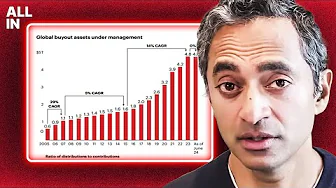
Private equity’s expansion to about $5 trillion was powered by cheap money, but the same flood of capital is now eroding returns. The speaker links zero rates to leverage-fueled growth, then argues overcrowding and overpaying have left cash distributions scarce for four or five years.
-
The better test for alternative investments is cash returned, not headline IRR. He says investors should ask for DPI, expects capital to leave weak private-equity managers and concentrate in proven firms like Silver Lake, while warning that private credit is becoming the next crowded bubble.
-
Continuation funds can disguise the absence of real exits by selling assets into a new vehicle and “resetting the clock.” Although private-company secondary trading has recovered over the past year, the discussion argues that recycled ownership is no substitute for a functioning IPO market.
-
Traditional IPOs and direct listings fail in different ways, which is why the speaker is still trying to redesign the route to public markets. He says banks charge 6–8% and underprice IPO stock for favored customers, while his Slack experience left him about $1 billion “offside,” prompting him to sell Coinbase on day one.
-
His new SPAC pitch is built around removing the incentives that damaged the first SPAC boom. He says 98.7% of the capital came from top institutional investors, who did not demand warrants and accepted a structure where the sponsor receives no compensation unless the transaction actually succeeds.
-
His next SPAC iteration would look less like a blank-check vehicle and more like a pre-arranged IPO. He envisions lining up $1–3 billion of flexible common equity before a merger, so the target avoids redemption risk and arrives public with committed capital already in place.
-
Saudi Arabia is using EA’s $55 billion take-private as a long-horizon gaming platform bet, not a simple buyout. PIF will be the majority owner after already holding 10%; Affinity will own about 5%, while Saudi vehicles have also bought Scopely and Niantic and hold stakes in Nintendo, Take-Two and Activision Blizzard.
-
Chamath Palihapitiya argued that private equity’s real problem is a distribution drought caused by too much capital chasing too few good opportunities. He said distributions have been scarce for four to five years, expects capital to concentrate in proven firms like Silver Lake, and called private credit the next bubble forming.
-
Palihapitiya’s new SPAC is deliberately designed to remove the incentives that damaged the first SPAC boom. He said the sponsor earns nothing until the stock rises 50%, 98.7% of capital went to institutional investors, and he explicitly advised retail investors to avoid his own SPAC because the risk resembles venture investing.
-
AI adoption inside traditional private equity may be blocked more by ownership and management than by technology. Josh Kushner’s Thrive is buying CPA firms and applying AI, while Palihapitiya said his nine-figure AI business has won almost no private-equity portfolio work despite extensive selling; owner-controlled businesses move faster.
-
Cheap frontier models do not automatically win workloads because switching costs are becoming a serious form of lock-in. Palihapitiya said 8090 shifted substantial work from Amazon Bedrock to Kimi K2 on Groq for better economics and performance, but moving complex prompts between models can require weeks or months of re-engineering.
-
The U.S. may be leading most of the AI stack while China leads the most important open-source models. Sachs named DeepSeek, Kimi and Alibaba’s Qwen as leading examples, while stressing that a Chinese-origin model can be forked and run entirely on U.S. infrastructure without sending customer data back to China.
-
AI’s near-term constraint may become electricity politics before model capability. An energy executive told Palihapitiya household rates could double within five years without changes; Sachs said shifting only 40 peak hours annually to backup generation could unlock roughly 80 gigawatts, buying time for more gas capacity and eventually nuclear.
-
The coming U.S. AI-policy fight is increasingly about whether states can impose dozens of incompatible regimes or Washington preempts them with one national standard. Colorado already imposes liability on AI developers and deployers for certain discriminatory outcomes; an earlier federal moratorium failed in Congress, but Sachs said Trump backs a single national standard.
-
Khanna said H-1B abuse is real and backed prevailing-wage and skilled-job rules, but rejected Trump’s blanket $100,000 fee as especially damaging to startups. He also wants H-1Bs to move faster toward green cards, warning that blunt limits can simply push jobs overseas.
-
Khanna said Democrats should plainly admit the Biden administration let too many people cross without adequate border security. He opposed Trump’s near-zero asylum approach but said he would work with him on legal status for long-settled, tax-paying undocumented workers without criminal records.
-
At a Trump tech dinner, one host said Trump asked executives their biggest problem; after Google raised European regulatory pressure, Trump made calls and applied pressure the next day. Khanna said Biden ignored his warning that Silicon Valley allegiance was cultural, not about donations, allowing Trump to claim the pro-innovation future.
-
Khanna said the shutdown fight is fundamentally about whether Trump can disregard spending Congress already appropriated, not merely a routine budget dispute. He said expiring ACA exchange credits could raise a roughly $7,000 annual premium to about $21,000, making their extension the likely basis for a deal.
-
Khanna’s sharpest intra-party break is free speech: his leaked email opposed Twitter suppressing the New York Post’s Hunter Biden laptop story. He also opposed arresting a comedian over a transphobic post, arguing Democrats lose credibility when they defend speech only after censorship hits their own side.
-
Khanna said progressive criminal-justice policy swung too far and supported tougher treatment of repeat retail theft, while rejecting federal troop deployments as the answer. His preferred model is more police, court-ordered treatment for repeatedly unstable offenders, and temporary housing rather than denying voters’ lived safety concerns.
-
Khanna said Zohran Mamdani broke through because he centered New York’s affordability crisis and opposition to Netanyahu’s Gaza policies, issues rivals failed to own. He supports Mamdani but says governing requires pairing rent freezes with far more housing and avoiding tax-driven capital flight; failure would damage progressives nationally.
-
Khanna said he supports banning congressional stock trading and does not personally trade stocks; his wife’s inherited assets sit in trusts he says he neither controls nor directs. When told someone tied to the family had made roughly 30,000 trades, he said he had no idea and no involvement.
-
Kyle Samani’s core thesis is that 2025 marks the first real alignment of scalable blockchains and supportive U.S. regulation. He points to sub-cent Solana transactions, Trump’s crypto executive orders, the GENIUS Act and SEC Chair Paul Atkins’s push to modernize rules for on-chain securities.
-
The SEC’s proposed “super app” framework could collapse several financial businesses into a single regulated interface. Samani describes platforms handling crypto, tokenized securities and traditional securities alongside staking, lending and DeFi, potentially without separate licensing across every state or multiple federal regimes.
-
Samani expects firms such as Robinhood, Coinbase and SoFi to become gateways between regulated finance and permissionless crypto protocols. His important prediction is not merely tokenized stocks, but ordinary users reaching DeFi infrastructure through familiar regulated applications instead of interacting directly with crypto-native tools.
-
Stablecoins could expand the dollar’s global reach precisely because many people who want dollars cannot easily access the existing banking system. Samani treats the GENIUS Act as geopolitical infrastructure: permissionless rails could distribute dollar-denominated assets globally while reinforcing demand for the U.S. currency.
-
His most distinctive prediction is that markets will become embedded inside media rather than remaining separate destinations. News articles, sports broadcasts, group chats, livestreams and podcasts could let audiences trade or make prediction-market bets directly inside the content they are consuming.
-
Prediction markets are central to that media thesis because they turn opinions and live events into continuously priced contracts. Samani expects financial media to expand beyond stocks and rates toward markets on politics, sports and other events, making the market price itself part of the story.
-
Samani is betting on replacement, not gradual modernization, of today’s capital-market infrastructure. He argues that layers of exchanges, clearing houses, custodians and other intermediaries create fees, delays and institutional inertia, while blockchains could combine issuance, trading and settlement on a shared programmable ledger.
-
The presentation is ultimately an investment thesis: Samani believes on-chain finance and AI are arriving together as mutually reinforcing platform shifts. He predicts 2025 will eventually resemble the 1996 Telecommunications Act moment for the internet—a claim that depends on today’s regulatory momentum producing widespread adoption rather than another crypto cycle.
September 30, 2025
Rick Caruso on California’s Collapse: Broken Leadership, LA Wildfire Failures & the Fix
-
Rick Caruso said his team pre-positioned private firefighters, water trucks and retardant in Pacific Palisades two days before the fire, saving his development and the surrounding block. His crews then loaned equipment and water to L.A. firefighters after hydrants failed, turning private preparation into emergency public support.
-
Caruso believes the Palisades fire was preventable, or at minimum far less destructive than it became. He pointed to the fire starting where another blaze had occurred seven days earlier, no fire-department pre-deployment, an unfilled major reservoir and hydrants that ran dry.
-
Nine months after the fires, Caruso blamed Los Angeles bureaucracy and lack of urgency for the slow rebuilding. He highlighted that after roughly 7,000 homes were lost, city plan checkers were still working remotely rather than being deployed directly to the Palisades to accelerate approvals.
-
Caruso gave Gavin Newsom credit for waiving environmental and Coastal Commission barriers, while arguing the state should go much further. He wants Sacramento to force rapid infrastructure replacement—including underground power and new water systems—and said California will also need billions in federal help, making political confrontation with Washington counterproductive.
-
Caruso is actively weighing another run for office, with people around him pushing either Los Angeles mayor or California governor. He declined to choose publicly but said he “may give that a try,” while the All-In hosts offered their platform’s support whichever race he enters.
-
Caruso said Los Angeles is spending about $900,000 for each homeless person it successfully removes from the streets, calling the system enormously wasteful. His alternative is to bar encampments and street drug sales while redirecting money toward organizations with proven housing, mental-health and addiction-treatment results.
-
Caruso favors aggressive local law enforcement but opposes sending the National Guard into Los Angeles except as a last resort. He distinguished Washington, D.C., as federal territory and argued that L.A.’s first failure is political leadership restricting police from enforcing existing laws against drugs, disorder and encampments.
-
Caruso’s governing pitch is essentially the management philosophy behind his developments: design around the resident’s experience, then make decisions competitors or bureaucracies avoid. He illustrated it with the Grove and Rosewood Miramar, where features others considered liabilities—including an active train line—were deliberately turned into amenities.
September 30, 2025
Arm CEO Rene Haas on AI: Nvidia Lessons, Intel’s Decline and the US-China Chip War
-
Nvidia’s defining strength was Jensen Huang’s willingness to redirect the company brutally fast when strategy changed. Haas recalled one offsite where Nvidia moved roughly 2,000 of only 6,000 employees from an Intel-related chipset effort toward Arm-based systems, helping set up its later trajectory.
-
Arm has become extraordinarily valuable without manufacturing chips: SoftBank bought it for $32 billion, and its market value later reached about $150 billion. Masayoshi Son has resisted selling shares, while Arm’s licensing position gives it exposure across smartphones, AI systems and increasingly custom silicon.
-
Nvidia is not really Arm’s enemy; it is one of Arm’s most important customers. Nvidia’s Grace Blackwell systems use 72 Arm CPUs alongside Blackwell accelerators, illustrating how Arm can profit from AI growth regardless of which accelerator architecture wins.
-
Arm is openly considering moving beyond chip designs and potentially deeper into finished silicon. Haas would not commit to manufacturing chips, but said Arm is examining going “a little bit further,” a meaningful strategic shift for a company whose neutrality across competing chipmakers has long been central to its model.
-
Haas expects AI hardware to fragment into training, specialized inference and smaller models that can both learn and serve users. He believes physical AI could eventually exceed data centers in unit volume because robots may require tens or hundreds of chips, creating an enormous endpoint-computing market.
-
Intel’s decline was described as a compounding consequence of two major misses: mobile computing and timely investment in EUV manufacturing. Once TSMC attracted leaders such as Apple, Nvidia and AMD, their workloads improved its fabs further, making it progressively harder for Intel or Samsung to catch up.
-
Rebuilding U.S. semiconductor manufacturing requires more than subsidies because the country has lost operational “muscle memory.” Haas contrasted America with Taiwan, where round-the-clock factory responsiveness and semiconductor careers carry prestige, and argued universities need to rebuild manufacturing and microelectronics expertise alongside corporate investment.
-
Haas warned that broad semiconductor export controls could eventually weaken Western dominance by forcing other countries to build separate computing ecosystems. Arm already has license requests delayed for years, and he argued that globally compatible hardware and software standards remain one of the West’s biggest competitive advantages.

September 29, 2025
Science Corner Special! David Friedberg, Cleo Abram, Alex Filippenko, and Keller Rinaudo Cliffton
-
Cleo Abram’s six-million-subscriber YouTube channel grew from a deliberate bet that optimistic, technically rigorous journalism could find a mass audience outside traditional media. Her business now illustrates a broader model: creators can build IP through advertising and sponsorship first, then use streamers for upfront capital without beginning inside the old studio system.
-
James Webb’s unexpectedly early massive galaxies do not overturn the Big Bang; they expose weaknesses in current models of how quickly galaxies formed. Alex Filippenko argued that the universe’s early hot, dense, expanding state and the cosmic microwave background remain strongly supported despite sensational claims that Webb has disproved them.
-
Filippenko said current U.S. science cuts are already changing who gets trained and hired, not merely trimming future projects. He said NSF graduate fellowships and NASA funding were cut roughly in half, graduate programs are restricting admissions and postdocs, and he personally stopped adding researchers until he can fund his existing group.
-
Zipline has moved drone delivery from demonstration to infrastructure: 1.6 million deliveries, 115 million autonomous commercial miles and no reported safety incidents. Its network serves about 5,000 health facilities, while a University of Pennsylvania study measured a 51% reduction in maternal mortality at hospitals it serves.
-
Rwanda’s health minister gave Zipline what its CEO calls the best advice the company ever received: “just do blood.” With roughly half of transfusions serving mothers with postpartum hemorrhage and 30% children with severe malaria-related anemia, that narrow mission gave a 20-person startup a measurable problem before it expanded.
-
Zipline’s U.S. rollout is growing fast enough that it turned off demand-generation marketing to protect capacity, yet growth barely changed. Dallas volume was rising 20–30% weekly, customers ordered three to four times a week, NPS reached 94, and viral customer videos were bringing millions of organic views.
-
The rollout is also accelerating operationally: Zipline’s first Dallas site needed about 2.5 months to reach 100 daily deliveries, while a recent site reached that level in five days. The company calls 100 deliveries roughly site break-even and expects deployment to accelerate from about one site weekly to one daily by next year’s first quarter.
-
Zipline’s economic thesis is less about “drones” than replacing a 4,000-pound, human-driven vehicle with a roughly 50-pound autonomous electric aircraft for tiny orders. Its current eight-pound payload limit still covers about 95% of Amazon packages and food-delivery orders, making most instant-delivery demand technically addressable without moving people or cars.
September 28, 2025
Inside the GLP-1 Gold Rush: Eli Lilly CEO on New Breakthroughs, Addiction & Mental Health, Pricing
-
Eli Lilly’s obesity breakthrough was a decade-long bet, not an overnight discovery. Tirzepatide began in 2014, and a 2016 trial was stopped because healthy volunteers were losing too much weight; Lilly then accelerated factories, supply and clinical development years before demand exploded.
-
Tirzepatide has become one of pharma’s biggest commercial successes, generating $8.1 billion in a single quarter while growing 80%. CEO Dave Ricks said it surpassed Keytruda as the world’s best-selling drug in Q2, while roughly 20 million people globally now use prescription GLP-1 medicines.
-
Lilly is using its GLP-1 windfall to build another growth engine rather than simply return the cash to shareholders. It spends about 25% of sales on R&D—$14.2 billion this year—employs roughly 4,200 PhD scientists, and is building six U.S. plants with four more planned.
-
The biotech financing market has collapsed even as large pharmaceutical companies remain hungry for external innovation. Ricks said annual new biotech investment fell from roughly $20 billion to $5.5 billion and about half of listed biotech companies trade at or below their cash holdings, while Lilly is doing roughly one deal every two weeks.
-
China’s competitive advantage in biotech increasingly comes from rapidly designing around Western patents rather than simply copying protected drugs. Because U.S. firms disclose inventions early under first-to-file rules, Chinese teams can reverse-engineer published structures—sometimes using AI—to create similar molecules outside the original patent scope.
-
GLP-1 drugs may ultimately matter far beyond obesity and diabetes. Lilly found a 93% reduction in progression from pre-diabetes to diabetes, observed unexpected reductions in smoking and other compulsive behaviors, and is now testing a more brain-active GLP-1 in bipolar disorder and major depression.
-
Ricks openly favors reducing pharmaceutical advertising despite acknowledging that it works. He described drug advertising as a competitive “prisoner’s dilemma,” said more than half of Lilly’s consumer spending is already outside television, and would rather shift money toward R&D or better ways of informing patients.
-
Lilly believes the traditional pharmacy-benefit-manager model is nearing the end of its useful life. Ricks said the original claims-processing function is no longer technologically difficult, criticized major PBMs for optimizing for themselves rather than customers, and said Lilly itself is moving to a more transparent alternative.
-
Trump’s new $100,000 one-time H-1B fee was framed as a market filter meant to reserve scarce visas for genuinely hard-to-replace talent. Sacks and Chamath argued that outsourcing-heavy use and lower pay have distorted a program capped at 85,000 new visas, while OPT and national-interest waivers could preserve access for elite graduates and researchers.
-
Friedberg argued the U.S. should separate mass immigration from strategic talent recruitment and actively target a few thousand world-class AI, chip and scientific specialists. The proposed model resembles a modern Operation Paperclip, using government and industry to recruit scarce people whose location could materially shift technological competition.
-
The strongest autism discussion centered not on a single cause but on a measurable folate-receptor autoimmune pathway that may explain a subset of cases. Friedberg said an auto-antibody test has existed since about 2012, cited one study finding it in over 70% of a severe sample, and noted planned leucovorin labeling work.
-
The Tylenol evidence presented was association, not proof of causation. A 46-study review reportedly found 27 positive associations, nine none and four negative; its Harvard author had also been a $150,000 paid expert against Tylenol and later stressed that the link remains uncertain.
-
An MIT/Microsoft planning paper reportedly pushed Llama 3 from 1% to 64% on a planning benchmark by training explicit state-action-state reasoning with external validation. The framework reached up to 94% on some benchmarks, suggesting large gains from teaching models structured planning rather than relying only on raw next-token prediction.
-
A German paper claimed an attention-memory architecture could deliver 100× faster inference and 70,000× lower energy use than an H100 in its tests. Friedberg said edge AI could become dramatically more practical if it scales; Sacks cautioned that academic breakthroughs matter only once reproduced in products.
-
The All-In “shadow ban” turned out to be a profanity-detection bug: muted swear words remained in YouTube’s transcript and triggered Restricted Mode. That silently cut traffic on networks using Safe Mode; YouTube told the hosts mass reporting was unrelated and said creators currently lack a clear restriction notice or reason code.
-
Friedberg said YouTube has now acknowledged being pressured by the Biden administration to remove content, placing it alongside similar claims previously made about Meta and Twitter. The hosts connected that history to California SB 771, arguing that vague hate-speech liability could again pressure platforms to suppress lawful but offensive speech.
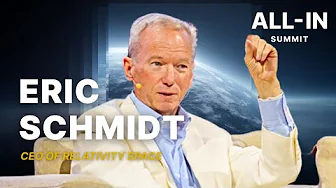
-
Schmidt now sees China pursuing a different AI strategy from the United States: less emphasis on frontier AGI, more on embedding AI into consumer products, robotics and industry. Chip restrictions and shallower capital markets limit giant training projects, while Chinese robotics firms are trying to repeat the country’s EV success.
-
China’s open-model strategy may matter geopolitically as much as raw model capability. Schmidt fears countries across the developing world will adopt Chinese open-weight systems while leading U.S. models remain closed, giving Chinese technology and assumptions a distribution advantage resembling a digital Belt and Road.
-
Schmidt does not believe true AGI is three years away; he expects highly superhuman specialist systems sooner, perhaps in six or seven years. The missing capability is autonomous goal-setting: current systems cannot reliably change their own objective function or demonstrate recursive self-improvement, despite startups claiming progress.
-
For the next several years, Schmidt expects AI to amplify humans rather than replace them outright. His formulation is that humans remain “end-to-end” while AI operates “middle-to-middle”: people define objectives, provide context, validate results and redirect systems while machines perform increasingly powerful intermediate work.
-
Cheap drones are breaking the economics of traditional warfare: Schmidt contrasted roughly $4,000–$5,000 drones with American tanks costing about $30 million. He expects drones to displace much artillery and force soldiers, vehicles and infrastructure away from exposed fixed positions, with drones increasingly fighting other drones ahead of humans.
-
Ukraine’s naval-drone campaign is Schmidt’s clearest example of small autonomous systems changing strategic outcomes. He said Ukrainian unmanned surface vessels effectively crippled Russia’s Black Sea fleet, helping reopen grain exports through Odesa—commerce he estimated at roughly 6–10% of Ukraine’s economy.
-
Schmidt thinks large autonomous drone forces could eventually create deterrence because neither side would know the other’s AI-generated battle plan. But he rejects the idea that such wars become clean or bloodless: enormous drone exchanges could destroy infrastructure on both sides before humans still have to cross territory and occupy it.
-
Schmidt’s takeover of Relativity Space is a direct bet that SpaceX will not remain unchallenged in launch. He said Relativity’s order book is already full and the central problem is execution—getting its rocket launched—after discovering that rocket engineering remains far less mature and far harder than he had assumed.
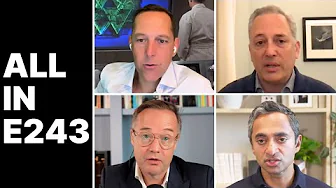
September 19, 2025
Charlie Kirk Murder, Assassination Culture in America, Jimmy Kimmel Suspended, Ellison Media Empire
-
Charlie Kirk’s killing is presented as a murder motivated by the belief that some political views should be silenced rather than debated. Sacks, who says he knew Kirk and appeared on his show about six times, cites Robinson’s text—“some hate can’t be negotiated out”—and notes Kirk had warned months earlier about assassination culture.
-
The hosts split sharply over whether Jimmy Kimmel’s suspension was mainly government pressure or a convenient business decision. FCC chair Brendan Carr had warned of consequences for ABC affiliates, while Nexstar and Sinclair refused to air Kimmel; weak ratings and ABC’s $45 million, three-season deal made cancellation economically attractive.
-
The most consequential business story is the Ellison family’s attempt to assemble a vertically integrated media empire spanning studios, news and social distribution. David Ellison is pursuing Warner Bros. Discovery and reportedly The Free Press for $200 million, while Oracle was described as the favorite for TikTok U.S.—potentially linking CBS, CNN, HBO and TikTok-scale distribution.
-
That strategy matters because premium-media economics are weakening while social platforms command much larger audiences. Friedberg says Netflix and Amazon are squeezing creators toward cost-plus-10% deals, while YouTube’s audience exceeds Netflix’s by more than tenfold, making sponsorship- or advertising-funded direct distribution increasingly attractive.
-
TikTok U.S. is only about 5–8% of TikTok’s global business, but the panel treats control of its recommendation system as strategically more important than its size. Chamath argues competing owners should run competing algorithms, while Jason proposes algorithm disclosure, user-selectable feeds and loss of Section 230 protection for opaque systems.
-
The show’s own summit became a case study in opaque distribution when several major interviews disappeared under YouTube Restricted Mode. The hosts confirmed Tulsi Gabbard, Tucker Carlson–Mark Cuban and Alex Karp videos were filtered for mature audiences, but could not determine whether keywords, automated classification or coordinated reporting caused it.
-
The summit itself operates on sponsorship economics rather than ticket sales alone. The hosts said they spend more than ticket revenue, with Solana, OKX and IREN funding major activations and helping underwrite scholarship tickets—an unusually explicit glimpse at the economics behind a high-end conference.
-
Kirk’s political reach is framed partly as a distribution achievement: he left college at 18, built Turning Point and converted campus debates into internet content watched by millions. The hosts argue that bypassing traditional gatekeepers—and treating opponents as people to persuade—was central to his ability to attract younger audiences.
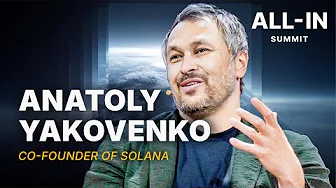
September 18, 2025
Solana’s Anatoly Yakovenko on Crypto's Next Era: Quantum, AI, and the Future of Money
-
Yakovenko says the U.S. regulatory shift has changed crypto’s survival prospects, not merely its growth rate. He described the first six months under David Sacks as “night and day” and said another four years of Gary Gensler’s approach might have been fatal to the industry.
-
He expects stablecoins to become a major new source of demand for U.S. government debt. Yakovenko cited estimates of $1–10 trillion moving onto public chains under the GENIUS Act and predicted that, within five years, internet-based holders could collectively become the largest owners of U.S. Treasuries.
-
Solana was built around a fundamentally different ambition from Ethereum: execute global finance at near-physical speed rather than mainly settle it. Yakovenko says his original design appeared roughly 1,000 times faster than Ethereum and envisions money moving among major cities in about 120 milliseconds.
-
Yakovenko does not expect Solana to replace regulated exchanges; he wants institutions such as Nasdaq to run directly on the network. Solana has spoken with banks, exchanges and regulators, while its decentralized protocol structure means Yakovenko cannot order validators to stop operating even if he wanted to.
-
The creator-economy use case he finds most promising is giving audiences an economic stake in creators and intellectual property, not merely selling speculative tokens. He cited projects such as Claynosaurz and argued clearer rules could eventually let digital assets carry copyright or revenue rights tied to successful characters and creators.
-
Regulatory uncertainty consumed an extraordinary share of Solana’s early capital. Yakovenko says a roughly $14 million seed raise required about $2 million in legal fees to launch a token compliantly in the United States; he sees the CLARITY Act as potentially removing precisely this founder-level friction.
-
Yakovenko thinks real-world assets matter less as a crypto novelty than as the missing diversification needed for on-chain finance to manage risk properly. Real estate, bonds, commodities and even insurance could provide uncorrelated collateral, whereas a system dominated by meme coins remains dangerously correlated during crashes.
-
His most concrete technological warning is quantum computing: he gives roughly 50% odds of a meaningful breakthrough within five years and wants Bitcoin prepared now. He says migration to quantum-resistant signatures should accelerate once companies such as Google and Apple broadly adopt quantum-resistant cryptographic infrastructure.
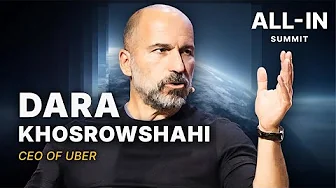
September 17, 2025
Uber CEO Dara Khosrowshahi on self-driving's future, changing business model, job displacement
-
Uber is positioning itself as the distribution layer for autonomous vehicles rather than betting on a single robotaxi winner. It has more than 20 autonomy partners, including Waymo and China’s Baidu, WeRide and Pony, and will only admit systems meeting its safety and economic thresholds.
-
Dara Khosrowshahi believes Uber’s existing demand network remains its main moat even when drivers become machines. An autonomous fleet plugged into Uber should get shorter pickups, higher utilization and more revenue per vehicle than a standalone fleet, while human and autonomous cars coexist for years.
-
Uber expects robotaxi ownership eventually to become a financial asset class rather than something Uber itself must own. Khosrowshahi envisions capital providers resembling Blackstone owning fleets, with Uber temporarily taking balance-sheet risk to prove vehicle economics before those assets are financed and moved off its books.
-
Uber says it can fund an aggressive autonomy buildout while still returning enormous amounts of capital to shareholders. The company generated more than $8.5 billion of cash flow in the prior 12 months, reported 18% top-line and 35% bottom-line growth, and nevertheless announced a $20 billion buyback.
-
Tesla remains the conspicuous holdout from Uber’s multi-platform strategy. Khosrowshahi said Tesla currently wants to go alone, while arguing that Tesla robotaxi owners would earn more by also accessing Uber’s demand network; he nevertheless expects multiple autonomous-driving winners.
-
Uber thinks automation can address roughly half of its delivery market before a harder physical problem appears. Sidewalk robots can handle short dense trips and drones can serve spread-out suburbs, but getting food out of restaurants and into apartments leaves the unresolved first-and-last-mile challenge.
-
Khosrowshahi expects autonomy to avoid major driver displacement for roughly five to seven years, but not indefinitely. Uber is already reducing driver recruitment where robotaxis launch so existing drivers retain earnings; he said displacement becomes a much harder societal problem over a 10-to-15-year horizon.
-
Uber increasingly sees itself as a capital-light demand network connecting consumers to other companies’ expensive physical assets. That logic now spans rides, food, groceries and future autonomous fleets, while Uber selectively deploys its own capital where doing so helps build the ecosystem rather than permanently owning the infrastructure.

-
Trump’s most consequential AI policy claim was that data-center builders can build their own power plants instead of waiting on the existing grid. He said excess electricity can be sold back to the grid, effectively allowing hyperscale projects to become quasi-utilities and removing power availability as a major constraint.
-
The tech hosts have unusually direct access to Trump and senior Washington power. Trump called them “a big part” of his administration and made tech the first industry invited to a new Rose Garden dinner; the hosts also described recent private dinners with Trump and Senator Mike Crapo.
-
Trump is personally remaking the White House as both a presidential workplace and a venue for political and business access. He said he selected the Oval Office art himself, added 24-karat gold and marble, and paved the Rose Garden so it can host dinners, lawmakers and press events.
-
Trump said a major White House ballroom was about two weeks from starting construction and roughly two years from completion. Planned beside the East Room with views toward the Treasury and Washington Monument, it is intended to replace the tents currently required for large state and industry events.
-
Trump described a revealing institutional fight in which White House curators had prevented a delicate artwork from being displayed despite two previous presidents wanting it hung. His team devised a curtain system to protect it from light, overcoming the conservation objection and finally putting the piece on display.
-
Trump’s economic strategy is explicitly coercive: use tariffs to push manufacturing into America, then reinforce that pressure with investment deals and tax incentives. He cited claimed commitments of $600 billion from Japan, $950 billion from Europe and $350 billion from South Korea, while repeatedly saying companies are building domestically to avoid tariffs.
-
The hosts relayed an unusually specific private claim from Senator Mike Crapo: that a bill initially scored around $3 trillion in the red had supposedly shifted to roughly a $300 billion surplus. Trump immediately attributed the improvement to tariff revenue, illustrating how the administration and its allies are framing tariffs as fiscal policy, not merely trade policy.
-
Trump said his market-bottom call after “Liberation Day” was driven more by instinct than formal analysis. After the hosts noted that his Truth Social encouragement to invest coincided with the market low, Trump said he simply felt prices were low and described instinct as sometimes more important than intellect.
September 16, 2025
The College Crisis: Heads of Dartmouth & Berkeley Debate the Decline of US Universities
-
Dartmouth’s president said colleges should bear some responsibility when students leave with heavy debt and weak job prospects. Dartmouth packages aid without loans, a third of students attend free, and lower- or middle-income students may pay about $5,000 a year.
-
Both leaders conceded that higher education needs internal reform, especially after universities blurred education with politics and advocacy. Dartmouth’s president said universities “lost sight” of their mission, while Berkeley’s chancellor acknowledged the campus had not been sufficiently tolerant of viewpoint diversity.
-
Dartmouth restored the SAT because its own data suggested standardized testing helped identify talented lower-income applicants. The president argued tests were less influenced by family spending than recommendation letters, summer activities, and other application advantages; other Ivy League schools subsequently followed.
-
Berkeley is preparing for a future with less federal research money by looking harder at industry partnerships and philanthropy. Its chancellor described research funding as a bundle that may need to shift as federal support declines, rather than assuming Washington will remain the dominant source.
-
Administrative growth is partly self-inflicted bureaucracy and partly the result of universities being expected to provide far more services than decades ago. Berkeley has a formal “bureaucratic burden” initiative, while both leaders pointed to compliance requirements, advising, and large-scale mental-health services that now require staffing.
-
The presidents do not expect AI to make elite residential universities obsolete because they see their strongest product as human development rather than knowledge delivery. They emphasized agency, empathy, face-to-face disagreement, resilience, and identity formation—skills they argue develop through sustained residential interaction, not merely access to information.
-
The discussion placed part of America’s education failure before college: K–12 schools are not meaningfully closing achievement gaps students bring into kindergarten. Dartmouth’s president also cited her prior research finding that some elementary teachers themselves lacked sufficient mathematics competency, weakening what gets transmitted to students.
-
Large endowments are not simply investment pools; at these universities they directly subsidize both financial aid and research infrastructure that grants do not fully cover. Dartmouth’s president said the institution loses money on each research dollar because buildings, compliance, and supporting systems require additional university funding.
September 15, 2025
Tulsi Gabbard on Russiagate Hoax Evidence and How She’s Reforming Politicized Intelligence Agencies
-
Gabbard said newly declassified records show Obama-era intelligence leaders reversed earlier assessments on Russian election interference after Trump won in 2016. She highlighted a December 8 presidential brief saying Russia had not affected the election outcome, its withdrawal hours before publication, and a December 9 Obama tasking for a new assessment on Russian meddling.
-
She portrayed the January 2017 Russia assessment as a leadership-driven product that relied on disputed material despite objections from intelligence professionals. Gabbard said senior CIA officials challenged some sources, including the Steele dossier, while previously hidden emails show NSA chief Mike Rogers resisted signing because his agency lacked time to vet the report.
-
Gabbard did not claim Russia stayed out of the 2016 election; she said intelligence showed Moscow sought to sow chaos, while disputing the stronger claim that Trump was controlled by Russia. Under questioning, she also agreed that an honest FBI should investigate suspicious contacts, while arguing the FBI leadership conducting those investigations had become politicized.
-
Her response to the intelligence abuses she alleges is personnel reduction, internal restructuring, declassification and criminal referral rather than one sweeping institutional reform. Gabbard said she has already cut staffing and reorganized ODNI around mission priorities, while sending the documents her office uncovered to the Justice Department for possible accountability.
-
Gabbard defended Trump’s strike on Iran as a narrowly defined operation with a clear objective and exit, rejecting reports that she opposed it. She said Iran’s nuclear capability and much of its military infrastructure were destroyed, but warned that economic collapse or regime instability could produce consequences the United States cannot reliably control.
-
The administration’s designation of major cartels as foreign terrorist organizations has pulled the U.S. counterterrorism apparatus directly into the anti-cartel and fentanyl fight. Gabbard said the National Counterterrorism Center now coordinates with federal and local law enforcement against groups using drones, counterintelligence and sophisticated weapons inside and near the U.S. border.
-
Gabbard explicitly rejected the claim that U.S. intelligence shows China is deliberately using fentanyl to destabilize America. She said Chinese precursor chemicals remain part of negotiations, but reported that cartels are having more difficulty obtaining those inputs and that fentanyl flows appear to be declining alongside tighter border enforcement.
September 15, 2025
Robinhood CEO Vlad Tenev on tokenizing stocks, expanding access to private shares, fintech's future
-
Robinhood’s next major bet is turning stocks—including private-company stakes—into blockchain tokens that retail investors can trade. In Europe it has already tokenized exposure to OpenAI and SpaceX, and Tenev says the company is now working on U.S. structures and intends to expand the model substantially.
-
Tenev sees private-market access as more important than 24/7 public-stock trading because ordinary investors are excluded from the companies driving AI and space. He argued that giving people meaningful ownership in AI companies could align them economically with technology that may otherwise disrupt their jobs and livelihoods.
-
Robinhood wants accredited-investor rules loosened so ordinary people can qualify for risky private investments largely by acknowledging the risk themselves. Tenev proposed self-certification—even simply confirming that an investor understands they could lose 100%—rather than limiting access primarily by wealth.
-
The regulatory change in Washington materially altered Robinhood’s posture from defense to expansion. Tenev said the previous administration repeatedly pursued enforcement and issued a Wells notice while declining in-person meetings, whereas the current administration has been far more willing to engage and collaborate.
-
Robinhood is deliberately evolving from a brokerage into a household’s primary financial institution. Tenev said retirement accounts and credit-card adoption increased customers’ brokerage deposits rather than cannibalizing them, encouraging Robinhood to pursue direct deposit, family accounts and children as part of a broader financial platform.
-
Robinhood is positioning itself to capture part of the enormous generational wealth transfer from older Americans to younger customers. Tenev cited more than $130 trillion expected to change hands and said Robinhood already holds more than a quarter-trillion dollars of customer assets, which he considers small relative to the opportunity ahead.
-
Tenev is separately building Harmonic, an AI company aimed at “mathematical superintelligence,” not simply another chatbot. He says its formal model achieved gold-medal-level International Mathematical Olympiad performance, while its deeper goal is mathematically verifiable reasoning that could reduce hallucinations and automate verification of massive volumes of AI-generated software.
-
Google DeepMind is now Alphabet’s centralized AI engine, not a standalone research lab. Hassabis says the merged division has about 5,000 people, over 80% engineers and PhD researchers, and its models run across nearly every Google surface, reaching billions of users.
-
Genie 3 points beyond video generation: it creates interactive worlds pixel-by-pixel as users move through them, without a conventional 3D rendering engine. Trained on video plus synthetic game data, it can maintain world consistency for a minute or two, making it a test bed for physical-world understanding.
-
DeepMind is pursuing an “Android for robotics” strategy alongside vertically integrated robot systems. Hassabis expects a major robotics “wow moment” within a couple of years and eventually millions of robots, but says scaling hardware too early risks locking factories into designs that may be obsolete six months later.
-
Hassabis rejects claims that today’s models are already “PhD intelligences” and puts true AGI roughly five to ten years away. He says current systems lack consistent general reasoning, continual learning and human-like creative leaps, and probably still need one or two fundamental breakthroughs rather than scaling alone.
-
Isomorphic Labs is trying to compress drug discovery from years—or a decade—to weeks or days within the next ten years. Hassabis says it has partnerships with Eli Lilly and Novartis, works with MD Anderson, and expects its own drug programs to enter preclinical development next year.
-
For scientific AI, DeepMind expects hybrid models to remain necessary for roughly the next five years. In biology and chemistry, sparse data means learned systems still need scientific constraints; AlphaFold and AlphaGo combined neural learning with engineered rules or search before later systems absorbed more of that structure end-to-end.
-
AI efficiency is improving dramatically without reducing total power demand. Hassabis says models have become roughly 10× to 100× more efficient at the same performance over two years, but frontier training keeps expanding, so cheaper inference and rising total compute demand are happening simultaneously.
-
DeepMind is already co-designing creative AI with professional filmmakers, including Darren Aronofsky, rather than treating creators only as end users. Hassabis says elite creatives can become 10× to 100× more productive with these tools, while skill, taste and storytelling still separate top professionals from casual users.
September 9, 2025
Elon Musk on DOGE, Optimus, Starlink Smartphones, Evolving with AI, Why the West is Imploding
-
Musk says Optimus now consumes more of his attention than any other single project, and Tesla is finalizing a third-generation design intended for human-level hand dexterity, autonomous perception and mass production. Tesla had to design every actuator from scratch, and Musk estimates roughly $20,000–$25,000 production cost at one million robots annually.
-
Tesla’s next AI5 chip is designed around weaknesses discovered while jointly developing its driving software and hardware, producing far larger gains than raw computing power alone. Musk said AI5 has about 8× compute, 9× memory and 5× memory bandwidth versus AI4, with some workloads improving as much as 40×.
-
Musk expects existing AI4-equipped Teslas—not future hardware—to become at least two to three times safer than human drivers through software improvements alone. He said FSD version 14 will increase model parameters roughly tenfold and called it Tesla’s biggest software upgrade since version 12, with release expected within months.
-
SpaceX’s $17 billion spectrum purchase is aimed at turning Starlink into a direct competitor to terrestrial mobile service, but compatible phones will require new radio hardware. Musk expects supported handsets in roughly two years, eventually allowing one Starlink account to provide home internet and high-bandwidth mobile connectivity globally.
-
Musk expects SpaceX to demonstrate fully reusable Starship operations next year, including recovery of both stages while carrying more than 100 tons to useful orbit. The remaining fundamental obstacle is the heat shield: unlike the Shuttle’s labor-intensive tiles, Starship’s must survive repeated orbital reentry without individual inspection or refurbishment.
-
xAI is using inference compute to rewrite its training corpus before training future Grok models, checking source material for errors, omissions and misleading context rather than simply ingesting it unchanged. Musk also agreed to discuss publishing those rewritten materials as a “Grokpedia,” potentially turning an internal data-cleaning process into a public knowledge product.
-
Musk’s current AI forecast is extraordinarily aggressive: machines smarter than any individual human at any task could arrive next year, and exceed humanity’s combined intelligence around 2030. His rough scaling assumption is that a tenfold increase in computing power might double intelligence, so he expects capability growth to continue despite diminishing returns.
-
Musk now frames Mars success not as landing people there but as creating a civilization able to survive permanently after Earth resupply stops. He estimates that could be achieved in roughly 25 years, provided cargo delivered to Mars grows exponentially across about 10–15 biennial transfer windows.
September 9, 2025
Palantir CEO Alex Karp: Why the West is Destroying Itself, Data Empire, Skeptics, How to Win
-
Karp said a Democratic administration once asked Palantir to build a Muslim database, and the company refused. He also said Palantir has never built systems to surveil or infer profiles on U.S. citizens and has rejected work with China, Russia, and other adversaries even when it cost revenue.
-
Palantir’s early civil-liberties safeguards became part of its competitive advantage in enterprise AI. Karp said immutable logs, permissions, branching, serialization and controlled data access—originally designed to constrain surveillance—now provide the same infrastructure needed to govern large language models inside companies.
-
Karp confirmed Palantir is used in Israel and described that use as “precise and deadly,” while refusing operational details. His argument is that better targeting software can reduce civilian harm, making Palantir’s military role inseparable from his broader defense of technologically enabled warfare.
-
Karp’s immigration position is stricter than his civil-liberties rhetoric initially suggests, but he explicitly rejects indiscriminate surveillance. He favors removing criminals and “criminal-adjacent” undocumented immigrants first, while acknowledging that identifying them without facial-recognition dragnet systems, predictive data, or weakened legal protections is genuinely difficult.
-
His foreign-policy position is hawkish without being neoconservative: use force when necessary, but do not occupy countries to remake their societies. He linked the failures of Afghanistan-style nation-building and mass immigration to the same assumption—that people can simply be transformed into Western liberals by policy.
-
Karp sees Western Europe’s deeper problem as declining confidence in its own culture and meritocracy, not merely immigration. He singled out Germany’s energy, immigration and technology failures and argued that France, despite extraordinary mathematical talent, has failed to convert that human capital into leadership in AI.
-
On China, Karp’s strategic prescription is to strengthen America internally rather than obsess over every hostile Chinese action. He accepts that Beijing may exploit fentanyl, TikTok and other vulnerabilities, but frames destabilization as an adversary’s job and domestic resilience as America’s responsibility.
-
Karp supports treating major drug cartels more like terrorist organizations than ordinary criminal enterprises. With tens of thousands of Americans dying from fentanyl, he argued that legal frameworks producing chronic incapacity will eventually provoke harsher politics because voters will not tolerate persistent state failure.