
All-In Podcast
...

September 12, 2023

All-In Summit: Ro Khanna on China, political reform, major challenges facing the US and more

  • Khanna said Washington had a China-access problem: Bob Iger, Tim Cook and Elon Musk were getting more meetings there than U.S. political or military leaders. China had invited him, but he wanted a bipartisan delegation; at the time, Congress had not sent one to the PRC in more than three years. (Congressman Ro Khanna)

  • On Taiwan, Khanna favored strategic ambiguity and the one-China policy rather than an explicit U.S. war guarantee. (Congressman Ro Khanna) He also wanted Taiwan armed with long-range weapons, Harpoons and HIMARS while keeping U.S.-China dialogue open—deterrence and communication at the same time.

  • Khanna’s reindustrialization plan relied on federal financing joined with private industry and labor, not simple protectionism. He highlighted a bipartisan bill with Marco Rubio to create a national development council; the proposal authorized $20 billion over 10 years for a national development strategy. (Congressman Ro Khanna)

  • He backed permitting reform selectively, not as blanket deregulation. Khanna wanted faster approvals for chip plants, clean energy and California housing while opposing Mountain Valley and Willow, and he argued deliberate offshoring—not permitting delays—was the main reason steel, aluminum, paper and textiles disappeared.

  • Khanna’s anti-corruption package targeted political careerism with congressional and Supreme Court term limits, a stock-trading ban, and restrictions on PAC, lobbyist and revolving-door money. His formal plan specified 12-year congressional terms, 18-year Supreme Court terms and a lifetime lobbying ban for former lawmakers. (Congressman Ro Khanna)

  • Khanna described incumbency as a financing barrier: he once polled 3% against an incumbent at 60%, yet Silicon Valley backers funded him and were willing to “double down” after a loss. He said that risk tolerance is unusual elsewhere and estimated only 30–40 House seats are genuinely competitive.

  • David Sacks hosted a fundraiser for Khanna despite major policy differences. (The Washington Post) Khanna cited common ground on Yemen, military spending, the First Amendment and manufacturing; Puck reported the event raised about $200,000, while Khanna said Democratic colleagues criticized him for appearing on Fox News or All-In. (Puck)

  • Khanna said Pentagon accountability was not a Washington priority, then cited his lone vote against the House Armed Services Committee’s FY24 defense bill. The committee passed it 58–1; Khanna objected to spending approaching $1 trillion and argued that contractor price gouging and campaign money were weakening oversight. (quincyinst.org)
...

September 8, 2023

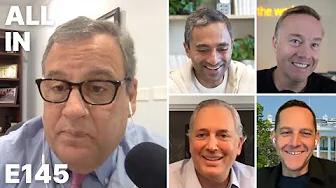
In conversation with Chris Christie

  • Christie proposed means-testing Social Security and gradually raising the retirement age only for people now in their 40s or younger. He said politicians privately admit the next administration must address entitlements, but tell him they cannot believe he is saying so publicly.

  • On Ukraine, Christie put most responsibility on Putin but said weak U.S. signaling contributed to the invasion. He called the 2008 NATO promise without a plan a poorly considered provocation, supports membership after the war, and opposed admission during fighting because it could trigger direct NATO-Russia war.

  • Christie said Pentagon waste is significant and argued for zero-based budgeting rather than assuming the $877 billion defense budget should simply continue. He would spend less if requirements could be met, otherwise reallocate money toward ammunition, submarines, ships and air power, while restricting officials from immediately working on issues they oversaw in government.

  • His immigration position paired a merit-based legal system with tougher border enforcement, not military intervention inside Mexico. He would deploy the National Guard with Customs and Border Patrol against fentanyl trafficking and, if local prosecutors refused to act, direct U.S. attorneys to take over violent- and drug-crime prosecutions in affected cities.

  • Christie presented New Jersey’s bipartisan bail reform as evidence that criminal-justice reform need not mean weaker public safety. He said the state added dangerousness to bail decisions, closed two prisons, saw 98% of released defendants return for court, and cut recidivism nearly 40% among inmates who completed prison-based addiction treatment.

  • On Trump’s cases, Christie said he would have brought the two federal prosecutions but not the New York or Georgia cases. He said prison would make little sense for Trump at his age; as president he would not pardon a valid conviction, though he would consider commuting a prison sentence.

  • Christie said his 2016 Trump endorsement was pragmatic: he expected Trump to win the nomination, preferred him to Hillary Clinton and hoped their 15-year relationship let him influence Trump. After 22 years knowing Trump, he said the presidency made him worse and that Trump did not truly believe the 2020 election was stolen.

  • Christie treated family access-for-profit as a bipartisan corruption problem. He said Hunter Biden’s foreign business appointments were about gaining influence with Joe Biden, but also called Jared Kushner’s post-White House $2 billion Saudi investment and Trump-family financial behavior “grift,” pledging his own family would not profit from his presidency.

...

September 1, 2023

E144: Biden targets Elon, BRICS challenges the West, Tiger hit piece & more

  • The show had the anonymous Tiger Global memo before it became a wider story and deliberately chose not to amplify it. The hosts cited its missing byline and provenance, obvious errors and potentially slanderous claims; Tiger later told LPs it believed a disgruntled former employee was behind it.

  • Chamath’s defense of Tiger Global came with unusually important personal context. He said Chase Coleman seeded his first angel fund and Chamath later helped Tiger onto Facebook’s cap table, a long reciprocal relationship that helps explain why he spoke from personal trust rather than as an outside observer.

  • The BRICS discussion separated economic scale from institutional cohesion: Sacks emphasized growing weight, while Chamath argued the bloc still had little record of coordinated action. Chamath pointed to India-China hostility and incompatible political systems; Friedberg’s middle ground was that the desire for greater economic independence matters even before policy machinery exists.

  • Sacks argued that BRICS’ practical objective was not a euro-style common currency but more trade settlement outside the dollar system. He also identified the unresolved mechanics: exporters need somewhere useful to park surpluses, citing Russia’s reluctance to keep accumulating rupees from oil sales to India.

  • Sacks framed India as pursuing two tracks at once: closer US security cooperation against China while preserving economic independence from Washington. He argued that India’s anti-colonial politics, ties with Russia and need for cheap energy explain why it resisted Western pressure over Russian trade rather than treating alignment as all-or-nothing.

  • Oliver Anthony explicitly rejected Fox News using “Rich Men North of Richmond” as a partisan Republican anthem. He said the song targeted both parties and specifically older conservative politicians associated with the wars of his childhood, telling the debate candidates that they were among the people he was criticizing.

  • The summit had gone over budget, and the podcast itself was generating sponsors capable of closing part of the gap. Jason said House of Macadamias, Pavise and Bruvi approached after hearing related products discussed on the show, turning conversational influence directly into event financing.

...

August 26, 2023

E143: Nvidia smashes earnings, Arm walks the plank, M&A market, Vivek dominates GOP debate & more

  • Nvidia’s Q2 revenue hit $13.5 billion, up 101% year over year, while net income reached $6 billion and the board authorized a $25 billion buyback. The panel argued GPU scarcity was creating unusually rich margins, but custom silicon and competing architectures should eventually pressure them.

  • Friedberg described current AI-compute spending as a bubble because companies are buying capacity before knowing where additional compute stops producing adequate returns. He expects spending to be rationalized as those limits emerge, while Sacks noted GPUs differ from dot-com fiber because chips require frequent replacement.

  • Chamath’s larger AI thesis is that big tech will drive foundational models toward near-free or open-source, moving economic value into applications built on top. He cited computational biology and a materials-science company he co-founded, which has an experimental next-generation battery candidate showing encouraging but unproven signs.

  • The panel expects enterprise AI to revolve around private internal chatbots that understand company data, permissions and access controls. They argued many businesses will prefer self-hosted or open-source models because sensitive HR, email, Slack and internal documents are information they may not want entrusted to an outside model provider.

  • Chamath argued SoftBank’s ARM IPO was driven partly by SoftBank’s need to reduce debt and replenish liquidity, not simply ARM’s growth prospects. ARM had roughly $2.7 billion in fiscal-2023 revenue with little growth, while SoftBank had already been selling down Alibaba as another source of balance-sheet relief.

  • The clearest startup advice was that companies unable to sustain VC-grade growth should stop assuming another funding round exists and become cash-flow positive. Sacks cited 2× growth, 50% gross margin, 100% net-dollar retention, 12–18-month CAC payback and a 1.5-or-better burn multiple as “good” fundability benchmarks.

  • Chamath said adding a private-equity firm to one portfolio company’s board accelerated its path toward self-sustainability by roughly 12–18 months. The company had more than $300 million in revenue, and he credited PE discipline with producing clearer operating mandates and faster responses to execution misses.

  • Chamath and Sacks interpreted Vivek Ramaswamy’s debate strategy as building credibility with Trump’s base without directly attacking Trump, positioning himself as an alternative within the same constituency. Their broader reading was that the Republican contest reflected competing MAGA, religious-right and interventionist foreign-policy factions, not merely differences in candidate personality.

...

August 18, 2023

E142: "Rich Men North of Richmond" hits #1, upward mobility, real estate capital crunch, Trump RICO

  • The widely reported “$1.6 billion Michael Burry short” cannot be inferred from his 13F filing. Friedberg explained that the filing shows contract counts but not premiums, strikes, expiries or undisclosed short legs, so the puts could represent a far smaller hedge rather than a giant directional wager.

  • The sharpest real-estate risk discussed was multifamily refinancing, not empty buildings. Properties can be full yet still fail when loans reset from roughly 3–4% to 8–9%, lower valuations reduce allowable debt, and mezzanine capital can cost about 15%, forcing owners to inject equity or surrender assets.

  • David Sacks gave a concrete example of how severe the credit squeeze had become. On a roughly $15 million office building with a $9 million loan maturing, his lender would refinance only $2.4 million against the property and wanted public securities plus a personal guarantee for the rest, so he planned to repay it.

  • Even future Fed cuts may not rescue leveraged property owners. Sacks noted that real-estate borrowing tracks longer-term rates; the Fed could cut its short rate while the 10-year Treasury stays elevated, leaving a refinancing wall without the cheaper debt many developers are counting on.

  • The hosts treated Adyen’s share-price collapse as evidence that payments companies are being repriced as low-power middlemen. After Adyen fell about 40%, Chamath argued Stripe’s $50–55 billion valuation might be closer to $25 billion because large customers can rebid processing contracts and force providers into margin competition.

  • The wealth debate became most useful when the hosts shifted from inequality to mobility. Chamath said his family often lived on $15,000–$21,000 a year and welfare, Friedberg described arriving with little money, and Sacks said his father earned about $27,000 in 1977; they argued static income charts miss who changes brackets.

  • Chamath made the episode’s most self-critical point about class. He credited his rise to “fate and luck and hard work and opportunity,” then said wealthy hosts should stop pretending they understand blue-collar frustration and instead ask what conditions keep people from moving upward.

...

August 11, 2023

E141: State of Series A's, VC dry powder, IPO window opens + more with Bill Gurley & Brad Gerstner

  • Bill Gurley is not retiring: he remains on nine Benchmark boards, has begun occasional angel investing, and is writing a book about finding and succeeding in a dream career. He said the book grew from his University of Texas talk and that he no longer wants new board seats, making angel investing deliberately low-intensity.

  • Venture funding had stabilized near 2019 levels, yet Sacks expected one to two more years of distress for companies funded at 2020–21 peak prices. Gerstner simultaneously saw $400–600 million AI and data deals for firms with little or no revenue, showing the reset was sharply uneven.

  • “Dry powder” was far less deployable than headlines implied: VC commitments remain in LP accounts until called, often across five or six drawdowns over a decade. Gurley added that private marks stay sticky because GPs dislike markdowns and some LP staff are compensated on paper performance, though he described this as emergent rather than coordinated.

  • LP retrenchment threatened a delayed capital squeeze, with participants hearing of venture commitments being cut by 50%, two-thirds, or even entirely. Sacks tied this partly to the “denominator effect”: falling public portfolios plus lagging private marks left institutions overallocated to venture, forcing new commitments down.

  • The software recession was severe enough that one startup reportedly renewed a Twitter contract at only 20% of its previous value after Twitter cut roughly 80% of staff. Sacks said his investment standards were unchanged; far fewer companies met them because enterprise customers were cutting seats, consolidating vendors and delaying purchases.

  • Many 2021-era unicorns had become structurally hard to refinance because stacked liquidation preferences and conflicting investor marks made fresh private rounds unattractive. Gurley said an IPO can clear that logjam by converting preferred shares to common; Instacart, then discussed around $10 billion after a $50–60 billion private mark, was the example.

  • Gurley argued venture’s long-run outperformance is concentrated in brief boom windows, so failing to sell at peaks can erase exceptional paper gains. He estimated only 10–15 companies in venture history justify “hold forever”; Sacks said Craft’s default is to distribute SpaceX shares to LPs after an IPO.

  • Gerstner’s preferred measure of monetary tightness—the San Francisco Fed’s effective-funds proxy—was above 7%, its highest level since May 2000, even as core CPI slowed to 0.2% monthly. He read that combination, alongside record consumer debt and heavy Treasury refinancing, as evidence that lagged tightening could still force a meaningful slowdown.

...

August 4, 2023

E140: LK-99, Sclerotic establishments, Fitch downgrades US debt, Trump indicted... again

  • At the time of the episode, LK-99 was nowhere near proven: no lab had replicated room-temperature superconductivity, and one Chinese group reportedly made 8,000 samples before finding one zero-resistance sample around 170 K. Simulations suggested copper might need to occupy one exact lead site, making manufacturing precision the central bottleneck.

  • Even if LK-99 failed, the modeling opened a potentially useful materials-search path: teams found crystal structures theoretically compatible with superconductivity, and one modeled gold as potentially better than copper. Friedberg’s durable bet was therefore on a broader design space for superconductors, not necessarily LK-99 itself.

  • Friedberg’s sharpest criticism of academia was incentive design: grants reward novel positive results, while replication, falsification and failed experiments are harder to fund. The panel linked that bias to incremental research and cited Future Ventures’ 15-year fund as one attempt to stretch beyond the standard 10-year VC horizon.

  • Calacanis said one of his best venture tactics is backing founders whose previous companies failed—if they can explain exactly why and how the next attempt will differ. He cited Travis Kalanick’s path from Scour to Red Swoosh to Uber, treating learned failure as more informative than a spotless record.

  • Treasury then expected roughly $1.86 trillion of net market borrowing across July–December 2023, just as Fitch cut the U.S. long-term rating from AAA to AA+. Friedberg feared a debt spiral; Sacks warned higher yields could crowd out risk capital; Chamath argued the dollar still lacked a credible reserve alternative. (U.S. Department of the Treasury)

  • The fiscal problem was politically boxed in: a Data for Progress poll found 82% of likely voters opposed reducing future Social Security benefits for Americans under 50. Friedberg’s point was that even if entitlement cuts improve long-term finances, voter resistance makes a bipartisan deal exceptionally hard. (Data For Progress)

  • Sacks called Trump’s post-2020 conduct “indefensible” but argued the January 6 case turned on difficult intent questions, while viewing the classified-documents case as legally stronger. The August 2023 indictment charged four counts; the panel’s dispute was whether condemnation of Trump’s conduct translated cleanly into criminal liability. (justice.gov)

...

July 27, 2023

E139: Recapping Chamath's wedding, VC surplus, unions vs Hollywood, room-temp superconductors & more

  • The hosts’ strongest career advice was to build companies before trying to advise them as a venture capitalist. Calacanis said most young people would learn more by founding or operating a company, while Sacks said his firm requires investment-team hires to have operating experience and ideally founder experience.

  • Chamath said his own venture returns illustrate how brutally liquidity can change performance. He said his gross IRR had been about 31–32% before falling as distributions dried up, forcing earlier sales; the group also noted top public-tech stocks had compounded above 25% during the prior era.

  • The discussion separated venture capital into two viable models: elite selection and deep operating support. Friedberg contrasted Founders Fund’s pick-the-best-and-get-out-of-the-way approach with firms such as First Round and Andreessen Horowitz, which built large support systems around recruiting, operations, and founder assistance.

  • The most concrete Hollywood point was that ownership, not salary, creates the extraordinary payouts. Calacanis said Jon Favreau told him he received no Disney equity for The Mandalorian and Disney+, while Todd Phillips reportedly waived his Joker fee for equity after the studio doubted the film, which ultimately grossed about $1 billion.

  • The hosts argued Hollywood’s real competitive threat is the migration of attention to creators, with AI potentially making production far cheaper and more abundant. Friedberg envisioned vastly more films at dramatically lower cost, while the group pointed to TikTok, YouTube, podcasts, and MrBeast as already taking hours from traditional television.

  • Chamath argued labor should bargain for long-term equity upside, not only higher current compensation. He said that belief was one reason he sold his Warriors stake, and used NBA stars such as Michael Jordan and LeBron James to argue that workers can create enormous franchise value without directly owning much of it.

  • The room-temperature-superconductor claim was presented as potentially historic but nowhere near established. Friedberg said a South Korean team reported superconducting behavior at ambient pressure in copper-modified lead apatite, while condensed-matter physicists who contacted him were skeptical and replication was still required.

  • Chamath disclosed that a materials startup he backed was using machine learning to search for better low-cost LFP battery chemistries. He said the team had recently raised money, was finding unexpected dopants computationally, and expected to announce a significant battery breakthrough within weeks.

...

July 21, 2023

In conversation with Vivek Ramaswamy

  • Chamath Palihapitiya and Natalie married in Portofino, with Jason Calacanis secretly serving as officiant and the gathering doubling as a high-stakes poker week. Chamath said he won a $1.2 million pot, an unusually candid glimpse of the wealth surrounding the event.

  • David Sacks said Craft Ventures requires investment-team members to have operating experience, ideally as founders, because downturns expose the weakness of passive “cheerleader” VCs. He expects many bull-market entrants without a real value proposition to lose LP money and fail to raise again.

  • Chamath said his venture business entered the downturn with roughly 31–32% gross IRR, then saw IRR “fall off a cliff” as distributions dried up. The lack of cash returns pushed him toward selling holdings earlier than he otherwise would, illustrating the liquidity pressure hidden by paper valuations.

  • Calacanis said Jon Favreau told him he received zero Disney equity for The Mandalorian and Disney+, while Todd Phillips reportedly waived his Joker fee for equity. Their contrast made the ownership gap between corporate executives and valuable creative talent unusually concrete.

  • Chamath said a major reason he sold his Golden State Warriors stake was the valuation reaching about $5.2 billion; he also worried that players were not sharing sufficiently in equity creation. He argued unions should seek ownership-like upside while allowing more flexibility when businesses weaken.

  • Friedberg treated the South Korean LK-99 room-temperature-superconductor paper as potentially enormous but explicitly unverified, noting condensed-matter physicists had already emailed him skepticism. He said successful replication at ambient pressure would rank among the century’s most important physics discoveries.

  • Chamath disclosed that he and three others had spent roughly two-and-a-half years using machine learning to search materials space for better low-cost LFP battery chemistry. He said the project had just raised substantial funding and had a breakthrough they expected to announce within weeks.

...

July 14, 2023

E137: Inflation cools, market rips, Ripple/MSFT beat regulators, NATO summit, cocktails of youth

  • Chamath Palihapitiya’s central market call was that stocks could rise materially even if interest rates stayed higher for longer. He argued trillions parked defensively would rotate into growth before Fed cuts, while David Sacks countered that persistently higher rates would restrain valuations.

  • The sharper software argument was that cost cutting had bought time, not fixed weak SaaS economics. Chamath said rapid feature copying keeps many firms on an expensive treadmill without durable profits; Sacks countered that category leaders retain exceptional gross margins and defensible distribution advantages.

  • High borrowing costs were already showing up clearly in cars, where financing dominates demand. The hosts cited 80% of new-car purchases being financed, average loan rates rising from roughly 3.7% to 7%, and used-car prices falling 4.2% in one month.

  • Ripple’s court ruling was mixed, not a blanket declaration that XRP lay outside securities law. The judge treated $728.9 million of direct sales to sophisticated buyers as unregistered securities but exchange sales differently; Jason Calacanis said Brad Garlinghouse texted him that Ripple felt vindicated.

  • The FTC’s Microsoft–Activision loss pushed the discussion toward narrower antitrust enforcement rather than broad resistance to tech acquisitions. Sacks argued suppressing M&A can damage startup exits, while the hosts favored targeting conduct such as bundling, interoperability restrictions and deceptive subscription practices.

  • The Ukraine discussion’s most concrete point was the strain on US production of 155mm artillery shells. Sacks cited output rising from roughly 14,000 monthly to 20,000–30,000, with a much higher target years away, and connected the shortage to Washington’s decision to supply cluster munitions.

  • Ukraine’s NATO membership remained the central fault line at the Vilnius summit, with no immediate invitation or timetable agreed. The episode emphasized Article 5 escalation risks behind Biden’s resistance, while NATO instead removed the Membership Action Plan requirement and created a NATO–Ukraine Council. (NATO)

  • The science segment highlighted six small-molecule cocktails that rejuvenated aged cells in laboratory experiments, offering a possible alternative to gene-based reprogramming. Friedberg said they reproduced aspects of short Yamanaka-factor treatment without viral delivery, but the evidence discussed was cellular research—not proof that an anti-aging pill works in humans.

...

July 9, 2023

E136: Hacking the pod, Threads launches, Fed minutes, immigration, balloon farce, heart health

  • Jason Calacanis skipped episode 136 and his producer/editor also refused, so Friedberg, Sacks, Chamath and last-minute substitute Brad Gerstner produced it themselves. They described a year of internal fights over who controls whether the show continues, with one earlier substitution dispute consuming a day and producing an LLC.

  • Meta’s Threads launch was framed as evidence Meta can ship faster: Gerstner said rumors had roughly 20 people building it in six to nine months, reaching 30 million early signups. Chamath and Sacks countered that Instagram makes signups cheap; sustained posting and habit, not downloads, would determine whether Twitter faced a real threat.

  • Gerstner argued consumer chatbots’ next leap is action, not better answers: find a hotel, then book it through software agents. He also cited 600 Snowflake startup-contest applicants using ChatGPT on Snowflake data, suggesting enterprise demand was stronger than a temporary dip in consumer traffic implied.

  • Gerstner’s soft-landing case rested on job openings falling from nearly 12 million to 9.8 million while much of the hot ADP hiring came from hospitality and leisure. Altimeter had already reduced net exposure as markets rose, while futures implied Fed funds peaking near 5.45% in November before easing.

  • Chamath said the bigger risk was an 18-to-24-month corporate debt wall: overlevered real-estate and private-equity companies could breach covenants and require recapitalization, causing trillions in capital impairment without sinking the whole economy. Friedberg separately bet the government would create TARP-like commercial-real-estate support before the first Fed rate cut.

  • Gerstner said he sent Canada’s move to lure tech workers, including expiring U.S. H-1B holders, to a Democratic House member and Republican senator. Both privately gave him essentially the same answer: comparable U.S. reform was dead until a broader immigration deal, and electoral incentives were why Washington was not moving.

  • The episode highlighted a Pentagon statement that the Chinese balloon had intelligence-collection capability but did not collect while crossing the U.S. or transmit data back to China. That sharply contrasted with the earlier national-security frenzy; the hosts also noted upgraded radar sensitivity had begun surfacing smaller objects previously ignored.

  • After reassuring fitness and LDL markers, Gerstner said a $150 coronary calcium scan still showed nonzero plaque; a follow-up contrast CT found little stenosis. He then started 10 mg of rosuvastatin daily and reported no adverse effects, showing how the scan changed his treatment despite otherwise reassuring routine markers.

...

July 1, 2023

E135: Wagner rebels, SCOTUS ends AA, AI M&A, startups gone bad, spacetime warps & more

  • Sacks argued that Prigozhin’s mutiny was driven partly by Wagner’s planned absorption into Russia’s Defense Ministry, which threatened his income and status. He said roughly 8,000 fighters entered Rostov, 3,000 headed toward Moscow, and the lack of elite backing left Prigozhin to accept a Lukashenko-brokered deal. (Reuters)

  • The affirmative-action debate exposed a separate Harvard preference system: more than 43% of white admits were athletes, legacies, donor-linked applicants, or children of faculty and staff. NBER estimated roughly three-quarters of those white ALDC admits would have been rejected as ordinary applicants, making legacy and athletic preferences a major parallel advantage. (National Bureau of Economic Research)

  • Calacanis said AOL once refused to promote him from SVP to EVP explicitly because he was white, while offering equivalent bonus compensation. He presented it as a first-person example of informal demographic balancing affecting a corporate promotion decision, rather than as a general claim about all DEI programs.

  • Sacks disclosed that his firm was preparing to invest in MosaicML at a $400 million post-money valuation before Databricks’ acquisition interrupted the round. He said another investor then offered a $700 million valuation, while MosaicML’s founder privately told him the acquisition was underway; the announced headline price was about $1.3 billion.

  • Calacanis said four of seven companies in his latest accelerator batch would not have been economically viable before recent language-model APIs. He also said startups he meets typically test six to eight models and do not consistently choose OpenAI, implying the early market was already multi-model rather than winner-take-all.

  • Inflection AI’s $1.3 billion funding round looked less like ordinary startup financing than a massive compute buildout. Chamath estimated that 22,000 H100 GPUs alone represented about $900 million of capex, arguing that much of the capital was effectively flowing through to Nvidia and cloud providers rather than funding a conventional software organization.

  • IRL’s collapse gave the panel a concrete example of boom-era venture diligence failure: a board investigation found 95% of its claimed 20 million users fake after a $170 million round at a $1 billion-plus valuation. Sacks argued giant funds magnify errors because they must deploy $200 million where smaller funds might risk $10 million.

  • NANOGrav’s 15-year pulsar-timing dataset was the episode’s strongest science item, providing evidence for a very-low-frequency gravitational-wave background. Friedberg said the method could eventually map supermassive black-hole systems and add a new “fingerprint” of the universe alongside cosmic microwave background measurements. (nanograv.org)
...

June 24, 2023

E134: Ukraine counteroffensive, China tensions, COVID Patient Zero, RFK Jr reaction & more

  • Crossover investors told roughly 1,400 unicorns that the old financing model is over: get profitable, cut costs, or sell. Gerstner said software customers were consolidating vendors and shrinking seats, making “2x the new 3x” for growth companies.

  • Private tech had repriced by roughly 60%, yet Gerstner still saw few bargains. Startup secondaries were offered about 61% below last rounds; he would own fewer than 5% of 1,400 unicorns, expected 30–40% to disappear, another roughly 40% to fall 50–80%, and fewer than 10% to approach old marks.

  • Sacks argued that a 2022 Istanbul framework could have traded Ukrainian neutrality for Russian withdrawal toward prewar lines, but the hosts did not establish that a final peace deal existed. Calacanis repeatedly called the evidence thin, while Sacks cited Naftali Bennett, Ukrainian Pravda and Putin’s displayed draft. (Reuters)
  • Sacks framed artillery production as a major Western constraint in Ukraine, not just battlefield tactics. He cited roughly 20,000 Russian shells a day versus 3,000–6,000 Ukrainian, while U.S. monthly production was about 20,000 and a 90,000 target was years away.

  • Blinken’s Beijing trip was described as a fragile stabilization effort that Biden complicated almost immediately by publicly calling Xi Jinping a dictator. Blinken met Xi, emphasized open communication and said military-to-military talks remained unfinished, while the hosts viewed Biden’s remark as undercutting that diplomacy. (U.S. Department of State)

  • Gerstner relayed a striking private signal from Taiwan: one influential family planned to move most relatives out once additional Arizona chip capacity came online around 2025–26. He linked that hedge to expectations that reduced U.S. dependence on Taiwanese semiconductors could weaken the island’s perceived de facto protection.

  • Palihapitiya and Sacks had hosted an RFK Jr. fundraiser, but the podcast itself was not uniformly backing him. Sacks explicitly preferred Kennedy to Biden on issues including war and free speech, while Calacanis and Friedberg withheld endorsements and Gerstner said he would have joined mainly to gather information.

  • The $9.2 billion conditional DOE loan to Ford-SK exposed a real split over U.S. industrial policy. Palihapitiya and Gerstner treated domestic battery capacity as a national-security investment; Sacks warned about politically connected recipients, while Gerstner acknowledged likely waste and said he knew battery companies receiving federal checks. (Reuters)

...

June 16, 2023

E133: Market melt-up, IPO update, AI startups overheat, Reddit revolts & more with Brad Gerstner

  • AI is threatening the web’s “10 blue links” model, shifting the valuable top-of-funnel toward conversational agents and knowledge extraction. After discussions with DeepMind co-founder Mustafa Suleyman and Expedia/Zillow founder Rich Barton, Brad Gerstner said Google is well positioned technically but must reinvent AI search without destroying the economics of its core business.

  • Reddit’s API revolt exposed how much of its enterprise value depends on moderators and users it does not employ. With roughly 95% of Reddit reportedly going dark and Apollo facing about $20 million annually in API fees, Chamath argued Reddit should have established meaningful revenue-sharing with moderators before aggressively monetizing their ecosystem.

  • The panel’s sharpest AI-investment warning was that venture firms may be using expensive equity to finance rapidly depreciating computing hardware. Mistral reportedly raised $105 million before building a product, while Friedberg argued that model-training costs could collapse so quickly that today’s $100 million compute expenditure may soon buy little durable advantage.

  • Gerstner said his firm had already rejected more than 60 AI companies because being right about the platform shift does not mean early investments will win. He compared the frenzy with 1990s search, when most contenders disappeared, and favored pacing capital toward applications, specialized models and tools that can build customers and defensible advantages now.

  • CalPERS is reversing years of minimal venture exposure, with plans discussed to expand from roughly $800 million to $5 billion. Chamath attacked the pension fund’s previous allocation process, while Gerstner—after interacting with its new team—said it is now pursuing concentrated strategic partnerships and thematic bets around major technology cycles such as AI.

  • Public-market investing materially changed how Gerstner evaluates venture risk. He said his firm stopped making venture investments in October 2021 because public markets looked unhealthy, and described another major VC firm finding public-market experience useful for pricing private investments and deciding when to distribute public shares to limited partners.

  • Gerstner remained bullish on Nvidia’s business while treating its extraordinary stock move as a reason to hedge rather than abandon the position. He cited Nvidia raising its quarterly revenue guide from $7 billion to $11 billion as shares climbed from about $125 to above $400, and said selling six-month calls could lock in roughly 20% yield.

  • The proposed Arm IPO was framed primarily as a liquidity event for SoftBank, not an obvious bargain for new investors. SoftBank had paid $32 billion in 2016, while Chamath valued Arm around the mid-$20 billions despite reports of a possible $70 billion valuation; Gerstner said post-2021 IPO buyers would demand substantially larger discounts.

...

June 10, 2023

E132: SEC goes after crypto giants, Sequoia splits, LIV/PGA, Messi's deal + LIVE Q&A!

  • The SEC’s twin cases against Binance and Coinbase marked a shift from post-FTX cleanup toward a fight over whether crypto platforms could keep operating as they had in the United States. Chamath Palihapitiya expected fines, litigation and offshore relocation, while the panel sharply disagreed over whether enforcement or suppression was the real goal.

  • Sequoia’s breakup with its China and India/Southeast Asia arms was read less as portfolio housekeeping than as a structural retreat from an increasingly unwieldy global model. The panel tied China’s separation to geopolitical scrutiny around AI and chips, while Chamath considered the India split harder to justify because of India’s growth potential.

  • The PGA-LIV merger showed the leverage Saudi capital created by spending roughly $2 billion to recruit golfers, including a reported $200 million guarantee accepted by Phil Mickelson. The PGA had condemned LIV and sidelined defectors, yet its commissioner was then slated to run the combined entity, exposing how completely the economics changed the outcome.

  • Messi’s Inter Miami package was built like an ownership deal: Apple and Adidas reportedly gave him revenue participation tied to subscriptions and merchandise, not just salary. The hosts argued stars should similarly receive phantom equity in teams, citing Golden State’s rise from about $480 million to $5.3 billion during Stephen Curry’s era.

  • Making bank executives personally liable for depositor losses could reduce risk-taking, but Friedberg argued it would also change banking’s economics rather than simply make banks safer. If banks cannot earn spreads by investing deposits, they would shift toward charging customers custody and service fees—an outcome he said was already beginning after bank failures.

  • For AI investing, the clearest warning was that the middle of the stack may have almost no durable moat: a company valued at $500 million could be replicated weeks later by open-source software costing roughly $100,000. Chamath’s preferred barbell was silicon at the bottom and proprietary data providers at the top.

  • Friedberg argued that the deeper AI opportunity is not language generation itself but connecting probabilistic models to structured data and deterministic computation. That combination—LLMs for inference, software and mathematical systems for exact calculation—could make AI substantially more reliable and commercially useful across biology, chemistry, materials and other specialized domains.

...

June 2, 2023

E131: 2024 Fantasy President picks, debt ceiling agreement, Dollar dominance & more

  • David Sacks said his political influence was being overstated: he was funding both Ron DeSantis and RFK Jr., while he and Chamath planned an RFK event, but he denied being DeSantis’s hidden “architect.” He said one press story rested on a call that never happened with someone he did not know, describing himself instead as a “mid-level donor.”

  • Chamath had hosted Joe Manchin for dinner at his home the previous week, giving the group direct personal access to a senator they were discussing as a possible presidential entrant. Chamath praised Manchin but refused to speculate on whether he would run if Biden left the race, which was more informative than the hosts’ guesswork.

  • Friedberg’s debt warning was that the ceiling deal changed the slope only marginally: roughly $2.1 trillion in six-year cuts against about $42 trillion of spending. He argued rising interest costs were already competing with defense and would increasingly squeeze Social Security and Medicare unless both parties addressed the structural budget gap.

  • The de-dollarization debate produced a more nuanced picture than either side’s rhetoric: foreign holdings of marketable Treasuries had fallen sharply as a share, but the yuan still represented only about 2.2% of Swift payments. China-Brazil agreements pointed toward diversification, while dollar-serviced Belt and Road loans showed how far the dollar remained from displacement.

  • Nvidia’s Grace Hopper strategy was treated as a potential lock-in play, not merely a faster chip: integrated CPU, GPU, memory and CUDA could make switching hardware painfully expensive. Chamath said the next two quarters were crucial; without credible alternatives from AMD and hyperscalers, Nvidia could effectively run away with the AI hardware layer.

  • AI model economics were simultaneously collapsing: participants said work costing $2–3 million a year earlier could now cost about $200,000 through software improvements. Narrower domain models and cheaper inference could reduce compute per model, although Friedberg expected falling costs to unlock much more total demand.

  • Chamath described a ruthless attention-management rule: he estimates he has only four or five useful thinking hours a day and refuses to spend them on remote disaster scenarios. He focuses on probable outcomes and long-tail risks only when they can make money, explaining how he filters macro fear from investable opportunity.

...

May 26, 2023

E130: DeSantis's Twitter Spaces, debt ceiling, Nvidia rips, state of VC, startup failure & more

  • DeSantis’s campaign chose Twitter Spaces for his 2024 presidential launch, with Elon Musk and David Sacks co-hosting; Sacks said the first room crashed above 700,000 listeners, with more than a million trying to enter. The restart drew about 300,000 live listeners in Sacks’s room while parallel Spaces carried commentary. (CNN Transcripts)

  • A major data-center REIT’s CEO and CFO told Friedberg that recent demand exceeded the previous decade, driven almost entirely by GPU racks for AI infrastructure. Nvidia simultaneously guided roughly $11 billion of next-quarter revenue versus about $7 billion expected, and one major customer said it had to “beg” for thousands of GPUs.

  • Sacks described venture markets as “the best of times” for AI startups and the worst for nearly everyone else. Craft was approaching AI cautiously, while later-stage software companies were broadly missing forecasts and seeing sales cycles lengthen; larger funding rounds would again require revenue and conventional operating metrics.

  • One host described a $32 million-ARR startup whose founders may receive nothing after a $25 million cram-down round carrying a 3× liquidation preference. He estimated that cutting expenses to about $1 million monthly could instead have produced roughly $20 million EBITDA and supported a private-equity sale around $150 million.

  • Friedberg said he invested more than $30 million in Cana, the molecular-beverage printer, but returned customers’ money after two financing term sheets disappeared as markets deteriorated. Cana had a working, manufacturing-ready prototype, yet could not fund the production line once pre-revenue hardware became much harder to finance.

  • Sacks said Callin sold to Rumble after reaching hundreds of thousands of users but failing to achieve the millions—ideally tens of millions—needed for a durable consumer network. He called the acquisition roughly a break-even “base hit” for investors; Rumble’s distribution and aligned creator tools made the deal worthwhile.

  • Friedberg said the downturn’s psychological toll had become severe across Silicon Valley, including an acquaintance who ended up in the hospital under pressure. He and Chamath described repeated failures, declining portfolios and imposter syndrome as common even among experienced investors, not isolated founder problems.

...

May 19, 2023

E129: Sam Altman plays chess with regulators, AI's "nuclear" potential, big pharma bundling & more

  • Sam Altman’s call for AI licensing created a sharp split between safety and incumbent advantage. Sacks argued licensing could become a moat for leaders like OpenAI, while Friedberg said proliferating open-source models would make model-by-model auditing practically unenforceable.

  • The strongest evidence for rapid AI commoditization was MosaicML’s MPT-7B, reportedly trained from public data for about $200,000. Friedberg used it to argue capable models were becoming dramatically cheaper, weakening the premise that only a few easily regulated actors could build them.

  • Chamath’s alternative to broad AI licensing was identity checks at the scarce bottleneck: very large compute clusters. He proposed requiring names, tax IDs, or similar KYC information above a GPU threshold, arguing frontier-scale training remained expensive enough to police before models became portable.

  • Linda Yaccarino was framed as a deliberately complementary CEO for Twitter rather than a replacement for Musk. Sacks expected her to handle advertising and business operations while Musk kept product and technology, comparing the arrangement to Gwynne Shotwell’s division of responsibilities with him at SpaceX.

  • The Amgen–Horizon debate exposed a real trade-off between drug-market competition and biotech financing. Friedberg found the FTC’s bundling theory credible, while Chamath and Sacks argued that broadly blocking large acquisitions could reduce the exit prospects that help finance risky early-stage biotech.

  • Apple’s rumored $3,000 headset looked less like a finished mass-market product than a platform-seeding prototype. Sacks welcomed an early release as a way to iterate, while Chamath refused to judge a product none of them had actually used.

  • Housing pessimism had reached an extreme: only 21% of Americans in the cited Gallup survey said it was a good time to buy. The hosts focused on mortgage lock-in—owners with roughly 3% loans trading into rates near 7%—as a force freezing transactions and geographic mobility.

  • San Francisco’s office market was described as roughly 35% vacant, leaving more than 30 million of its 90 million square feet empty. A broker told Sacks AI companies represented only about one million square feet of demand, leaving distressed towers and eventual bank write-downs as the larger risk.

...

May 12, 2023

E128: Google enters AI wars, Druck’s warning, Trump crushes CNN & more

  • Google’s Bard impressed the hosts less for model quality than for live-data integration and distribution potential. It combined search, flight data and YouTube transcripts quickly, but also invented Sacks quotes, credited him with WeWork, and fabricated article authorship—making Google’s reach powerful while accuracy remained visibly unreliable.

  • The AI-regulation debate already had a clear strategic fault line: safety safeguards versus incumbent protection. Sam Altman had endorsed an IAEA-like model for AI, while Sacks argued that large technology companies could shape such rules into entry barriers because they already possess Washington relationships, lobbyists and regulatory access.

  • The fiscal argument turned on arithmetic, not whether U.S. debt would keep rising. Druckenmiller warned that aging-related entitlements could overwhelm revenues, while the hosts calculated that $50 trillion of debt at 4% would cost $2 trillion annually in interest; Chamath instead expected continued monetary expansion and favored owning risk assets.

  • Friedberg explicitly rejected RFK Jr.’s habit of turning isolated vaccine problems into a case against vaccination broadly. He said childhood vaccines have saved many lives, criticized extrapolating from particular failures to systemic overuse, and said their earlier two-hour interview lacked time for the deeper challenge the subject required.

  • The hosts saw Trump’s CNN town hall as exposing competing political effects rather than producing one clear advantage. They described his combative performance as appealing to Republican voters while noting that his comments on January 6 and Roe v. Wade simultaneously supplied Democrats with obvious campaign material.

  • Calacanis’s UAE trip convinced him that Gulf capital was actively courting Silicon Valley during the venture downturn. After roughly a dozen meetings, he described a local strategy of using the next 20–30 years to turn oil wealth into technology capital, with the reset opening venture funds that previously had little room for new investors.

  • Generative AI was already collapsing the effort required to build coherent visual worlds, not merely automating office work. The hosts cited a Wes Anderson–style Lord of the Rings trailer made in days and game tools that extend one artist’s palette into new characters, objects, backgrounds and player-directed storylines through prompts.

...

May 5, 2023

In conversation with Robert F. Kennedy Jr.

  • Kennedy’s Ukraine position is unusually personal: his son left law school secretly, joined Ukraine’s Foreign Legion and fought as a machine gunner, yet Kennedy said he would use US leverage to force a ceasefire. He would take NATO expansion off the table and reject open-ended military support, arguing Ukraine cannot continue without US backing.

  • Kennedy refused to promise that the United States would defend Taiwan if China invaded. He said such a pledge would pre-commit the country to a potentially catastrophic war and reduce room for negotiation, preferring de-escalation and strategic ambiguity.

  • On the federal debt, Kennedy admitted he did not yet have a concrete path back to a balanced budget. He would target defense, homeland-security and surveillance spending, while treating Social Security, Medicare and Medicaid as red lines and rejecting debt-ceiling brinkmanship.

  • Kennedy framed the “deep state” not as a secret cabal but as systemic regulatory capture tying agencies to powerful industries. He also said he believes the CIA was involved in JFK’s assassination, recalled his father immediately asking the CIA if it was responsible, and favored separating intelligence gathering from covert action.

  • Kennedy argued that the pandemic response was shaped by military and pharmaceutical incentives, including an alleged motive to suppress early treatments that could threaten emergency vaccine authorization. Friedberg directly challenged Kennedy’s evidentiary method, saying some of his claims turn correlation or circumstance into causation without adequate proof.

  • Kennedy’s nuclear position was more conditional than a simple anti-nuclear stance: he said he supports safer new technologies if they can compete without shifting accident or waste costs to taxpayers. His preferred near-term energy bet was expanded wind and solar connected by a modern long-distance grid.

  • Kennedy offered unusually specific anecdotes for his belief that pharmaceutical money distorts media coverage. He said Roger Ailes told him drug advertising supplied 70% of prime-time news revenue at Fox, and separately said Jake Tapper told him a vaccine-related story they had worked on for 21 days was killed by corporate management.

...

April 28, 2023

E126: Big Tech blow-out, Powell’s recession warning, lab-grown meat, RFK Jr shakes up race & more

  • Google’s quarter was financially solid but strategically unresolved: cloud turned profitable for the first time, net income was $15 billion, and it authorized a $70 billion buyback. The sharper concern was that management still had not clearly explained its AI response or cost structure, despite anecdotes of faster internal releases.

  • The group’s broader thesis was that mega-cap tech had become cash-generating, low-growth businesses rather than primary sources of new platform innovation. Microsoft, Google and Meta were running at roughly 7%, 3% and low-single-digit revenue growth, while layoffs and buybacks increasingly supported earnings and share prices.

  • Jason was already using GPT-4 plugins and Zapier for LP research, social-profile discovery, outreach workflows and newsletter production, not just experimentation. He estimated roughly 30% of current knowledge work was automatable and had put employees at both companies on GPT-4 and the Playground.

  • The strongest AI argument was product creation, not job cutting: one self-taught coder reportedly assembled a voice-and-vision assistant in hours by combining existing tools. Friedberg’s point was that cheap, composable intelligence lets individuals build products that recently would have required a startup team.

  • San Francisco office values had reset brutally: 350 California Street, valued around $300 million four years earlier, was expected to attract bids near $60 million. With vacancy above 30% and potentially nearing 40%, the speakers thought buyers would need equity, patience and a five-to-ten-year horizon.

  • The same cheap-money reset was visible in venture capital: Chamath said 70% of companies that went public since 2020 traded below total cash invested since founding. He argued many private startups were therefore likely worth less than their preference stacks, leaving viable businesses with capital structures that no longer matched underlying value.

  • Recombinant animal proteins look technically workable but remain bottlenecked by economics and manufacturing capacity rather than basic biology. Friedberg said only about 1 million of roughly 100 million liters of global biomanufacturing capacity was rentable, while about 200 synthetic-biology startups competed for it, pushing capacity costs up roughly fourfold.

  • Cultivated meat is much further from mass-market economics because whole animal cells require suspension growth, scaffolding substitutes and costly signaling inputs. Costs remained orders of magnitude too high and may require years and billions more, while higher-value proteins such as rennet and pepsin were already being displaced by recombinant production.

...

April 21, 2023

E125: SpaceX launch, Fox News settlement, "Zombie-corn" exodus to AI, late-stage implosion

  • Starship’s first integrated test cleared Max Q and reached 39 km before destruction, giving SpaceX crucial flight data from a vehicle Elon Musk had privately described as roughly a 50-50 bet to leave the pad. The next vehicle already had more than 1,000 design changes before engineers incorporated this flight’s data.

  • If SpaceX achieves full Starship reusability, Gavin Baker estimated it could put more than 100 metric tons in orbit for under $2 million in variable cost, versus Falcon 9’s 17 tons for roughly $15 million. That implies about a 50-fold reduction in cost per unit of payload.

  • Chamath Palihapitiya said a “bleeding-edge” AI company cut one-third of its workforce after replacing that work with an agent trained in six weeks. He treated the anecdote as evidence that boards may soon demand AI-driven cost reductions before approving more capital.

  • The economics of AI startups may break the venture model built around large rounds: the hosts argued two or three people can now do work that once required 20–30. That favors hundreds of thousands or low millions in funding, while multibillion-dollar funds may struggle to deploy capital efficiently.

  • Chamath estimated that 70–80% of Series C-and-later startups could now be worth less than their preferred-investor stack, putting founder and employee common equity at risk. He expects trapped talent, plus investors avoiding recapitalizations, to migrate toward fresh early-stage AI companies.

  • David Sacks described a portfolio company with roughly $20–30 million ARR and about 50% growth that failed to get a growth-financing term sheet and instead sought a $20 million pay-to-play round. Existing investors had to fund their pro-rata share or face roughly 10-to-1 dilution.

  • Chamath said his firm marked one portfolio company down by two-thirds after two private-equity firms independently valued it near the same level, then sold its stake. Other investors in the same company left their marks unchanged, illustrating how reported private-market valuations can lag executable prices.

  • Chamath’s team abandoned plans to raise a new fund despite interest from sovereign-wealth investors because he could not confidently value existing private assets or decide whether future checks should be hundreds of thousands or hundreds of millions. He called it his first such period of uncertainty since moving to Silicon Valley.

...

April 14, 2023

E124: AutoGPT's massive potential and risk, AI regulation, Bob Lee/SF update

  • AutoGPT marked the shift from chatbot to autonomous agent: the two-week-old open-source project had about 45,000 GitHub stars, including 10,000 overnight. Sacks described a developer giving it one travel request and watching it recursively find venues, build a schedule, set a budget, and produce an event checklist.

  • Chamath argued that AI could radically shrink both startups and venture funds, saying an MVP that once needed 40–50 people might need only three or four. He questioned whether his own $1 billion fund model still made sense, suggesting as little as $50 million deployed over four years could fit the new economics.

  • The deeper threat to enterprise software may be agents that buy infrastructure ruthlessly, ignoring relationships and continuously switching to the cheapest provider. Chamath argued this could weaken expensive sales organizations and create openings for hundreds of one-person companies to rebuild incumbent software stacks with far lower costs.

  • AI-generated media looked close enough for amateurs to become serious producers, but not yet close enough to replace top studios reliably. Calacanis cited Runway and Wonder Studio demonstrations, while Sacks stressed that moving from 90% quality to 99% and 99.9% is progressively harder, making theatrical-quality automation slower than headline demos imply.

  • The sharpest disagreement was over regulating AI before a major failure: Chamath wanted an FDA-like body testing powerful models in sandboxes before broad deployment. Sacks argued the standards do not yet exist and premature approval regimes would favor politically connected incumbents, while Friedberg preferred regulating harmful acts rather than the underlying software.

  • The Bitcoin discussion turned the promise of anonymity on its head: the hosts described blockchain history as a permanent evidentiary trail increasingly useful to law enforcement. They highlighted James Zhong, whose Silk Road exploit produced a fortune later recovered after investigators found crypto keys hidden among his possessions, including in a popcorn container.

  • The arrest in Bob Lee’s killing reportedly involved someone he knew in the tech industry, directly contradicting the hosts’ initial assumption that his death was another random San Francisco street crime. Friedberg explicitly acknowledged that he had fitted the murder into an existing narrative about the city before considering an interpersonal killing.

...

April 7, 2023

E123: Trump indictment, de-dollarization, should VCs back Chinese AI? RIP Bob Lee

  • Jason Calacanis said Google’s Panda update crushed Mahalo from roughly $10 million in revenue to $500,000 almost overnight. He said Google throttled traffic to major content sites and that his contacts inside Google stopped returning his emails afterward.

  • Calacanis and David Sacks, despite sharply different views of Trump, both treated the Manhattan indictment as unusually weak. Calacanis hoped Alvin Bragg had unrevealed evidence; Sacks argued the legal theory was stretched and warned that a weak first prosecution could damage public trust in stronger cases later.

  • The panel rejected the idea that China-Brazil trade in local currencies proves rapid de-dollarization, but split sharply on the longer-term risk. Chamath Palihapitiya emphasized the yuan’s dollar peg, while Sacks and David Friedberg argued U.S. debt, sanctions and reserve seizures could gradually encourage countries to diversify away from dollars.

  • They connected America’s fiscal problem to pensions and commercial real estate, not merely federal borrowing. Sacks cited severely underfunded public pensions, while Friedberg noted pension funds hold office-property assets and debt, meaning a commercial-property decline could deepen pension shortfalls and eventually increase pressure for government support.

  • Their proposed fiscal paths diverged dramatically: Friedberg expected higher taxes, spending restraint and hoped-for productivity gains, while Chamath doubted a dramatic crisis would arrive within their lifetimes. Sacks favored austerity and entrepreneurship; the group repeatedly returned to AI as a potential productivity engine capable of expanding economic output.

  • Chamath interpreted Saudi Arabia’s decision to publicize its venture-fund investments as a deliberate pitch to become a premier global source of capital. With U.S. endowments, family offices and other limited partners constrained, he argued Saudi and UAE sovereign capital had an unusually favorable opportunity to attract top funds.

  • The hosts drew a much harder line around strategic technology flowing to China than around ordinary commerce. Chamath argued U.S. investment in advanced Chinese AI deserves restrictions analogous to CFIUS scrutiny, while Sacks said his practical rule is avoiding capital relationships with governments Washington treats as adversaries while continuing non-strategic trade.

  • Bob Lee’s killing became the episode’s clearest example of the hosts reaching a broad institutional conclusion before investigators had identified a suspect. With no arrest yet announced, Sacks explicitly guessed the case likely resembled a random attack by a mentally ill homeless offender, and the discussion quickly expanded into a sweeping indictment of San Francisco governance.

...

March 31, 2023

E122: Is AI the next great computing platform? ChatGPT vs. Google, containing AGI & RESTRICT Act

  • David Sacks said ChatGPT cut a blog post from roughly a week of research and writing to one day, while humans still did substantial editing and review. He now plans to use it routinely as researcher, first-draft writer and editor, especially to eliminate the blank-page bottleneck.

  • Sacks’s more durable startup idea was “gift to get”: reward users with credits for contributing scarce proprietary data, then let them spend those credits using the AI. He argued this could seed vertical models in fields such as architecture or medicine, where plans, lab results and reports are difficult to obtain.

  • OpenAI’s plugins changed the strategic question from “AI API” to “AI destination”: ChatGPT could browse, call services and move from a natural-language request to an actual transaction. Friedberg’s key point was that this closes the gap between search and commerce, threatening interfaces built around lists of links rather than completed actions.

  • The group disagreed on whether OpenAI’s early lead would compound or be overwhelmed by incumbent distribution. Sacks emphasized ChatGPT’s user attention and developer ecosystem; Chamath emphasized Google, Meta, Apple and Microsoft’s built-in distribution, proprietary data and economic incentive to keep users inside their own products.

  • Friedberg’s most specific Google diagnosis was institutional, not technical: regulatory scrutiny and a defensive approval culture had kept strong AI capabilities focused internally rather than turned into consumer products. He argued Google had the talent, data, hardware and cost structure to compete, but would need to accept short-term revenue risk and organizational disruption.

  • The panel did not expect an AI pause to hold because capital, talent and competitive pressure were accelerating the race, not slowing it. Sacks noted YC was already heavily AI-focused, while Friedberg argued software models could be copied, forked and improved too easily for regulation or intellectual-property barriers alone to contain them.

  • The clearest labor example was a 3D game artist who said Midjourney cut character work from weeks to two or three days, leaving him mostly prompting and editing. Chamath expected displacement to show first at Accenture, TCS and Cognizant, where margins directly reward doing the same coding work with fewer people.

  • The final policy concern was that the 2023 RESTRICT Act reached beyond TikTok, giving Commerce broad authority over foreign-adversary-linked technology transactions. The bill carried maximum penalties of $1 million and 20 years for willful violations, but the transcript’s claim that ordinary VPN use alone could trigger them was not explicit in the bill.

...

March 24, 2023

E121: Macro update, Fed hike, CRE debt bubble, Balaji's Bitcoin bet, TikTok's endgame & more

  • David Sacks said commercial real estate, not another SVB-style bond loss, was the next major banking fault line. He cited 30–40% San Francisco office vacancy, roughly $300 billion of CRE debt needing refinancing within a year, and banks already retreating from new lending as deposits fled smaller institutions.

  • The panel’s strongest banking reform idea was full—or much broader—deposit insurance rather than bailing out bank owners. Sacks estimated about $17.5 trillion of U.S. deposits, with roughly $10 trillion already insured, and argued covering the remaining ~$8 trillion could require about $100 billion more in bank-paid premiums.

  • They identified a structural mismatch at the heart of banking: depositors think they are buying safety, while banks treat deposits as cheap, leveraged funding. Chamath argued that 100% deposit protection should therefore come with risk-taking funded separately by investors who knowingly bear the losses.

  • The Fed’s 25-basis-point hike exposed a sharp split over what policy should do next. Sacks preferred a pause after the banking failures, while Chamath wanted a 50-basis-point hike to attack inflation decisively, arguing the Fed could later restore liquidity through its balance sheet.

  • Sacks rejected Balaji Srinivasan’s 90-day hyperinflation timetable but proposed a slower three-stage crisis: banks, commercial real estate, then government debt. He expected CRE distress to be deflationary first, followed later by inflationary pressure if governments monetize rising debt costs; the sequence, he said, could take years.

  • Chamath argued the dollar’s global role can strengthen during financial stress rather than collapse, because foreign central banks need more dollar liquidity. He pointed to the Fed moving swap-line access with major partner central banks from weekly to daily, undercutting the episode’s near-term dollar-collapse thesis.

  • TikTok’s congressional hearing left several panelists expecting forced U.S. divestiture or shutdown. The pivotal issue for them was the CEO’s failure to give unequivocal answers about CCP consultation and Chinese access to U.S. data, which weakened TikTok’s claim of operational independence.

  • Relativity Space’s launch delivered several concrete engineering milestones even though the vehicle did not complete its full mission. Chamath said the 85%-3D-printed methalox rocket survived Max Q, reached main-engine cutoff and stage separation, unlocking contracts while Terran R is designed to lift about 20,000 kilograms versus 1,500.

...

March 17, 2023

E120: Banking crisis and the great VC reset

  • The speakers rejected the idea that SVB was merely a VC-driven panic, arguing that the week exposed broader banking stress from rate hikes and duration mismatches. They distinguished SVB, Signature and Silvergate’s liquidity problems from First Republic’s loan-book pressure and Credit Suisse’s separate confidence shock.

  • Chamath Palihapitiya argued that SVB’s deepest Silicon Valley issue was conflict of interest, not depositor panic. He described VCs receiving fund investments or credit from SVB and then directing portfolio-company deposits there—relationships he said would face much stricter disclosure in public markets.

  • The Fed’s emergency lending facility was portrayed as a one-year bridge, not a cure. Palihapitiya said banks could borrow against depressed securities at par, estimated roughly $2 trillion of underwater assets outside the four largest banks, and warned the structure could postpone rather than remove the problem.

  • The most concrete reform proposed was continuous, software-based bank supervision. Palihapitiya argued regulators should see real-time dashboards of assets, liabilities and duration risk, while the group also floated fee-based “bank vault” accounts that would safeguard deposits without lending them out.

  • For startups, the practical treasury advice was redundancy: spread cash across institutions and favor highly liquid government-backed instruments. They discussed insured cash sweeps distributing balances in $250,000 FDIC-sized chunks, while Sacks preferred large, Treasury-bill-backed money-market funds over startups managing their own bond ladders.

  • The venture market was described as undergoing a hard reset across funds, valuations and staffing. Founders Fund was cutting its eighth fund in half, Stripe had taken roughly a 50% valuation haircut, Tiger marked its private book down 33%, and Y Combinator eliminated its late-stage team and 17 jobs.

  • Jason Calacanis said the downturn is already changing founder quality and funding behavior. His Founder University had made roughly 20–30 $25,000 checks to small teams reaching an MVP, and he said laid-off builders now looked more product- and customer-driven than the hype-heavy founders of the prior cycle.

  • Ranga Dias’s new paper claimed room-temperature superconductivity at about one gigapascal, but his credibility remained a central problem. His 2020 Nature claim was retracted after failed replication; Palihapitiya said he had nevertheless pursued a spinout two years earlier, until the University of Rochester blocked it.

...

March 11, 2023

E119: Silicon Valley Bank implodes: startup extinction event, contagion risk, culpability, and more

  • SVB failed because a liquidity mismatch turned falling bond values into an immediate cash crisis. At year-end 2022 it had $173 billion in deposits, about $14 billion in cash and heavy long-duration securities exposure; rising rates cut bond values while startup withdrawals forced sales.

  • The actual run was breathtaking: depositors tried to withdraw $42 billion on March 9, roughly a quarter of deposits. California regulators said SVB ended that day about $958 million cash-negative, after its $1.8 billion securities loss and attempted capital raise alarmed the market.

  • Silicon Valley’s unusually dense information network accelerated the bank run itself. Founders and VCs exchanged messages in real time; once major investors urged withdrawals, waiting carried major downside while leaving carried little, turning individually rational decisions into a collective failure within roughly 24 hours.

  • Some startups discovered that apparently safe money-market sweep balances linked to BlackRock or Morgan Stanley were still trapped with SVB. Speakers said customers expected protected assets but instead faced receivership claims above the $250,000 insured limit, leaving companies unable to access cash they believed had been separated from the bank.

  • The immediate danger was not startup valuations but payroll and operating cash. One VC cited a fund with $350 million tied up at SVB needing $27 million for the next 30 days, while Rippling’s SVB exposure disrupted a payroll cycle serving businesses far beyond venture-backed technology.

  • Distress buyers were already pricing trapped deposits at steep discounts. A company with $100 million at SVB was reportedly offered about 60 cents on the dollar for its claim, illustrating how severely firms needing immediate liquidity could be penalized even if eventual recoveries proved much higher.

  • The failure immediately pushed venture investors from growth mode into triage. Speakers described calling LPs for early capital, reconsidering new deals and prioritizing existing portfolio companies, while expecting already-distressed startups to lose rescue financing—adding another financing shock to an industry already struggling with fundraising.

  • The speakers’ central remedy was to protect depositors while allowing SVB shareholders and management to be wiped out. They argued that otherwise moving uninsured business deposits from regional banks toward the largest banks would be rational, potentially turning one bank failure into a broader regional-bank run.

...

March 3, 2023

E118: AI FOMO frenzy, macro update, Fox vs Dominion, US vs China & more with Brad Gerstner

  • The AI boom was already crowded: roughly 500 generative-AI startups had raised more than $11 billion, excluding Microsoft’s OpenAI investment. The investors broadly agreed AI was a major platform shift, but argued foundation models may commoditize while scarce data and specialized silicon capture more durable value.

  • OpenAI’s 90% API price cut pointed toward a platform strategy rather than simply selling an expensive model. Cheap access lets products such as Notion add AI without building models themselves, potentially making OpenAI a small but pervasive “tax” on thousands of applications.

  • Venture investors said institutional LPs were concentrating money into established firms rather than abandoning venture altogether. Brad Gerstner argued first- and second-time funds without demonstrated distributions would struggle, while large LPs would keep long-term allocations but narrow their managers sharply.

  • Early-stage investing had become materially more disciplined after the 2021–22 crash. Jason Calacanis described $5–10 million startup valuations, six-week fundraising processes, milestone-based rounds and founders again presenting customer-acquisition models while scrutinizing salaries, hiring and capital deployment.

  • The cleanest fix for an overvalued startup, the group argued, is often to reset the valuation and restore employee equity rather than engineer complicated financing. Chamath Palihapitiya described one troubled company where they halved the valuation and reissued options because existing employees had become economically underwater.

  • Silicon Valley’s efficiency push followed extraordinary headcount expansion: Salesforce grew from roughly 19,000 employees in 2015 to 80,000 seven years later. Benioff subsequently made profitability his top strategy, while the discussion cautioned that Twitter-style mass cuts could break larger public companies if applied too abruptly.

  • Stock-based compensation emerged as one of the episode’s sharpest criticisms of tech-company accounting. Booking.com reportedly diluted shareholders about 5% over 15 years versus roughly 25% at Salesforce and Expedia; the argument was that excluding stock compensation from adjusted earnings hides a genuine shareholder expense that buybacks later consume cash to offset.

  • The macro picture had shifted from expectations of falling rates toward “higher for longer,” even as markets remained unexpectedly resilient. The two-year Treasury yield had moved from roughly 4.1% to 4.9% in a month, while Gerstner stressed that short-term macro forecasting remained unreliable enough that investors should prioritize businesses able to grow through different rate environments.

...

February 24, 2023

E117: Did Stripe miss its window? Plus: VC market update, AI comes for SaaS, Trump's savvy move

  • Stripe’s long private run created a liquidity problem: the panel said expiring employee RSUs produced roughly $4 billion in tax obligations while its valuation fell from $95 billion to $55 billion. A leaked deck reportedly showed Stripe needed $2.3 billion by Q1 2023.

  • Stripe grew from just over 2,000 employees to nearly 8,000 in two years, while Adyen expanded about 75% and maintained stronger operating leverage. The panel tied the gap to Stripe’s costly long-tail SMB model versus Adyen’s concentration on large customers and lower staffing costs.

  • Chamath Palihapitiya said Facebook once developed a mobile operating-system plan with Intel and AT&T but lacked the billions needed to pursue it without going public. He recalled Zuckerberg later saying Facebook should have floated sooner, making delayed IPOs a strategic constraint, not merely an employee-liquidity issue.

  • In a downturn, the panel argued burn multiple and true cash returns matter more than flattering CAC or LTV accounting. Sacks warned founders against entering 2023 above a 2× burn multiple, while Friedberg said real LTV must include support, engineering, deployment and infrastructure costs that emerge at scale.

  • The panel expects much of the 2021–22 venture boom to be marked down because capital was deployed quickly at unusually high valuations. One speaker contrasted $5.5 trillion of paper marks with a long-run $1.60 returned per dollar raised; another said some startups are now worth less than their preferred equity.

  • The strongest near-term AI use cases identified were automatic summaries, in-app copilots that eliminate much support traffic, and autocomplete across many kinds of work. David Sacks argued AI could do to SaaS what mobile did to Web 1.0: turbocharge products that adapt and disrupt those that do not.

  • The panel’s economic bet was that AI will create huge user value without guaranteeing huge profits for every AI startup. Chamath pointed to Nvidia as the clearer “picks and shovels” winner, while Sacks argued jobs will initially compress—five accountants becoming two or three—rather than disappear entirely.

  • Jason Calacanis said Launch Fund 4 drew $51 million in online requests before a single in-person LP meeting, already topping his previous $44 million fund. He also said Launch Fund 3 redirected several hundred thousand dollars of management fees into follow-ons, leaving the fund 103–104% invested.

...

February 17, 2023

E116: Toxic out-of-control trains, regulators, and AI

  • Friedberg raised $80,000 for the Humane Society, while Chamath Palihapitiya won about $361,000 for Beast Philanthropy in a televised poker game. Friedberg said his money would support animal-welfare programs, while the Beast contribution was expected to help feed tens of thousands of people.

  • The most concrete East Palestine takeaway was that even Friedberg, after reviewing the chemistry, said he would leave during the burn and avoid tap water until testing cleared it. He described vinyl chloride as carcinogenic and said the controlled burn traded explosion risk for hazardous combustion products whose long-term local effects remained uncertain.

  • FTC commissioner Christine Wilson’s resignation became the clearest evidence of the internal fight over Lina Khan’s leadership and antitrust strategy. Wilson accused Khan of disregarding due process and concentrating power; the panel favored narrower interventions such as app-store competition, sideloading and attacking self-preferencing rather than broadly targeting corporate size.

  • The Section 230 dispute turned on whether recommendation algorithms are merely distributors or have effectively become editors. One side argued that platforms intentionally amplify engagement-driving content, while the other warned that treating recommendations as publication decisions could expose platforms to liability for enormous volumes of user content.

  • David Sacks argued that weakening Section 230 could produce more censorship, not less. His reasoning was straightforward: once platforms face publisher-style liability, risk-averse companies have a financial incentive to remove far more controversial material, so he preferred Congress addressing algorithmic recommendations and censorship directly rather than broadly stripping liability protection.

  • Chamath Palihapitiya’s broader business lesson was that government has become the unavoidable third actor in major technology markets, alongside companies and customers. As technology penetrates communications, finance and politics, he argued that founders who ignore regulators and policymakers are playing an incomplete game because government decisions can create, constrain or destroy businesses.

  • The panel identified AI’s trust-and-safety layer as a crucial source of hidden editorial power because humans ultimately decide which model outputs users are allowed to see. The “DAN” jailbreak showed that carefully constructed prompts could bypass some restrictions, making the gap between underlying model behavior and the polished consumer product unusually visible.

  • OpenAI’s evolution from a nonprofit origin toward a commercial structure became the episode’s central example of how safety missions can collide with enormous financial incentives. Sacks worried that users could increasingly trust AI answers without knowing their hidden editorial assumptions, while Friedberg expected cheaper competing models eventually to give audiences meaningful alternatives.

...

February 11, 2023

E115: The AI Search Wars: Google vs. Microsoft, Nordstream report, State of the Union

  • The hosts did not establish who sabotaged Nord Stream; Sacks said Seymour Hersh’s single-source account of US-Norwegian involvement was “more plausible than not,” while Friedberg demanded data and rejected speculation. The transcript also notes that Hersh’s detailed account remained uncorroborated in the discussion and that the administration denied it.

  • Friedberg said a private dinner with military leaders unsettled him because every discussion assumed further escalation rather than considering de-escalation. He described the mood as “bigger, deeper, harder, stronger,” using it as firsthand evidence for his view that institutional incentives tilt toward expanding conflict.

  • Friedberg estimated generative-AI answers cost roughly 30¢ in compute versus about 2.5¢ for a traditional Google search, implying an order-of-magnitude cost gap. At Google-scale query volume, he estimated an all-AI search product could cost around $80 billion per quarter unless inference costs fall sharply.

  • Chamath framed Microsoft’s AI move as economic warfare on Google: even a five- or six-point share loss could force Google to spend more and weaken margins. His countermeasure was equally financial—use Google’s cash flow to pay publishers more for preferential or exclusive AI access, making content rights a defensive moat.

  • The panel’s sharpest AI disagreement was over who gets paid when models synthesize publishers’ work. Jason Calacanis argued publishers should organize like the music industry and demand attribution or licensing, while Friedberg and Sacks argued synthesis is harder to trace and may eliminate many low-value content sites rather than preserve existing economics.

  • Sacks described an AI plug-in that could explain a complex financial spreadsheet and instantly generate a working Excel formula from plain English. The example moved the discussion from chatbot novelty to embedded assistants inside everyday software, where voice or text could directly execute tasks rather than merely answer questions.

  • Chamath’s Stripe thought experiment was that AI could let five or ten elite engineers build what previously required far larger teams, then use the saved capital to undercut incumbent pricing. The broader implication was pressure on “middleman” businesses whose advantage comes mainly from labor-heavy software development rather than proprietary distribution, data, or standards.

  • Friedberg argued the US fiscal problem is politically trapped because neither party wants to cut Social Security or Medicare while debt and interest costs continue compounding. His proposed escape hatch was not austerity but much cheaper, far more abundant energy; he identified scalable storage—not generation—as the main technical bottleneck.

...

February 4, 2023

E114: Markets update: whipsaw macro picture, big tech, startup mass extinction event, VC reckoning

  • The clearest message was that the 2021 startup valuation regime was over, even if public markets rallied. SaaS revenue multiples had recovered to 6.1× from roughly 4–5×, but remained far below 2021’s 16× peak, while the yield curve pointed toward a longer-run cost of money near 3.5%.

  • They expected the real startup financing crunch in late 2023 and 2024, not immediately. A cited founder survey said four in five early-stage startups had under 12 months of runway, while Mark Suster’s analysis estimated roughly half of a large seed-to-Series-B cohort could fail.

  • Many later-stage startups could remain operating businesses yet still be economically insolvent for founders. The panel said more than two-thirds of companies going public since 2020 were worth less than the venture capital they had raised, meaning private equivalents could sit below their liquidation-preference stacks and require painful recaps.

  • Venture debt was portrayed as a hidden accelerator of distress rather than harmless runway extension. Because lenders seek repayment before cash runs out, covenants or “material adverse condition” clauses can shrink flexibility when founders need it most, while the debt also makes the next equity round less attractive.

  • Chamath Palihapitiya said his team’s PitchBook review found the biggest realized venture winners were overwhelmingly commercial investors, not product or engineering operators. Among 20 people identified as generating more than $1 billion on a deal more than once, he said none came up purely through engineering or product management.

  • Jason Calacanis said even Series A and B founders sometimes did not understand their own revenue, accounting, or true runway. His firm had begun teaching seed founders basic accounting and pricing because conversations with company accountants were exposing large gaps between founders’ internal picture and the actual books.

  • Despite the broader reset, Chamath said major banks had quietly resumed testing investor demand for IPOs. Banks were calling investors about confidentially filed companies, circulating S-1s and asking where buyers would price them—evidence that bankers were probing whether the frozen new-issue market could reopen.

  • The Meta and Twitter efficiency push was framed as an organizational problem, not merely a layoff story. Sacks said Twitter found roughly half its engineering department had not checked in code for months, while Meta’s stock jumped about 20–25% after emphasizing fewer management layers and greater efficiency.

...

January 27, 2023

E113: DOJ tries to break up Google, vaccine questions, Ukraine escalation & more

  • The most consequential insider disclosure was Chamath Palihapitiya’s claim that Microsoft’s Teams bundling helped force Slack into Salesforce’s arms. As a Slack Series A investor and former board member, he said Slack might have remained independent if it had competed against another startup rather than Microsoft’s bundled distribution.

  • The panel argued that Google’s ad-tech power looks very different depending on how the market is defined. Google was cited at 26.5% of digital ads overall, while the DOJ’s narrower broker-market framing put it above 90% on the publisher side; Friedberg said Google’s roughly 70% publisher payout and auction explain its stickiness.

  • Their preferred software-antitrust remedy was price transparency, not breakups. They proposed forcing enterprise bundles to disclose component prices and making those prices sum to the bundle total, limiting Microsoft-style cross-subsidies that can undercut standalone SaaS competitors without banning bundles outright.

  • Friedberg highlighted a small Mass General study that found circulating spike protein in vaccinated myocarditis patients but not controls. He said it involved 16 myocarditis cases and 45 controls, with no major antibody or T/B-cell differences, making impaired spike clearance a more specific research question rather than proof of a broad mechanism.

  • The vaccine debate ended with a notable change in personal posture: several hosts said they were not planning another booster. Their broader conclusion was that emergency-use treatments should remain individual doctor-patient decisions rather than mandates, particularly when effectiveness changes as a virus evolves.

  • Friedberg treated a Harvard-led mouse study as a major clue that aging may be driven by epigenetic information loss rather than accumulated DNA mutations. Accelerated DNA breaking aged mice without altering their genome, while Yamanaka-factor reprogramming restored youthful gene-expression patterns and improved multiple measures of health.

  • One listener’s screening anecdote was unusually concrete: a Prenuvo scan reportedly found a five-centimeter kidney tumor in his father. The father flew to Vancouver, had the tumor removed days later, and was reportedly doing well, giving the hosts a striking example of advanced imaging detecting serious disease early.

...

January 20, 2023

E112: Is Davos a grift? Plus: globalist mishaps, debt ceilings, TikTok's endgame & more

  • Jason Calacanis said the World Economic Forum recruited him about 15 years earlier as a “global future leader,” then sent him a roughly $40,000 bill; he declined. That anecdote fed the panel’s distinction between Davos’s genuinely powerful invited speakers and a broader paid status network surrounding them.

  • Chamath Palihapitiya said he is investing heavily in underexplored natural-resource regions such as India as deglobalization reshapes supply chains. His thesis is that governments will accept slower consumer cycles and longer paybacks for domestic jobs, while Western technology restrictions raise China’s production costs and narrow its advantage.

  • Calacanis proposed separating mass labor immigration from elite-talent recruitment: roughly 2–3 million legal workers annually, plus hundreds of thousands of top graduates encouraged to remain in America. The group broadly converged on skills- or points-based selection, while Sacks argued border control must come first for reform to win public support.

  • Palihapitiya argued TikTok’s geopolitical exposure could erase $70–80 billion from ByteDance’s valuation and advised existing investors to sell if they can. He said a forced U.S. sale could let buyers bargain brutally—illustratively valuing TikTok U.S. around $10 billion rather than paying anything close to ByteDance’s prior private-market marks.

  • The strongest evidence discussed against TikTok was not hypothetical surveillance but ByteDance’s own admission that employees improperly accessed U.S. user data while trying to identify journalists’ sources. The panel also noted that this proved internal misuse, not systematic Chinese-government spying, a distinction often lost in the political argument.

  • BioNTech’s roughly $600 million purchase of about 250-person InstaDeep highlighted how strategic buyers can value AI capability even without a conventional software product. Palihapitiya countered that pharma AI still has not clearly improved discovery hit rates, arguing the stronger model may be giving tools away for a small royalty on successful drugs.

  • Calacanis argued accounting is a cleaner near-term AI target than many flashy generative-AI demos, citing Americanas’s multibillion-dollar accounting failure as the kind of human error software should prevent. His proposed end state was AI producing the P&L directly, giving CEOs and CFOs a machine-checkable system rather than relying on opaque manual workflows.

...

January 13, 2023

E111: Microsoft to invest $10B in OpenAI, generative AI hype, America's over-classification problem

  • Jason Calacanis said OpenAI had already put him in a private ChatGPT iOS TestFlight with searchable conversation history, before a public mobile app existed. He described an iMessage-like interface handling follow-up restaurant questions, showing OpenAI was already testing ChatGPT as a persistent consumer assistant.

  • The panel’s clearest startup thesis was that foundation models may commoditize while proprietary data and feedback loops become the durable moat. A company with unique usage or experimental data can improve generic models in ways Microsoft, Google or OpenAI cannot easily reproduce, turning data collection itself into strategy.

  • David Sacks viewed generative AI as technologically real but questioned whether venture investors could capture much value at the model layer. He expected capital-intensive foundation models to concentrate around giants such as Microsoft, Google and Facebook, leaving startups to build applications and vertical products on top.

  • OpenAI’s shift from a nonprofit created to keep powerful AI broadly available to a Microsoft-backed commercial structure was treated as the central governance contradiction. The speakers contrasted its 2015 mission with later investment terms permitting returns up to 100×, making ownership and control of frontier models a first-order issue.

  • The speakers identified training-data economics as a likely collision point between AI assistants and businesses such as Yelp. If ChatGPT answers from a publisher’s content without returning traffic, it can substitute for the original service; they anticipated fights over permission, attribution, compensation and even an “AI.txt” convention for machine use.

  • The panel expected AI leverage to change company staffing dramatically, while disagreeing on whether that means fewer jobs overall. Calacanis imagined companies operating with tiny fractions of today’s headcount; Friedberg argued new tools instead create new kinds of work, shifting advantage toward people who can precisely direct AI systems.

  • A personal disclosure sharpened the homelessness debate: one host said an adult relative with severe mental-health problems could not be compelled into treatment without an extreme legal intervention. He described the alternatives as waiting for an arrest or pursuing control over the person’s affairs, illustrating the practical gap families can face.

  • The media discussion contained one concrete operational claim: outlets may test several headlines, sometimes using small paid social campaigns, and publish the version attracting the most clicks. The speakers used Slate’s changing headline about their podcast to argue that a story’s reporting and its distribution incentives can diverge sharply.

...

January 6, 2023

E110: 2023 Bestie Predictions!

  • Late-stage startup valuations had already collapsed far more than headline marks admitted. Chamath said seven companies valued at $3–12 billion could not place convertibles because market-clearing prices were 80–90% lower, while structured warrants could preserve paper marks and eventually wipe out common shareholders and employees.

  • OpenAI was already being priced like a major platform, but its defensibility remained unsettled. As a reported $29 billion tender involving Founders Fund and Thrive surfaced, the hosts argued that models trained on the same public data may converge, making proprietary data crucial while commercial use of copyrighted training material could trigger lawsuits.

  • Google Search was identified as the incumbent most exposed to generative AI even if no single challenger wins. Chamath estimated that losing 10–15% of usage would materially hurt Google because several well-funded rivals can crawl the web and offer a simpler proposition: answers instead of search results.

  • Relativity Space’s January launch was framed as a binary company-making event. Chamath, an early investor, said success would unlock roughly a $10 billion order book and claimed full 3D printing could cut rocket build costs to $5–50 million, versus roughly $100–500 million for SpaceX.

  • Commercial real estate looked poised for a financing reckoning, not merely a remote-work slump. The discussion cited roughly 27% San Francisco office vacancy and Blackstone BREIT’s redemption restrictions; Chamath said UC supplied about $4 billion after Blackstone guaranteed 11.5% and posted $1 billion of its own equity as support.

  • Consumer credit was presented as the likeliest place where household strain would finally break. The hosts cited 19.6% average credit-card rates, mortgages above 7%, falling savings and still-heavy spending, with Friedberg expecting defaults to spread across cards, buy-now-pay-later products and mortgages.

  • Cell and gene therapy had become an infrastructure story as much as a medical one. Friedberg cited 27 FDA-approved therapies and more than 1,000 clinical trials, but treatments costing over $1 million because editing, handling and reinfusing cells requires complex bespoke systems that still take days or weeks.

  • Starlink’s addressable market was argued to be much larger than simply replacing home broadband. Chamath pointed to roughly one million subscribers and aircraft connectivity costing around $500,000 annually via Ka-band versus about one-tenth as much for Starlink, arguing the product also serves second connections and places without prior broadband.

...

December 24, 2022

E109: 2022 Bestie Awards Live from Twitter HQ

  • Musk said Twitter had cut its cost structure three- to fourfold and was no longer on a fast track to bankruptcy, while still running with roughly 2,000 employees and nearly 5,000 contractors. He said most trust-and-safety work remained contractor-run and the core service itself could operate with only hundreds of people.

  • Musk described Twitter’s new operating model as speed over perfection: swing for the fences, accept mistakes, and recover quickly. He said exceptional, trusted, hard-working employees should stay, and later told the team that if roughly 10% of changes are not rolled back, they are not pushing hard enough.

  • Musk said Twitter’s old focus on monetizable daily active users created an incentive to treat fake accounts as real, so the new team was attacking bots while expanding paid verification. He framed organization-affiliation badges as both identity infrastructure and a revenue product, not merely cosmetic verification.

  • The clearest business consensus was that the cheap-money era had ended and survival now mattered more than growth at any price. Sacks urged founders to cut burn immediately; Chamath said his portfolio companies should be cash-flow break-even or funded through Q1 2025, allowing time to survive recession and raise later.

  • ChatGPT was treated not as a novelty but as the first product showing generative AI could reshape search, software, media, games and enterprise tools. Calacanis argued answer-first search conflicts with Google’s ad-click model, while Friedberg called the emerging behavior a “narrator economy” in which users describe products and software into existence.

  • FTX was framed as a failure of investors and governance as much as a fraud story. Friedberg argued hot-money competition led investors to skip diligence, boards and controls, while Calacanis praised investors who still demanded governance—making FTX a case study in what easy capital had normalized.

  • The most consequential science story was a 13-year-old British leukemia patient whose cancer became undetectable after base-edited donor T cells, according to Chamath’s account. By contrast, Friedberg called fusion’s net-energy result a major milestone rather than a finished breakthrough; Chamath argued private capital may be premature until government labs solve more of the physics.

  • The market winners exposed how completely 2022 reversed the prior decade’s playbook: oil-and-gas equities rose about 47%, while major defense names gained roughly 20–40% as the S&P fell about 20%. The hosts tied those returns to energy scarcity, war-driven demand and a higher-rate regime that punished long-duration growth assets and rewarded cash-generating sectors.

...

December 16, 2022

E108: Doxing debate, Nuclear fusion breakthrough, state of the markets & more

  • The fusion breakthrough was real, but it was not net electricity production. The National Ignition Facility delivered about 2 megajoules to a deuterium-tritium target and got roughly 3 back, while its 192-laser system consumed about 322 megajoules overall.

  • Thoma Bravo’s $8 billion Coupa deal became the panel’s clearest benchmark for the SaaS valuation reset. It priced Coupa at about 8.4× forward revenue and 10.4× trailing revenue despite a bidding war, versus roughly 5.5× for median public SaaS and about 8× for higher-growth names.

  • Coupa’s headline cash generation looked much weaker after accounting for stock compensation. Friedberg cited about $170 million of stock-based compensation over nine months against roughly $210 million of operating cash flow over twelve months, leaving the business near break-even once employee equity pay was treated as a real cost.

  • Late-stage private valuations had already collapsed far more than early-stage valuations. Citing roughly 1,000 Cooley-tracked deals, Sacks said Series D valuations fell from $3.5 billion to $527 million, Series C from $520 million to $130 million, Series B from $164 million to $90 million, and Series A from $58 million to $45 million.

  • Sacks’s operating advice was to preserve cash because software demand could deteriorate on three fronts at once. His rule of thumb was 50% less new business, small-business logo churn rising from about 15% to 25–30%, and fewer paid seats as customers froze hiring or cut staff.

  • Chamath argued that inflated venture marks could hand future upside to private equity instead of founders and VCs. Using historical gaps between paper marks and realized returns, he estimated roughly $1 trillion of global venture value—and about $600 billion in the U.S.—could disappear if recent marks regress toward older norms.

  • Friedberg admitted he removed his claim that Google could cut roughly 75% of staff because Google is a partner and investor in his company and he has friends there. The panel criticized the edit because the remaining material made his position appear closer to the opposite of what he had actually said.

  • Calacanis said five webinars produced about $45 million in commitments from hundreds of investors for his current fundraise. He said institutional LP conversations had shifted toward secondary-sale strategy, earlier entry, larger ownership positions, governance and board seats—signs that cash realization and control now mattered more than paper marks.

...

December 10, 2022

E107: The Twitter Files Parts 1-2: shadow banning, story suppression, interference & more

  • Twitter’s internal tools, as described in the episode, quietly reduced visibility for accounts including Dan Bongino, Charlie Kirk and Jay Bhattacharya without telling them. The central dispute was whether this was covert ideological censorship, as Sacks argued, or ordinary editorial curation by a private platform, as Friedberg argued.

  • The strongest shared prescription was transparency: users should know when reach is limited, why, by whom and how to appeal. Chamath and Calacanis argued that such disclosure should become a legal requirement because moderation can shape public debate even when no post is deleted.

  • The episode says Twitter suppressed the New York Post’s Hunter Biden story under its hacked-material policy despite internal doubts about whether that rationale held. Sacks called that election interference; Calacanis agreed the story should not have been blocked but stressed the 2020 context of fears about foreign hacking.

  • Former FBI lawyer Jim Baker had become Twitter’s deputy general counsel and was involved in handling access to documents sought for the Twitter Files. According to the hosts, Bari Weiss discovered his role after document requests stalled; Twitter then fired Baker, and she subsequently received the second batch of files.

  • Kevin O’Leary received $15 million to act as an FTX spokesperson, making him the episode’s clearest example of how widely Sam Bankman-Fried paid for credibility. The hosts noted that payments traceable to fraudulently obtained funds could potentially be clawed back under fraudulent-conveyance rules.

  • Friedberg’s broader FTX insight was that crypto companies could manufacture legitimacy by spreading money among celebrities, politicians, regulators and other influential figures. His point was not that every recipient was complicit, but that purchased credibility can make a weak underlying business appear established and trustworthy.

  • Chamath rejected the idea that one Foxconn letter caused China’s retreat from zero-COVID, arguing that reopening fit Xi’s post-consolidation strategy and mounting public pressure. Friedberg’s broader conclusion was that even authoritarian governments may change course when unrest becomes costly enough to threaten stability.

  • Sacks interpreted Kyrsten Sinema’s move from Democrat to independent as a preemptive defense against a progressive primary challenge. His strategic reading was that leaving early could force Democrats to support her or risk splitting their vote in a three-way Arizona Senate race.

...

December 3, 2022

E106: SBF's media strategy, FTX culpability, ChatGPT, SaaS slowdown & more

  • Sam Bankman-Fried’s post-collapse media blitz was interpreted as an effort to recast potentially intentional misconduct as catastrophic negligence. David Sacks argued that SBF’s sudden “I wasn’t in control” posture could muddy public perception and improve his odds of avoiding a Madoff-scale sentence.

  • The strongest case against calling FTX’s collapse “a bank run” was that customer terms barred using deposits this way, while Alameda received a special exemption from normal auto-liquidation. The hosts argued that customer dollars were removed while internally controlled tokens stood in as collateral, leaving ordinary users exposed to Alameda’s losses.

  • FTX’s collapse was also presented as a governance failure: no normal board, no CFO, weak investor diligence and unresolved regulatory oversight. The hosts fought over who deserved most blame, but ultimately agreed that SBF, capital allocators, regulators and the press had each failed in different ways.

  • The hosts argued that SBF’s elite credentials, political giving and relationships with media and regulators helped him win unusual trust before the collapse. They emphasized that he was simultaneously participating in crypto-regulation discussions that, in their account, could have favored FTX while disadvantaging competitors.

  • Chamath Palihapitiya argued that U.S. coverage was overstating China’s lockdown protests as a democratic uprising. Comparing CNN with Al Arabiya and BBC coverage, he saw the immediate grievance as burdensome zero-COVID restrictions, while Friedberg interpreted subsequent easing as evidence that Beijing could respond when social and economic pressure became costly.

  • The episode identified ChatGPT’s biggest near-term disruption as search, not merely writing automation. Instead of returning links, a conversational model could synthesize direct answers, potentially attacking Google’s core interface while also automating coding, copywriting, customer support and other knowledge-work tasks.

  • Chamath’s more durable AI thesis was that models themselves would commoditize and proprietary training data would become the real moat. He predicted a shift from SaaS toward “models as a service,” with multimodal systems becoming more valuable once they could combine text, voice, video and specialized private datasets reliably.

  • The SaaS warning was unusually concrete: Sacks cited Salesforce net-new ARR falling roughly two-thirds quarter-over-quarter while similar sales spending pushed estimated CAC payback to 155 months. He expected layoffs and seat contraction to reverse the old 120–150% customer-expansion dynamic, making even 2× annual growth unusually strong.

...

November 19, 2022

E105: Tech culture wars: Elon vs. SBF, Sabotaging Republicans with Trump

  • FTX’s collapse was described as a corporate-control failure beyond even Enron, and one speaker said his investment team was denied financial statements during diligence. New CEO John J. Ray said he had never seen such absent controls or unreliable financial information in 40 years of restructuring work.

  • FTX reportedly loaned Sam Bankman-Fried about $1 billion and its engineering chief roughly $500 million from company funds, illustrating how extraordinary the internal transactions had become. The panel contrasted that with the prestige of FTX’s investor roster and questioned how much meaningful diligence many investors performed.

  • Alphabet had reached roughly 187,000 employees after increasing headcount about 25% in a year, while activist investor Chris Hohn argued its average employee cost of roughly $296,000 was unsustainably high. Freeberg’s deeper point was that large companies can reward successful projects without imposing meaningful consequences when expensive projects fail.

  • The clearest criticism of Alphabet was not that it experiments too much, but that it lacks Amazon’s discipline in killing failed experiments. Freeberg contrasted Google with Jeff Bezos’s practice of rapidly ending projects such as the Fire Phone while continuing to fund successes like AWS.

  • Twitter’s employee base had grown roughly 7.5-fold while monthly users increased only about 50%, making Musk’s severe downsizing a live test of how much staffing large software companies actually need. Employees who stayed after the initial layoffs were later offered three months’ severance if they rejected the new high-intensity culture.

  • Nearly half of 627 non-SPAC, non-finance IPOs since 2020 were worth only about 20 cents for every dollar of lifetime capital they had consumed. Those companies had burned roughly $107 billion yet carried only about $26 billion in aggregate market value, while just 9% of the full sample had produced positive cumulative earnings.

  • Venture returns remained brutally concentrated even among supposedly de-risked growth companies: one large portfolio generated 85% of its returns from just 10 of roughly 180 investments. The same power law persisted after IPO, meaning reaching the public market was far from proof that a venture-backed company had created economic value.

  • The panel argued that venture-board incentives can discourage investors from confronting weak founders because being difficult may hurt future deal flow. Sequoia was cited as the opposite model: its willingness to replace founders reflected the view that preserving the company should outrank preserving the founder’s job.

...

November 12, 2022

E104: FTX collapse with Coinbase CEO Brian Armstrong + election results, macro update & more

  • Armstrong’s account: Alameda likely suffered major losses, then SBF used or lent FTX customer assets to prop it up instead of letting the hedge fund fail. He said customer assets should be held one-for-one and segregated; mixing them with an affiliated trading firm was, in his view, where probable fraud began.

  • Armstrong said the warning sign he missed was FTX’s unexplained liquidity. In 2021, Coinbase had about $7B revenue while FTX had about $1B, yet SBF was buying 9% of Robinhood and deploying roughly $1B elsewhere; Armstrong accepted assurances that Alameda was “printing cash.”

  • Chamath Palihapitiya said his firm rejected FTX’s $17B financing round after asking for basic governance protections and getting a hostile response. His team proposed a board and safeguards around related-party transactions; Palihapitiya said an FTX representative replied “go fuck yourself,” a stark pre-collapse warning that outside investors could already see governance risk.

  • The immediate danger was broader than FTX customers: Armstrong said Coinbase was already getting calls from firms seeking emergency financing. He described several contagion channels—assets trapped on FTX, loans involving Alameda, and leveraged crypto positions being liquidated as prices fell—while saying Coinbase had no material FTX, Alameda, or FTT exposure.

  • Palihapitiya argued that FTX could expose a wider Silicon Valley token business model, not just one fraudulent exchange. He said some venture firms taught startups to create tokens, bought locked equity while receiving liquid tokens, then sold those tokens publicly; he expected serious FTT scrutiny to spread toward prominent VC firms.

  • Friedberg’s deeper criticism was that crypto’s “decentralization” can disappear at the user-access layer. Even if the network itself is decentralized, users often cluster around a dominant exchange or wallet; FTX showed how custody at that gateway can recreate the same centralized power and failure risk crypto was meant to avoid.

  • Chamath told startups to plan for enough cash to survive through the first quarter of 2025—roughly eight or nine quarters from the episode. He expected higher rates, another recessionary leg, and delayed VC recovery, estimating that $500B of roughly $1T invested in venture from 2018–2022 could ultimately be destroyed.

  • Sacks said his failed “red wave” forecast underestimated abortion’s electoral importance and overcorrected for earlier polling misses. He contrasted pre-election polling around 15% with exit polling around 27–28%, and argued Trump’s re-entry also shifted the midterms away from a pure referendum on Biden. (prod.transcripts.cnn.com)

...

November 5, 2022

E103: Tech layoffs surge, big tech freezes hiring, optimizing for profits, election preview & more

  • Sacks said he and Jason Calacanis were only part-time helpers at Twitter, while Musk remained the sole decision-maker. Their access was real enough that they met trust-and-safety chief Yoel Roth during the racist-spam incident, when Sacks said Musk ordered Roth to shut it down.

  • Sacks attributed the post-takeover spike in racist tweets to a coordinated 4chan bot attack rather than a moderation-policy change. He said hundreds of thousands of spam posts were quickly suppressed, after which reports of a 500% spike reached news outlets and advertisers and contributed to the boycott.

  • The fake “Ligma Johnson” Twitter layoff stunt became the episode’s clearest example of reporting failure. Several outlets repeated the prank before verification, while the panel split on why: Sacks emphasized confirmation bias, and Calacanis emphasized gutted fact-checking, live-news pressure, and the race for social clicks.

  • Sacks said his portfolio deteriorated from roughly two-thirds of companies hitting plan after Q1 to two-thirds missing after Q2, then almost the entire portfolio reforecasting after Q3. Even its strongest companies were seeing major headwinds, giving him unusually direct evidence of an economy-wide private-company slowdown.

  • One panelist described a private software unicorn whose estimated value had fallen below the total capital it had raised, making an employee’s options effectively worthless. He warned this could become systemic among scaled unicorns needing another round after their valuations fell beneath the preferred capital already invested.

  • Sacks argued founders were still mentally valuing cash at 2021 prices: $50 million remaining from a $1 billion financing looked like 5% dilution, but his current-value example treated it as 20%. With 4% T-bills and 6–8% corporate bonds available, money-losing growth companies suddenly faced much stronger alternatives for capital.

  • Chamath said he gave $1 million to a Senate PAC because he wanted Democrats to retain the Senate while Republicans took the House, producing divided government. He described the donation as an attempt to create political stasis through 2024 while he expected economic conditions to deteriorate.

  • Meta’s AI team predicted structures for 617 million proteins from metagenomic data, compared with AlphaFold’s roughly 200 million proteins from known genomes. Friedberg cautioned that Meta used a different, faster technique and said only about one-third were high quality, but the approach could expand discovery of medicines, antibiotics, fertilizers, and other engineered products.

...

October 29, 2022

E102: Elon closes Twitter deal, $META uncertainty, Zuck's historic bet, big tech decline & more

  • Twitter’s board secured $54.20 a share by holding Elon Musk to the signed acquisition despite a collapsing tech market. Chamath Palihapitiya’s point was that whatever one thought of management, the board’s legal strategy protected shareholder value when many major tech stocks were down sharply.

  • The most concrete Twitter business idea was to separate verified real identities from anonymous accounts, giving verified users full distribution and making anonymous users pay to amplify. The speakers paired that with paid verification and a longer-term payments roadmap, turning identity, reach, and transactions into revenue.

  • Chamath said his support for temporary social-media lockouts during mental-health crises came from a family member’s manic episodes, which could produce 60–80 emails and roughly 100 texts a day. He argued access should return after stabilization, framing moderation as reversible crisis management rather than permanent exile.

  • Meta’s real problem, in their view, was not VR itself but the scale of Reality Labs spending relative to visible progress. Chamath extrapolated roughly $4 billion a quarter toward a possible $200–250 billion cumulative bet by 2030, arguing consumer products need measurable iteration, not a decade-long trust-me moonshot.

  • The governance discussion exposed a sharp contrast: Musk chose one class of stock for Twitter, while Silicon Valley’s dual-class model gives founders lasting control. Chamath argued that model spread partly because bankers used founder control to win IPO mandates after Google, not because it had been proven superior governance.

  • Thirty House progressives urged Biden to pair continued support for Ukraine with direct diplomacy toward a negotiated settlement, then withdrew the letter the next day. The episode focused less on the proposal itself than on how quickly backlash and election timing made even a parallel diplomatic track politically costly. (Congressional Progressive Caucus)

  • The Biden administration’s October 2022 chip controls went far beyond blocking finished semiconductors, restricting advanced manufacturing equipment and certain support by U.S. persons for Chinese chip programs. The speakers agreed the policy was strategically significant but differed over whether limiting China’s technological rise justified additional escalation risks. (Commerce.gov)

  • Freeberg highlighted research linking a specific gut bacterium to rheumatoid arthritis through molecular mimicry, where bacterial proteins resemble human joint proteins and trigger autoimmune attack. The practical implication was a new therapeutic path: identify and suppress the microbial trigger rather than only treating downstream inflammation, though the discussion concerned emerging research.

...

October 22, 2022

E101: Ye acquires Parler, Snap drops 30%, macro outlook, VC metrics, valuing stocks & more

  • Snap’s collapse was not a usage collapse. Snap fell 91% from its peak while daily users rose from roughly 265 million to 360 million; Brad Gerstner argued Apple’s IDFA changes damaged monetization across social platforms far more than user demand.

  • Snap’s governance became a central explanation for why growing usage failed to translate into investor confidence. Chamath Palihapitiya attacked its effectively non-voting public shares as eliminating meaningful shareholder pressure, while Gerstner said governance and management responsiveness were reasons he had never owned the stock.

  • The zero-rate era left major technology companies carrying far more employees than their businesses required. Gerstner argued they could produce similar revenue with substantially fewer people, noting that even a 20% Meta workforce reduction would merely return personnel expense to roughly 2021 levels.

  • Venture capital’s reported paper returns may conceal hundreds of billions of dollars in future markdowns. Cambridge Associates data showed unusually high TVPI since roughly 2011–2012; Gerstner expected significant mean reversion, while Palihapitiya estimated roughly $500–700 billion of invested capital could ultimately be impaired.

  • Crowded venture portfolios may be especially vulnerable because firms repeatedly bought the same fashionable companies at elevated prices. Palihapitiya’s portfolio-overlap analysis argued that high correlation increases drawdown risk, while Gerstner said venture remains power-law driven, with roughly 90% of gross profits concentrated among 10% of deals and investors.

  • The funding boom had not entirely disappeared: Stability AI reportedly raised $101 million at a $1 billion valuation before having meaningful revenue or a finished product. The panel treated such deals as asymmetric venture bets but noted that entering at $1 billion sharply compresses returns when successful companies commonly exit around only several billion dollars.

  • Public-market investors were rapidly shifting from rewarding growth stories to demanding demonstrable earnings and cash generation. Friedberg said managers across SaaS, consumer, hardware and other sectors were being pressed to show a credible path to profits, because a roughly 5% cost of capital made indefinite future-growth promises far harder to finance.

  • The strongest investing lesson was that a compelling thesis is insufficient without valuation, portfolio sizing and time. Friedberg argued most stock-picking commentary ignores financial statements and hidden risks; Gerstner described holding roughly 90% of his portfolio in five to ten companies and using multi-year holding periods as a source of advantage.

...

October 14, 2022

E100: Reflecting on the first 100 shows, fan questions, nuclear threat, markets, Amazon & more

  • The downturn was framed as a major opening for strong startups, not merely a funding crisis. Weak companies without product-market fit were shutting down, releasing talent to proven businesses while scarce capital forced founders to replace growth-at-any-cost with margins, discipline, and real unit economics.

  • The hosts argued that venture capital’s boom years produced paper wealth and investors who had never learned to generate cash returns. They contrasted TVPI with actual distributions and said experienced operators such as Bill Gurley become disproportionately valuable when companies must manage cost of capital rather than simply raise another round.

  • Their clearest wealth lesson was to own something that compounds rather than live entirely from transactions or wages. They also acknowledged how much their own fortunes benefited from timing—PCs, the internet, mobile computing and near-zero interest rates—while emphasizing equity, technology and growing capabilities as sources of leverage.

  • David Sacks disclosed that he was already building an unreleased B2B software company he described as “Yammer 2.0,” and had not yet raised outside money. Chamath and Jason immediately pushed to invest, turning a hypothetical “start from nothing” question into an unusually candid glimpse of a live project and their investing relationships.

  • Sacks was seriously considering taking roughly four to ten weeks off the podcast to return to unfinished business writing and a planned SaaS book. He said the recording itself takes only hours, but following issues, preparing arguments, writing articles and absorbing days of messages and criticism consumes far more cognitive energy.

  • The hosts believed the podcast’s advantage came from friendship plus disagreement: controversial arguments could be challenged and “steel-manned” inside a group whose relationships survived the conflict. Chamath said he was repeatedly surprised by how many influential people outside Silicon Valley used the show to understand technology and current affairs.

  • On Ukraine, Sacks explicitly said the United States should be willing to threaten withdrawal of weapons support unless Ukraine negotiated, with Crimea excluded from a Western-backed attempt at reconquest. His argument was that American support should serve a negotiated settlement and avoid creating an open-ended commitment that could draw the United States into direct war with Russia.

  • Amazon’s hiring freeze and renewed emphasis on frugality were treated as evidence that Silicon Valley’s decade-long competition through headcount, compensation and perks was ending. Friedberg expected a structurally leaner operating model, while Chamath interpreted Amazon’s shift as an attempt to become more cash-generative rather than continue maximizing expansion.

...

October 7, 2022

E99: Cheating scandals, Twitter updates, rapid AI advancements, Biden's pardon, Section 230 & more

  • Musk’s return to Twitter’s $54.20 offer was framed as a contract problem, not a fresh valuation decision. Chamath said the specific-performance clause left few exits, while the banks were roughly $1–2 billion underwater on committed debt and could not freely walk until the financing deadline.

  • Chamath’s case for making the Twitter price work depended heavily on radical cost reduction. He estimated Twitter’s stand-alone value at $32–35, argued roughly $10 a share could be recovered through operating cuts, and floated cloud migration as another multi-billion-dollar lever.

  • Chamath said Facebook’s growth team created the “data scientist” title almost accidentally while recruiting a Google PhD in 2007–08. The candidate rejected “data analyst” as beneath his self-image as a scientist; Facebook changed the offer, hired him, and the title then spread internally.

  • The strongest AI thesis was that computing progress had shifted from transistor density to brute-force scale in GPUs, power and capital. Chamath argued this keeps effective compute compounding despite Moore’s Law slowing, while multimodal systems push toward intelligence whose marginal cost approaches zero.

  • Friedberg’s most concrete prediction was that AI moves people from creators to “narrators.” Instead of manually producing blueprints, films or games, users would describe and iterate on what they want while software performs the creation—turning knowledge work into direction rather than execution.

  • Tesla AI Day was described less as a product launch than a recruiting demonstration of an integrated AI stack. Tesla showed early Optimus robots with a stated $20,000 target and emphasized Dojo, custom chips and simulated driving scenarios, placing robotics atop much of the same autonomy infrastructure.

  • The Section 230 argument became more interesting when the speakers separated content platforms from the infrastructure beneath them. Sacks softened his case for treating Twitter or YouTube as common carriers, but argued payment rails, banks, ISPs, cloud hosts and similar “pipes” should not discriminate by viewpoint.

  • Their most original compromise was “algorithmic choice”: platforms could expose recommendation systems like an app store rather than impose one feed. Users could choose family-safe, educational or other third-party filters, separating hosting from editorial ranking and creating a market for algorithms instead of one platform-controlled default.

...

October 1, 2022

E98: Big tech starts making cuts, Fed incompetency, global debt, Russia/Ukraine & more

  • Big Tech’s austerity marked a structural end to Silicon Valley’s 18-year employee boom, not just another round of cuts. Meta planned a smaller workforce, Google questioned productivity and Apple faced weaker iPhone demand; the panel expected tighter compensation, fewer perks and less job-hopping as growth companies become cash-flow businesses.

  • The technology downturn had already reached Hollywood, where lavish competition for creative talent had abruptly stopped. A showrunner told David Sacks that buyers had effectively disappeared as Netflix and its rivals reassessed huge talent deals, illustrating how falling growth-stock valuations were withdrawing real money from writers and producers.

  • For surviving startups, the same contraction could dramatically improve access to talent and lower operating costs. Engineers previously receiving $300,000 salaries and million-dollar equity packages from Big Tech were becoming available, failed startups were releasing workers, advertising demand was weakening, and remote hiring had widened the talent pool beyond expensive technology hubs.

  • The central market disagreement was timing: several speakers expected a hard recession, while Chamath Palihapitiya believed equities could already be near their lows. He argued stocks historically bottom early in tightening cycles and estimated markets might be within 3–5% of the lows; others remained concerned about unemployment, mortgages and collapsing demand.

  • The panel’s most concrete institutional proposal was to modernize central banking around real-time data rather than lagging economic reports. They discussed opening Federal Reserve models to public scrutiny and feeding payments, rents and sensor data into software that could adjust rates continuously in tiny increments, with human oversight.

  • David Sacks treated Ukraine as the episode’s largest unresolved market risk, while Chamath and Freeberg questioned how much further escalation would still transmit economically. Sacks argued that disappearing diplomatic “off-ramps” increased tail risk; the counterargument was that markets had already spent months rerouting energy, commodities and financial exposure.

...

September 23, 2022

E97: SPAC updates, public/private market overview, Putin's end game & more

  • Chamath Palihapitiya shut down two SPACs rather than force deals into a market he thought offered bad risk-reward, accepting an estimated $10–20 million personal loss. He said late-stage companies were typically pricing 50–60% below their last private valuations, while boards preferred staying private to accepting the markdown.

  • Palihapitiya said he began selling roughly $100 million of assets in late 2021 and continued systematically reducing exposure through 2022. He tied the move to record asset prices, rising inflation and heavy selling by Elon Musk and Jeff Bezos, treating those signals as reasons to protect liquidity.

  • The panel described a venture market where some investors skipped basic diligence and simply copied prior investors, allowing social proof to substitute for evidence. They recalled founders using friends’ small checks to manufacture credibility, and one case where investors requested a data room only to discover none existed.

  • The headline claim that U.S. venture funds held $290 billion of “dry powder” was challenged as potentially badly overstated. Funds can be announced months after fundraising, while one Tiger fund was reportedly two-thirds deployed before announcement; slower post-boom deployment also means far less capital reaches companies each year.

  • The Fed’s September 2022 forecast shift mattered more than its 75-basis-point hike: expected additional tightening rose by roughly a full percentage point in two months. The panel interpreted that revision as evidence inflation was proving stickier than expected and expected substantially tighter financing conditions for growth companies.

  • The Magnus Carlsen–Hans Niemann dispute exposed a deeper vulnerability in competitive games: computer assistance can be decisive even if used on only a few critical moves. The panel noted Niemann’s past online cheating, Carlsen’s extraordinary withdrawal and two-move resignation, and tournament moves toward delayed broadcasts and tougher screening.

  • Palihapitiya said Peter Thiel introduced him to DeepMind founder Demis Hassabis around 2011–12, when Hassabis explained the company through game-playing AI. The underlying idea was that mastering games could produce a general problem-solving system, an early framing Palihapitiya recalled finding extraordinary.

  • The panel’s sharpest energy point was the disconnect between cheaper renewable generation and rising household utility bills in California. Palihapitiya claimed renewable generation costs had fallen about 90% while electricity rates had doubled, and argued household solar, batteries and backup systems could provide greater resilience than relying solely on utilities.