MrBeast’s 1,000 Blind People Video Gets the Big Picture Right — and the Medical Details Wrong
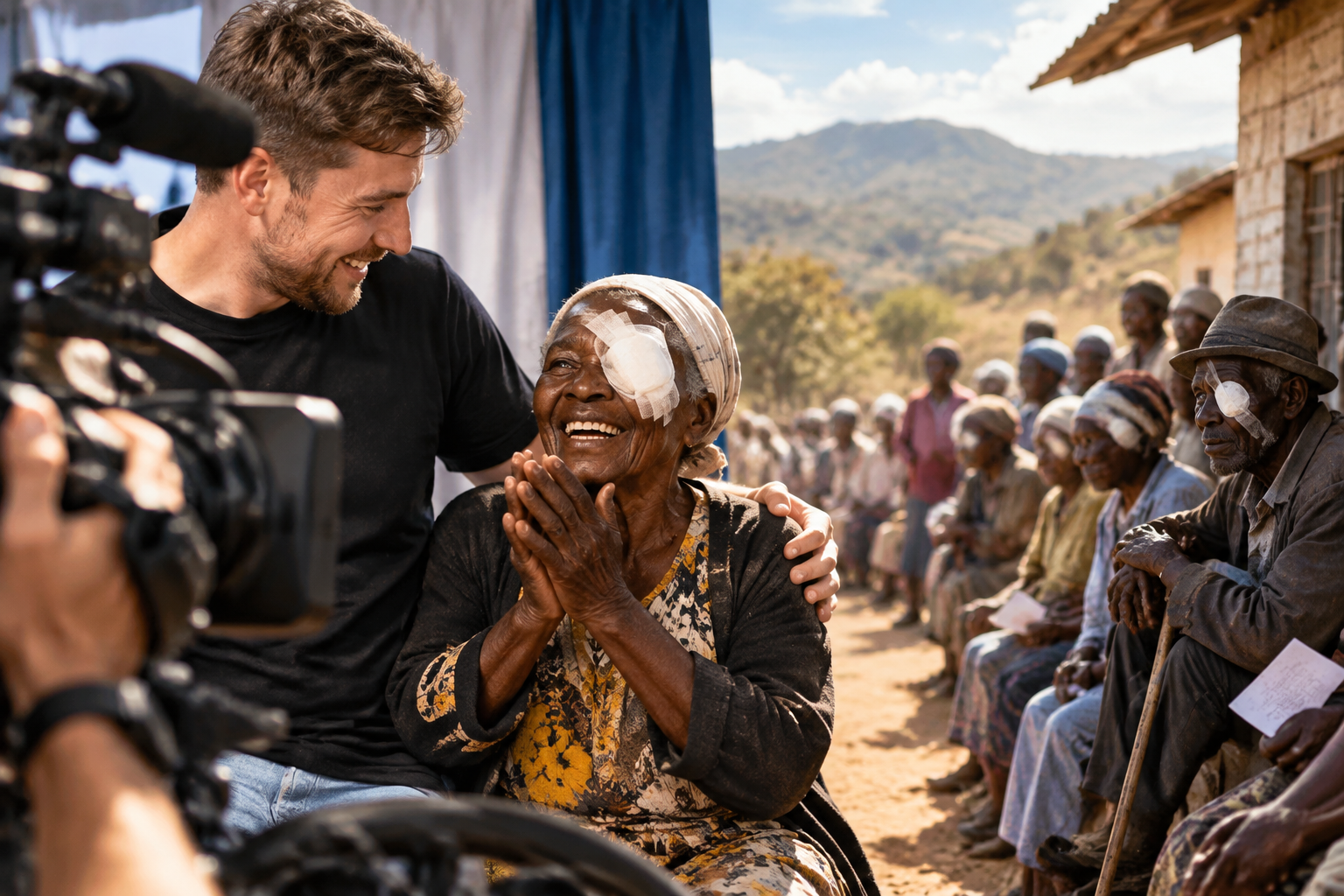
The easiest accusation against MrBeast's 2023 blindness project is that its headline achievement cannot be verified. That accusation does not survive investigation. SEE International, the medical charity involved in the project, confirms that its teams coordinated 1,000 sight-restoring procedures across nine countries in three weeks. The International Agency for the Prevention of Blindness (IAPB) also documented the partnership.
The more substantial criticism is different: the video turns a complicated global health problem into a deceptively simple story about blindness, a ten-minute operation and 1,000 lives transformed. The underlying medical intervention is real. The way the video explains its scale and implications deserves much closer scrutiny.
The 200 million figure hides two different medical problems
The video says 200 million people see the world through the same blurred image. That number has a legitimate source: WHO's 2019 World Report on Vision estimated that nearly 200 million people had moderate-to-severe distance vision impairment or blindness caused by cataracts or uncorrected refractive error. The distinction matters.
World Health Organization
Refractive error is commonly corrected with spectacles. Cataracts require surgery. They are not interchangeable conditions, and 200 million people with these forms of vision impairment are not 200 million people awaiting cataract operations.
WHO's February 2026 fact sheet makes the distinction clearer. Among at least one billion people with preventable or unaddressed vision impairment, it identifies 94 million cases attributable to cataracts and 88.4 million attributable to refractive error.
World Health Organization
The video's illustration is not necessarily a false representation of impaired vision. Its problem is what happens next: the audience is moved from a broad population with different eye conditions to a single surgical solution without being told that the original statistic combines two different treatments.
Cataracts do not account for half of all blindness everywhere
Dr. Jeffrey Levenson's statement that half of all blindness worldwide could be addressed through a ten-minute operation is the most consequential claim in the video.
Cataracts are indeed the leading cause of blindness. But a 2024 meta-analysis published in Eye, using 2020 global estimates, calculated that cataracts accounted for approximately 39.55% of blindness worldwide, with a 95% uncertainty interval of 33.48%–46.34%. The contribution varies substantially by region: the estimate for South Asia was 53.2%.
PMC
There is another important distinction. Research on global blindness has found that cataracts and uncorrected refractive error combined account for approximately half of blindness. That does not mean half of blindness can be corrected through cataract surgery alone.
PMC
The doctor's statement is directionally understandable, particularly in regions where cataracts dominate preventable blindness. But presenting it as a universal global statistic without explaining the population, geography and underlying conditions is poor medical communication.
Glaucoma, diabetic retinopathy and age-related macular degeneration also cause blindness. Cataract surgery cannot reverse damage caused by those conditions.
Ten minutes in the operating room is not the whole treatment
Cataract surgery really is remarkably effective. A surgeon removes the clouded natural lens and replaces it with an artificial one. The video explains the basic procedure correctly.
But the operation is only one part of medical care. WHO describes cataract surgery as typically taking around 15 minutes, while NHS guidance gives an operating time of 20–45 minutes. Neither duration includes the complete patient journey.
World Health Organization+1
Patients require examinations, measurements to select the replacement lens, infection prevention, recovery monitoring, medication and follow-up appointments. The National Eye Institute says most patients are healed within eight weeks, recommends follow-up checks and reports that approximately nine in ten patients see better after surgery. Complications, including infection and vision loss, remain possible.
National Eye Institute
The distinction between an operation performed and a successful visual outcome is important enough that WHO has a separate measure called effective cataract surgical coverage. It counts patients who undergo surgery and achieve a defined level of good vision, rather than simply counting operations.
World Health Organization
MrBeast's video does not publish standardized before-and-after visual acuity measurements or long-term results for its 1,000 beneficiaries. It shows immediate reactions and selected recoveries.
That does not establish that the operations failed. It establishes that the video demonstrates a campaign and its featured moments, not the long-term clinical outcome of every patient.
To its credit, the video acknowledges this uncertainty in Jeremiah's case. Born with cataracts, his right eye had never received light, and the team explicitly says the operation has only a 50% chance of working. That is precisely the kind of medical qualification that should accompany a broader discussion of restored sight.
The thousand operations were real. The video leaves out the machinery behind them.
There is a substantial correction to make to the original editorial suspicion: MrBeast did not simply announce a thousand operations without a medical partner.
SEE International confirms that its Chief Medical Officer, Dr. Jeffrey Levenson, worked with MrBeast on the project. SEE coordinated the international operations across Jamaica, Honduras, Namibia, Mexico, Indonesia, Brazil, Vietnam and Kenya, alongside the initial work in Jacksonville, Florida. The organisation reports that 1,000 sight-restoring surgeries were completed in three weeks.
SEE International
News4JAX separately interviewed Levenson, who confirmed that MrBeast paid for the project. The report identified 40 Jacksonville-area patients who received treatment through the collaboration.
WJXT
This is meaningful evidence. The project had an experienced ophthalmologist, established charitable organisations and an international network. The number is supported by the people who organised the work.
But the video does not give viewers a breakdown of the 1,000 cases by country, diagnosis, procedure or measured outcome. Nor does it explain how many patients received cataract surgery versus other sight-restoring treatment.
A thousand procedures is a useful output figure. It is not, by itself, a complete measure of restored vision.
The $35 operation is not a $35 healthcare system
There is another revealing detail in Levenson's interview with The Ophthalmologist in February 2023.
He explained that small-incision cataract surgery could be performed at a material cost below US$35 per case. He also identified infrastructure, training, education and public awareness as barriers to providing treatment.
A Beast of a Problem
That material-cost figure should not be confused with the total cost of delivering treatment.
For comparison, News4JAX reported that cataract surgery for an uninsured American cost approximately $2,000. Action News Jax reported a figure of $3,100 per patient for the 40 Jacksonville cases. These are different cost measures and cannot be directly compared with the cost of surgical materials alone.
WJXT+1
The difference illustrates the missing economics. A cheap surgical procedure still requires qualified medical personnel, equipment, facilities, diagnosis, patient access and postoperative care.
The WHO's February 2026 assessment identifies the same structural obstacles: shortages and unequal distribution of trained eye-care professionals, high out-of-pocket costs, waiting times and limited awareness. It also reports that three in four people needing cataract surgery in the African Region remain untreated, with women experiencing disproportionately poor access.
World Health Organization
The video shows an international campaign, but it does not explain how the countries involved can build the permanent capacity needed to treat people after the cameras leave.
The surgeon himself calls it a Band-Aid
Perhaps the most revealing assessment comes from Levenson himself, in a January 2024 interview with Ophthalmology Management.
He welcomed the possibility of working with MrBeast again but described the project as a temporary intervention:
“Ultimately, this is a ‘Band-Aid,’ and what we really need is a better healthcare delivery system with overseas capacity building.”
That is a considerably more honest description of the challenge than the video's triumphant ending.
Ophthalmology Management
There is an important qualification: SEE International's wider work already involves local doctors, supplying materials, transferring surgical skills and building medical capacity. Levenson explained that its international programmes coordinate nearly 200 trips annually across 50 countries. The organisation is doing more than arranging isolated operations.
A Beast of a Problem
But that is precisely the story the video leaves largely unexplored. The lasting achievement is not simply getting 1,000 people into operating rooms. It is building enough local medical capacity that another thousand, and another thousand after them, can receive treatment without waiting for a celebrity to arrive.
The $100,000 announcement needs a receipt
The video's closing passage announces:
“We want to make a $100,000 donation.”
It says the contribution will bring sight to thousands more people, but the spoken exchange does not identify the donor or recipient clearly.
SEE International subsequently confirmed that MrBeast made an additional generous donation. However, its published account does not specify the amount or independently establish that the particular $100,000 announcement was transferred.
SEE International
That is not evidence of wrongdoing. It is simply a distinction between an announced commitment and a documented payment. A charitable promise should not automatically become a completed donation in the reader's mind.
The verdict: A real achievement wrapped in an incomplete medical explanation
I would not call this project fraudulent, staged or medically worthless. The 1,000 operations were real, the medical partnership was genuine, and the intervention restored sight to people who otherwise lacked access to treatment.
But the video makes a complicated global health crisis look remarkably simple: 200 million people see poorly, half of blindness can be fixed with a ten-minute operation, and a thousand people can be rescued through one enormous charitable campaign.
The evidence tells a more complicated story. The 200 million figure combines different eye conditions. Cataracts account for roughly two-fifths of global blindness in the 2020 estimates, not a universal half. Successful surgery requires proper diagnosis, qualified professionals, postoperative care and measurable outcomes.
Most importantly, the surgeon who helped deliver the project has acknowledged that it is only a temporary intervention without stronger healthcare systems.
MrBeast deserves credit for paying for real treatment. But the video deserves criticism for making the cure look bigger, simpler and more universal than the medical evidence allows.
The world does not need another thousand-minute celebration of what cataract surgery can accomplish. It needs the medical infrastructure to make that surgery available to everyone who needs it.
References
1. 1,000 Blind People See For The First Time — MrBeast, YouTube, January 28, 2023. The original video and the source of the medical, charitable and financial claims examined here.
2. SEE Collaborates with YouTube Star MrBeast — SEE International, February 2023. Confirms the medical partnership, international operations and 1,000 procedures, while describing the additional donation without specifying its amount.
3. Global Mega Star and YouTuber MrBeast Gives the Gift of Sight to 1000 — International Agency for the Prevention of Blindness, February 1, 2023. Independently documents the collaboration within the international eye-health sector.
4. World Report on Vision — World Health Organization, 2019. Establishes what the approximately 200 million figure actually measures: moderate-to-severe distance vision impairment or blindness from cataracts or uncorrected refractive error.
5. Blindness and Vision Impairment — World Health Organization, February 10, 2026. Provides current global estimates for cataracts, refractive errors and unmet treatment needs.
6. Global Estimates on the Number of People Blind or Visually Impaired by Cataract: A Meta-analysis from 2000 to 2020 — Eye, March 2024. Establishes the estimated 39.55% contribution of cataracts to global blindness in 2020.
7. Causes of Blindness and Vision Impairment in 2020 — The Lancet Global Health, 2021. Explains why combining cataracts and uncorrected refractive error produces a figure of approximately half of global blindness.
8. One in Two People Facing Cataract Blindness Need Access to Life-Changing Surgery — World Health Organization, February 11, 2026. Documents treatment-access inequalities, including the particularly severe gap in Africa and disparities affecting women.
9. Cataract Surgery — National Eye Institute, December 5, 2024. Explains surgical preparation, recovery, success rates and complications.
10. Viral Vision: Sight of 1,000 People Restored in YouTube Megastar's Video Featuring Jacksonville Eye Surgeon — News4JAX, February 1, 2023. Provides an independent interview with Dr. Levenson confirming the funding arrangement and the Jacksonville operations.
11. A Beast of a Problem — The Ophthalmologist, Oscelle Boye, February 16, 2023. Provides Levenson's detailed account of the project, surgical costs, medical barriers and the wider healthcare challenge.
12. A Greater Purpose: Curing Blindness With MrBeast — Ophthalmology Management, Andrew Sweeney, January 12, 2024. Contains Levenson's own assessment that the campaign was a temporary intervention rather than a substitute for stronger healthcare delivery systems.