MrBeast’s Glass-Cube Challenge Had 300 Cameras. It Never Shows Who Was Responsible for the Children.
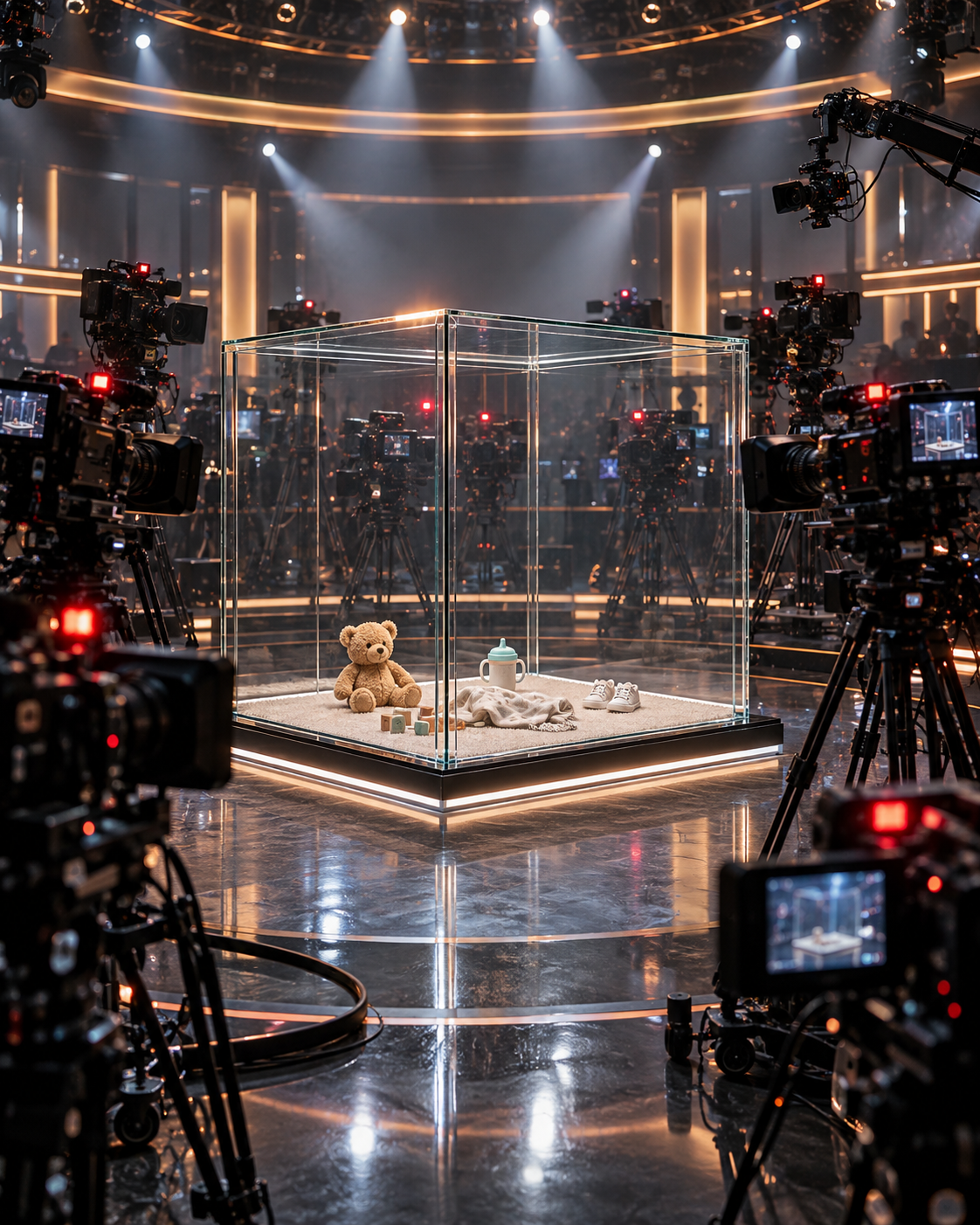
MrBeast's Ages 1–100 Fight for $500,000 makes surveillance part of the spectacle. More than 300 cameras monitor 100 contestants, ranging from an infant to a centenarian, competing to be the last person inside a glass cube.
But the production leaves its most important question unanswered: who was responsible for the youngest participants, and what arrangements protected their welfare and legal rights?
This is not an accusation that children were abused or endangered. The available evidence does not establish that. It is a criticism of a production that provides extraordinary detail about its technology and competition while offering virtually no account of how it handled the children it placed at the centre of the spectacle.
First, the timeline matters
The one-year-old did not spend eight days inside a glass cube. The video indicates that the infant had already left within the opening hours, when the production reported that ten contestants had departed.
The ten-year-old is a different matter. He remained in the competition until the voting elimination on day four. Other contestants identified him as a potential winner and voted him out partly because they feared his chances.
MrBeast subsequently said he felt bad about the elimination and invited the child onto the stage to co-host the remaining challenge.
The competition itself lasted almost eight days, according to Jason Elliott, MrBeast's director of photography, in a subsequent interview with equipment manufacturer Atomos.
These distinctions matter. There is no evidence that the infant endured the entire competition, but the ten-year-old participated over several days. The question is not whether the production literally imprisoned children. Contestants could leave voluntarily, and many did. The question is what arrangements governed the children's participation.
Cameras record. They do not provide childcare.
MrBeast tells viewers that more than 300 cameras were positioned throughout the facility to monitor contestants' movements.
Elliott subsequently explained that the first 1–100 production involved continuous recording, with cameras operating 24 hours a day until filming ended. He also described a camera-team policy of non-interference, designed to prevent filming operations from disturbing contestants.
That is an impressive technical operation. It is not an explanation of child protection.
The video explains how contestants requested portable toilets: they activated a signal, an exterior light came on, and a crew member delivered one.
But where is the comparable explanation for the youngest participants?
Who was responsible for their feeding, rest, hygiene and medical needs? Were parents or guardians physically present? Who had authority to remove a child from the competition if the child became distressed or needed assistance?
These questions do not establish that appropriate arrangements were absent. They establish that the published account does not tell viewers what those arrangements were.
A camera can record a child sleeping. It cannot replace the adult responsible for deciding whether that child should be sleeping somewhere else.
North Carolina law makes the financial question concrete
MrBeast's production operation is based in Greenville, North Carolina. North Carolina has specific statutory provisions governing minors' entertainment contracts and the money they earn.
Under North Carolina General Statutes §48A-11, covered agreements include contracts granting another party rights to use a minor's likeness, voice recording, performance or personal story in television and the entertainment industry.
The financial provisions are particularly relevant.
Under §48A-15, when a covered minor's contract is not submitted for court approval, 15% of the minor's gross earnings under that contract must be placed in a trust for the child's benefit. Court-approved contracts carry the same minimum protection under §48A-14.
The statute also addresses the documentation required when a parent or guardian enters such an agreement on a minor's behalf.
This is not a claim that the children were entitled to 15% of the $500,000 prize. That money went to the winning adult, Joe. The statutory protection concerns each child's own earnings under a qualifying agreement.
Nor does the existence of the statute establish that MrBeast violated it. We do not have the children's contracts, their payment arrangements or evidence of any trust accounts.
But those are precisely the documents that would answer an important question: were the children merely featured in a video, or were their appearances commercially contracted, and how were their financial interests protected?
There is another relevant provision. North Carolina's youth employment statute, §95-25.5, preserves employment-certificate requirements for minors employed as performers in television productions, even while exempting them from most other provisions of the section.
Whether these particular contestants legally qualified as employed performers cannot be established from the edited video. That distinction matters, and it would be irresponsible to announce a violation without examining the actual agreements and employment arrangements.
The production has the information needed to answer these questions. The audience does not.
The youngest contestants deserve more than a dramatic elimination
The ten-year-old's elimination is presented as an entertaining strategic development. Other contestants considered him a threat, voted against him, and celebrated his departure.
MrBeast then brought him back as a co-host.
There is nothing inherently wrong with a child participating in entertainment or a competition. Children can enjoy these experiences, and parents can make informed decisions about their participation.
But a child's willingness to participate is not the entire responsibility of the production. The adults organising the event still have responsibilities concerning supervision, working conditions where applicable, contractual rights and the child's welfare.
The video devotes considerable attention to the contestants' alliances, rivalries, bathroom arrangements, elimination decisions and chances of winning. It even explains the commercial sale of pieces from the set through the Shop app.
It never gives viewers an equivalent account of the arrangements protecting its youngest participants.
That imbalance is worth examining.
The verdict: The production shows everything except the safeguards that matter most
I cannot establish from this video that MrBeast endangered a child, violated employment law or withheld money belonging to a minor. Making those accusations without the necessary evidence would be dishonest.
But the absence of proof of wrongdoing does not make the production's lack of transparency irrelevant.
This was an eight-day production involving a one-year-old participant who exited early and a ten-year-old who remained through day four. The production publicly celebrated its ability to record virtually everything, yet the published work provides no meaningful explanation of who was responsible for the children's care or how their commercial rights were protected.
The questions are answerable. The production can explain its supervision arrangements, provide clarity on the children's agreements and disclose how any earnings were handled.
Until then, viewers are being asked to admire the extraordinary machinery of the competition without being shown the arrangements that matter most to its youngest participants.
Three hundred cameras can document a competition. They cannot establish that the children in it were properly protected.
References
1. Original video — Ages 1–100 Fight For $500,000, MrBeast, YouTube. Primary source for the rules, contestants' ages, elimination timeline, camera claims and prize.
2. Production interview — In the Belly of the Beast, Atomos, June 26, 2024. Director of photography Jason Elliott discusses the original challenge's nearly eight-day duration, continuous recording and camera-team non-interference policy. Atomos is a production-equipment manufacturer, not an independent welfare auditor.
3. Minor entertainment contracts — North Carolina General Statutes, Chapter 48A, North Carolina General Assembly. Sections 48A-11 through 48A-16 establish the scope of covered entertainment contracts and financial protections for minors.
4. Youth employment — G.S. 95-25.5, North Carolina General Assembly. Establishes youth employment restrictions and preserves certificate requirements for television performers.
5. Employment certificate guidance — Youth Employment Certificate, North Carolina Department of Labor. Explains the state's certificate requirements for employed minors; it does not establish whether these contestants were legally employees or whether certificates were issued.
6. Production location — MrBeast scoops up more land and homes as YouTuber broadens reach across NC city, Brian Gordon, The News & Observer, March 27, 2024. Documents the Greenville production campus and studio operations, but does not independently establish the exact filming location of this particular challenge.