MrBeast Built a $10 Million Village. But Did He Actually Save Children From Cocoa Labor?
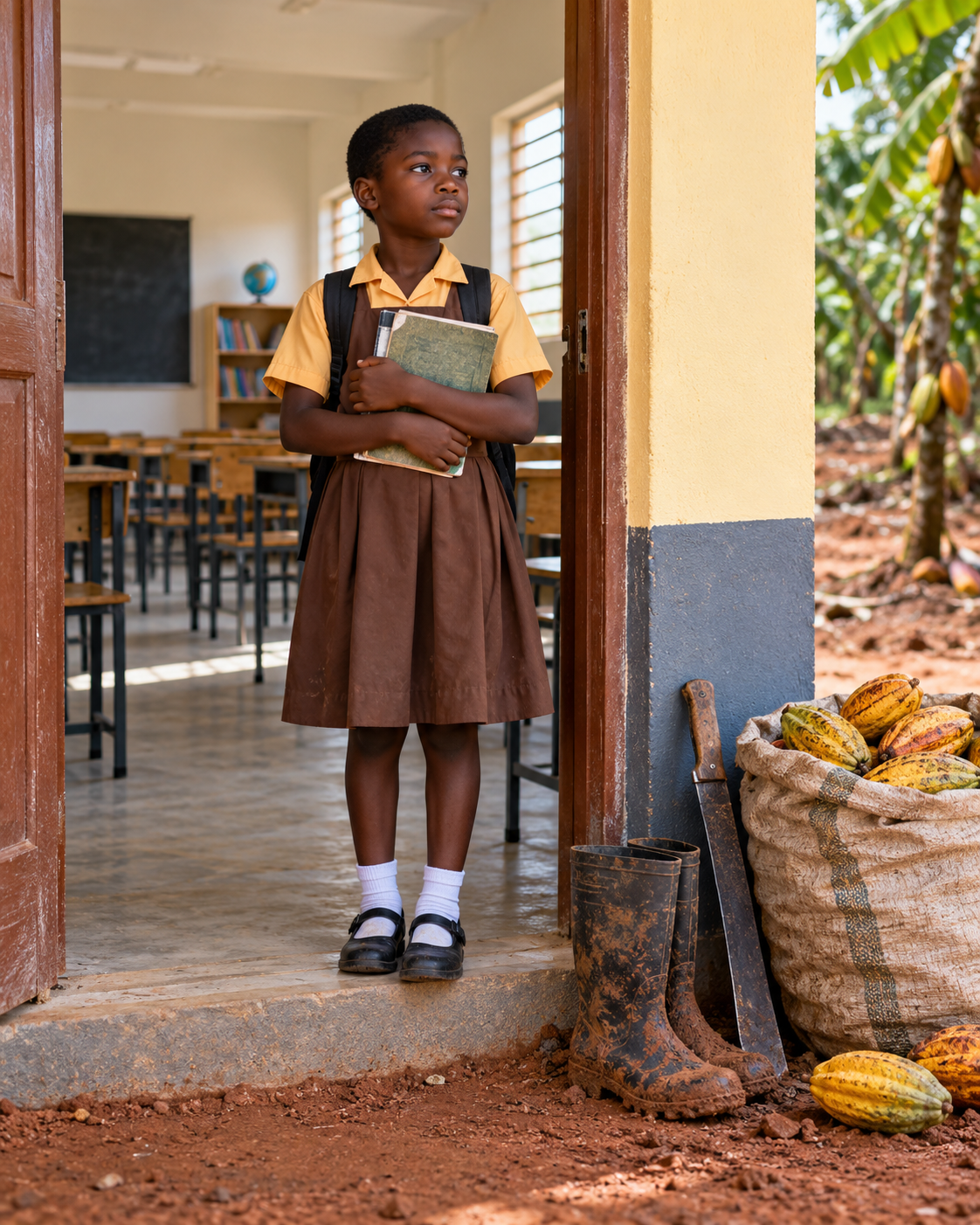
MrBeast built a village in Ghana with ten houses, a school, clean water, solar electricity, a medical center, and facilities for growing food. It was an extraordinary construction effort. But the most important achievement promised by the video's title remains unproven: getting children out of illegal labor on cocoa farms.
In I Built A City To Save Kids From Illegal Labor, published September 19, 2026, Jimmy Donaldson presents Abna Dakwa Village as a solution to child exploitation in the chocolate industry. His team spent eight months constructing facilities that could improve daily life for an entire community.
Residents gained access to services they previously lacked. Teachers received new homes. Children received classrooms with fans and electricity. The project also promised five years of free school meals.
The construction is not the problem. The leap from construction to rescue is.
MrBeast's video carefully documents what his team built. It does not establish how many children stopped performing hazardous work, whether their families can now survive without that work, or whether the village's services can operate independently once outside support ends.
Those are not minor details. They are the difference between building a remarkable village and demonstrating that it has solved the problem it was built to address.
1. Going to School Does Not Mean a Child Has Stopped Working
MrBeast's central argument is straightforward: children cannot work on cocoa farms while attending school, so improving education will reduce child labor.
The logic sounds convincing. The evidence is more complicated.
A 2020 study by NORC at the University of Chicago, funded by the U.S. Department of Labor, examined child labor in cocoa-growing areas of Ghana and Côte d'Ivoire.
Its findings expose a serious weakness in treating school attendance as proof that children have escaped exploitation.
In Ghana, 99% of children aged 5–11 identified as engaging in cocoa-related child labor were also recorded as attending school during the preceding 12 months. Among children aged 12–14, the figure was 97%.
These were not simply children helping their parents with harmless chores. NORC separately reported similarly high attendance among children performing hazardous cocoa work.
The survey covered the 2018–2019 growing season, not MrBeast's village in 2026. It cannot establish what happened to children in Abna Dakwa. But it establishes something crucial about the problem he claims to address: school attendance and child labor can coexist.
A child can attend classes and still carry dangerous loads, handle sharp tools, or work on a farm outside school hours.
MrBeast is correct that time spent in class cannot simultaneously be spent working in a field. He is also correct that improving access to education can reduce barriers that contribute to child labor.
But those facts do not establish that attending school eliminates hazardous work.
There is stronger local evidence supporting his concern. Reporting based on the Ghana project organizers' information described child-labor rates approaching 40% in the community and increased school absenteeism during cocoa harvests, particularly among pupils in grades four through nine. Those figures were not accompanied by a publicly described survey method.
That seasonal pattern is precisely why a school could make a difference.
It is also why success must be measured beyond enrollment.
The questions are concrete. How many children performed hazardous cocoa work before construction? How many continued afterward? Did harvest-season absences decline? Did children stop handling pesticides and sharp tools, or merely reduce their working hours?
The video supplies no answers.
A school is a powerful intervention. It is not a substitute for measuring what happened to the children.
2. The Most Important Results Are Missing From the Celebration
The video reaches its emotional peak when residents enter the completed village.
There are functioning water systems, classrooms, playground equipment, a football field, and a marketplace where people have already begun selling food.
Teacher Isaac receives a house tailored to his preferences. Previously, he shared two rooms with his wife and three children in a crowded building. Now he has a furnished home with a kitchen, bathroom, and solar power.
MrBeast explicitly tells Isaac that he owns the house outright and owes no rent.
The importance of that gift is obvious.
But a gift to an individual teacher and a reduction in community-wide child labor are different achievements.
MrBeast does not explicitly claim that a particular number of children have already escaped cocoa labor. That restraint matters. Nevertheless, the video's title and triumphant presentation encourage viewers to connect the completed village with the achievement of its ultimate objective.
An opening ceremony cannot establish that result.
The International Cocoa Initiative provides a useful comparison.
Its 2024 annual report describes systems that identify children engaged in child labor, deliver assistance, and conduct repeated follow-up visits.
Among children identified as engaging in child labor within ICI-supported monitoring systems, 44% were recorded as no longer engaging in child labor after two consecutive follow-up visits.
ICI emphasizes that a child who stops hazardous work after one intervention may resume it later.
This is what serious measurement looks like. It recognizes that escaping child labor is a process, not a single event.
And here is the important complication for critics of MrBeast: his organization appears to understand this.
Beast Philanthropy's published Ghana initiative describes an intervention covering 11 cocoa-farming communities, with direct engagement already underway in seven. It reports 2,919 farmers and students surveyed and outlines a minimum five-year commitment.
The organization also describes child-labor monitoring, household interviews, remediation, and follow-up visits, with technical support from the International Cocoa Initiative.
That is substantive work beyond what the video explains.
It weakens any accusation that MrBeast simply built a village, filmed the results, and walked away without planning further action.
But the publicly available project overview does not provide a comparable numerical result showing how many children have stopped hazardous labor after repeated checks.
It distinguishes completed interventions from future plans, yet does not provide a clear before-and-after child-labor outcome for Abna Dakwa Village.
That distinction is the central weakness of the video.
MrBeast has presented evidence of construction. His organization describes a system for measuring outcomes. What viewers still lack is the actual outcome measurement.
One month after the village's opening, it would be unreasonable to demand proof of five years of progress.
It is entirely reasonable, however, to insist that the completion of construction not be confused with the completion of the mission.
3. The $10 Million Village Has More Financial Partners Than the Video Makes Clear
MrBeast opens with an extraordinary financial commitment: almost $10 million devoted to building the village.
The figure establishes scale. It does not explain financing.
The project was not simply an isolated undertaking by a wealthy YouTuber.
The official 1 Billion Followers Summit campaign identifies the Mohammed bin Rashid Al Maktoum Global Initiatives and the Varkey Foundation as important institutional partners.
A September 20, 2026, announcement by the Emirates News Agency describes a partnership involving the summit, those institutions, and Beast Industries, Donaldson's entertainment company.
The project also benefited from assistance by Neuro Gum's founders, who appeared in the video and received an extended product promotion. MrBeast said they were helping finance another Ghanaian village as well.
The video acknowledges institutional support. The problem is not that these relationships were entirely concealed.
The problem is that the audience never receives a meaningful financial account of the project.
How much of the announced $10 million represents money provided by Beast-related organizations? How much came from institutional partners? How much was donated through other arrangements? What were the construction costs, and what resources were reserved for operations?
The reviewed public materials identify participants and commitments but do not establish a complete project-level financial breakdown.
That does not prove financial misconduct or misrepresentation. It means the celebrated amount cannot be independently reconstructed from those disclosures.
The distinction matters because the project is being presented as an example others should follow.
A financial model cannot be replicated from a promotional budget.
Neither can its efficiency be evaluated without knowing what the money purchased and what its continuing obligations will cost.
4. A Self-Sustaining Village That Still Needs Five Years of Outside Support
Near the end of the video, MrBeast declares that the project has produced a functioning, self-sustaining village.
That description is considerably more ambitious than the evidence establishes.
The village has solar panels, water storage, irrigated farmland, chickens, fish tanks, and a marketplace.
These assets could reduce dependence on outside suppliers. But possessing productive infrastructure does not establish the ability to finance, operate, repair, and replace it indefinitely.
The school provides the clearest example.
MrBeast promises every student 200 free meals annually for five years.
At a constant enrollment of 325 students—the figure given for the existing school—that would represent approximately 325,000 meals over five years.
That is a substantial commitment.
It is also a recurring expense.
The Rockefeller Foundation announced a partnership with Beast Philanthropy on September 17, 2026, to support school-meal programs in Ghana and Kenya over five years.
The broader initiative aims to provide meals for approximately 4,000 children across the two countries. Its Ghana component involves ten schools serving nine communities, with local farmers participating in food production. These figures describe the wider program, not an allocation exclusively to Abna Dakwa.
This arrangement is more credible than an unexplained promise to feed children indefinitely.
But it does not establish that Abna Dakwa can sustain its feeding program without philanthropic assistance.
The same questions apply to the village's medical facilities, water infrastructure, electricity systems, and agriculture.
Who pays for replacement equipment? Who maintains the pumps? How are medical staff funded? What happens to school meals after the fifth year?
Beast Philanthropy does describe an answer in principle.
Its Ghana strategy runs from 2025 to 2030 and anticipates communities and farmer cooperatives gradually assuming responsibility as local income-generating activities develop.
That is a legitimate sustainability plan.
But a plan for self-sufficiency is not evidence that self-sufficiency has already been achieved.
A village can possess solar panels and still depend on outside money. A farm can produce vegetables and still struggle to cover its operating costs.
Long-term sustainability requires a functioning economic arrangement, not simply an impressive collection of buildings.
MrBeast announces that the destination has been reached while his organization's own strategy makes clear that the journey is still underway.
5. Feastables Has Real Ethical Credentials. That Does Not Prove Its Farmers Earn a Living Income
The video's final section shifts from village construction to the global chocolate industry.
MrBeast attacks large chocolate manufacturers for profiting while children work in dangerous conditions.
He then presents his company, Feastables, as evidence that chocolate can be produced differently.
His main claims concern Fairtrade sourcing, payment of living-income reference prices, child-labor monitoring, and community investment.
These claims should not be dismissed merely because Feastables is his business.
Fairtrade America announced in April 2025 that Feastables had reached 100% sourcing from Fairtrade-certified cocoa cooperatives. The organization also publicly recognized Feastables' commitment to paying living-income reference prices.
That is meaningful independent support for the company's sourcing credentials.
But the presentation becomes less convincing when ethical purchasing commitments are allowed to stand in for demonstrated economic outcomes.
Fairtrade itself makes an essential distinction.
A Living Income Reference Price is calculated to help farmers earn enough for a decent standard of living under specified conditions.
Paying that reference price does not guarantee that an individual farmer earns a living income.
Fairtrade explains that farm size, crop yields, operating costs, cooperative arrangements, and the proportion of production purchased by a particular buyer all affect the amount farmers ultimately receive.
It explicitly warns that a company's commitment to paying the reference price does not guarantee that the full amount reaches individual farmers.
That distinction is not an argument against paying higher prices.
It is an argument against confusing a purchasing standard with a verified improvement in household income.
MrBeast's video does not provide farmer-level income measurements, purchasing volumes, or evidence showing how many participating households have crossed the living-income threshold.
Nor does it establish that child labor has been eliminated from Feastables' supply chain.
Having monitoring and remediation systems is a meaningful safeguard. It is not a certificate stating that exploitation no longer occurs.
Feastables deserves credit for participating in recognized sourcing and monitoring frameworks.
But an ethical commitment becomes a demonstrated social outcome only when its effects are measured.
6. MrBeast's Attack on Other Chocolate Companies Is Too Convenient
MrBeast's most sweeping accusation comes near the end:
“Big chocolate will not care about rampant child labor until you ... do something about it.”
The chocolate industry has serious problems. The estimated 1.56 million children engaged in cocoa-related child labor across Ghana and Côte d'Ivoire in NORC's 2018–2019 research provide ample reason for concern.
But that historical estimate is not a current count of children whose labor can be attributed directly to every chocolate brand sold in 2026.
Nor does the persistence of child labor establish that every major manufacturer has refused to act.
The International Cocoa Initiative reports that its members and partners had extended child-labor monitoring coverage to approximately 1.17 million cocoa-farming households by the end of 2024.
Coverage does not guarantee effective remediation. The initiative's own results demonstrate that helping children leave hazardous work is difficult and incomplete.
Nevertheless, these programs are evidence that industry efforts exist.
A separate 2026 evaluation published by Save the Children Italy examined a child-labor reduction program implemented with Ferrero from 2020 to 2025.
The evaluation reported reductions in child labor and improvements in school attendance, while warning that institutional sustainability remained fragile.
It is a program evaluation involving a commercial partner, not proof that Ferrero's entire supply chain is free of child labor. But it directly contradicts the impression that meaningful industry initiatives begin and end with Feastables.
There is an even more revealing connection.
Feastables belongs to Tony's Open Chain, a sourcing initiative established by Tony's Chocolonely.
The initiative includes other commercial participants, among them Aldi, Ben & Jerry's, and Waitrose.
Its members work within a shared framework addressing cocoa traceability, purchasing practices, and farmer livelihoods.
Feastables is therefore participating in a broader collective effort rather than creating an entirely separate solution.
This should strengthen MrBeast's argument for industry reform.
Instead, his closing presentation increasingly makes the issue sound like a choice between supporting Feastables and tolerating exploitation.
That is a false choice.
Consumers can demand better cocoa sourcing from established manufacturers, support other responsible brands, and press governments to enforce child-protection standards.
None of those actions requires buying MrBeast's chocolate.
7. The Video's Final Appeal Turns Humanitarian Concern Into Brand Demand
The most revealing moment comes after the village has opened.
MrBeast asks viewers to purchase Feastables.
He argues that if the company cannot demonstrate commercial demand for ethically sourced cocoa, the broader effort to end child labor may fail.
His appeal becomes increasingly urgent:
“Stop supporting unethically-sourced cacao, and eat Feastables.”
The commercial interest is unmistakable.
Donaldson founded Feastables. Its success can benefit his business, even as its purchasing practices may benefit cocoa-growing communities.
These outcomes are not mutually exclusive. A company can create genuine social value while earning money.
The presence of a financial incentive does not invalidate the underlying charitable work.
But the video places viewers in an uncomfortable position.
After showing children in poverty, inadequate classrooms, unsafe water, and families living in crowded conditions, it presents buying a particular chocolate bar as a meaningful response to that suffering.
The emotional force of the humanitarian project becomes part of a commercial sales argument.
This is more than a routine advertisement.
The central concern is whether the evidence presented justifies the moral urgency attached to the purchase.
Feastables' Fairtrade certification provides a credible reason for ethically concerned consumers to consider the product.
It does not establish that purchasing Feastables is necessary to combat child labor, that competitors offer no comparable alternatives, or that the company's commercial success is a prerequisite for industry reform.
MrBeast's suggestion that the problem may never be fixed if Feastables fails is especially difficult to defend.
The international efforts described by Fairtrade, the International Cocoa Initiative, Tony's Open Chain, and other organizations existed independently of Feastables and extend beyond its commercial prospects.
His company may contribute to that work.
It cannot reasonably be presented as the deciding condition for its survival.
The children in Ghana need effective protections, sufficient family incomes, functioning schools, and sustained public and private investment.
They do not need the world to accept that their future depends on one confectionery brand winning market share.
The Verdict: MrBeast Has Built the Infrastructure. The Rescue Remains Unproven.
Abna Dakwa Village is a substantial humanitarian achievement.
Dismissing the houses, classrooms, water systems, and agricultural facilities would be absurd. These are tangible improvements with immediate value to the people using them.
The project's strongest defense is that construction is only its first stage.
Beast Philanthropy has outlined several years of monitoring, economic support, and eventual local responsibility. Its institutional partnerships and Feastables' sourcing arrangements are more substantial than a superficial examination might suggest.
That makes the weakness in the video more important, not less.
MrBeast already has access to the expertise needed to distinguish construction output from measurable social change.
Yet his audience receives a satisfying story whose central outcome has not been established.
The proof will come from following the children after the cameras leave.
Are they attending school throughout the cocoa harvest? Have they stopped performing hazardous work? Can their families afford to keep them out of the fields? Do those improvements persist for years?
Those questions are answerable.
They require baseline measurements, repeated interviews, transparent reporting, and a willingness to publish disappointing results alongside successful ones.
A completed village is worth celebrating. It is not the same as a completed mission.
The greatest risk in MrBeast's presentation is not that the development was insincere or ineffective. The available evidence does not justify either accusation.
It is that an extraordinarily persuasive video can make an unfinished struggle appear resolved.
MrBeast has demonstrated that he can build a village in Ghana. He has not yet demonstrated that the village has freed its children from cocoa labor.
Until that evidence exists, the appropriate verdict is not failure.
It is that the most important promise remains outstanding.
References
1. Original work — I Built A City To Save Kids From Illegal Labor.
MrBeast, YouTube, September 19, 2026.
Watch the original video
Primary account of the project's construction, financial announcement, five-year meal commitment, claimed outcomes, and Feastables promotion. It documents the facilities but does not provide a measured reduction in child labor.
2. Assessing Progress in Reducing Child Labor in Cocoa Production in Cocoa Growing Areas of Côte d'Ivoire and Ghana.
NORC at the University of Chicago, October 2020.
Read the original research report
The central statistical evidence: Table 30 demonstrates that children engaged in cocoa-related child labor frequently attend school, challenging the assumption that attendance alone establishes freedom from exploitation. The data concern 2018–2019, not the village's subsequent outcomes.
3. Annual Report 2024.
International Cocoa Initiative, 2024.
Read the annual report
Documents the reach of child-labor monitoring systems, the importance of repeat visits, and results recorded among children receiving support.
4. Ghana Child Labor Initiative.
Beast Philanthropy, ongoing project overview, accessed October 2026.
Read the program description
Describes the organization's 11-community strategy, five-year commitment, monitoring arrangements, local partnerships, and planned transfer of operational responsibility; it does not publish a comparable post-project child-labor outcome for the featured village.
5. Dubai-backed kindness campaign brings water, education and healthcare to Ghana village.
Khaleej Times, September 20, 2026.
Read the reporting
Provides local context on community poverty, reported child-labor prevalence, seasonal school absenteeism, and the institutional partnership; its local figures derive from project information rather than a separately documented independent survey.
6. Beast Philanthropy and Rockefeller Foundation Partner on Nutritious, Sustainable School Meals in Ghana and Kenya.
The Rockefeller Foundation, September 17, 2026.
Read the partnership announcement
Confirms the five-year school-meal collaboration, its approximately 4,000 intended beneficiaries across Ghana and Kenya, and the Ghana program's local agricultural partners.
7. 1 Billion Acts of Kindness Drives Ghana Village Development, Sets Global Benchmark.
Emirates News Agency, September 20, 2026.
Read the announcement
Identifies the institutional partners and describes the village's development as a collective undertaking involving philanthropic organizations, Beast Industries, and content creators.
8. 100% of Cocoa in Feastables' Chocolate Is Fairtrade Certified.
Fairtrade America, April 8, 2025.
Read the Fairtrade announcement
Independently supports Feastables' certified sourcing position and documents its stated commitment to living-income reference pricing; it does not establish that every participating farmer earns a living income.
9. Living Income Reference Prices: Frequently Asked Questions.
Fairtrade International, undated, accessed October 2026.
Read Fairtrade's explanation
Explains why reference-price commitments do not guarantee individual farmer receipts or adequate household incomes.
10. Mission Allies.
Tony's Open Chain, ongoing participant directory, accessed October 2026.
See participating companies
Confirms Feastables' participation in an existing ethical cocoa-sourcing initiative alongside other businesses, challenging the suggestion that responsible sourcing depends on one company.
11. Final Evaluation of the Project “Stop Child Labour in Cocoa Sourcing Communities”.
Save the Children Italy, 2026.
Read the evaluation overview
Reports measured improvements from a Ferrero-partnered intervention while identifying continuing sustainability risks, providing a relevant example of both industry action and the difficulty of establishing lasting results.