MrBeast Saved 1,000 Animals. But What Does “Saved” Actually Mean?
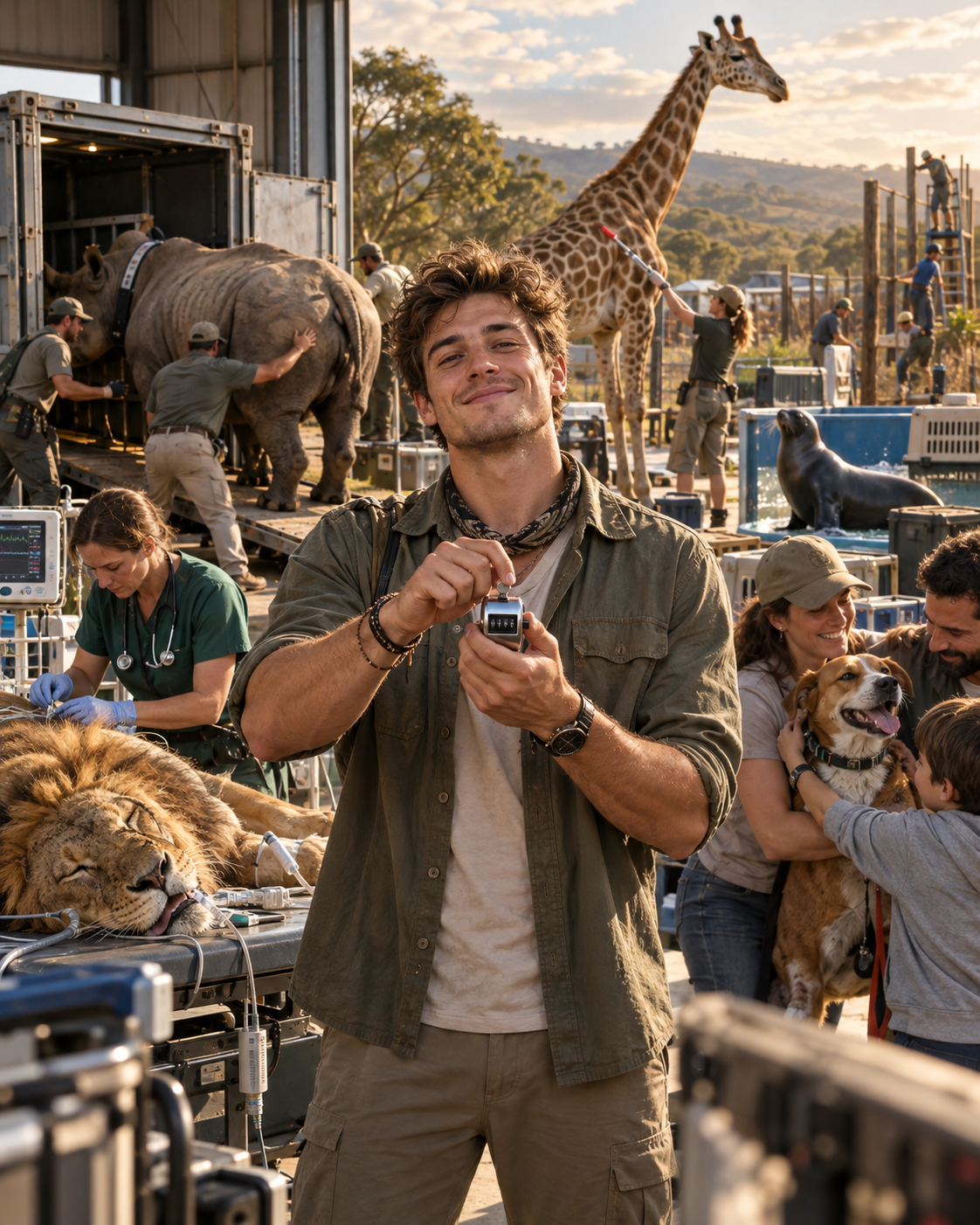
MrBeast's animal rescue video makes an extraordinary promise: 1,000 animals saved from dying. The difficulty is that the video never establishes how many deaths were actually prevented.
Some animals received medical treatment. Others were vaccinated, adopted, relocated, released from rehabilitation, or placed under the care of organizations receiving financial support. These are valuable interventions, but they are not interchangeable outcomes.
An examination of the rescue organizations' records reveals another problem. Some of the video's most dramatic achievements were organized by people whose work began long before MrBeast arrived.
The animals deserve their second chances. The people responsible for delivering those chances deserve accurate recognition. And viewers deserve something more substantial than a dramatic number.
1. One Thousand Animals, Several Different Definitions of Rescue
The video's first animal is a lion suffering from a dangerous dental infection. Veterinarian Dr. Alex performs a root canal to remove infected material that could otherwise cause serious complications.
This is a straightforward medical intervention with a clear purpose.
The next operations are harder to classify.
MrBeast's team relocates three rhinoceroses threatened by territorial conflict inside a fenced reserve. It vaccinates 70 giraffes. Later, 100 shelter dogs are adopted, more than 200 animals are released into the Amazon rainforest, and four organizations receive financial support for another 212 animals.
Every animal enters the same running total.
But the interventions have profoundly different meanings.
The 70 giraffes were given preventative medication. The video does not identify the diseases being prevented, name the vaccine, establish the animals' prior exposure, or explain the expected reduction in mortality.
A conservation worker claims that contracting one of the relevant diseases would mean certain death.
That statement may concern a genuinely deadly disease. Without knowing which disease, however, viewers cannot evaluate its accuracy.
More importantly, administering a vaccine does not establish that the recipient would otherwise have died.
The Merck Veterinary Manual explains that vaccine protection varies between animals and is never absolute. Vaccine effectiveness depends on the disease, the individual animal's immune response, and the circumstances of administration.
Vaccinating 70 giraffes is an identifiable achievement. Claiming 70 lives were saved from death requires additional evidence.
The same distinction applies to the 100 dogs.
MrBeast describes shelter overcrowding and euthanasia before arranging adoptions. The danger is real: Best Friends Animal Society recorded approximately 237,000 dogs killed in American shelters during 2024.
The video reports that all 100 dogs were adopted, with their adoption fees and medical bills covered. That is a meaningful outcome. But it never establishes that every individual dog faced imminent euthanasia or would have remained unadopted without the event.
A dog finding a home is worth reporting without inventing a certainty about its alternative fate.
The distinction becomes particularly important toward the end.
MrBeast announces assistance for hundreds of animals already receiving treatment at established organizations. In several cases, the achievement is paying for their care.
One sea lion, Rocky, still requires recovery time following surgery. His treatment is continuing when he enters the total.
There is nothing improper about funding an unfinished rescue. The problem is declaring the outcome complete before it has been established.
Even the arithmetic deserves closer attention.
Treating the video's listed categories as separate, and counting its claim of more than 200 Amazon releases as 200, produces approximately 956 animals before the unspecified number of miniature horses.
That calculation is not a verified total. Some groups may overlap, the Amazon count is approximate, and the video does not supply an animal-by-animal ledger.
The announced 1,000 is numerically plausible. It is not independently auditable from the information presented.
The video provides a count of animals assisted under several different definitions. It does not establish that 1,000 otherwise-fatal outcomes were prevented.
2. The Three Lions Were Rescued by an International Operation Already Underway
One of the video's most powerful sequences involves three lions escaping the war in Ukraine.
MrBeast describes traveling to Ukraine and transporting the animals more than 7,000 miles to South Africa, where wildlife conservationist Anthony Peniston helps release them into a sanctuary.
The underlying rescue was real.
But the history of that operation is considerably more revealing than the video.
On September 15, 2025, Animal Survival International announced that the three lions had already arrived safely in South Africa.
That was 40 days before MrBeast published his video on October 25.
The organization's statement identifies the animals as Cleopatra, Zorya, and Mira.
Cleopatra had been rescued from a private zoo that had lost funding during the war. The two younger lions had been found near the frontlines suffering from broken rear legs and severe malnutrition.
The Wild Animal Rescue Center in Ukraine had rescued and sheltered them.
Animal Survival International helped finance their care and provided specialized transport crates.
Anthony Peniston and the LionWatch Project initiated, planned, and executed the relocation. The operation took approximately a year to organize.
Qatar Airways Cargo provided the flights free of charge through its WeQare initiative.
There is also a significant geographic omission.
Ukraine's airspace was closed. The lions were transported by road to Warsaw, Poland, before flying through Doha to Johannesburg.
MrBeast's narration describes bringing in a cargo plane to transport the lions out of Ukraine. The actual evacuation required an overland journey before the animals could board an aircraft.
The difference matters because the difficult work was not simply obtaining an aircraft.
It involved caring for injured animals, keeping them alive in a war zone, securing international permissions, transporting them across a threatened country, clearing customs, and arranging permanent accommodation.
Animal Survival International's September report names numerous participating individuals and organizations. Its account does not identify MrBeast as the mission's organizer.
That omission does not establish that he contributed nothing. His video's description explicitly thanks Qatar Airways Cargo and the participating organizations, and his involvement may have provided additional resources or extraordinary publicity.
But the available documents establish that this was an existing international rescue operation, not an undertaking that began with the celebrity's arrival.
The strongest evidence of the lions' rescue comes from the organizations that planned and completed it before the video appeared.
The distinction between supporting an achievement and owning its history should not disappear because one participant has the largest audience.
3. Ukraine Disappeared From the Russian-Language Version
The lion rescue contains another remarkable editorial discrepancy.
The original English narration identifies Ukraine and explains that years of war have destroyed zoos and endangered rescued animals.
The Russian-language version reportedly removed those references.
On October 28, 2025, independent news outlet Meduza documented the difference between the two audio tracks.
Instead of naming Ukraine, the Russian narration described traveling to an unspecified location where unfortunate lions were living in temporary shelters.
The references to the ongoing war were also removed.
This was not an insignificant difference in wording.
Ukraine was essential to explaining why the animals needed evacuation. The war was the reason the rescue was dangerous and urgent.
Removing both turned a specific humanitarian emergency into an anonymous animal rescue.
The English narration itself did not identify Russia as the invading country. But it at least preserved the location and the existence of the conflict.
The Russian version reportedly went further, removing the facts necessary to understand the circumstances.
The available reporting does not establish who authorized the change, whether MrBeast personally reviewed the Russian narration, or whether the decision originated with a localization contractor.
Assigning responsibility without that evidence would be irresponsible.
But the editorial consequence is plain.
Audiences hearing different language tracks were given materially different explanations for the same rescue.
A documentary account of animals escaping a war should not make the war disappear when the language changes.
4. Lowe's Supplied Far More Than a Convenient Sponsor's Logo
At Maya Higa's Alveus Sanctuary in Texas, MrBeast joins Lowe's to construct a safer enclosure for an emu named Stompy.
The bird had been living around larger animals, creating a risk of accidental injury.
The episode shows fencing, planting, construction work, and the introduction of a second emu.
MrBeast also presents Maya with a proposed $50,000 contribution toward a new wolf sanctuary.
Lowe's receives extensive promotional attention, including references to its wider corporate community program.
This was not an incidental charitable mention.
Creator-industry publication Tubefilter classified the video as sponsored by Lowe's in its November 3, 2025, review of branded YouTube content.
More importantly, Lowe's own account reveals the scale of the work behind the construction montage.
In a corporate article published on October 25, the company reported that more than 20 employees from four stores participated.
According to Lowe's operations manager Ross Hubbard, workers cleared and leveled more than 25,000 square feet, removing 18 truckloads of boulders and rocks.
The company also supplied materials, plants, fencing, and tools.
Those details establish substantial physical contributions by the sponsor's employees.
The video's celebrity-centered presentation gives viewers only a limited understanding of that labor.
There is another important financial detail.
Alveus was already an established nonprofit with an independent fundraising operation.
Following the July 2025 Texas floods, its community raised more than $250,000 toward rebuilding a damaged access road.
The sanctuary subsequently launched the Alveus Research & Recovery Institute, intended to support conservation programs involving endangered wolves.
On October 22, three days before MrBeast published his video, Alveus announced that its supporters had raised $1 million toward the institute's initial development.
The money came through a crowdfunding campaign involving 10,000 individual contributions represented by pixels in a digital mural.
The $50,000 contribution announced in MrBeast's video is therefore only one part of a considerably larger fundraising story.
The two amounts should not be treated as identical budget items without further records. The institute's broader development costs may differ from those of the particular wolf facility shown.
Nor does the fundraising timeline establish what MrBeast knew when the scene was filmed.
Nevertheless, the video's published account leaves out the scale of Maya's own fundraising success immediately before its release.
It also does not provide a financial breakdown distinguishing Lowe's contributions, MrBeast's contributions, and the sanctuary's independent funding.
That is especially important when charitable work is incorporated into sponsored entertainment.
Sponsorship does not invalidate the assistance. Commercial incentives can help make expensive projects possible.
But an accurate account should identify who financed the work, who supplied the labor, and what each participant actually contributed.
A promotional partnership and a charitable intervention can coexist. Their financial roles should not be interchangeable.
5. Releasing an Animal Is Not the Same as Establishing Its Survival
The final weakness is scientific rather than financial.
MrBeast repeatedly treats the successful completion of an intervention as the end of the rescue story.
A rhinoceros reaches its new territory.
A rehabilitated sea lion enters the ocean.
A tortoise returns to its natural environment.
These are important milestones.
But wildlife conservation does not measure success solely by whether an animal leaves a transport enclosure.
The International Union for Conservation of Nature's guidelines for conservation translocations emphasize measurable conservation benefits and monitoring after relocation.
The purpose is to establish whether an intervention achieves its intended biological outcome, not merely whether the transport was completed.
The difficulty becomes clear in scientific research.
A 2025 study of wildlife rehabilitation in Berlin examined 5,102 wild birds admitted over two decades.
Approximately 71% were eventually released.
Yet researchers struggled to establish whether those released birds survived afterward.
Among 1,767 banded birds included in the post-release analysis, survival beyond the initial period could be verified for only a small fraction. For approximately 99%, survival status remained unknown.
The researchers concluded that more effective monitoring was needed to evaluate rehabilitation success.
These figures describe the Berlin study, not MrBeast's animals. They cannot be used to estimate mortality among his rescued wildlife.
Their relevance is methodological: even established rehabilitation organizations can struggle to determine what happens after release.
That is precisely why the final scene of a rescue should not be mistaken for definitive evidence of long-term survival.
The video's rhinoceros relocation offers a useful example.
The team fitted one animal with a tracking collar capable of detecting unusual movement that might indicate poaching.
That technology could help document subsequent outcomes.
Yet viewers receive no follow-up information establishing how long the relocated animals survived, whether territorial conflict was permanently reduced, or whether the collars generated useful conservation data.
Similarly, the video reports more than 200 animals released into the Amazon through Minga Lodge & Sanctuary.
It does not provide release records, species-level outcomes, or subsequent monitoring results.
These omissions do not establish that the interventions failed.
They establish that the video's account stops before the questions necessary to judge long-term success have been answered.
6. The Missing Financial and Rescue Records
The video ends by asking its audience to help save another 1,000 animals.
That appeal gives its central number greater significance.
The completed project becomes evidence for the next fundraising campaign.
But donors evaluating the achievements are not shown a consolidated account of the resources used or the results obtained.
Several basic questions remain unanswered.
How much money was distributed to each participating rescue organization?
Which interventions were financed by MrBeast's team, which were provided by corporate partners, and which were already underway through independent charitable funding?
How many animals had completed treatment when the final total was announced?
How many had been returned to the wild, permanently rehomed, or placed in lifelong sanctuary care?
Which animals were still undergoing treatment?
Were any animals counted in more than one reported group?
And what follow-up arrangements were established to measure their welfare?
These are not demands for an impossible guarantee that every rescued animal will live indefinitely.
They are ordinary questions about funding, attribution, and results.
An animal-by-animal public register would not necessarily be appropriate where privacy, conservation security, or anti-poaching concerns apply.
Aggregated records, partner confirmations, financial disclosures, and documented outcomes could nevertheless establish a far clearer account.
Such reporting would also distinguish MrBeast's genuinely additional contribution from work already being performed by his partners.
That distinction matters to donors deciding where future assistance would make the greatest difference.
The Verdict: A Rescue Campaign Is Not a Verified Survival Count
MrBeast's video documents substantial animal welfare activity.
The three lions genuinely escaped Ukraine. The dog adoption event reportedly placed 100 animals in homes. Wildlife organizations received support for medical care, rehabilitation, and relocation.
The evidence does not justify treating those achievements as imaginary.
But neither does it justify treating every intervention as a demonstrated life saved from death.
Independent records establish that the lion evacuation was organized by an international network of rescuers before the video's publication. Corporate records document substantial work by Lowe's employees. Alveus's own fundraising history reveals significant financial contributions beyond the celebrity partnership.
And the altered Russian-language narration raises a separate concern about the integrity of the story presented to different audiences.
The central defect is an accounting one.
MrBeast offers a single emotionally powerful figure for a collection of outcomes that cannot be evaluated using one consistent measure.
He presents an impressive list of activities without supplying the evidence necessary to determine how many lives were demonstrably saved, how much of the work was additional, and who deserves responsibility for each outcome.
That does not make the rescues worthless.
It makes the headline stronger than the evidence supplied to support it.
When an audience is asked to celebrate 1,000 lives saved, the creator owes it more than 1,000 reasons to feel good. He owes it an accounting.
References
-
I Saved 1,000 Animals From Dying — MrBeast, YouTube, October 25, 2025.
Original work under examination, establishing the announced rescue total, individual interventions, project participants, sponsorship acknowledgments, and fundraising appeal. -
From the Frontline to Freedom: Three Lions Rescued From Ukrainian War Zone Find Sanctuary in South Africa — Animal Survival International, September 15, 2025.
Documents the lions' identities, medical history, rescue organizations, year-long planning, overland evacuation, and free flights supplied by Qatar Airways Cargo. As an organizer's account, it is direct evidence of its own documented role rather than an exhaustive assessment of every contributor. -
MrBeast Removes Mention of Ukraine From Russian-Language Version — Meduza, October 28, 2025.
Compares the English and Russian narrations and documents the disappearance of references to Ukraine and the war; it does not establish who authorized the alterations. -
Lowe's Red Vests Power a Sanctuary Makeover Alongside MrBeast — Lowe's Corporate, October 25, 2025.
Identifies the corporate workforce, donated materials, 25,000-square-foot work area, and 18 truckloads of removed debris. It establishes the sponsor's reported contributions but not the full financial terms of the partnership. -
About Alveus Sanctuary — Alveus Sanctuary, organizational history.
Documents Maya Higa's independent conservation organization, the July 2025 flood recovery fundraiser exceeding $250,000, and the October 2025 launch of its research institute. -
Alveus Research & Recovery Institute Pixel Project — Alveus Sanctuary, organizational fundraising record.
Confirms that the sanctuary's supporters raised $1 million toward the institute's initial development, separately from the contribution announced in MrBeast's video. -
Maya Higa's Alveus Sanctuary Hits $1 Million Donation Goal — Dexerto, October 23, 2025.
Establishes that the $1 million fundraising milestone had been announced before MrBeast's video was published. -
Top Five Branded Videos of the Week — Tubefilter, November 3, 2025.
Identifies Lowe's as the commercial brand associated with the video in an industry ranking of sponsored YouTube content. -
Vaccine Failure and Other Adverse Events in Animals — Merck Veterinary Manual, updated September 2024.
Explains why vaccination does not guarantee individual protection, supporting the distinction between preventative treatment and a demonstrably prevented death. -
2024 National Shelter Data Report — Best Friends Animal Society, 2024 national figures.
Reports approximately 237,000 dogs killed in American shelters in 2024, establishing the scale of the problem without proving the individual fate of any dog featured in the video. -
Guidelines for Reintroductions and Other Conservation Translocations — IUCN Species Survival Commission, 2013.
Establishes professional principles for planning, monitoring, and evaluating conservation relocations rather than treating the act of release as sufficient evidence of lasting success. -
Worth the Effort? Rehabilitation Causes and Outcomes and the Assessment of Post-Release Survival for Urban Wild Bird Admissions in a European Metropolis — Engler and colleagues, Animals, June 13, 2025.
Provides empirical evidence that releasing rehabilitated wildlife and verifying subsequent survival are distinct outcomes; its Berlin bird data cannot establish survival rates for the animals in MrBeast's project.