MrBeast Told Millions That Dire Wolves Were Back. The DNA Tells a Different Story.
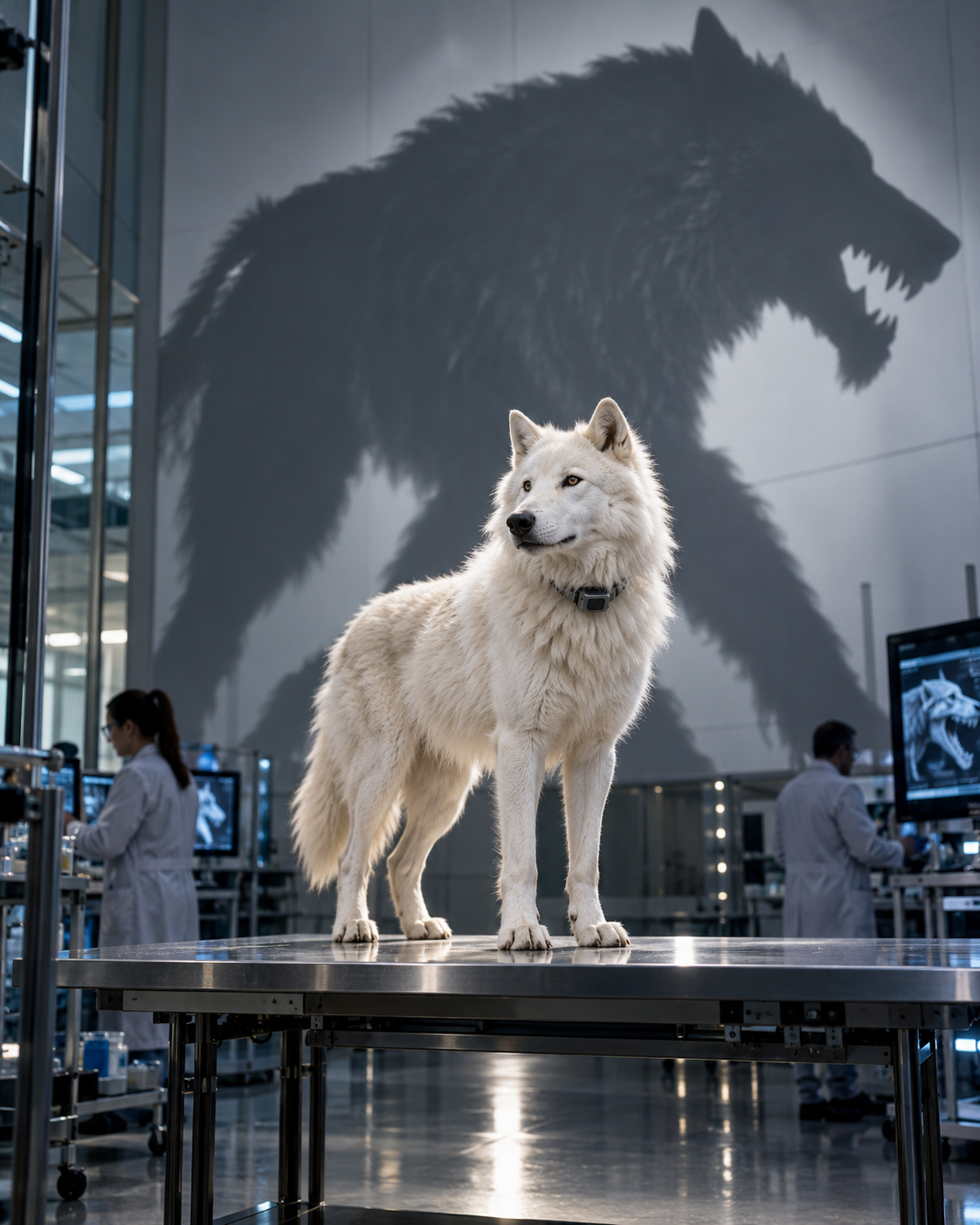
In January 2026, MrBeast presented what appeared to be one of biotechnology's greatest achievements: an animal extinct for approximately 12,000 years had returned to life.
The company responsible, Colossal Biosciences, had supposedly accomplished the impossible. Dire wolves were back. MrBeast toured its laboratories, handled genetically engineered mice, and arranged for two enormous white wolves to receive a cake made of meat.
There was just one problem.
Colossal had not recreated an extinct dire wolf. It had genetically modified modern gray wolves to reproduce selected characteristics of the vanished animal.
That distinction is not a trivial argument about names. It separates the restoration of an extinct species from the engineering of a living one.
The underlying technology deserves serious attention. But MrBeast's presentation turned a remarkable genetic experiment into a claim of biological resurrection that the evidence does not establish.
And by the time his video was published on January 24, 2026, scientists had already spent months explaining why.
1. Twenty Genetic Edits Cannot Recreate Millions of Years of Evolution
The original dire wolf, Aenocyon dirus, was not simply a large gray wolf.
A landmark study published in Nature in January 2021 examined ancient genetic material from five dire wolves. Its researchers concluded that dire wolves belonged to a deeply separated evolutionary lineage, with an estimated divergence from living canids approximately 5.7 million years earlier.
Their outward resemblance to modern wolves concealed a substantially different evolutionary history.
Colossal approached the problem through genetic engineering.
Researchers recovered ancient DNA from a roughly 13,000-year-old tooth and a specimen approximately 72,000 years old. They compared that genetic information with modern wolf genomes, identified variants associated with selected characteristics, and used CRISPR gene editing to alter living gray-wolf cells.
The company reported making 20 changes across 14 genes.
Scientists then used the edited cells in a cloning procedure, creating embryos that were carried by domestic dogs.
Three living animals resulted: Romulus, Remus, and Khaleesi.
The important distinction is that these animals developed from edited modern-wolf cells. They were not clones of ancient dire-wolf cells recovered from fossils.
Colossal's chief science officer, Beth Shapiro, has acknowledged that the animals are gray wolves with genetic modifications, while continuing to defend the company's broader definition of de-extinction.
This is where the scientific achievement and the public claim begin to separate.
Colossal engineered a small number of selected genetic characteristics. It did not restore the complete ancestral genome, population history, or ecological identity of the extinct species.
In an August 2025 investigation published by Nature, researchers reported that only 15 of Colossal's 20 edits matched sequences identified in ancient dire wolves. The remaining changes were intended to reproduce particular effects using other genetic variants.
The difference matters.
A genetic modification that creates a desired characteristic does not necessarily recreate the evolutionary mechanism that originally produced it.
And an animal displaying some recognizable features of an extinct species does not automatically belong to that species.
2. Colossal's Own 2026 Research Makes the Resurrection Claim Harder to Defend
The scientific evidence has become more detailed since MrBeast published his video.
In August 2026, researchers including Colossal scientists published a peer-reviewed study in Cell Genomics examining the ancestry and evolution of extinct dire wolves.
Their analysis produced important findings that refined the earlier understanding of the species.
The researchers reconstructed substantially more of the ancient dire-wolf genome and identified approximately 14.6 million sequence changes relative to the gray-wolf reference genome used in their reconstruction.
They also estimated that the dire-wolf lineage separated from other canids approximately 4.5 million years ago, although uncertainty remained substantial.
The study revised the earlier picture of dire wolves as an almost entirely isolated lineage.
Its strongest model suggested that ancient dire wolves emerged from the mixture of two ancestral canid lineages. Approximately 61% of their inferred ancestry came from a lineage related to the ancestors of modern wolf-like canids, while roughly 39% came from a more deeply separated lineage.
These percentages describe inferred ancient ancestry, not the genetic composition of Colossal's engineered animals.
This is valuable science. It improves our understanding of an animal that disappeared thousands of years ago.
It also exposes the enormous distance between understanding an extinct genome and rebuilding an extinct species.
Consider the numbers.
Colossal reported making 20 targeted edits. Its later genome reconstruction identified roughly 14.6 million differences relative to the modern reference.
That is approximately one targeted edit for every 730,000 identified differences.
This comparison does not measure biological importance. Some mutations can influence many characteristics, while others have little visible effect.
But it illustrates why creating a selection of recognizable traits cannot, by itself, establish that a vanished evolutionary lineage has been restored.
The 2026 researchers also acknowledged significant limitations. Their work relied on two comparatively high-quality ancient specimens, and missing fossil evidence continued to restrict their ability to reconstruct the species' evolutionary history completely.
The paper did not demonstrate that Colossal's engineered animals possessed the restored genetic identity of an ancient dire wolf.
It reconstructed the ancestry of extinct animals.
That is not the same scientific accomplishment as bringing those animals back.
3. Even the White Fur Is Scientifically Contested
The animals at the center of Colossal's announcement are visually extraordinary.
Their thick white coats, substantial bodies, and striking appearance make them ideal subjects for photographs and viral videos.
But appearance is a difficult foundation for declaring an extinct species restored.
Colossal argues that its genetic research supports the likelihood of light-colored dire wolves. The company says variants identified in ancient DNA helped inform the appearance of its engineered animals.
Other scientists have disputed how confidently those characteristics can be reconstructed.
Thomas Gilbert, an evolutionary geneticist at the University of Copenhagen and a scientific adviser to Colossal, publicly questioned whether ancient dire wolves would have resembled the company's white animals.
He suggested that their appearance may instead have been closer to that of a somewhat larger coyote.
The company's interpretation remains different: it maintains that its genomic evidence supports pale fur.
Neither position should be confused with direct observation of a living ancient dire wolf.
Scientists can analyze ancient genetic variants and estimate their effects. They can compare skeletal remains and reconstruct probable physical characteristics.
They cannot simply look at two modern engineered animals and establish that this is precisely how an extinct predator appeared.
There is another problem.
Colossal's three animals were not raised by ancient dire wolves, did not acquire the extinct species' social knowledge, and have never occupied its original ecological environment.
A species is more than a collection of visible characteristics.
Its history includes inherited behavior, interactions with other organisms, adaptation to its environment, and the evolutionary relationships that produced it.
Colossal can engineer selected biological features.
It cannot recreate thousands of years of vanished animal experience.
4. The Conservation Experts Rejected the Claim
The strongest criticism did not come from an entertainer, rival biotechnology company, or political opponent.
It came from specialists responsible for understanding and protecting wild canids.
On April 18, 2025, the International Union for Conservation of Nature's Species Survival Commission Canid Specialist Group published an assessment of Colossal's announcement.
The group acknowledged the technical achievement involved in isolating living wolf cells and genetically modifying them.
But its conclusion about the animals' identity was unambiguous.
“The three animals produced by Colossal are not dire wolves.”
The specialists also rejected their classification as appropriate conservation proxies for the extinct species under the relevant IUCN guidelines.
Their reasoning went beyond genetics.
Dire wolves disappeared along with the ecosystems in which they evolved. Their former prey included animals such as mammoths and giant ground sloths. Modern North American ecosystems are substantially different.
Gray wolves already occupy important predatory roles in those environments.
Producing an animal with selected dire-wolf characteristics therefore does not automatically restore a missing ecological function.
Colossal disputes that interpretation.
Its website maintains that the project follows IUCN conservation principles and that the resulting animals can serve as research models for technologies that may help endangered species.
That is a legitimate scientific ambition.
But agreement with an organization's published principles is not the same thing as receiving that organization's endorsement.
The distinction is especially important when the relevant specialist group has explicitly rejected the central classification.
5. An Extinct Species Cannot Be Restored to an Ecosystem It Will Never Enter
Colossal's public messaging offers an especially revealing contradiction.
Its website describes its achievement as returning the dire wolf to its rightful place in the ecosystem.
Yet the company also acknowledges that it has no plans to release these engineered animals into the wild.
Instead, they live in a privately managed preserve where their health, development, and behavior can be monitored.
There are reasonable reasons for this arrangement.
The animals are genetically engineered, their long-term health and reproductive characteristics require observation, and their ecological effects cannot simply be assumed.
Confinement is a responsible precaution.
But it also exposes the weakness of presenting their existence as ecological restoration.
A carefully maintained population of engineered animals in a protected facility is not the same as restoring a self-sustaining wild species.
The IUCN specialists warned that suggesting extinction can be readily reversed through technology risks distracting from the immediate work of protecting living animals and their habitats.
Their concern deserves attention because habitat destruction, conflict with humans, and the decline of functioning ecosystems cannot be repaired merely by editing a genome.
Even flawless reproduction of an ancient animal would not automatically reconstruct the environment needed to sustain it.
The scientific achievement and the conservation achievement must be evaluated separately.
6. MrBeast Managed to Get the Number of Dire Wolves Wrong
There is a smaller, simpler error in the video.
MrBeast tells viewers that they are watching the only two dire wolves in existence.
But Colossal had already announced three genetically engineered animals.
Romulus and Remus were born in October 2024. Their female counterpart, Khaleesi, followed in January 2025.
The existence of all three was publicly documented months before MrBeast's video appeared in January 2026.
The footage may have been recorded earlier, and the two males were the animals featured in the feeding sequence. The transcript does not establish when that particular scene was filmed.
Nevertheless, the published statement that only two existed was inaccurate.
By October 2026, Colossal was still reporting the existence of all three animals. Its latest update described Romulus weighing approximately 134 pounds, Remus approximately 132 pounds, and Khaleesi approximately 102 pounds.
The company also reported plans to expand the group.
Miscounting engineered wolves is hardly the most serious scientific error imaginable.
But it matters in a video asking viewers to accept a much more extraordinary claim.
If the number of living animals was not checked against the company's published information, the audience has little reason to assume the deeper biological claims received greater scrutiny.
7. The Real Conservation Breakthrough Is Less Spectacular
Colossal has accomplishments that deserve attention without requiring the public to believe dire wolves have returned.
Its researchers developed techniques for collecting and manipulating cells that may reduce the need for more invasive tissue sampling.
The company has also reported cloning four endangered red wolves using genetic material associated with populations carrying valuable ancestral variation.
Unlike the extinct dire wolf, the red wolf is a living species facing a severe conservation crisis.
Adding genetic diversity to its surviving population could have meaningful consequences for its future.
The University of California, Santa Cruz described the red-wolf work in April 2025 as a potential application of the biotechnology developed through Colossal's research.
However, creating cloned animals does not by itself establish that a wild population has recovered.
Colossal has subsequently reported expanding its conservation partnerships, including a 2026 initiative with the U.S. Fish and Wildlife Service to preserve genetic material from threatened and endangered species.
Such projects have identifiable conservation objectives. Their success can eventually be measured through preserved genetic diversity, healthy breeding populations, and improved prospects for species survival.
These are the achievements worth examining.
They are also more difficult to explain in a viral video than announcing that an extinct predator has returned from the dead.
That difference should trouble anyone who wants biotechnology judged by its scientific contributions rather than the excitement of its publicity.
8. The Financial Incentive to Announce a Resurrection Is Real
Colossal is not an ordinary university research laboratory.
It is a privately backed biotechnology company with substantial commercial ambitions.
By August 2025, Nature reported that the company was valued at approximately $10 billion and had attracted investors including prominent entertainment figures.
Its founder, Ben Lamm, has defended the dire-wolf announcement and emphasized the overwhelmingly positive attention it received.
That commercial context does not establish that its scientists misrepresented their work intentionally.
It does, however, make the distinction between evidence and promotion especially important.
The company's scientific and entertainment relationships sometimes overlap.
The August 2026 dire-wolf genome paper includes George R. R. Martin among its authors. Its disclosures identify him as an investor and cultural adviser to Colossal.
The study also includes Colossal executives and researchers, alongside scientists from outside institutions.
Those affiliations do not invalidate the genetic findings. They do make transparency and independent scrutiny essential.
MrBeast's episode gave Colossal valuable exposure.
The video description thanked the company for hosting the visit. Other portions of the episode included disclosed commercial partnerships with Shopify and Wing.
There is no established evidence in the material examined that Colossal paid MrBeast to endorse its claims or controlled his editorial decisions.
The problem does not require such an accusation.
The company's preferred description of its achievement became the video's description of scientific reality.
MrBeast repeated the resurrection claim without explaining the genetic method, the objections from conservation specialists, or the unresolved question of whether these animals qualify as dire wolves.
Access to a laboratory is not independent verification.
Watching an animal eat a cake is not evidence of its evolutionary identity.
And enthusiasm cannot settle a question that specialists continue to dispute.
The Verdict: A Scientific Breakthrough Disguised as Something Greater
Colossal Biosciences has demonstrated that researchers can recover ancient genetic information, identify selected characteristics, modify living animal genomes, and produce healthy offspring through sophisticated reproductive techniques.
That is an important technical accomplishment.
Its potential applications to endangered species deserve continued research.
But those achievements do not establish that an extinct species has returned.
The strongest available genetic evidence identifies Colossal's animals as products of modern-wolf genome engineering, not restored members of the ancient dire-wolf lineage.
The IUCN's canid specialists have rejected the company's classification. Colossal's subsequent peer-reviewed research has made the genetic history of dire wolves more understandable, but it has not demonstrated their resurrection.
MrBeast's failure was not showing viewers a technology that could eventually transform conservation.
It was treating the company's most dramatic interpretation as an established scientific fact.
Colossal engineered wolves with selected traits associated with an extinct predator. MrBeast told his audience the predator itself had returned.
Those are different accomplishments.
The first is impressive enough to deserve serious attention.
The second remains unproved.
And science becomes less credible, not more exciting, when the difference disappears.
References
-
MrBeast — $1 vs $1,000,000,000 Futuristic Tech! (YouTube, January 24, 2026).
Watch the original video
The original work establishes MrBeast's resurrection claims, Colossal laboratory visit, and presentation of the animals. -
Colossal Biosciences — Science: Dire Wolf (company research documentation, undated).
Colossal's scientific explanation
Describes the genetic engineering process, 20 targeted changes across 14 genes, and the company's interpretation of its achievement. -
Perri and colleagues — Dire wolves were the last of an ancient New World canid lineage (Nature, January 13, 2021).
Read the scientific paper
Establishes the original ancient-DNA evidence that dire wolves belonged to an evolutionary lineage substantially separated from living gray wolves. -
Gedman and colleagues — On the ancestry and evolution of the extinct dire wolf (Cell Genomics, August 12, 2026).
Read the peer-reviewed study
Provides the newer paleogenomic reconstruction, evidence of mixed ancient ancestry, estimated evolutionary divergence, and acknowledged research limitations. -
IUCN Species Survival Commission, Canid Specialist Group — Conservation perspectives on gene editing in wild canids (April 18, 2025).
Read the specialist group's statement
Explicitly rejects identifying Colossal's engineered animals as restored dire wolves or suitable conservation proxies under the group's criteria. -
Ewen Callaway — This Company Claimed to ‘De-extinct’ Dire Wolves. Then the Fighting Started (Nature, August 4, 2025; republished by Scientific American, August 15, 2025).
Read the investigation
Documents the genetic methods, disagreements among scientists, Colossal's responses, commercial context, and uncertainties surrounding the animals' appearance. -
Jensen-Seaman and colleagues — The dire wolf (Aenocyon dirus) resurrection that wasn't (The Anatomical Record, published online September 10, 2025; July 2026 issue).
Read the research abstract
Provides an independent scientific critique distinguishing selected genetic modifications from recreation of the extinct species; the accessible abstract does not establish every argument developed in the full paper. -
University of California, Santa Cruz — World's first “de-extinction” is accomplished: Meet dire wolf 2.0 (April 10, 2025).
Read the university report
Explains the scientific case advanced by Colossal-associated researchers and documents the possible conservation relevance of the company's red-wolf cloning work. -
Colossal Biosciences — Dire Wolf (official project website, undated).
Colossal's official project description
Documents the company's assertion that dire wolves have been restored and its simultaneous acknowledgment that the engineered animals are not intended for release into the wild. -
Colossal Biosciences — Colossal's Dire Wolves Mark Their Second Birthday With Healthy Checkups and Plans to Expand the Pack (October 19, 2026).
Read the company update
Reports the three animals' continued existence, latest stated body weights, and proposed expansion; these measurements are company-reported rather than independently verified here. -
Colossal Biosciences — Colossal Biosciences and the U.S. Fish and Wildlife Service Partner to Preserve the Genetics of More Than 2,300 Endangered Species (June 2026).
Read the partnership announcement
Describes a proposed genetic preservation program for threatened and endangered species; the announcement establishes the stated initiative, not its eventual conservation outcomes.