MrBeast’s $40 Million Water Campaign Has a Problem: The Promise Arrives Before the Proof
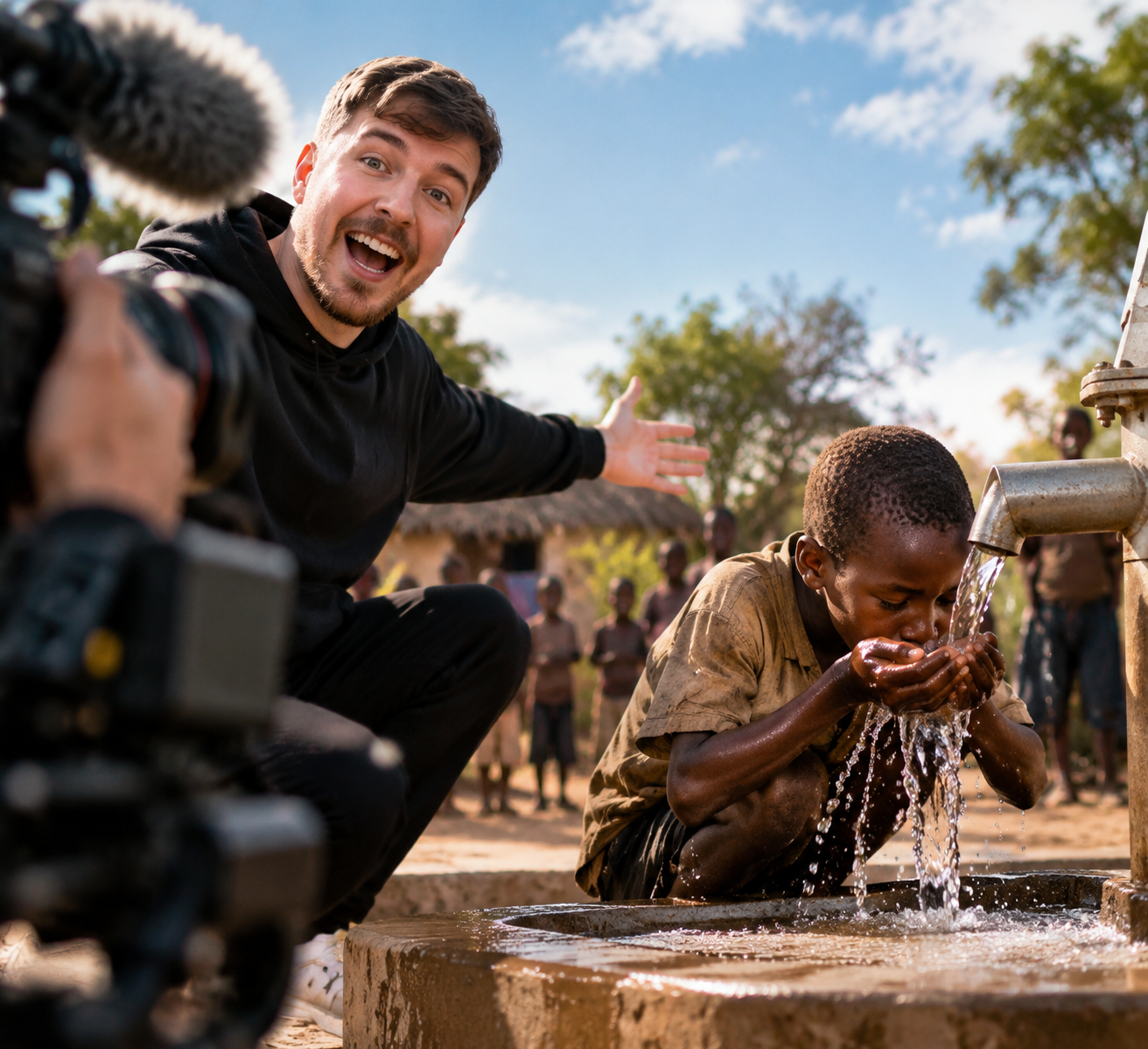
MrBeast’s Team Water campaign raised more than $40 million for an essential cause. But its launch video, 2,000,000 People Get Clean Water For The First Time!, packages a future promise in the language of a completed achievement, while leaving viewers without the evidence needed to judge the campaign’s eventual success.
The distinction matters. WaterAid’s own project timeline places the goal of reaching two million people in September 2030, with the first campaign communities expected to come online in 2026–2027 and outcomes scheduled for documentation and third-party verification. Those are legitimate milestones, but they are not proof that two million people already have reliable, safe drinking water.
Clean Water Projects Worldwide+1
The title is ahead of the timeline
The video appeared on August 1, 2025, the day the public fundraising campaign launched. Its goal was to raise $40 million by August 31, not to announce that two million people had already received clean water. WaterAid’s launch announcement also identifies the featured Malawi well as an installation from July 2025, before the public fundraising period began.
YouTube+2
To be fair, the narration is more careful than the headline. MrBeast says, “We're on a mission to give 2 million people” clean water and describes the featured projects as a sample of the work planned. The problem is the packaging: the title announces the outcome while the narration describes the ambition.
The campaign’s own current project timeline makes the distinction explicit. It places the first communities coming online in 2026–2027, with independent verification of outcomes, and sets September 2030 as the deadline for reaching two million people.
Clean Water Projects Worldwide
A completed demonstration is valuable evidence that a project can work. It is not evidence that the entire campaign has achieved its target.
Clear water is not proof of safe water
The film repeatedly uses visual demonstrations to make its case. Viewers see dirty water, filtration equipment producing clear water, and community members drinking the results. In Colombia, Christo tastes the filtered water; in Ecuador, the output is described as completely clear.
These scenes establish that equipment was installed and people were willing to drink the water. They do not establish its microbiological or chemical safety.
The World Health Organization’s drinking-water monitoring framework defines safely managed drinking water through three requirements: an improved source accessible on premises, availability when needed, and freedom from faecal and priority chemical contamination.
World Health Organization
The video supplies no laboratory results, sampling dates, contaminant concentrations or independent test reports for the featured systems. It also does not demonstrate that water quality remains safe after months of use.
That is a limitation of the film, not proof that the water is unsafe. WaterAid has extensive experience in water infrastructure, and the current campaign plan includes water-quality monitoring and third-party verification. But those safeguards need to be demonstrated through evidence, not inferred from a successful taste test.
WaterAid+1
The Ecuador statistic needs a source
The Ecuador segment makes one of the film’s most consequential claims: 34% of children under five in the featured community experience malnutrition and stomach problems. It also attributes contamination to the local river, naming E. coli and Giardia.
The video does not identify the underlying study or show the water-test results supporting those specific claims.
Ecuadorian news outlet Primicias reported on the project on August 3, 2025, and noted that the video did not present a study supporting its claims about river contamination. That does not establish that no study exists; it establishes that viewers were not shown one.
Primicias
There is strong independent evidence that Ecuador faces serious water-quality problems. UNICEF Ecuador reports that 36.7% of children under five consume water contaminated with E. coli, rising to seven in ten children in the Amazon region. Those figures draw on national data and establish the scale of the broader problem. They do not independently verify the precise statistic for the community featured in the video.
UNICEF
The distinction matters because the film uses the statistic to explain the urgency of its intervention. A serious public-health claim deserves a traceable source, particularly when it concerns children and is being used to solicit donations.
The $1 promise is a planning average, not a receipt
The fundraising pitch says that each dollar donated will provide one person with clean water for a year. That figure is mathematically consistent with the campaign’s target: $40 million divided among two million people equals $20 per person, enough for 20 years at $1 per person-year.
The campaign’s own project page now explains that clean-water provision can cost approximately $10–$150 per person, depending on the community and infrastructure, and that the planned portfolio averages roughly $20 per person. It explicitly describes the dollar-per-year figure as a planning average.
Clean Water Projects Worldwide
That qualification is important. A planning average is useful for setting a fundraising target, but it does not mean that every dollar directly purchases one identifiable person-year of safe water. Different communities need different systems, and the actual costs and maintenance requirements vary.
The public project page provides tangible progress figures. It lists 700 household filters distributed in Brazil, 50 homes connected to a water line in West Virginia, and completed solar-powered water projects in Kenya and Tanzania. It also notes that additional funders contributed alongside Team Water to some projects.
Clean Water Projects Worldwide+1
Those are meaningful outputs, but the page does not provide a project-by-project budget showing how much Team Water contributed, the cost per verified beneficiary, or a campaign-wide reconciliation of spending against the two-million-person target.
This is not evidence of financial misconduct. It is a gap between a compelling fundraising metric and the information needed to evaluate value for money. Donors should be able to distinguish the amount raised, the amount deployed, the contribution of other funders, and the number of unique people actually served.
A promise of decades requires a maintenance plan
In Malawi, MrBeast says the well can “practically last forever” as long as it is maintained, adding that Team Water will take responsibility for that maintenance.
The condition is doing the real work in that sentence. Pumps break. Filters require replacement. Treatment systems need testing. Infrastructure can fail when parts, trained technicians or maintenance funding are unavailable.
The campaign’s current plan recognises this challenge. It describes systems being handed over to local operators and governments and calls for community-led maintenance rather than permanent dependence on outside support. WaterAid likewise describes local maintenance and government support for ongoing costs as part of its approach.
Clean Water Projects Worldwide+1
That is a reasonable model, but it leaves practical questions that the video does not answer. Who pays for repairs at each site? Who tests the water after installation? Who is accountable if a system fails? And what evidence will establish that the infrastructure continues to work over the promised two decades?
The campaign does not need to solve every maintenance problem on camera. It does need to distinguish an expected lifespan from a demonstrated outcome. The current timeline itself acknowledges that the full target is a multiyear undertaking, not a completed result.
The verdict: a fundraising film is not an impact report
Team Water raised more than $40 million, and its public project records document real infrastructure and completed work. WaterAid is an established implementation partner, and the evidence reviewed here does not establish fraud, misuse of funds or failed water systems.
WaterAid+1
The defensible criticism is narrower: the video is much stronger at making the promise feel real than at proving the promise has been fulfilled. Its headline compresses a future target into an apparent achievement, its demonstrations do not establish water safety, and its simplified cost metric obscures the variation behind the average.
The appropriate next step is not to dismiss the campaign. It is to demand the evidence that will determine whether it succeeds: independently verified beneficiary counts, published water-quality results, project-level spending, clear maintenance responsibilities and long-term operational records.
Two million people receiving safe water for decades would be an extraordinary achievement. Until the evidence establishes that outcome, it remains a goal worth pursuing—not a result a launch video can prove.
References
1. 2,000,000 People Get Clean Water For The First Time! — MrBeast, YouTube, August 1, 2025. The original fundraising film establishes the headline, stated goal, featured demonstrations and donation claims; it is not an independent impact evaluation.
2. #TeamWater: Clean Water Projects Worldwide — Beast Philanthropy, current project page. Provides the campaign timeline, cost assumptions, partner information and reported project outputs; its reporting is produced by the campaign organization.
3. YouTube Stars MrBeast and Mark Rober Join with WaterAid to Launch Global #TeamWater Campaign — WaterAid, August 1, 2025. Establishes the campaign’s launch date, fundraising goal, WaterAid partnership and the timing of the featured Malawi installation.
4. Water Supply, Sanitation and Hygiene Monitoring — World Health Organization. Defines the international criteria for safely managed drinking water; it does not evaluate Team Water’s individual installations.
5. El equipo de MrBeast volvió a Ecuador, ¿qué regaló esta vez? — Primicias, August 3, 2025. Reports on the Ecuador project and notes that the video did not present a study supporting its local water-contamination claims; this does not prove that no underlying study exists.
6. Agua, saneamiento e higiene y resiliencia al clima — UNICEF Ecuador. Provides independently sourced national and regional evidence of contaminated drinking water in Ecuador, but does not verify the specific statistic cited for the featured community.
7. #TeamWater — WaterAid, current campaign update. Documents the implementing partner’s stated approach and examples of ongoing work; it provides progress context rather than a completed, independent audit of the campaign’s lifetime results.