MrBeast’s Pyramid Expedition Sells Discovery It Never Makes
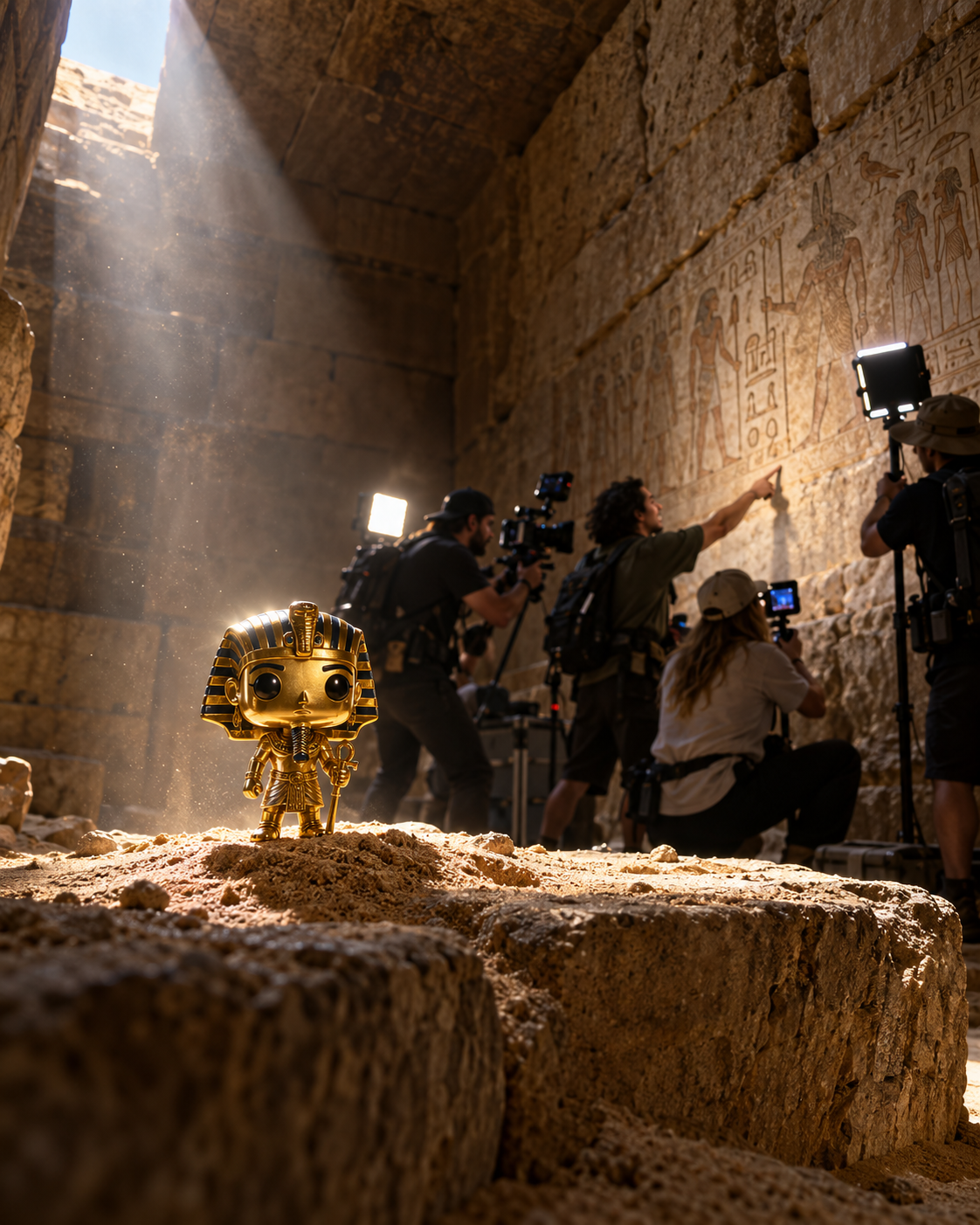
MrBeast’s I Spent 100 Hours Inside The Pyramids! promises an investigation into ancient Egypt’s greatest mysteries. It opens with claims of “unrestricted access,” teases the possibility of finding Pharaoh Khufu’s missing body, and ends by presenting ancient graffiti as the final answer to who built the pyramids. Yet the expedition reports no newly discovered chamber, finds no royal body, and establishes no new archaeological result. Its central failure is the gap between the breakthrough it promises and the guided tour it actually delivers.
The problem is not that the video concludes Egyptians built the pyramids. Archaeological evidence supports that conclusion. The problem is how a production built around spectacle converts established facts, plausible interpretations and unanswered questions into the appearance of an original investigation.
“Unrestricted access” was never the same as independent exploration
The opening declaration that MrBeast somehow has “unrestricted access” establishes the episode’s central attraction: a creator apparently entering places that ordinary people cannot reach.
Egypt’s Ministry of Tourism and Antiquities provided an important qualification in its December 2024 statement. It said MrBeast had not rented the Giza Plateau but had received a filming permit for outside regular working hours. The site remained open to visitors, and archaeologists accompanied the crew to ensure compliance with preservation rules.
That statement does not erase the unusual access the production secured. The team genuinely entered restricted chambers, explored a partially submerged tomb and climbed into upper areas of the Great Pyramid. But the experience was supervised, permitted and guided by Egyptian specialists. It was not unrestricted exploration.
The title also compresses several different activities into the promise of spending 100 hours inside the pyramids. The episode includes an outdoor base camp, camel rides, road travel, helicopter flights and excursions around the plateau. The film documents an expedition lasting 100 hours, not 100 hours physically spent inside pyramid interiors.
There is a further problem with the claim that fewer than 50 people have reached the highest chamber. The narration alternates between “modern history” and “the last 5,000 years” without defining who counts or providing a source for the number. That may sound like a minor detail, but the rarity claim is a major reason viewers are invited to regard the expedition as historic.
The access was exceptional. The film simply gives viewers little basis for measuring just how exceptional it was.
The climactic inscription was known long before MrBeast arrived
At the Great Pyramid’s highest point, guide Dr. Zahi Hawass interprets graffiti associated with Khufu’s work crew. The video translates the inscription as referring to the pharaoh’s team or friends, then presents it as decisive evidence that Egyptians built the pyramids.
The evidence is relevant. It is also old.
In a 2010 article for Ahram Online, Hawass described ancient graffiti in the Great Pyramid’s fifth relieving chamber, including an inscription identifying the “Friends of Khufu” and another referring to a regnal year. The chambers and their builders’ markings were documented during Howard Vyse’s nineteenth-century investigations, recorded in Operations Carried On at the Pyramids of Gizeh in 1837.
The inscription is not a discovery made by this expedition. It is established archaeological evidence that the video brings to a new audience.
That distinction matters because the production repeatedly promises to uncover secrets and settle competing theories. It does not explain the inscription’s research history, show viewers how specialists evaluate it, or distinguish what the writing establishes from what remains uncertain. Instead, a familiar piece of evidence becomes the climax of a mystery the video itself has constructed.
The broad conclusion is sound: ancient Egyptians built the pyramids. But presenting known evidence as the dramatic resolution of an original investigation overstates what this particular expedition accomplished.
A skeleton cannot identify the exact work that caused its injuries
The visit to the Workman’s Tomb offers a potentially more revealing line of inquiry. Hawass shows Jimmy a skeleton said to have remained in its original location for approximately 4,600 years. He explains that remains from the cemetery show signs of strenuous physical labour.
Jimmy then asks whether the strain resulted from moving two-ton blocks. Hawass agrees.
The exchange is satisfying television. It is also a leap from a general finding to a specific explanation.
Egypt’s own Ministry of Tourism and Antiquities account of the Workers’ Town and Cemetery describes a settlement associated with the builders of Khafre’s and Menkaure’s pyramid complexes. An older settlement beneath it may date to Khufu’s reign. The ministry reports that many bodies show evidence of hard physical labour and broken bones, many of which healed.
That supports the presence of workers who performed demanding tasks. It does not establish that the particular skeleton shown moved two-ton blocks, identify the precise task responsible for its injuries, or prove which pyramid that individual worked on.
The distinction is not an argument against Egyptian construction. It is an argument against presenting a plausible explanation as though the skeleton itself confirms it.
The episode could have explained what skeletal injuries can reveal, how archaeologists distinguish different kinds of physical stress, and what evidence links a burial to a particular workforce. Instead, the viewer gets a leading question, an immediate agreement and a confident conclusion.
An expert’s interpretation deserves attention. It should not replace the explanation that allows viewers to judge it.
The Sphinx inspection does not test the claim it claims to settle
Jimmy approaches the Sphinx with a specific question: is there a hidden temple filled with gold beneath the monument? He enters an accessible opening, sees an empty space and presses Hawass for a statement. The scene ends with Jimmy declaring that there is “nothing inside the Sphinx.”
That conclusion is broader than the inspection shown.
In a 2019 report by EgyptToday, Hawass rejected claims of a hidden city beneath the Sphinx as unsupported by scientific evidence while also discussing historical tunnels associated with the monument. The existence of tunnels does not establish a gold-filled temple. Equally, inspecting one opening does not establish that every internal space has been examined.
The appropriate conclusion from the footage is narrower: the team found no gold in the opening it inspected, and the video presents no evidence for the alleged treasure-filled temple.
That would have been enough to challenge the conspiracy theory. Instead, the scene turns a limited inspection into a sweeping declaration.
This is a recurring weakness in the production. The camera reaches a place, an expert provides an explanation, and the edit supplies a satisfying conclusion. The viewer is rarely shown the boundary between what was observed and what the observation can establish.
Real discoveries require evidence, not just extraordinary access
The Great Pyramid does contain unresolved internal structures. Researchers have demonstrated that fact through methods far more informative than entering a chamber and speculating about its purpose.
A 2017 study in Nature reported a large void above the Grand Gallery, with a minimum length of 30 metres. Researchers detected it using cosmic-ray muon imaging and confirmed the result through three detection technologies and independent analyses. The study did not establish what the void was for.
A 2023 study in Nature Communications further characterized a corridor-shaped structure near the pyramid’s northern entrance, measuring approximately nine metres long.
These findings illustrate the difference between discovering an unknown structure and explaining what it means. A void is not automatically a room; a room is not automatically a burial chamber; and an unidentified space does not establish that Khufu’s body is hidden inside it.
MrBeast’s expedition explores known chambers and raises the possibility that the king’s body remains undiscovered. But it does not locate that body or test the possibility through a new archaeological method. The final revelation is the known graffiti.
The film could have used the unresolved voids to explain what archaeologists know, what remains uncertain and why responsible researchers distinguish between detecting a space and identifying its purpose. Instead, uncertainty becomes another source of suspense.
The archaeological mystery becomes a toy advertisement
The Sphinx sequence also exposes the production’s commercial priorities. While investigating the supposed hidden gold, Jimmy buries a gold Swarm collectible with a letter intended for the future. He identifies the item as worth $10,000 and jokes that the conspiracy theory is now correct because the Sphinx really does contain gold.
The video’s official description explicitly discloses promoted content in partnership with Moose Toys. Later, the episode urges viewers to buy Swarms before the season-one collection disappears and promotes a limited run of 1,000 hyperchrome collectibles. Feastables also receives a promotional mention.
The partnership is disclosed; the evidence does not justify calling it a secret sponsorship. The editorial problem is more direct: the production folds a commercial pitch into the narrative of an archaeological investigation.
A supposed search for a hidden gold-filled temple becomes the setup for planting a branded collectible, repeating its advertised value and directing viewers toward a product range. The film supplies no independent valuation for the $10,000 figure. Nor does it explain what makes burying a commercial object an archaeological discovery.
The result is a scene in which a historical monument lends its mystery and authority to a product promotion. The joke works precisely because the audience has been encouraged to think about hidden treasure before the collectible appears.
Commercial content does not automatically invalidate historical information. But when the same sequence moves from a supposed archaeological question to a branded object and a purchase pitch, the viewer deserves a clear distinction between evidence and entertainment.
Verdict: A guided tour marketed as a breakthrough
MrBeast’s expedition gives viewers access to remarkable places and introduces them to genuine archaeological evidence. Those are real features of the film, but they do not establish that the production has made a new discovery or independently tested the mysteries it promotes.
The strongest evidence shown—the workers’ remains and the Khufu-associated graffiti—supports the established conclusion that ancient Egyptians built the pyramids. It does not turn this expedition into original archaeological research. The Sphinx scene does not comprehensively test the hidden-temple claim, the skeleton exchange does not establish the exact work that caused the injuries, and the promised search for Khufu’s body ends without finding it.
My objection is not that the video reaches the wrong broad answer. It is that the production repeatedly blurs the difference between access and discovery, observation and proof, and historical explanation and commercial promotion.
The pyramids do not need an alien theory to be mysterious, and they do not need a YouTube spectacle to make their history compelling. What they deserve is a presentation that respects the difference between what archaeologists know and what an entertaining expedition can actually establish.
The film delivers spectacle. Its claim to have settled ancient Egypt’s mysteries is the part that fails.
References
- MrBeast — I Spent 100 Hours Inside The Pyramids!, YouTube, February 8, 2025. The primary source for the expedition’s claims, the scenes involving the Sphinx and workers’ remains, the final inscription and the Swarms promotion.
- Egypt State Information Service — “Tourism Ministry Refutes Claims of Mr Beast Renting Giza Pyramids for Filming”, December 20, 2024. Records the Egyptian ministry’s account of the filming permit, continued public access and archaeological supervision.
- Zahi Hawass — “Who Built the Pyramids?”, Ahram Online, December 7, 2010. Documents the established archaeological significance of the workers’ cemetery and the “Friends of Khufu” graffiti.
- Howard Vyse — Operations Carried On at the Pyramids of Gizeh in 1837, original publication 1840. Provides historical context for the nineteenth-century exploration of the Great Pyramid’s upper chambers and the recording of builders’ markings.
- Egyptian Ministry of Tourism and Antiquities — “Workers’ Town and Cemetery”, official monument record. Describes the settlement’s relationship to different pyramid-building projects and the physical evidence of strenuous labour among excavated remains.
- Morishima et al. — “Discovery of a Big Void in Khufu’s Pyramid by Observation of Cosmic-Ray Muons”, Nature, November 2, 2017. Establishes how researchers detected and independently confirmed a large internal void without entering it, while leaving its purpose unresolved.
- Boudet et al. and the ScanPyramids research team — “Precise Characterization of a Corridor-Shaped Structure in Khufu’s Pyramid by Observation of Cosmic-Ray Muons”, Nature Communications, March 2, 2023. Documents a separate nine-metre corridor and illustrates the distinction between detecting an internal structure and determining its purpose.
- Fatma El-Bakry — “Hawass Affirmed the Presence of Three Tunnels Inside Sphinx”, EgyptToday, April 20, 2019. Provides context for Hawass’s rejection of unsupported hidden-city claims and his discussion of historical tunnels associated with the Sphinx.
Clarify my strongest evidence-versus-spectacle argument