MrBeast's 14-Day Fast: The Doctor Was Watching. Who Was Watching the Recovery?
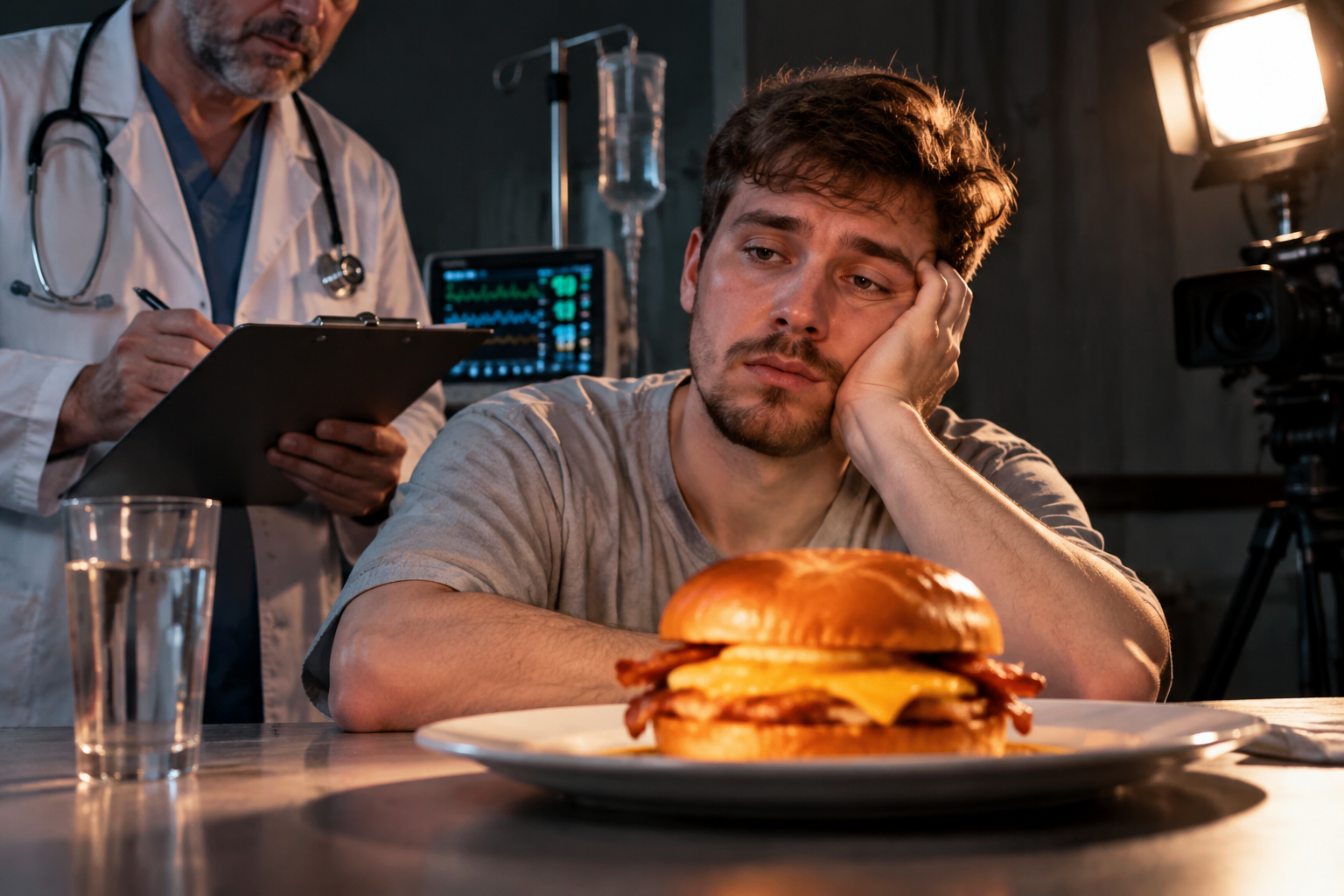
MrBeast called it a 30-day challenge. He lasted 14 days, lost 18 pounds, became so exhausted that standing and walking were difficult, and eventually surrendered to a breakfast sandwich prepared by Gordon Ramsay. The video repeatedly reassures viewers that doctors are monitoring him. But it leaves a much more important question unanswered: what happened medically when he started eating again?
I am not accusing MrBeast of having suffered refeeding syndrome. The video establishes no such diagnosis. My criticism is that it introduces a potentially serious medical complication, acknowledges the danger, and then ends the experiment without showing viewers how the recovery was managed.
That is a significant omission in a video watched by millions.
The fast was medically supervised. That matters.
There is evidence of genuine medical involvement. Jimmy says doctors monitored his vital signs daily, discusses blood-test results, and consults a doctor when his energy deteriorates.
The doctor reports that his electrolytes remain satisfactory but expresses concern about his declining energy. He explicitly offers to stop the fast for Jimmy's safety. Jimmy acknowledges that the experiment is catching up with him.
This is not a case where we can fairly claim that he simply starved himself without medical oversight.
But monitoring someone while they are fasting and managing their return to eating are two different responsibilities.
Refeeding syndrome is not a throwaway line
Refeeding syndrome occurs when nutrition is reintroduced after prolonged starvation. The return of carbohydrates stimulates insulin, which can drive phosphorus, potassium and magnesium into cells, causing dangerous changes in blood electrolyte levels.
The American Society for Parenteral and Enteral Nutrition (ASPEN) identifies more than seven days without meaningful food intake as a significant risk criterion. Its recommendations include checking phosphorus, potassium and magnesium before feeding, monitoring electrolytes every 12 hours during the first three days in high-risk patients, and providing thiamine before feeding.
aspenjournals.onlinelibrary.wiley.com
Wiley Online Library+1
The British National Institute for Health and Care Excellence (NICE) similarly identifies more than ten days with little or no nutritional intake as a high-risk criterion. Its guidance calls for appropriately trained healthcare professionals and a gradual return to nutritional requirements.
NICE+1
There is an important qualification. A 2025 consensus from the Australasian Society of Parenteral and Enteral Nutrition takes a more conservative approach to identifying risk, requiring at least two risk factors. It also emphasizes that actual refeeding syndrome is rare and that the evidence behind risk-screening methods remains imperfect.
PMC+1
These differences make individual medical assessment essential. They do not justify treating a normal electrolyte check during fasting as proof that refeeding is safe.
ASPEN specifically warns that blood electrolyte levels can appear normal even when the body's total stores are depleted. The doctor's reassuring comment about Jimmy's electrolytes therefore cannot, by itself, establish that the subsequent return to eating was safe.
aspenjournals.onlinelibrary.wiley.com
Wiley Online Library+1
What proper medical supervision can actually look like
There is published research on medically supervised water-only fasting that provides a useful comparison.
A 2018 study by Finnell and colleagues reviewed 768 fasting visits involving 652 patients at a residential medical facility. Its protocol included comprehensive medical examinations, blood testing, twice-daily monitoring of vital signs, reduced physical activity and a structured refeeding period lasting half the duration of the fast.
For a 14-day fast, that meant approximately seven days of refeeding, beginning with juice and progressing gradually to solid plant foods. The study recorded two serious adverse events requiring hospitalization, involving dehydration and dangerously low sodium levels.
PMC+1
This was a retrospective study at one facility, not a universal clinical standard. Its laboratory records were also incomplete, limiting the conclusions that can be drawn.
Nevertheless, it illustrates something important: medical supervision is a complete process, not simply checking somebody's vital signs and declaring that everything looks good.
MrBeast's video documents daily medical attention, but does not identify the supervising physicians, publish the relevant laboratory results or explain the refeeding arrangements. We cannot establish that these safeguards were absent. We can establish that the audience was not shown them.
The Crohn's disease explanation changes the context
There is another important detail missing from the video.
After its release, Jimmy explained that he has Crohn's disease and wanted to see whether giving his digestive system a break from food might reduce inflammation. He described the experiment as personally useful.
Dexerto+1
That is a more meaningful motivation than simply losing weight. It also makes the medical questions more important.
ASPEN specifically includes Crohn's disease among conditions associated with increased refeeding risk. That does not establish Jimmy's individual risk category, but it is relevant information when assessing a prolonged fast.
aspenjournals.onlinelibrary.wiley.com
Wiley Online Library
There is now some interesting research in this area. A randomized, controlled study published in Nature Medicine on January 13, 2026, investigated a fasting-mimicking diet in adults with mild-to-moderate Crohn's disease.
Participants followed five consecutive days of a calorie-restricted fasting-mimicking diet each month for three months, returning to their normal diet between cycles. The researchers reported better clinical response and remission rates in the intervention group than in the control group.
Nature Medicine
But this distinction matters enormously: a structured, calorie-restricted dietary intervention is not a 14-day water-only fast.
The newer research does not validate Jimmy's experiment as a Crohn's treatment. Nor does it establish that his personal experience was worthless. It demonstrates why an individual's experience, a medical intervention and a clinical trial must not be treated as interchangeable evidence.
The real physical cost emerged later
Perhaps the most revealing information came after the original video.
In a later appearance on Theo Von's podcast, Jimmy discussed the results of a before-and-after DEXA scan, which measures body composition.
He reported losing approximately 13 pounds of fat and seven pounds of lean mass. He separately described losing around six pounds of muscle and said that the muscle did not simply return when he started eating again.
HappyScribe
These are Jimmy's reported measurements, not independently published scan results. Lean mass is also not identical to skeletal muscle.
But his account changes how the original 18-pound weight-loss figure should be understood.
The video presents the falling number on the scale as a dramatic milestone. The later account reveals that the loss included substantial lean tissue, alongside fat, and that the consequences extended beyond the final weigh-in.
Jimmy also described the final days as particularly debilitating. Standing and walking became difficult, and he never experienced the supposed mental clarity he had hoped fasting would bring. He was simply exhausted.
HappyScribe
That is considerably more useful information than watching a man lose weight and then have his head shaved.
The entertainment ending is not a medical ending
The video finishes with the haircut. Chris starts shaving Jimmy's head, Jimmy loses confidence in his friend's razor skills, and a professional barber completes the job.
It is a satisfying ending to the entertainment challenge. It is not a satisfactory ending to the medical story.
The title promises 30 days, but the actual fast lasts 14. The video does acknowledge the failure, and Jimmy deserves credit for ending the experiment rather than forcing himself to reach an arbitrary target.
However, the production gives considerable attention to the spectacle of resisting food, the Feastables photoshoot, the chocolate factory, the friends' food ambushes and the eventual punishment. The recovery receives virtually none.
There is no documented account of the first 72 hours after food was reintroduced. There is no explanation of subsequent meals, electrolyte monitoring or clinical follow-up. The video does not establish whether these things happened off camera.
That distinction is the heart of my criticism.
MrBeast has no obligation to publish his private medical records. But once a production uses doctors and medical tests to reassure viewers about an extreme physical challenge, it assumes a responsibility not to leave the most consequential safety question unexplained.
A disclaimer saying not to try this at home is useful. It does not explain what responsible medical supervision actually involves.
The verdict: The missing half of the experiment
I do not dispute that Jimmy attempted the fast, that doctors monitored him, or that he eventually stopped when he could no longer maintain the challenge.
I also will not claim that he developed refeeding syndrome or that his doctors failed him. The available evidence does not establish either conclusion.
What it does establish is that the video documents a 14-day water-only fast, significant physical deterioration and a medically consequential return to eating, without adequately documenting the final stage.
The subsequent DEXA account makes the omission more revealing: the experiment cost Jimmy lean mass as well as fat, and he described lasting consequences for his physical condition.
Thirty days was the spectacle. Fourteen days was the result. But the most important part of the experiment was what happened after the cameras stopped following the fast.
That is the story MrBeast's video never properly tells.
References
1. I Didn't Eat Food For 30 Days — MrBeast, YouTube, July 2, 2022. Original account of the challenge, medical monitoring, physical deterioration and decision to break the fast.
2. Nutrition Support for Adults: Recommendations (CG32) — NICE, 2006. Establishes clinical criteria for refeeding risk and the need for qualified medical supervision.
3. ASPEN Consensus Recommendations for Refeeding Syndrome — da Silva et al., Nutrition in Clinical Practice, 2020. Provides adult risk criteria, electrolyte-monitoring recommendations and guidance on nutritional reintroduction.
4. The Australasian Society of Parenteral and Enteral Nutrition: Consensus Statements on Refeeding Syndrome — Matthews-Rensch et al., Nutrition & Dietetics, March 2025. Explains the more conservative risk criteria, rarity of actual syndrome and importance of clinical monitoring.
5. Is Fasting Safe? A Chart Review of Adverse Events During Medically Supervised, Water-Only Fasting — Finnell et al., BMC Complementary Medicine and Therapies, February 20, 2018. Documents a residential fasting protocol, its refeeding process and recorded adverse events.
6. E548: MrBeast — This Past Weekend with Theo Von, podcast transcript, approximately 50:46–52:24. Contains Jimmy's later account of his DEXA results, muscle loss and physical exhaustion.
7. MrBeast Reveals How Gordon Ramsay Made Him Fail 'Hardest' Challenge Yet — Emma Hill, Dexerto, July 3, 2022. Reports Jimmy's explanation that Crohn's disease motivated his experiment.
8. A Fasting-Mimicking Diet in Patients with Mild-to-Moderate Crohn's Disease: A Randomized Controlled Trial — Kulkarni et al., Nature Medicine, January 13, 2026. Provides clinical evidence for a structured fasting-mimicking dietary intervention, not prolonged water-only fasting.