MrBeast’s Buried-Alive Challenge Makes Death the Entertainment—and Safety a Mystery
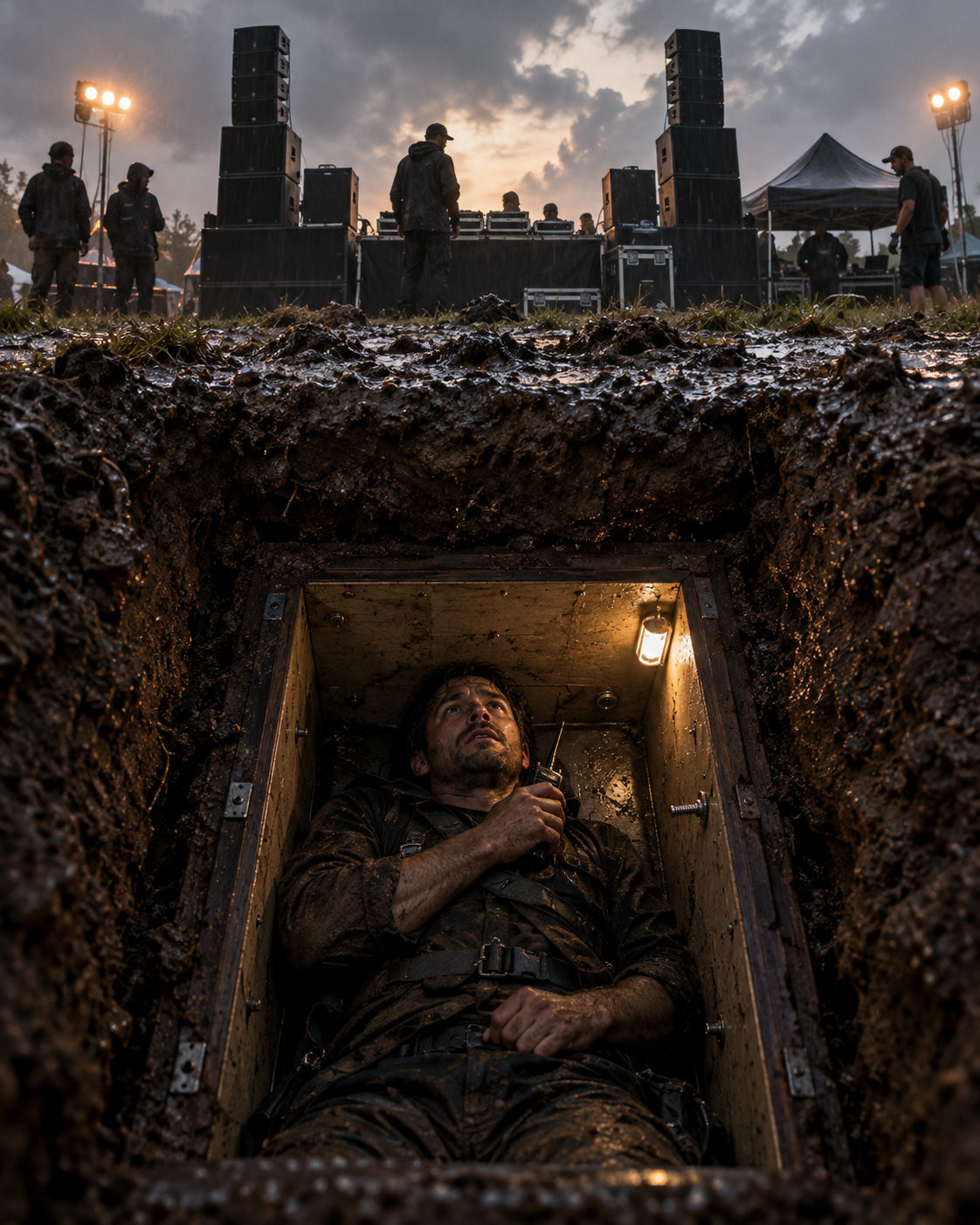
MrBeast's I Spent 7 Days Buried Alive has a problem more serious than its deliberately terrifying premise: it makes potentially fatal danger the central attraction while giving viewers remarkably little information about how that danger was controlled.
Jimmy Donaldson spends seven days underground beneath a claimed 20,000 pounds of dirt. He fears the coffin will collapse, worries about suffocation, discovers a loose bolt, experiences heavy rain above ground, and eventually questions whether he will survive standing up.
The production repeatedly reminds viewers that this is real and dangerous. Yet the engineering, emergency procedures and medical safeguards that would distinguish a carefully controlled stunt from an extraordinary gamble remain largely outside the story.
That is an important omission. When a production makes death its entertainment premise, safety should be more than background equipment.
The coffin becomes part of the entertainment
The opening establishes the stakes immediately.
Jimmy says:
"I'm entrusting my life to this coffin for the next seven days."
He worries about 20,000 pounds of dirt pressing down on the structure and says he needs people watching continuously to prevent suffocation.
Then the production introduces a particularly troubling sequence.
The crew places 15 speakers above his grave and uses them to shake the coffin. During this sequence, Jimmy discovers an unscrewed bolt at its base. He asks whether he should be concerned, and a voice responds:
"Max it out."
Jimmy subsequently complains that the vibrations are hurting his head.
The video never shows an engineering inspection, an assessment of the loose connection, or an explanation of whether the coffin remained structurally sound.
Perhaps the bolt was insignificant. Perhaps the structure had substantial safety margins. We cannot establish either conclusion from the footage.
But the production knows how to turn an apparent mechanical problem into entertainment. It does not give viewers the corresponding technical information needed to understand whether the problem was actually resolved.
A camera can show that someone is frightened. A walkie-talkie can communicate an emergency. Neither establishes that the structure protecting that person is sound.
The excavation raises questions the video never answers
The weather creates another potential hazard.
After heavy rain and thunder, the crew expresses concern that the dirt above Jimmy has become heavier. They worry about the possibility of the coffin being crushed.
The video then introduces an underground tunnel excavation.
Jimmy's friends spend the night digging toward his coffin, deliberately playing construction noises to conceal the excavation. One crew member admits:
"I'm not certified to do this at all."
This statement does not establish incompetence or a regulatory violation. OSHA's definition of a competent person does not simply require a certificate; it requires the ability to identify hazards and authority to take corrective action.
But it makes an important question unavoidable: who was responsible for assessing the excavation?
OSHA's construction excavation guidance identifies several essential precautions:
- Assessing soil conditions and selecting appropriate protective systems.
- Inspecting excavations before work and throughout operations.
- Reinspecting after rainstorms or other events that increase hazards.
- Evaluating atmospheric hazards, including insufficient oxygen.
- Providing safe access, emergency equipment and appropriate rescue arrangements.
Its regulations specifically require inspections after rainstorms for covered excavation work. OSHA's excavation safety guidance and 29 CFR 1926.651 explain these requirements.
OSHA's confined-space construction rules also address hazard assessment, ventilation, atmospheric monitoring, communications and emergency rescue. Their legal applicability depends on the particular workplace, people involved and operation; this video alone cannot establish a violation. OSHA confined-space requirements.
The problem is not that the video proves nobody performed these checks. It doesn't.
The problem is that an excavation involving a buried person is presented as an overnight project for friends, while the person responsible for technical oversight is never identified.
The audience gets the jokes, the digging and the suspense. It does not get the safety plan.
The medical ending is not a medical report
Jimmy's concerns about blood clots are not invented for dramatic effect.
He says he promised his doctor he would move daily to reduce the risk. He also acknowledges that remaining in the same position for seven days could be dangerous.
The CDC identifies limited movement and reduced blood flow as risk factors for venous thromboembolism, which includes deep vein thrombosis (DVT) and pulmonary embolism.
There is an important detail the video does not explain: approximately half of people with DVT have no symptoms. Diagnosis requires appropriate medical testing, not simply an absence of obvious discomfort. CDC: About Venous Thromboembolism; CDC: Testing and Diagnosis.
At the end, the production shows a request to wait for a medic, questions about nausea and dizziness, and then Jimmy standing for the first time in a week.
He experiences weakness in his legs and a rush of blood to his head. The scene concludes with relief that he has survived.
That is an understandable emotional payoff. It is not a complete account of the medical assessment.
The video does not establish what testing, monitoring or subsequent medical follow-up occurred. Nor does it establish that Jimmy developed a blood clot.
The distinction matters. An entertaining recovery scene should not be mistaken for evidence that a serious medical risk was comprehensively assessed.
There is evidence that MrBeast understood the engineering requirements
A fair investigation must acknowledge information that weakens the accusation of reckless preparation.
In his January 2023 interview with Lex Fridman, Donaldson discussed his earlier 50-hour burial challenge.
He said the coffin had been buried ten times before he entered it, for periods longer than the challenge itself. He described testing the airflow and consulting David Blaine, who had experience spending a week underground, along with other people familiar with burial challenges.
He also described extensive research and professional consultation.
These are significant admissions. They indicate that the earlier challenge was not simply a coffin, a pile of dirt and a group of friends hoping for the best.
Lex Fridman Podcast #351 contains the interview and discussion of the previous burial challenge. A transcript preserves the relevant exchange.
But this evidence has a limitation: it concerns the earlier 50-hour challenge.
The 2023 production extended the experience to 168 hours, more than three times as long.
The seven-day video does not explain whether the earlier structural tests, airflow arrangements and emergency procedures were repeated or upgraded for the longer challenge.
In a 2026 interview with Jon Youshaei, Donaldson also recalled sleeping in a coffin in his garage for hours each night before the seven-day video. He explained that he wanted to establish whether he would experience a panic attack.
That demonstrates preparation for the psychological experience. It does not, by itself, establish the engineering safety of the final installation.
The experiment became a production template
There is another development worth considering.
In the 2026 interview, the Beast Games production discusses burying nine contestants alive in oversized coffins, with four cameras inside each one.
The team explicitly explains that its camera-placement approach benefited from Jimmy's seven-day experience.
This does not establish that the later contestants were exposed to the same depth, duration or danger. Nor does it prove that their production lacked safety procedures.
It does establish that the original challenge became a reference point for subsequent productions.
That changes the significance of the missing information.
A one-off personal endurance challenge is one thing. A format that is adapted for multiple contestants is another. Engineering standards, emergency procedures and medical safeguards become increasingly important as the production repeats the concept.
The interview explains how the team learned to film people inside coffins. It does not provide a comparable account of the safety engineering behind the later installations.
The distinction between learning how to film a dangerous challenge and learning how to control its dangers deserves considerably more attention.
Even the sponsorship receives clearer qualifications
The video incorporates Verizon 5G Home Internet into the celebration of MrBeast reaching 200 million subscribers.
Jimmy connects to the service underground through a specially adapted setup, and the crew turns the achievement into a product demonstration.
There is an important qualification in the official video description: Verizon's 5G Home Internet is not a mobile service, and the demonstration does not represent typical customer experience.
That is a sensible commercial disclosure. It prevents viewers from interpreting an unusual demonstration as an ordinary product capability.
The same precision would have improved the safety presentation.
The official description says:
"Please don't try this at home lol."
That warning is better than nothing. But it does not explain the precautions that made the challenge possible or distinguish the deliberately frightening moments from actual safety failures.
The production knows how to qualify a commercial claim. It should apply comparable care to claims involving physical danger.
The verdict: A dangerous premise deserves more than dramatic editing
I cannot establish that MrBeast's production was negligent, that the coffin was structurally unsound, or that Jimmy was deprived of adequate medical supervision.
There is evidence of substantial preparation for his earlier burial challenge, including airflow testing, repeated burial tests and expert consultation. That evidence must not be ignored.
But the seven-day video leaves important questions unanswered.
Who approved the coffin's structural design? What happened when the loose bolt was discovered? Who assessed the site after heavy rain? Who supervised the tunnel excavation? How was the atmosphere monitored? What emergency extraction arrangements were available? What medical assessment followed the seven days of restricted movement?
These are not unreasonable demands for technical trivia. They are the questions that distinguish a professionally controlled stunt from a dangerous experiment.
The most revealing feature of this production is that it repeatedly tells viewers how close Jimmy might be to death while providing little information about the systems designed to prevent it.
The audience is invited to fear the coffin, the dirt, the rain and the machinery. It is not given enough information to judge the safeguards behind them.
MrBeast may have engineered an exceptionally well-controlled challenge. But the video does not demonstrate that achievement. It demonstrates how effectively the appearance of danger can hold an audience's attention.
That is an editorial failure worth taking seriously.
References
1. I Spent 7 Days Buried Alive — MrBeast, November 18, 2023. The original challenge, including the coffin, loose bolt, rain, tunnel excavation, medical concerns and Verizon sponsorship.
YouTube
2. OSHA — Construction: Trenching and Excavation. Establishes the importance of soil assessment, competent-person inspections, atmospheric testing, water precautions and inspections following rainstorms.
Occupational Safety and Health Administration
3. OSHA — 29 CFR 1926.1204: Permit-Required Confined Space Program. Sets out hazard evaluation, ventilation, monitoring, communications and emergency-equipment requirements for covered construction work.
Occupational Safety and Health Administration+1
4. CDC — About Venous Thromboembolism, March 5, 2025. Explains the relationship between limited movement and blood-clot risk, including the fact that many DVT cases have no symptoms.
CDC
5. CDC — Testing and Diagnosis for Venous Thromboembolism, May 15, 2024. Explains why appropriate medical testing is necessary to diagnose blood clots rather than relying exclusively on symptoms.
CDC
6. Lex Fridman Podcast #351 — MrBeast, January 2023. Donaldson describes the earlier burial challenge's airflow testing, repeated burial tests and consultations with experienced people, providing important counterevidence to claims of wholly improvised preparation.
Lex Fridman #351+1
7. How MrBeast Works 18 Hours Per Day — Jon Youshaei, April 3, 2026. Documents Donaldson's preparation for the seven-day burial and the later use of buried coffins for nine Beast Games contestants, with four cameras per coffin.
Jon Youshaei · Modern Creator+1
8. Colin and Samir Show — MrBeast Interview Transcript, September 20, 2021. Provides Donaldson's earlier account of coffin testing, ventilation, medical planning and professional consultation; it concerns the earlier burial project, not independent verification of the 2023 challenge.
The Singju Post+1