All-In Podcast

All-In Podcast

Watch Facts Elle's
...

August 1, 2025

Trump AI Speech & Action Plan, DC Summit Recap, Hot GDP Print, Trade Deals, Altman Warns No Privacy

  • The All-In circle has direct access to Washington: David Sacks helped shape the AI agenda, and Trump signed three AI executive orders around their summit. Friedberg said the event was built in ten days and cabinet appearances were squeezed around Trump’s security schedule. (The White House)

  • The administration’s AI program centers on exports, faster infrastructure permitting and ideological-neutrality rules for models bought by the federal government. Sacks explicitly said the neutrality order does not control private AI products; it sets procurement conditions for vendors selling models to Washington. (The White House)

  • Trump’s copyright position, as Sacks described it, favors broad training access to internet material while preserving liability for copying or plagiarism in outputs. Friedberg distinguished open-web material from paywalled or pirated content, arguing the latter should be licensed or removed from training data.

  • Palihapitiya said a business he is involved with licensed video content to OpenAI only briefly because the long-run value of copyright was impossible to price. Six months later, he said he is underwriting copyright value toward zero and focusing on operational moats rather than legal protection.

  • Sam Altman’s warning about AI privacy was one of the clearest unresolved risks: intimate ChatGPT conversations currently lack therapist-, lawyer- or doctor-style privilege. Sacks said chat logs are legally closer to search history despite being far more personal, while Calacanis proposed default encryption that providers themselves cannot read.

  • Calacanis said Commerce Secretary Howard Lutnick privately described a negotiation pattern: Trump opens with an extreme demand, Lutnick establishes a workable deal, then Trump returns near the finish to add several asks. Calacanis presented this as the emerging logic behind tariff talks that initially looked chaotic.

  • The strongest argument for the Fed’s caution came from tariff-sensitive goods, not headline GDP. Friedberg highlighted June monthly price jumps of 1.3% for furnishings and household equipment and 0.9% for recreational goods and vehicles, saying these may be early tariff effects.

  • Calacanis said Lutnick also told him he would advise Trump to direct foreign-investment commitments toward nuclear plants and small modular reactors. That private comment linked trade negotiations directly to the administration’s concern that AI growth will be constrained by power availability.


...

July 23, 2025

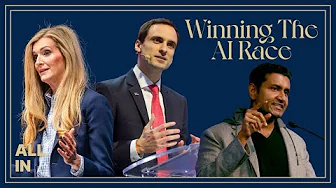
Winning the AI Race Part 5: President Trump on the AI Action Plan

  • Trump’s AI program was industrial policy as much as technology policy: build data centers, chips, transmission and power faster. The infrastructure order signed that day accelerates federal permitting, opens federal land and resources, and allows financial support for qualifying projects. (The White House)

  • The administration wants the full American AI stack—not merely chips—to become the default abroad. A second order created an export program covering hardware, cloud and data infrastructure, models, cybersecurity and applications, with government tools including loans, guarantees and technical assistance. (The White House)

  • Federal purchasing power will be used to push AI vendors toward the administration’s definition of ideological neutrality. The procurement order requires contracted LLMs to satisfy “truth-seeking” and “ideological neutrality” principles, with vendors potentially bearing decommissioning costs for uncured noncompliance. (The White House)

  • Trump explicitly argued that AI training should not require payment or contracts with every author or publisher whose work is read. He distinguished learning from copying or plagiarism, framing broad access to books and articles as necessary for competition with China; the speech itself did not change copyright law.

  • Trump also called for one federal AI standard that would supersede differing state rules. His argument was that the strictest state could otherwise become the effective national regulator and expose developers to overlapping litigation; this was a policy demand in the speech, not one of the three orders signed onstage.

  • Trump said he initially considered breaking up Nvidia, then abandoned the idea after being told a serious rival effort could still take roughly a decade to catch it. In his telling, Nvidia’s extraordinary technical lead—not a detailed antitrust analysis—was what persuaded him to move on.

  • The administration expects major AI developers increasingly to become power producers rather than ordinary grid customers. Trump said companies could build their own generation and sell excess electricity back to the grid, while presenting nuclear, gas, oil and coal expansion as necessary to meet AI’s extraordinary electricity demand.

...

July 23, 2025

Winning the AI Race Part 4: Scott Bessent, Howard Lutnick, Chris Wright, and Doug Burgum

  • Howard Lutnick said the $550 billion U.S.–Japan deal was built as committed Japanese capital for U.S.-chosen projects, with America receiving 90% of profits. He said he devised the structure after Japanese executives warned their market would never truly open; South Korean officials came to his office immediately after the deal was announced. (The White House)

  • Scott Bessent estimated hyperscalers are already spending about $300 billion a year on AI—roughly 1% of U.S. GDP—and hopes construction gives way to a productivity boom in 2026. His economic case is that AI could recreate 1990s-style growth: faster output without equivalent inflation, improving the debt trajectory.

  • The administration’s near-term AI power strategy is overwhelmingly about natural gas, not new nuclear plants. Chris Wright said gas will provide most new electricity because it is fast and reliable; he put advanced nuclear roughly ten years from operating on normal market economics despite three Gen-4 reactors expected at Idaho National Laboratory next summer.

  • The government is actively pairing AI infrastructure with power generation on federal land, and private demand appears substantial. Wright said 16 offered Energy Department locations drew 300 responses; four sites were selected first, matching DOE’s subsequent announcement of Idaho, Oak Ridge, Paducah and Savannah River. (The Department of Energy's Energy.gov)

  • Doug Burgum gave developers an unusually concrete shortcut: build AI facilities beside stranded gas rather than waiting for new pipelines and transmission lines. He specifically named the Marcellus, Permian and Bakken, arguing co-location can avoid two of the hardest permitting bottlenecks and support off-grid generation.

  • Lutnick described China policy as a moving boundary: ordinary trade should remain open, while the most capable chips and comparable strategic technologies stay restricted. For allied AI clusters, he said access may depend less on country tiers than on cluster size and whether trusted American companies control the operator and cloud.

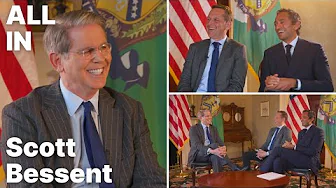
  • Bessent said he has breakfast with Federal Reserve Chair Jerome Powell almost every week and is personally pressing the case that tariffs need not create persistent inflation. He expects at least $300 billion in tariff revenue over twelve months and argued producers have so far absorbed much of the cost through lower prices or margins.

  • Bessent sees regulated dollar stablecoins as a new buyer of short-term U.S. government debt, potentially offsetting gradual Chinese Treasury divestment. The GENIUS Act requires qualifying reserve assets including short-dated Treasuries; Treasury itself later said stablecoin growth could create substantial new T-bill demand, though the scale remains uncertain. (home.treasury.gov)

...

July 23, 2025

Winning the AI Race Part 3: Jensen Huang, Lisa Su, James Litinsky, Chase Lochmiller

  • MP Materials’ Pentagon deal is an investment and guaranteed market, not a conventional subsidy. DoD is investing $400 million, taking equity and warrants, setting a commodity price floor, committing to 100% offtake for a planned 10x magnet facility, and sharing profits above a threshold 50/50.

  • TSMC’s Arizona fab is already matching Taiwan on AMD’s key yield metric, with a relatively modest cost penalty. Lisa Su said Arizona yields are equivalent to Taiwan’s and estimated U.S. production costs at more than 5% but less than 20% higher, roughly low double digits.

  • Even with U.S. reshoring, the chip supply chain would remain acutely exposed to a Taiwan disruption. Su said industry reserves would cover “months, not years,” while arguing that complete reshoring is unrealistic because lithography and other critical components will remain globally distributed.

  • Crusoe’s buildout shows AI infrastructure becoming physical megaproject construction at extraordinary scale. Its Abilene site targets more than 1.2 gigawatts and 400,000 NVIDIA GPUs with roughly 4,000 workers onsite daily, while Crusoe says its broader development pipeline totals about 40 gigawatts.

  • At NVIDIA, AI is already mandatory infrastructure for technical work rather than an experimental tool. Jensen Huang said every software engineer and chip designer uses AI, credited it with expanding the company’s capacity to pursue ideas, and predicted workers who ignore AI will lose out to peers using it.

  • NVIDIA’s older GPUs retain unusual economic value because software keeps improving their performance after shipment. Huang said Hopper hardware gained roughly fourfold performance through software, while estimating residual values around 75–80% after one year, 65% after two and 50% after three.

  • Huang views leading Chinese open models as strategically beneficial to the United States when they run on the American computing stack. He cited DeepSeek, Qwen and Kimi and argued their global adoption strengthens U.S. platform dominance because developers—including many in China—continue building on American technology.

  • Huang personally reviews compensation recommendations across NVIDIA’s 42,000 employees and says he always increases the company’s proposed spending. He described using machine learning to sort compensation data and confirmed maintaining discretionary equity grants, explaining his philosophy simply: take care of people and everything else follows.

...

July 23, 2025

Winning the AI Race Part 2: Vice President JD Vance

  • Vance said deportations should accelerate now that ICE has more funding and the administration has won favorable court rulings. He acknowledged frustration inside the administration over the pace and described himself and Stephen Miller as among its hardest-line voices on immigration.

  • The administration’s immigration compromise is enforcement without amnesty, while using automation to reduce industries’ dependence on migrant labor. Vance singled out agriculture as technologically behind and said automation is his preferred answer when employers argue they cannot operate without immigrant workers.

  • Vance described the administration’s AI strategy as deliberately choosing rapid technological development over Europe’s more cautious regulatory approach. His goal is not merely beating China but spreading an American technology stack globally, while still addressing privacy, consumer protection and intellectual-property risks.

  • A foreign leader privately proposed to Vance a NATO-like alliance outside Europe built around countries using American technology and sharing access to weapons. Vance said the idea came only the previous week and was so new that he had not yet discussed it with President Trump.

  • On China, Vance wants American companies selling broadly into the Chinese market while withholding technologies whose transfer could compromise critical intellectual property. He framed the objective as reversing an imbalance in which Chinese firms can access American markets while U.S. products face barriers in China.

  • Vance is less worried about robots eliminating jobs than about technology companies laying off Americans while simultaneously claiming they need foreign workers. After hearing that Microsoft had cut roughly 9,000 jobs, he began examining the issue, but explicitly admitted he had not yet confronted Microsoft about it. (Podspun)

  • The administration intends to use government-backed partnerships selectively to rebuild industries and technologies it considers strategically indispensable. Vance cited weapons, basic research and critical industrial capacity as areas where government can create demand or financing while leaving execution largely to private companies. (ebs.publicnow.com)

...

July 23, 2025

Winning the AI Race Part 1: Michael Kratsios, Kelly Loeffler, Shyam Sankar, Chris Power

  • David Sacks said Donald Trump’s appearance on the All-In podcast began the relationship that eventually led to Sacks being offered the White House AI and crypto role. That makes the podcast itself part of the access story: a media appearance became a direct path into government.

  • Sacks and Michael Kratsios described the administration’s AI Action Plan as 90 executive-branch actions built around innovation, infrastructure and making the U.S. AI stack globally dominant. Kratsios said the plan targeted measures achievable within six to nine months, including faster energy and data-center buildout and expanded use of federal scientific data.

  • Hadrian says its AI-run factories have produced a fourfold increase in manufacturing productivity and a tenfold increase in workforce productivity while training new workers in 30 days. Founder Chris Power said workers came from outside manufacturing, including retail, bus driving and the military, with some later moving into management or software roles.

  • Hadrian’s bottleneck is not simply AI models but physical capacity: skilled trades, energy, raw materials and even the machine tools used to manufacture parts. Power said the company builds much of its own software, keeps humans in the loop around 80% automation, and trains models on manufacturing data that largely never existed online.

  • Gecko Robotics said robot-collected plant data and AI produced roughly a 1% efficiency improvement at sites it serves, which it extrapolated to 11.9 gigawatts across the U.S. thermal fleet. The company also said predictive inspection can extend aging infrastructure by 10 to 30 years, turning physical data into an energy-capacity strategy.

  • The strongest workforce examples involved shortening expertise curves rather than replacing workers. A Panasonic operation said AI reduced training on complex equipment from about three years to three months, while Palantir said its four-week American Tech Fellows bootcamp identifies mechanically skilled frontline workers and places them with customers to build AI applications.

  • Paul Buchheit argued that natural language is becoming a programming interface, potentially widening startup creation far beyond trained software engineers. He also said foundation-model competition will remain capital-constrained, while open-source models matter because they give users an exit if closed providers censor or restrict capabilities.

  • SBA administrator Kelly Loeffler said the agency rewrote rules so SBA-backed loans can fund AI implementation and advanced manufacturing, and that 60% of $21 billion lent that year went to firms with one to five employees. She said the SBA was also considering larger loans and alternative equity structures for critical industries.

...

July 18, 2025

Trump vs Powell, Solving the Debt Crisis, The $10T AGI Prize, GENIUS Act Becomes Law

  • The fiscal danger is no longer just the Fed’s overnight rate, but the cost of refinancing $36 trillion of federal debt. With the 30-year Treasury near 5% versus a 3.3% average debt cost, the panel calculated annual interest could approach $2 trillion as old debt rolls over.

  • The GENIUS Act’s final push was unusually direct: Trump brought 12 House holdouts into the Oval Office and personally worked through their objections. David Sacks said that intervention got the stablecoin bill over the line; Trump signed it into law on July 18, 2025. (The White House)

  • A key GENIUS Act compromise protected community banks by preventing stablecoins from paying interest, while still allowing rebates, promotions and other rewards. The broader bargain gave issuers reserve and disclosure requirements while giving the crypto industry a legal framework designed to survive future administrations.

  • The strategic case for restoring Nvidia H20 sales to China is to keep Chinese AI dependent on American technology without giving China cutting-edge chips. Gavin Baker argued H20 remains behind the U.S. frontier but ahead of Huawei, potentially slowing development of a globally competitive Chinese accelerator ecosystem. (NVIDIA Blog)

  • AI may make low-cost production strategically important in technology again because cheaper computation directly buys more inference, reinforcement learning and usable intelligence. Baker contrasted this with 25 years of software investing and noted Google alone was spending roughly $70 billion that year, making infrastructure efficiency a potential competitive moat.

  • Grok 4’s significance was that its strongest benchmark gains came while still being trained on Nvidia’s older Hopper generation. Baker cited roughly double rival performance on semi-private ARC-AGI-2 and materially higher Humanity’s Last Exam results, arguing Blackwell-trained successors could produce another substantial jump.

  • Baker sees Apple and xAI as unusually natural partners because AI distribution may matter more than having the best model. Apple controls Safari and hardware distribution, while xAI lacks those channels; an Apple-Grok arrangement could also diversify Apple beyond Google as its search agreement faces antitrust scrutiny.

  • The AI buildout is already spreading far beyond Silicon Valley into power generation, construction and physical infrastructure. Pennsylvania’s summit announced more than $90 billion in AI and energy commitments, while Sacks described nuclear, natural gas, hydro, electricians and construction firms as direct participants in the expansion. (The White House)

...

July 11, 2025

Grok 4 Wows, The Bitter Lesson, Third Party, AI Browsers, SCOTUS backs POTUS on RIFs

  • Travis Kalanick says his food-robotics system is moving from prototype to customer deployment this quarter, cutting kitchen labor from roughly 30% of revenue to 7–10%. The 60-square-foot machine can assemble about 300 bowls an hour, portion ingredients precisely, bag orders, and place them in courier lockers.

  • Kalanick is also being approached about autonomous-vehicle projects, but says no deal exists yet. He framed autonomy as a shared logistics layer for moving both people and food, potentially linking his automated kitchens to driverless delivery.

  • Grok 4’s benchmark performance prompted the panel to question whether expensive human-labeled training data is becoming a rapidly depreciating asset. Palihapitiya emphasized compute-heavy learning and synthetic data, while Rabois estimated many labeling businesses may face only a one-to-three-year window as models increasingly label data themselves.

  • Kalanick cautioned that today’s mainstream LLMs still do not reliably invent genuinely new ideas; in his experience they cling hard to conventional knowledge. He thinks the breakthrough comes when models can generate hypotheses autonomously, but stressed that scientific claims still require physical experiments and verification.

  • Kalanick says consumer-software CEOs are already asking him how their businesses survive once agents replace direct app and webpage use. His expected end state is a concierge-like interface that simply handles tasks—such as booking travel—while many current consumer interfaces become invisible infrastructure.

  • The panel split sharply on Perplexity’s Comet browser: Rabois called it a necessary “Hail Mary,” while Palihapitiya argued Perplexity should attack Bloomberg instead. Palihapitiya said Bloomberg’s roughly $25,000 terminal has stale usability and that Perplexity’s financial-data work could target a far larger, defensible enterprise opportunity.

  • On Elon Musk’s proposed third party, the panel saw more leverage in a handful of congressional seats than in a presidential bid. Rabois stressed the difficulty of third-party Senate victories, while Palihapitiya pointed to 2023 FEC guidance expanding super-PAC ground operations as a mechanism Musk could potentially use.

  • Kalanick has quietly bought XG, the leading backgammon analysis engine, and plans to revive it with modern machine learning, larger compute and new training tools. He has also started competing himself, cashing in his first tournament and discovering attendees recognized him as XG’s owner rather than Uber’s founder.

...

July 7, 2025

"What The F Are We Doing?" David Friedberg On BBB’s Deficit Increase & Trump vs. Elon

  • Friedberg treated the Musk–Trump clash as secondary to a deeper fiscal problem: DOGE can identify waste, but lasting spending cuts require Congress to change statutes or appropriations. He said lawmakers are structurally rewarded for bringing money home to districts, pushing spending upward regardless of executive efficiency efforts.

  • The White House case, as Friedberg described it, was that the bill was only one piece: trim mandatory spending, preserve tax cuts, then use appropriations cuts, impoundment, tariff revenue and growth to close the deficit. He estimated Vietnam’s 20% tariff could yield about $26 billion annually if import volumes held.

  • Friedberg said the immediate numbers were still far from the administration’s fiscal target: roughly a 6% deficit-to-GDP ratio and 1.4% growth, against a “333” goal of 3% deficit, 3% growth and 3% inflation. Whether tax cuts, AI-driven productivity, tariffs or Fed easing could bridge that gap remained unresolved.

  • Ray Dalio reportedly returned from Washington saying senior officials in both parties were unlikely to change the debt trajectory enough to avoid painful consequences. Friedberg said this matched his own congressional meetings, where representatives focused on preserving or expanding federal money flowing to their states and districts.

  • The panel’s most concrete strategic idea for Musk was not a new party but turning America PAC into a policy machine backing candidates who sign onto a short platform. Jason proposed fiscal discipline, sustainable energy, U.S. manufacturing and pronatalism, using donations and a pledge model similar to Grover Norquist’s no-new-taxes campaign.

  • Jason said Musk’s roughly $250 million political spending and platform influence may have helped create a pro-Trump “preference cascade,” while acknowledging its electoral effect cannot be isolated. The larger point was that Musk had built a political distribution system he could redirect toward specific issues rather than simple allegiance to Trump.

  • Friedberg described the Trump–Musk relationship as strategically interdependent: MAGA needs tech alignment, while tech needs a government willing to let AI and other technologies proliferate. He called Musk the “de facto king of tech” and argued a prolonged rupture could be perceived as a wider break between Silicon Valley and Trump’s coalition.

  • Friedberg argued the debt problem is larger than federal borrowing alone, pointing to consumer, corporate, state and local debt plus trillions in public-pension liabilities. He said this broader debt stack makes a clean fiscal escape harder than the federal budget alone implies, with repayment, inflation or money creation ultimately bearing the burden.

...

July 4, 2025

Big Beautiful Bill, Elon/Trump, Dollar Down Big, Harvard's Money Problems, Figma IPO

  • The Senate version removed the proposed 10-year federal moratorium on state AI regulation, and Ted Cruz’s five-year compromise also failed. Friedberg and Chamath warned that more than 1,000 proposed state AI bills could create compliance costs that smaller startups cannot absorb, potentially strengthening incumbents.

  • Chamath disclosed a one-gigawatt data center outside Phoenix with a $25 billion investment cycle and an expected $2–3 billion equity commitment. He said nearby nuclear power made the deal underwritable, while a new natural-gas turbine could not arrive before 2030 because of supply-chain constraints rather than technology.

  • Friedberg argued that DOGE-style efficiencies cannot permanently change federal spending without Congress changing appropriations law. He described legislators’ incentive to keep money flowing to their districts, while the White House’s fiscal case depends on later appropriations cuts, impoundment, tariff revenue and stronger economic growth.

  • The episode reported that the dollar fell more than 10% in the first half of 2025, its weakest first-half start in over 50 years. Chamath argued that continued demand for US equities, real estate and other hard assets can outweigh currency erosion, making American innovation—not the dollar alone—the longer-term constraint.

  • Harvard borrowed $1.2 billion amid federal-funding uncertainty after the administration canceled more than $2 billion in research grants, according to the episode. Chamath argued that its private-equity allocation, roughly doubled from 20% to 40%, could become a liquidity problem if an estimated $1 billion annual funding gap persists.

  • AI may weaken universities’ monopoly on instruction, but the harder problem is replacing the credential as an employer’s talent filter. The hosts proposed projects, internships, internal training and AI interviews, while Chamath warned that late bloomers could lose opportunities when institutional brands no longer provide them an initial doorway.

  • Grammarly acquired Superhuman, which had raised $114 million, reached an $825 million peak valuation and reportedly generates about $35 million in annual revenue. Together with Grammarly’s earlier Coda acquisition, the transaction points toward broader AI workplace suites consolidating functions that previously lived in separate productivity products.

  • The deeper software risk discussed was that AI could eliminate the specialist jobs that create demand for entire categories of SaaS, not merely compete with individual products. Figma remains strong—$95 million Q1 free cash flow and roughly 130% net retention—but its long-term valuation depends partly on how much foundational models eventually absorb.

...

June 30, 2025

David Friedberg Reacts to Zohran Mamdani’s NYC Mayoral Run

  • Zohran Mamdani’s upset of Andrew Cuomo is the episode’s concrete starting point, not merely a symbolic story. The hosts focus on his affordability platform—free buses, rent freezes and city-run groceries—and interpret the win as evidence that younger urban voters are increasingly receptive to government-led economic relief. (AP News)

  • Freeberg’s central explanation is “negative capital”: young graduates enter expensive cities with debt, weak asset ownership and little confidence in the economic bargain they were promised. He argues this makes redistribution politically attractive because voters who cannot see a path to homeownership or solvency increasingly look to government for relief.

  • The argument depends heavily on student debt, which Freeberg says rose from about $500 billion to $2 trillion over two decades. He estimates roughly 32 million recent graduates carry debt averaging around $60,000, concentrating the political effects in cities such as New York, Los Angeles, Seattle, San Francisco and Chicago.

  • A second speaker sharpens the point: the problem is not college attendance but the widening gap between tuition costs and entry-level wages. He claims degree costs have risen about ten times faster than starting salaries, leaving some graduates with six-figure costs and reduced faith that the economic system can reward them.

  • Sacks’s most concrete policy proposal is to make student loans easier to discharge in bankruptcy and eventually eliminate federal student lending. He argues private lenders would then underwrite colleges and degrees by repayment prospects, cutting credit to weak programs and forcing universities to compete on economic value.

  • The hosts also see New York’s tax structure as a vulnerability if higher taxes drive affluent residents or businesses away. Their warning is that a city heavily dependent on top earners can lose revenue when alternatives such as Miami or Austin offer lower taxes and living costs.

...

June 27, 2025

12 Day War, Socialism Wins in NYC, Stocks All-Time High, AI Copyright, Science Corner

  • The Iran discussion ultimately centered on a limited U.S. intervention: strikes on three nuclear facilities followed by a ceasefire, without a regime-change war. Sacks praised that restraint, while Friedberg said the conflict remained unfinished and Calacanis argued Washington still owed the public a clear accounting of what the strikes actually destroyed. (Defense.gov)

  • Zohran Mamdani’s upset over Andrew Cuomo was treated less as a personality story than as a revolt against urban affordability and establishment politics. Friedberg and Sacks emphasized student debt and economic insecurity; Chamath pushed back, arguing Mamdani was using a proven big-city campaign formula whose national relevance remained uncertain. (AP News)

  • The most consequential science item was a primate study using FOXO3-enhanced mesenchymal progenitor cells to counter age-related decline. Friedberg highlighted improvements across brain, muscle, skin and other tissues; the published research confirms systemic benefits in aged monkeys, but it does not establish that comparable rejuvenation is safe or effective in humans. (Nature)

  • The market rebound produced two sharply different interpretations: Friedberg saw possible asset inflation masking weak fundamentals, while Chamath saw falling rates and sidelined cash creating a powerful equity trade. The tension was real: first-quarter U.S. GDP had contracted 0.5% even as the Nasdaq and S&P 500 were approaching record levels. (Bureau of Economic Analysis)

  • The Anthropic ruling established an important early distinction between AI training and piracy: transformative training received fair-use protection, while retaining pirated books remained legally vulnerable. Sacks emphasized the input-output distinction; Calacanis argued publishers should create competing AI products and licensing systems so they can demonstrate market harm and negotiate compensation. (Reuters)

...

June 24, 2025

Which Company Is Going To Win The AI Race? - David Friedberg

  • The panel’s core thesis was that the five-year AI race may favor vertically integrated companies rather than model-only labs. Nvidia, Tesla and Google dominated their selections because each controls several layers of the stack—chips, models, distribution, data or physical products—rather than relying on a single AI product.

  • Tesla drew the strongest upside case because AI could extend from its own computing stack into cars, robotaxis and Optimus humanoid robots. Chamath argued that combining Tesla’s vision systems and hardware with xAI’s language and reasoning models could create an unusually complete physical-AI platform.

  • One speaker argued Tesla and xAI should ultimately be merged so Elon Musk is not splitting leadership and engineering talent between them. He estimated Tesla at roughly $1 trillion and xAI at $100 billion, saying a combination would unite Tesla hardware, X’s real-time data and xAI’s models under one direction.

  • Google’s strongest defense against declining traditional search is that it can shift monetization from “price per click” toward AI-driven value across its enormous user base. Chamath pointed to Gmail, YouTube, Workspace and search as distribution surfaces where Google could monetize AI while preserving or improving advertising effectiveness.

  • The speakers argued Google could remain economically powerful even if it loses search share because better AI could make each advertisement more valuable. They cited Google’s knowledge from Gmail, Chrome, Android, YouTube and conversational searches as data that could improve targeting and potentially increase ad-network performance.

  • Nvidia was treated as the most durable AI infrastructure business, but China was identified as its most serious structural threat. Freeberg cited reported Chinese advances in advanced semiconductor manufacturing and roughly $40 billion of investment, arguing that export restrictions are simultaneously creating stronger incentives for China to build alternatives to Nvidia’s ecosystem.

  • Google was also valued as a portfolio of independent AI-era bets rather than merely a search company. The discussion highlighted Waymo, quantum computing, Isomorphic’s biology work and Gemini, arguing that one major success outside search could offset deterioration in the legacy business.

  • The conversation’s broader technical conclusion was that AI products are moving away from a single dominant model toward systems combining multiple specialized models and agents. Google’s work in areas such as weather forecasting and graph-based models was presented as evidence of research depth that could later improve search, Gmail, advertising and YouTube.

...

June 20, 2025

IPOs and SPACs are Back, Mag 7 Showdown, Zuck on Tilt, Apple's Fumble, GENIUS Act passes Senate

  • Meta’s AI catch-up has become an acquisition-and-talent campaign, not a normal product push. The episode cited Meta’s roughly $14 billion investment for 49% of Scale AI, Alexander Wang’s move to Meta, OpenAI and Google ending Scale contracts, and Sam Altman’s claim of $100 million signing offers.

  • Chamath’s strongest technical point was that frontier AI advantage increasingly comes from tightly coupling models to specific hardware. He said an 8090 attempt to redirect CUDA workloads failed because key transformer mechanisms had to be hand-tuned for each silicon target, leaving Meta’s off-the-shelf Nvidia approach strategically incomplete.

  • OpenEvidence was the clearest example of AI already changing professional work at scale. LaFont said roughly one-third of U.S. physicians were using the clinical decision-support system, often around ten times a day, with particularly strong adoption in oncology.

  • Beast Games is taking production economics seriously enough to move major work outside Los Angeles. Calacanis said season two secured a large Saudi deal, would film multiple episodes there and leave the sets behind, after earlier tax-credit deals in Las Vegas and Toronto; he said they would avoid Los Angeles unless necessary.

  • LaFont said median public SaaS growth fell from 17% in 2021 to 9% by 2025, while the share growing above 25% dropped from 25% to 5%. He estimated Anthropic alone added roughly 70% of the sector’s first-quarter net new ARR.

  • Chamath said AI-assisted custom software can already replace enterprise software spending at radically lower cost. He described an 8090 engagement with a giant private-equity firm where hundreds of millions in software licenses could be replaced by tens of millions in custom software, while his 30-person team handles hundreds of millions in work.

  • Chamath said he is “heavily leaning” toward launching another SPAC, but explicitly told ordinary listeners not to participate. The trigger was not merely his 58,000-vote X poll; he said respected Wall Street and crypto investors called urging him to proceed, envisioning participation by a small group of sophisticated capital pools.

  • David Sacks said the GENIUS Act’s ban on paying stablecoin holders interest was a banking-industry compromise, not a principle he strongly supported. He said community banks feared 5% stablecoin yields could drain deposits; the bipartisan Senate bill also established a regulatory framework requiring fully backed reserves. (banking.senate.gov)

...

June 19, 2025

Tony Robbins | All-In Live from Miami

  • Robbins says he now has interests in 114 companies generating a little over $9 billion in annual revenue. He describes the portfolio as deliberately diverse, with strong operating partners allowing him to move between businesses, speaking, sports, health and philanthropy without personally running each operation.

  • At 11, after a stranger delivered Thanksgiving groceries to his broke family, Robbins promised himself he would someday feed other families. He says that moment changed charity from humiliation into proof that strangers care, eventually becoming a feeding effort he says surpassed one billion meals in the United States.

  • Robbins says a Stanford-linked study of his five-day Date With Destiny program found 97% of participants had no depressive symptoms after six weeks, with suicidal ideation falling from 17% to zero. He attributes the reported durability to combining cognitive techniques with intense physical and emotional activation.

  • Robbins says his current philanthropic moonshot is a 100-billion-meal campaign, after previously reaching one billion meals in the United States. He says the newer effort reached 30 billion meals in its first 18 months and has since more than doubled, while he is also funding C-130 food airdrops into Darfur.

  • His time-management system starts with a measurable result, the reason it matters, and a “massive action plan,” then isolates the 20% of actions most likely to create 80% of progress. He sets weekly outcomes across separate categories such as family, health and companies, rather than treating every task as equally urgent.

  • At 65, Robbins says he only began seriously thinking about mortality in the previous year and a half, largely because he had a daughter at 61. He now frames longevity around being present for her adulthood, while looking to highly active friends in their 80s as the model for how he wants to age.

  • Five weeks before the interview, Robbins says testing found an arsenic level of 345 on a scale where 50 was already “off the charts”; days later, his retina detached and required emergency surgery. He says detoxification returned his measured metal levels to normal within five weeks, intensifying his focus on longevity and immune health.

  • Robbins says he personally tried psychedelics in South America after initially opposing them, and the experience substantially reduced his fear of death. He now sees potential in guided, intentional therapeutic use, but warns against unsafe settings and argues that altered-state experiences matter only if people integrate them into lasting behavioral change.

...

June 13, 2025

Tucker Carlson: ICE Raids, LA Riots, Strong Economic Data, Politicized Fed, War with Iran?

  • The panel agreed on tougher border enforcement but split sharply on what follows: Tucker Carlson favored full legal compliance and self-deportation, while David Sacks backed starting with violent criminals and gang members. Chamath Palihapitiya prioritized legal visa applicants; Jason Calacanis favored citizenship for long-settled workers plus recruiting one to two million high-skill immigrants annually.

  • Carlson said his break with Republican foreign-policy orthodoxy began after he went to Iraq in December 2003 to see where a friend had been killed. He said the trip convinced him the United States was acting like a colonial power while refusing to admit it had an empire.

  • Growth indicators improved while federal finances remained strained: CPI was 2.4%, Atlanta Fed projected 3.8% Q2 growth, and May’s deficit still reached $316 billion with $90 billion in interest. Palihapitiya projected tariffs and a 100-basis-point rate cut could together improve the annual fiscal picture by about $600 billion.

  • The clearest disagreement over the Fed was about motive: Palihapitiya and Carlson portrayed Jerome Powell as politically constrained. Sacks offered another explanation—Powell may fear repeating Arthur Burns—while still arguing Powell acted politically in 2021 before Biden renominated him, then tightened after confirmation.

  • Carlson opposed the “big, beautiful bill” mainly because its size makes legislation unreadable, staff-driven and difficult for voters or lawmakers to understand. Sacks backed it pragmatically as the reconciliation vehicle for Trump’s tax, border, tips, energy and missile-defense promises, arguing the larger deficit fight should wait until October 1.

  • Palihapitiya said he spent hours with Elon Musk at Tesla that week and sat in on meetings with the Dojo and Optimus teams, then concluded Musk and Trump were likely to find common ground. Calacanis said he skipped the prior week’s podcast to avoid having comments about his longtime friend Musk weaponized.

  • Carlson asserted there was no U.S. intelligence showing Iran was assembling a nuclear weapon or only months from doing so, and warned against striking before Steve Witkoff’s scheduled Oman talks. Palihapitiya likewise favored negotiations, warning that war could push oil toward $100–$112 a barrel and damage inflation and global growth.

  • On the Los Angeles unrest, Sacks argued ICE had begun by serving criminal warrants, while Calacanis supported National Guard deployment if local police were overwhelmed. Their narrower disagreement was over enforcement itself: all condemned attacks on police, but differed over whether ICE was conducting targeted arrests or broader workplace roundups.

...

June 4, 2025

Jared Isaacman: What went wrong at NASA | The All-In Interview

  • Isaacman believes his NASA nomination was killed by an influential adviser, not by Senate resistance or newly discovered political donations. He said his donations were already public, disclosed in Senate paperwork and rehearsed with the White House, while the withdrawal coincided with Elon Musk’s departure from government. (Reuters)

  • Isaacman says his relationship with Musk has been greatly exaggerated: they had spoken only a couple dozen times, mostly about space missions. In 2020 he tried unsuccessfully to invest in SpaceX; that inquiry instead produced an offer for a human spaceflight, and Inspiration4 was effectively born within days.

  • His path to the NASA nomination came through a broader Trump transition network rather than a direct approach from Musk. Generals Isaacman knew through Draken floated several government roles, Howard Lutnick interviewed him, and roughly 40 hours later he was at Mar-a-Lago presenting Trump with a one-page NASA plan.

  • Isaman’s central diagnosis of NASA was excessive management and congressional protection of small local programs that collectively drain attention from major missions. He wanted fewer deputies, committees and enormous review meetings, with decision-making pushed down to technical staff and resources concentrated on objectives such as the Moon, Mars and major scientific breakthroughs.

  • He would use the already purchased SLS hardware for a few lunar missions, then retire the costly expendable architecture rather than preserve it indefinitely. Isaacman described SLS and Orion as descendants of shuttle-era hardware protected partly by jobs, arguing the industrial base should eventually pivot toward newer capabilities such as nuclear space systems.

  • Isaacman was not involved in designing the proposed cut of NASA’s budget from roughly $25 billion to $19 billion, although he supported using tighter funding to force reform. He said nominees were intentionally kept away from sensitive budget decisions and believed the proposal’s timing helped him clear committee before senators saw its scale.

  • His science model favored many smaller, faster missions over a few enormous flagship projects that become too expensive to fail. He proposed roughly ten $100 million missions annually, accepting some failures and measuring “time to science,” while arguing Mars samples could eventually be returned by astronauts rather than a separate multibillion-dollar robotic program.

  • Isaacman’s preferred division of labor is for commercial companies to handle increasingly reusable transportation while NASA tackles capabilities private firms are unlikely to build alone. His clearest example was nuclear-electric propulsion and power, which he argued could reduce the enormous refueling and resource-production burden otherwise required for sustained Mars missions.

...

June 3, 2025

The Formula for Building America's Happiest City: Miami Mayor Francis Suarez | All-In Live

  • Suarez said Miami’s January 2025 count found 546 unsheltered people, an 11-year low, and set “functional zero” as the city’s goal. Miami reconnects people with relatives and rents existing homes to bypass construction delays; his estimate that more than 80% face addiction or mental illness was explicitly anecdotal. (Miami Herald)

  • Miami recorded 27 homicides in 2024, near its historic low, after 220 in 1980; at the interview Suarez said 2025 was tracking below the prior record of 24. He tied the decline to safety, employment and growth, while the hosts explicitly noted that correlation does not prove causation. ([w6.miami-police.org][2])

  • Suarez described Miami’s post-2009 fiscal recovery as austerity without layoffs: tiered salary cuts, pension reform and a balanced budget instead of higher taxes. He said the city government later expanded from roughly $500 million to $1.5 billion while tax rates fell, arguing that growth—not higher rates—created more public resources.

  • Suarez said FC Barcelona had just moved its American commercial operations from New York to Miami, using the relocation as proof that cities send powerful signals to businesses. He paired it with $900 million in financing for two local projects and Miami’s FIFA presence to argue that repeated wins reinforce the city’s investment ecosystem. (FC Barcelona)

  • Suarez acknowledged that Miami’s boom has pushed housing costs sharply higher and worsened traffic, calling them “problems of success” rather than denying the trade-off. He said the city uses public land and money to target 15–20 times leverage on development and is working with the Boring Company and eVTOL firms, without revealing progress.

  • Brightline was largely a private-sector story, not a city-built railway: Suarez said the company bought the right-of-way and built the project itself. Miami’s contribution was a Tri-Rail connection into the station, which he said the city made free for inner-city residents—an unusually concrete example of his government-enabling philosophy.

  • Suarez thinks zoning and permitting are ripe for automation because a long-running code has already produced repeatable precedents for nearly every routine decision. He estimated 97–98% of cases have known answers and argued software could replace six-to-18-month permit cycles with immediate approvals or machine-generated corrections.

  • Suarez did not signal a run for Florida governor, saying politics is circumstantial, noting Trump had already weighed in on the primary and stressing his good relationship with Byron Donalds. He said he would strongly consider an ambassadorship to a country whose relationship with the United States he cared about.

[2]: https://w6.miami-police.org/docs/MPD_Annual_Report_2024.pdf?utm_source=chatgpt.com "CHIEF
MANUEL A. MORALES
1"

...

May 31, 2025

AI Doom vs Boom, EA Cult Returns, BBB Upside, US Steel and Golden Votes

  • Sacks argued that the AI-safety push is also a political-regulatory network, not merely a technical debate. He pointed to Open Philanthropy’s AI-risk funding and former Biden AI officials Tarun Chhabra and Elizabeth Kelly joining Anthropic; those relationships are documented, while his claim of coordinated regulatory intent remains an interpretation. (Coefficient Giving)

  • Chamath’s most concrete labor claim was that AI is squeezing entry-level white-collar hiring before eliminating whole professions. He said existing employees can absorb “new-grad” task work, while his own firm works best with senior mentors plus young AI-native staff; he said expensive ex-Big-Tech senior hires often resist the tools.

  • The panel split over whether the U.S.–China AI competition should even be understood as a conventional race. Friedberg saw an open-ended productivity revolution benefiting many countries; Sacks defined U.S. success as global adoption of the American technology stack and roughly 80–90% market share, stressing AI’s military dual-use dimension.

  • Sacks corrected his earlier complaint that DOGE cuts were missing from the budget bill, saying those discretionary cuts would require separate congressional action. He pointed to rescission or appropriations rather than the reconciliation package, whose provisions are constrained by the Senate’s Byrd Rule and related budgetary tests. (Senate Budget Committee)

  • Pressed repeatedly, Sacks would not say whether Trump would balance the budget by the end of the term. He deferred that level of forecasting to Treasury Secretary Scott Bessent and instead argued that tax policy, AI-driven productivity and economic growth should improve the fiscal picture, while acknowledging he wanted deeper spending cuts.

  • Chamath made energy supply the hinge of his fiscal case: without substantially more power, the growth assumptions behind the budget become harder to achieve. He cited his one-gigawatt Arizona data-center project and argued renewables plus storage offer the fastest near-term capacity, while additional gas and nuclear generation would take years.

  • The U.S. Steel–Nippon deal exposed a genuine split over how far government should intervene in strategic industries. Chamath favored “golden vote” or similar influence in selected sectors, while Friedberg preferred tariffs and private investment; the completed arrangement gave the U.S. government a Golden Share in U.S. Steel. (The White House)

  • Friedberg proposed investing Social Security reserves in equities and strategic assets rather than holding them principally in Treasury securities. He tied the idea to looming trust-fund depletion and argued retirees should participate more directly in American growth; the SSA’s 2026 projections put OASI reserve depletion in 2032, with reduced—not zero—benefits thereafter. (ssa.gov)

...

May 29, 2025

Nico Rosberg on the Booming Business of F1 | All-In Live from Miami

  • Formula One’s economics have flipped from chronic losses to multibillion-dollar franchises. Rosberg said leading teams worth roughly $150 million and losing $50 million annually a decade ago can now command $5–6 billion valuations while earning $200–300 million in yearly profit.

  • Netflix and Liberty Media helped turn F1 into a much larger American entertainment property by selling personalities, not merely racing. Rosberg said U.S. fandom rose from about 20 million to 50 million in six years, while Drive to Survive succeeded because drivers and teams allowed unusually intimate behind-the-scenes access.

  • Nico Rosberg and Lewis Hamilton went from childhood best friends to genuine enemies while competing for Mercedes championships. They had raced together since age 14, but repeated head-to-head battles made normal friendship impossible and forced their own team to remain carefully neutral between them.

  • Rosberg retired immediately after winning the 2016 championship because he wanted to leave at his peak rather than sacrifice more of his life to Formula One. He had a one-year-old daughter, had endured an extraordinarily intense title fight, and said he consciously preferred quitting healthy and on top to declining later.

  • Modern F1 safety transformed the risk Rosberg inherited from his father’s generation. Rosberg said his father’s era could lose roughly two of 20 drivers during a season, whereas carbon-fiber structures, roll protection and the halo dramatically reduced fatalities; the halo later protected Hamilton when Verstappen’s car landed over him.

  • Rosberg treated mental processing speed as a trainable competitive advantage, not simply an innate racing gift. He built a custom program combining visual, audio and tactile inputs that accelerated as he improved, training himself to process the flood of information arriving at roughly 220 mph.

  • Rosberg’s venture career has become credible enough to include early investments in ElevenLabs and Applied Intuition. He says his edge is spending heavily on Silicon Valley relationships while using his racing profile to connect startups with European corporate customers, giving him access beyond simply supplying capital.

  • His biggest investing regret is hardware exposed to capital intensity and fragile supply chains. Rosberg cited German flying-taxi companies that later ran into bankruptcy and said tariffs have badly complicated Infinite Machine, his New York e-scooter investment, because so much of its supply chain remains concentrated in China.

...

May 25, 2025

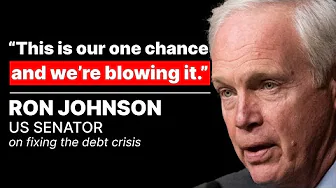
Senator Ron Johnson on the Senate showdown over Trump's Big Beautiful Bill | All-In Interview

  • Senator Ron Johnson said he would withhold support from the reconciliation bill unless Republicans stop adding to the deficit and commit to materially lower spending. He said several senators were working around a roughly $6.5 trillion 2026 spending target, versus about $7.3 trillion expected, making his objection potentially decisive.

  • Johnson said Trump had personally seen his spending charts, liked them, but had not yet made deficit reduction a central priority. Johnson has also pressed Scott Bessent, Kevin Hassett and Russell Vought directly; after a Treasury lunch, Bessent requested electronic copies of Johnson’s charts for distribution inside the department.

  • Johnson’s central warning was that Washington has normalized the pandemic-era spending jump instead of reversing it. He said federal outlays rose from roughly $4.4 trillion in 2019 to about $7 trillion, while many lawmakers he questioned could not even identify total annual federal spending.

  • He argued that DOGE’s announced savings are not secure until Congress legally cancels the underlying spending authority. Johnson said he tried to coordinate directly with Elon Musk so identified cuts could be tied to appropriations or mandatory accounts; Musk told him that codification was unnecessary, which Johnson explicitly disputed.

  • Johnson wants Republicans to split the legislation rather than force the entire fiscal agenda through one enormous bill. His preferred sequence is border funding, extension of current tax law, a roughly one-year debt-ceiling increase, and then months of line-by-line spending reviews before pursuing additional Trump tax proposals.

  • His proposed long-term budgeting system resembles a corporate forensic audit rather than Congress’s existing scoring process. Johnson wants DOGE-style technical teams and 100–200 forensic auditors examining thousands of spending lines, with agency heads required to justify expenditures against inflation-and-population-adjusted Clinton, Obama and pre-pandemic Trump levels.

  • Johnson said roughly three-quarters of federal spending now sits in mandatory accounts that generally escape the annual appropriations process. He highlighted “other mandatory” spending outside Social Security, Medicare and Medicaid, saying it jumped from about $642 billion in 2019 to $1.3 trillion last year and remains above $1 trillion.

  • Johnson told the hosts presidential pressure alone would not change his vote, saying he would rather leave the Senate than accept a bill he considers fiscally unacceptable. He identified Mike Lee and Rick Scott as allies and described Rand Paul as an even firmer likely opponent, giving the Senate dissent a concrete bloc.

...

May 24, 2025

Bond crisis looming? GOP abandons DOGE, Google disrupts Search with AI, OpenAI buys Jony Ive's IO

  • The House tax-and-spending bill landed as Treasury demand weakened, making debt-service costs the episode’s main fiscal concern. Friedberg cited a 5.1% 30-year yield versus a 3.6% budget-model assumption and estimated every extra percentage point adds roughly $350 billion a year in interest.

  • David Sacks said the new Gulf AI framework trades chip access for U.S. investment and American control of most regional compute. He said partners must invest one dollar in U.S. AI infrastructure for every dollar spent regionally, while at least 80% of regional chips must be owned and operated by U.S. cloud providers.

  • Google is attempting to move Search toward an AI-first interface without abandoning its existing business overnight. AI Mode is being expanded, while the $250-a-month AI Ultra bundle suggests Google is also testing subscription revenue as a second major consumer-AI business model.

  • OpenAI’s $6.5 billion all-stock purchase of Jony Ive’s io is fundamentally a hardware bet, not merely a design hire. OpenAI already owned 23% of io, and the discussion treated the acquisition as an attempt to create an AI-native consumer device that could move interaction beyond phones and apps.

  • A baby with a life-threatening CPS1 mutation received a custom gene-editing treatment designed specifically for his exact DNA error. Researchers delivered the edit to liver cells with lipid nanoparticles and administered three doses; the child tolerated treatment and was able to reduce some medicines used to control ammonia.

  • Friedberg argued that electricity, not AI software, is the binding constraint on American technological growth. He contrasted roughly one terawatt of U.S. power production with about three in China, said China is scaling toward eight, and noted new U.S. gas turbines can require waits until 2030.

  • The fiscal debate exposed a sharp split among Trump-aligned speakers over whether the House bill represents compromise or abandonment of DOGE-style restraint. Sacks defended the tax-cut extensions and said Congress lacks votes for deeper austerity; Friedberg and Chamath argued bond markets may ultimately force cuts Washington will not choose voluntarily.

...

May 21, 2025

Antonio Gracias: DOGE updates, Voter fraud, Finding 'Big Balls' | All-In Live from Miami

  • Antonio Gracias said DOGE found the federal government vastly more complex than Twitter, with his border-to-benefits process map stretching roughly 40 feet. He estimated about 15% of federal spending could be removed without cutting core entitlements, while acknowledging that estimate reflected his judgment rather than a completed audit.

  • At Social Security, Gracias said DOGE found an almost-empty headquarters and field offices still partly organized around COVID-era phone operations. His team pushed employees back into offices without closing field locations and began publishing service metrics, arguing that visible performance mattered more than financial incentives.

  • DOGE is attracting unusually strong private-sector talent by offering short, mission-driven government service rather than conventional federal careers. Gracias cited a Harvard student who left with two classes remaining and a rising KKR executive who quit his job, while describing peer referrals as a recruiting flywheel.

  • Gracias said DOGE manually matched DHS immigration records against voter rolls and referred suspected noncitizen voting cases to federal investigators. DOJ records confirm DOGE assisted investigations involving two Ukrainian noncitizens charged with voting in Florida; Gracias nevertheless said his sampling could not establish the nationwide scale. (Department of Justice)

  • Gracias’s preferred structural reform is a third category of federal worker: temporary public servants serving months or a few years before returning to private life. He argued that importing technical talent this way could improve government while giving more Americans firsthand experience of how difficult federal institutions are to operate.

  • Musk’s recruiting advantage appears to combine mission, personal magnetism and an unusually credential-blind search for people who can actually solve problems. The hosts described him spotting ideas in emails and posts, routing promising people for vetting, and sometimes favoring demonstrated ability over prestigious résumés.

  • Gracias supports a controlled border alongside substantially easier legal immigration for both skilled workers and lower-wage labor. After mapping immigration processing across DHS, State and Labor, he described the programs as disconnected and difficult to navigate and said his team wanted to leave behind reforms to both legal and illegal immigration systems.

  • Gracias presented easier citizenship verification as the practical answer to noncitizen-registration concerns, pointing to the federal SAVE system and making its use free for states. DHS eliminated SAVE transaction fees in 2025, although the system supplements rather than independently determines voter eligibility. (ncsl.org)
...

May 20, 2025

Sergey Brin, Google Co-Founder | All-In Live from Miami

  • Sergey Brin returned from retirement because the AI boom convinced him this was the most important technical moment of his career. An OpenAI employee named Dan challenged him to re-engage, and Brin now works inside Google without executive duties, running experiments and contributing code so he can understand the systems firsthand.

  • Brin thinks AI’s most important near-term advantage is scale: doing in minutes research that would take a person days or weeks. He described systems reading hundreds or thousands of sources, running follow-up searches, and synthesizing them—work fundamentally beyond what one person could practically do manually.

  • Brin has no convincing answer for how children should prepare for a world where AI may surpass what schools are teaching before students graduate. His own children are in middle and high school, and he expects AI capability a year from now to be difficult to compare with today’s curriculum.

  • Google’s repeated robotics efforts failed mainly because the software was not capable enough, not because the hardware was poor. Brin is also unusually skeptical of humanoid robots, arguing that advanced AI may learn to operate alternative bodies rather than requiring machines built to mimic human arms, legs, and movement.

  • Brin personally fought Google bureaucracy after discovering Gemini was listed internally among tools employees were not supposed to use for coding. He escalated the issue to Sundar Pichai, eventually got the restriction removed, and said Google is now testing multiple internal and external AI coding tools to measure productivity.

  • Brin expects AI development to keep converging toward powerful general models rather than fragmenting into many permanently specialized systems. Google may build specialized models to solve particular problems faster or cheaper, but Brin said those discoveries can usually be absorbed back into a broader model afterward.

  • Brin already used AI as a management tool to summarize team discussions, assign work, and identify an overlooked employee who deserved promotion. The model singled out a quiet young engineer; Brin checked with her manager, learned she had been performing exceptionally well, and said the promotion apparently followed.

  • Google still designs Gemini closely around its own TPUs because AI workloads remain too hardware-sensitive to treat chips as interchangeable. Brin said memory, communication, and processor architecture materially affect training efficiency, while Google also supports and buys Nvidia hardware for Cloud customers.

...

May 16, 2025

Trump's Big Week: Middle East Trip, China Deal, Pharma EO, "Big, Beautiful Bill" with Ben Shapiro

  • Trump’s Gulf trip marked a shift toward transactional foreign policy: economic deals first, political reform second. The administration announced a $600 billion Saudi commitment, nearly $142 billion in Saudi defense sales and major Qatar agreements, while the panel framed commerce as a tool for competing with China without intervention. (The White House)

  • Chamath disclosed a direct business stake in that shift: Groq was expanding Saudi AI-inference infrastructure at enormous scale. He said the company was building large data centers and had unique U.S. export permission; Groq had separately announced a $1.5 billion Saudi commitment earlier in 2025. (Groq)

  • Shapiro’s main Gulf warning was Qatar: engage it, but use American leverage rather than treating the relationship as unconditional. He pointed to Qatar’s relationship with Hamas and the U.S. air base, then called the proposed $400 million jet an avoidable corruption-optics problem because it was expected eventually to go to Trump’s presidential library. (Reuters)

  • The China tariff pause did not settle the trade argument; it moved the real fight into market access and regulatory barriers. U.S. tariffs on Chinese goods were temporarily cut sharply, while Friedberg argued success should be judged by whether American companies gain reciprocal access abroad, not by tariff revenue alone. (The White House)

  • Friedberg’s central domestic conclusion was that the Republican tax-and-spending bill did not meaningfully solve the deficit problem. He argued roughly $2.5 trillion annual deficits made DOGE-scale savings insufficient, and proposed two immediate rules: create no new programs and push existing discretionary programs back toward 2019 spending levels.

  • Chamath offered a different fiscal lever: monetize federal land, drilling rights, minerals and other public assets instead of relying only on austerity. The panel cited roughly 500 million federal acres and 3.2 billion acres of outer continental shelf, but Friedberg cautioned that lease and royalty revenue would arrive too slowly to erase near-term deficits.

  • Trump’s drug-pricing order created a tradeoff the panel thought politics was obscuring: lower U.S. prices could squeeze pharmaceutical R&D unless costs fall elsewhere. Chamath said China now rivals the U.S. in clinical-trial activity and trial expenses have exploded, while Shapiro warned reference pricing could shift costs or investment rather than eliminate them. (The White House)

  • The clearest healthcare target was the pharmacy-benefit-manager layer between manufacturers, insurers and pharmacies. Friedberg cited Caremark, Express Scripts and OptumRx, while the FTC found their affiliated pharmacies generated more than $7.3 billion above estimated acquisition costs on specialty generics from 2017–2022. (ftc.gov)

...

May 15, 2025

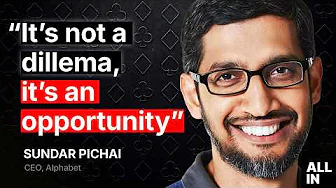
Sundar Pichai, CEO of Alphabet | The All-In Interview

  • Google says AI search is already preserving the economics of its core business rather than destroying them. AI Overviews reach more than 1.5 billion users, Google sees query growth where they appear, ad revenue has reached the non-AI baseline, and Pichai says serving costs have fallen sharply enough that latency matters more than cost.

  • Google’s biggest structural AI advantage may be infrastructure built long before the current boom. It trains Gemini internally on its own TPUs, is deploying seventh-generation chips, and plans roughly $75 billion of 2025 capital spending, with about half of compute investment going to Google Cloud while still using Nvidia GPUs where useful.

  • Sergey Brin is personally working inside the Gemini effort at an unusually technical level. Pichai says Brin sits with engineers, examines loss curves, discusses model architecture and post-training, while both Brin and Larry Page remain in frequent contact with him—giving Alphabet active founder involvement during its most important technological transition in years.

  • DeepSeek convinced Google that Chinese AI labs are closer to the frontier than many outsiders assumed. Google’s internal benchmarking found its own Flash models comparably efficient or better, but Pichai believes hardware constraints forced DeepSeek into valuable efficiency innovations and expects China to remain highly competitive in frontier AI.

  • Google is already compute-supply constrained, with mundane physical bottlenecks becoming strategically important. Pichai says Cloud capacity is constrained this year and projects are being delayed by permitting and shortages of electricians, making power generation, transmission, grid upgrades and skilled labor increasingly important limits on how quickly AI infrastructure can expand.

  • Pichai expects quantum computing to reach a practical breakthrough within roughly three to five years. He compares quantum today with AI around 2015 and expects a computation clearly superior to classical machines to create the field’s “aha” moment, with Google ultimately exposing useful quantum capabilities through its cloud platform.

  • Google believes AI has finally made robotics commercially interesting after its earlier hardware push came too soon. Pichai says Gemini-based vision-language-action models have changed the equation, estimates robotics may be two to three years from a major breakthrough, and confirms Google is exploring an “Android for robotics” model alongside possible first-party products.

  • Google once seriously debated buying Netflix. Asked for one major missed acquisition, Pichai named Netflix and said the company had discussed the deal “super intensely,” offering a rare glimpse at an alternate path in which Google might have owned one of the defining streaming businesses rather than building alongside it.

...

May 9, 2025

Fed Hesitates on Tariffs, The New Mag 7, Death of VC, Google's Value in a Post-Search World

  • Philippe Laffont is launching a hybrid Coatue interval fund seeded with $1 billion from the Bezos and Dell family offices. It will mix public stocks, private companies and cash, charge about 1.25% management and 12.5% incentive fees, and lower the normal barriers to long-duration private-tech investing.

  • Laffont’s real goal is to own the next “Magnificent Seven” before the market recognizes it. He expects roughly 25 core holdings across public and private markets, names SpaceX and Stripe as obvious candidates, and says he will wait until he has roughly 75% confidence in a category leader before paying up.

  • Laffont believes AI demand has become more important to tech markets than tariffs, summarizing his view as “tokens >> tariffs.” He cited Microsoft processing 100 trillion AI tokens in one quarter, half in March alone, while Coatue’s public and private companies were reporting shortages of chips and compute capacity.

  • The market is now treating AI cannibalization of Google search as a real financial risk. Apple’s Eddie Cue said its search volume fell for the first time in 20 years as users shifted toward AI tools, while Google countered that total queries from Apple devices were still growing.

  • Google is spending roughly $75 billion a year on AI while protecting the extraordinarily profitable search product those models threaten to replace. The panel argued that incremental rollout preserves today’s cash machine, but aggressive Gemini integration may be necessary before OpenAI captures the much larger market for AI-assisted work.

  • Sergey Brin appears to be back in operating mode at Google, not merely advising from the sidelines. The hosts said he is working roughly 70 hours a week, going into the office daily and discussing granular Gemini, Google Local and YouTube product decisions—founder-level involvement during Google’s most consequential product transition in years.

  • Laffont thinks consumer pessimism is currently a poor guide to the underlying U.S. economy. He said company earnings and payments data showed spending remained unexpectedly resilient through the tariff shock, leading him to treat sentiment as a lagging indicator that worsens after markets fall and improves after they recover.

  • The long decline in IPOs and acquisitions is changing what counts as a complete technology portfolio. Laffont argues that companies such as SpaceX and Stripe can remain private for years because sophisticated secondary markets provide liquidity, making a public-only portfolio structurally unable to own some of the most important technology companies.

...

May 6, 2025

Doug Burgum, Secretary of the Interior | All-In DC

  • Sabine Pass captures the scale of America’s shale reversal: a terminal built to import LNG became the country’s largest LNG export facility. Burgum said the project turned around after the shale boom; EIA now lists Sabine Pass as the largest U.S. LNG terminal at 3.6 Bcf/d nominal capacity. (U.S. Energy Information Administration)
  • Burgum said the administration’s immediate power plan is to keep existing baseload plants open, accelerate permits, and use natural gas as a bridge to a larger nuclear fleet. He described the Energy Dominance Council as a small “tiger team” that intervenes when major energy and data-center projects hit regulatory roadblocks. (U.S. Department of the Interior)

  • AI, not traditional household demand, is the force Burgum thinks has broken America’s old electricity assumptions. He said the five largest tech companies arrived at CERAWeek with roughly $300 billion of planned capital spending, turning power producers from background utilities into critical suppliers for data centers and advanced manufacturing.

  • Burgum wants Washington to treat federal land and mineral rights as an underused national balance sheet, not merely protected acreage. He said Interior is trying to value those assets and argued leases and royalties could generate far more non-tax revenue; BLM manages roughly 700 million acres of subsurface mineral estate. (U.S. Department of the Interior)

  • The most concrete critical-minerals proposal was to pair faster domestic mining with strategic stockpiles and insurance against future regulatory reversals. Burgum cited Resolution Copper’s decades-long permitting saga and a thin mining workforce; DOE reports only 162 U.S. mining-engineering bachelor’s degrees were awarded in 2023. (The Department of Energy's Energy.gov)

  • Burgum’s diagnosis of government inefficiency is unusually specific: Interior is technologically further behind than North Dakota’s state government was when he became governor. He said outdated systems force employees into repetitive work and estimated basic private-sector tools could eliminate about 20% of that workload, potentially allowing a smaller staff.

  • Burgum’s route into Trump’s Cabinet followed a quick political consolidation after ending his own presidential campaign. He said he endorsed Trump and spent 2024 campaigning for him; after eight years governing North Dakota, he is now Interior secretary and chairman of the National Energy Dominance Council. (U.S. Department of the Interior)

...

May 4, 2025

Brooke Rollins, Secretary of Agriculture | All-In DC

  • Rollins said AFPI quietly spent four years building a ready-made governing machine for a second America First administration. She said the network became a $90 million operation, prepared 300 draft executive orders and 196 agency plans, and now has seven alumni in the Cabinet plus dozens in the White House.

  • Her route into national power was built through long personal relationships rather than a conventional Washington career. Rick Perry, whom she met at 15, hired her at 28; years later Jared Kushner repeatedly recruited her to build a White House policy apparatus modeled on her Texas work, and she said no three times before joining.

  • At USDA, Rollins is pursuing a major reorganization rather than a narrow efficiency drive. She said nearly $6 billion in contracts had already been canceled and staff reductions were underway; USDA’s subsequent 100-day release reported more than $5.5 billion in canceled grants and contracts. (Farmers National Association)

  • Rollins and Robert F. Kennedy Jr. are trying to turn SNAP into a nutrition-policy lever, not merely a benefits program. Rollins said USDA spends $370 million daily across 13 nutrition programs and asked all 50 governors for waivers while arguing SNAP should stop subsidizing soda and junk food.

  • The administration was already designing a legal farm-labor program to accompany its immigration enforcement, though Rollins said details were not yet public. She said Trump raised it himself in a Cabinet meeting and wanted undocumented workers to leave while ensuring farms retained enough labor, especially for year-round operations such as dairies.

  • Rollins said the Agriculture job changed her from a free-market purist into a supporter of “fair markets” before freer trade. She argued U.S. farm products face unequal treatment abroad and said she planned trips to India, Japan, South Korea, Brazil, Peru and the UK to open markets for American producers.

  • Her small-government approach stops where she believes removing support would destroy farm capacity. Rollins said crop insurance cannot simply be gutted because thousands of farmers could fail and foreign buyers could acquire their land; her goal is to reduce such support only after stronger markets make it less necessary.
  • Rollins described the coming farm-bill fight as mostly a SNAP negotiation, not a farm-policy negotiation. She said roughly 85% of the bill is food stamps and 15% farmer programs, and that she was already holding bipartisan strategy discussions with Senator Amy Klobuchar while seeking SNAP reform and stronger farmer support.
...

May 2, 2025

Trump's First 100 Days, Tariffs Impact Trade, AI Agents, Amazon Backs Down

  • Flexport is already seeing the China tariff shock in real shipments: bookings from China to the U.S. are down 60%. CEO Ryan Petersen said prolonged triple-digit tariffs could bankrupt smaller importers whose Chinese supply chains depend on manufacturing capability, not merely cheap labor.

  • Importers are using bonded warehouses to postpone tariff bills rather than immediately rebuild supply chains. Petersen said firms can hold cargo in U.S., Mexican or Canadian bonded facilities and owe duties only when goods enter U.S. commerce, allowing them to benefit if China tariffs fall before release.

  • Chamath Palihapitiya disclosed a private dinner with Trump where nuclear war, not tariffs or cultural issues, became the president’s central theme. He said Trump spoke about his uncle teaching him the destructive power of nuclear weapons and presented avoiding war as a deeply held priority.

  • A new Trump-aligned Washington private club is being built as a curated network for insiders, with roughly ten $500,000 founding memberships. David Sacks said he cannot own it while serving in government but volunteered to be member number one, describing a younger Republican space intended to exclude untrusted reporters and lobbyists.

  • AI agents are already creating work companies previously considered too expensive to perform. Flexport uses AI for thousands of daily calls matching truckers to loads, while the podcast’s venture firm is automating analysis across 20,000 yearly applications—work it estimated would otherwise consume roughly 5,000 hours.

  • The bigger AI software opportunity may be labor budgets, not software seats. Box CEO Aaron Levie argued agents can sell outcomes once performed by paralegals or other staff, and estimated most future AI use will involve previously uneconomic work such as contract review, invoice processing and multilingual marketing.

  • Enterprise AI is still not reliable enough for many regulated workflows without substantial safeguards. Levie said Box’s benchmark—500 documents with 40 requested fields—put the best single-pass model at about 90% accuracy, requiring repeated runs, smaller chunks, tuned prompts and reasoning models for tougher production work.

  • AI’s near-term advantage is greatest where answers can be mechanically verified. Sacks argued coding and mathematics improve faster because outputs can be compiled or proven, while legal work lacks an equivalent validator; harder domains will therefore require multiple agents or models, additional compute and continued human review.

...

April 25, 2025

Trump Rally or Bessent Put? Elon Back at Tesla, Google's Gemini Problem, China's Thorium Discovery

  • China’s strongest trade leverage comes from supply-chain choke points, not tariffs alone. The panel noted China processes more than 90% of rare earths and produces a similar share of rare-earth magnets, giving Beijing leverage over components used across cars, electronics and defense.

  • Andrew Ross Sorkin said major American brands are quietly losing prestige in China. Executives from companies including Starbucks, McDonald’s and Nike told him they are increasingly presenting themselves as local businesses because Chinese consumers and employees no longer attach the same status to American brands.

  • Apple was reported to be preparing to manufacture in India all iPhones destined for the U.S., with a target of completing the shift by the end of 2026. The panel said Foxconn and Apple already have Indian production running, making this a scale-up rather than a factory build from zero.

  • Chamath Palihapitiya disclosed that he now owns a large rare-earth project in India negotiated with the prime minister’s office. After saying he lost roughly half his money over a decade investing in Indian technology startups, he shifted toward infrastructure and specialty-chemical processing following advice from leading Indian industrial families.

  • Alphabet’s results showed a business far more resilient than the “AI kills Google Search” narrative implies, but distribution is becoming Gemini’s central problem. Alphabet reported $90.2 billion in revenue, 270 million paid subscriptions and 30% cloud growth, while the panel argued those existing subscribers could immediately become Gemini users.

  • Nvidia told Chamath that its reported Asian revenue substantially overstates where its chips physically go. Roughly 47% of revenue appeared tied to China, Singapore and Taiwan because Nvidia records billing addresses; major U.S. companies often invoice through Singapore while products are shipped to the U.S., Mexico, Taiwan and elsewhere.

  • The panel distinguished DOGE’s claimed $160 billion in annualized savings from money actually removed from federal spending. They noted that some reported savings were not itemized and emphasized that Congress must eliminate the corresponding appropriations or future lawmakers can simply restore the spending.

  • China has reportedly demonstrated a working two-megawatt molten-salt thorium reactor while possessing an enormous newly disclosed thorium reserve. The reactor was reportedly refueled while operating, a ten-megawatt successor is planned by 2030, and the underlying molten-salt technology traces back to research pioneered decades ago at Oak Ridge National Laboratory.

...

April 24, 2025

Inside the All-In Summit: Behind the Scenes of the World's Greatest Conference 🚀

  • The clearest story is All-In’s transformation from a podcast into a high-level convening platform. The summit produced an unannounced J.D. Vance appearance, a last-minute Sergey Brin visit, Elon Musk, and Travis Kalanick’s first conference or press appearance in nearly a decade.

  • Vance argued that America’s biggest innovation gap lies in regulated physical industries rather than software. He wanted technology and policy attention broadened into transportation, logistics, energy and similar sectors, connecting stagnation there with wider economic frustration. (PodScripts)

  • One of the sharpest institutional arguments was to stop trying to reform prestige organizations from inside and build competitors instead. The speaker argued that donations, board seats and internal persuasion preserve incumbents, while new institutions create competitive pressure capable of forcing them to change.

  • A revealing M&A principle emerged: when an acquired startup had beaten the incumbent team with fewer resources, its leader was put in charge of that team. The logic was to import superior operating talent rather than merely absorb the product while protecting the existing hierarchy.

  • Musk’s core thesis was that AI is improving faster than any technology he has seen, while robotics and autonomy could remove practical limits on production. His more interesting caveat was human: if machines eventually outperform people at everything, the difficult problem becomes finding meaning rather than producing more goods.

  • Kalanick’s appearance mattered because he had stayed away from conferences and the press for close to a decade. Asked whether he might return to Uber and merge CloudKitchens with it, he avoided a substantive answer and joked that he already knew who his communications chief would be.

...

April 18, 2025

Trump vs Harvard, Nvidia export controls, how DEI killed Hollywood with Tim Dillon

  • The U.S. moved to restrict Nvidia’s H20 exports to China, a chip specifically designed to comply with earlier controls. Sacks said H20 has less compute than H100 but 20% more memory bandwidth, making it far more capable for newer AI workloads than the “weaker chip” label implies. (SEC)

  • The more consequential issue may be enforcement, not where the export-control line is drawn. Chamath alleged that Asian intermediaries are routing Nvidia chips to Chinese users, while Sacks said shell-company evasion is documented and argued Commerce’s BIS needs more monitoring, inspections and staff.

  • Harvard rejected the Trump administration’s demands over governance, hiring, admissions and DEI, after which $2.2 billion in grants and $60 million in contracts were frozen. The fight was moving beyond campus policy into whether federal funding and even tax-exempt status can be conditioned on institutional changes. (Harvard Public Health)

  • Friedberg highlighted a little-understood funding mechanism: Harvard’s general on-campus research indirect-cost rate was 69% of modified direct costs. In practical terms, $100 of eligible direct research spending could carry roughly $69 of added facilities-and-administration reimbursement, making research funding substantially larger than the headline laboratory grant. (Harvard Gazette)

  • Chamath said a senior Wall Street banker abandoned a Federal Reserve hiring process after being told before his final interview to “play up” being Indian. The banker, whose PhD specialty matched the role, reportedly replied that his relevant diversity was knowing the market better than anyone and withdrew.

  • Dillon’s best argument about AI job loss came from his own pre-comedy life: a $13-an-hour New York tour-guide job gave him enough flexibility to become a comedian. He argued that eliminating such modest “bridge jobs” could remove the economic runway that lets artists, retirees and unconventional workers pursue something else.

  • Dillon said a Romanian Bitcoin millionaire once paid him $100,000 for a 20-minute private birthday performance. Most guests spoke Romanian and barely understood the set, making the fee a striking example of how lucrative private entertainment can be compared with ordinary comedy work.

  • The most concrete science item was a Zhejiang University method that produced 854 times more mitochondria from cultured human stem cells, with 5.7 times higher ATP output. In a mouse osteoarthritis model, the engineered mitochondria promoted cartilage regeneration, making scalable mitochondrial transplantation a plausible new regenerative-medicine research path rather than just a theory. (pubmed.ncbi.nlm.nih.gov)

...

April 11, 2025

The Great Tariff Debate with David Sacks, Larry Summers, and Ezra Klein

  • The April 9 tariff “pause” did not restore the pre-April system: Trump kept a 10% baseline on most partners and raised China’s reciprocal tariff to 125%. The order suspended higher country-specific rates for 90 days after more than 75 partners approached Washington, making negotiations—not tariff removal—the immediate next phase. (The White House)

  • When Ezra Klein repeatedly asked for measurable two-year tests of success, David Sacks offered reindustrialization and supply-chain independence but no numerical thresholds. Chamath Palihapitiya supplied the clearest operational list: chips and AI, energy, critical minerals, and pharmaceutical ingredients—the sectors he said should be measured for domestic capacity versus imports.

  • Chamath described himself as an informal conduit to Washington: a businessman representing an unnamed president called him for a tariff off-ramp, and he also connected a tariff-hit U.S. company to White House officials. He said the foreign side offered zero tariffs, a Boeing-for-Airbus switch and U.S. energy sourcing; Trump officials “listened.”

  • Summers said about half a dozen prominent businesspeople had privately told him they felt “shaken down” by representatives of the president, describing requests to help or contribute. Sacks rejected the allegation, saying his own White House ethics review took months and required divestitures; the episode provided no independent evidence resolving the dispute.

  • The China debate turned on a key distinction: PNTR did not newly lower U.S. tariff barriers on Chinese goods; it made China’s annually renewed normal-trade status permanent. Sacks argued permanence then encouraged U.S. investment and outsourcing to China, while Summers emphasized China’s WTO concessions on U.S. market access. (GovInfo)

  • Klein’s governing prescription was not simply deregulation: he favored giving officials more discretion to act quickly, then auditing results and punishing mistakes afterward. He linked that to housing, citing RAND data showing California market-rate apartments cost 2.3 times Texas levels and publicly subsidized projects cost more than four times Texas market-rate housing. (RAND Corporation)

  • Summers argued DOGE could worsen the deficit if IRS staffing cuts reduce enforcement revenue by more than they save in payroll. He said fewer audits lose money directly and encourage aggressive reporting; Chamath countered that his own annual audits, despite 700–900-page filings, typically produced differences of only about $1,000.

  • Summers’ market warning was not the stock selloff alone but the combination of falling equities, rising Treasury yields and a weakening dollar. He argued that resembled an emerging-market confidence shock rather than normal U.S. safe-haven behavior, while Chamath cautioned that bond moves might partly reflect a leveraged Treasury trade.

...

April 4, 2025

DOGE updates + Liberation Day Tariff Reactions with Ben Shapiro and Antonio Gracias

  • Antonio Gracias said DOGE traced a sharp rise in “Enumeration Beyond Entry” Social Security numbers to asylum, parole and notice-to-appear cases. He described a path from asylum filing to work authorization to an automatically mailed Social Security card, and said 23% of sampled records lacked fingerprints.

  • Gracias also claimed 1.3 million people in the examined cohort were on Medicaid and that thousands appeared on voter rolls, with more than 1,000 voting in one state. He said some cases were referred for prosecution, but acknowledged the review covered only a handful of states; NPR later described the voter-fraud claims as dubious. (OPB)

  • Ben Shapiro’s sharpest tariff critique was mechanical: the administration’s “reciprocal” figure was based on trade imbalances, not simply the foreign tariff rate. Israel had just moved to eliminate its remaining U.S. tariffs yet still faced a 17% U.S. tariff, making the reciprocity label hard to read literally. (United States Trade Representative)

  • Chamath Palihapitiya argued the White House may tolerate equity-market pain because lower long-term Treasury yields reduce the cost of refinancing roughly $6 trillion of debt. His model requires Fed cuts and bank deregulation to keep credit flowing; he explicitly said the strategy creates recession risk if those pieces fail.

  • Chamath said the tariffs instantly turned a profitable, century-old American family manufacturer into a business facing potential losses of hundreds of millions of dollars. It employs thousands in America and competes with China, but production in other countries exposed it to tariffs, illustrating how blunt country-level levies can hit intended beneficiaries.

  • Friedberg pointed to the last trade war’s hidden fiscal cost: USDA authorized up to $12 billion in 2018 and $16 billion in 2019 to cushion farmers from retaliatory trade damage. His warning was that tariffs can protect one sector while creating losses elsewhere that government later has to absorb. (GovDelivery)

  • Chamath’s January credit-default “insurance” trade had moved sharply in his favor, with a roughly $1 million premium on $1 billion of exposure becoming worth about $7 million. He said widening CDS spreads matter because tariff-driven revenue declines can trip debt covenants and turn recession risk into a corporate-default cycle.

  • Ben Shapiro disclosed that Daily Wire generated about $220 million in revenue last year and said a public listing has crossed management’s mind. The comment followed Newsmax’s volatile IPO; Shapiro viewed its surge as retail-driven and expected the valuation to settle far below its roughly $20 billion peak.

...

April 2, 2025

All-In Live from Austin: Colin and Samir, Chris Williamson, and Bryan Johnson

  • For David Friedberg, All-In is more valuable as business leverage than as a media business. Farmers and senior executives already know him from the show, which he says removes the need to establish credibility before a pitch and reduces friction in real-world deals.

  • YouTube’s recommendation system has weakened the old subscriber model: Colin and Samir said major creators often get roughly 70% of views from non-subscribers. Their own channel gets about half its watch time from connected TVs, while old videos can keep accumulating views for years through recommendations.

  • Successful independent creators may now have stronger economics than the legacy platforms trying to recruit them. Jason Calacanis said SiriusXM once offered him less than This Week in Startups already earned while demanding ownership of the IP; the panel argued television deals must compensate creators for lost distribution, control and ownership.

  • Chris Williamson has turned Modern Wisdom sponsorships from individual ads into long-term, cross-platform partnerships. After personally selling ads for his first 500–600 episodes, he now packages roughly 40–60 million annual impressions with Instagram, a 300,000-subscriber newsletter with about 50% opens, appearances and multi-year deals.

  • Spotify’s new video economics produced a striking early result for Williamson: two months with only 10% of his catalog uploaded generated more revenue than his entire YouTube AdSense. The group cautioned that Spotify may currently be spending aggressively to recruit showcase creators, so the economics remain experimental.

  • Williamson deliberately spends roughly $30,000–$40,000 on some premium podcast productions because he believes visual quality itself can differentiate the show. His productions can use cinematographers, location scouts, 15-person crews and LED-wall sets, although he still uses low-friction remote recording when intimacy matters more than spectacle.

  • Bryan Johnson said Blueprint would exceed $100 million in sales within its first 12 months, despite being run at roughly break-even margins. He said the commercial business emerged only after his longevity project went viral—one Twitter thread drew about 50 million views—and audiences began asking for easier access to the products he sourced.

  • Johnson is also building “Don’t Die Certified,” a crowdfunded system intended to let consumers pay about $500 to independently test foods and pressure manufacturers to reimburse those tests. He said the goal is eventually to test the products representing 80% of the American diet, but the preliminary brand-level results discussed onstage had not yet been released.

...

March 28, 2025

The AI Cold War, Signalgate, CoreWeave IPO, Tariff Endgames, El Salvador Deportations

  • Baker said Nvidia’s investments in CoreWeave and other neo-clouds were meant to weaken hyperscaler buyer power, not manufacture revenue. He argued Nvidia could have sold the same GPUs to Meta, Tesla, Amazon or Microsoft, while reference-architecture customers got capacity online faster and diversified demand.

  • Nvidia’s receivables surge is a warning worth watching, but Baker tied it to the unusually difficult Hopper-to-Blackwell transition. Blackwell racks weigh about 3,000 pounds, draw 120kW and require liquid cooling versus Hopper’s 1,000 pounds and 60kW; he said continued receivables growth past July would concern him.

  • CoreWeave’s risk is obvious—nearly $8 billion of debt and more than 60% of revenue from Microsoft—but Baker thinks its operational skill is the overlooked moat. Synchronizing tens of thousands of GPUs reliably is difficult, and he argued only a small number of operators can run such training clusters well.

  • Baker said U.S. chip export controls may buy time while strengthening China’s incentives to build substitutes and improve algorithms. He considered a China-made Nvidia peer within five years essentially impossible, but would not make the same claim over ten years; he cited DeepSeek as evidence restrictions can spur efficiency innovation.

  • Chamath gave a rare firsthand example of why IP location can matter as much as factory location: Facebook shifted critical IP to Ireland while he was an executive signatory. He said that decision helped produce a 10–15-year IRS dispute and argued U.S. policy should make retaining valuable IP domestically easier.

  • Friedberg said he had heard the administration ultimately wanted to eliminate taxes for people earning under $150,000, alongside tariffs, spending cuts and deregulation. Chamath contrasted that ambition with a roughly $1.9 trillion deficit and Wall Street tariff-revenue estimates of only $170–300 billion, implying much deeper spending reductions if those estimates held. (RealClearPolitics)

  • The Signal episode was more than a wrong-recipient embarrassment: the panel identified both national-security exposure and federal-records risk. Jeffrey Goldberg had entered a senior-official Houthi-strike chat; Friedberg cited record-preservation precedent, while Baker noted the chat showed officials understood the Red Sea operation benefited Europe far more than America. (The Atlantic)

  • The administration sent 238 alleged gang members to El Salvador’s CECOT under the Alien Enemies Act, while the episode highlighted several possible misidentifications tied partly to tattoos. Friedberg opposed imprisonment without prior due process; Chamath argued errors could be corrected afterward, making the core dispute whether deterrence can justify innocent people being swept up. (investing.com)

...

March 21, 2025

White House BTS, Google buys Wiz, Treasury vs Fed, Space Rescue

  • Chamath Palihapitiya and David Friedberg said they spent three days operating from David Sacks’s White House office, with West Wing access and an Oval Office meeting with President Trump. They also secured long-form interviews with Treasury Secretary Scott Bessent and Commerce Secretary Howard Lutnick, and encountered Elon Musk, Marco Rubio and Sheikh Tahnoon.

  • The podcast disclosed that Hims/Hers, Gemini and iTrust helped fund its Washington trip. That matters because the same trip produced unusually intimate access to senior administration figures, making the financing relevant context for readers assessing the episode’s access and tone.

  • Howard Lutnick described a procurement model in which technology companies build government software for free and use the U.S. government as a reference customer. He also said the executive branch can accept gratis contracts without additional approval, making the model potentially faster than normal procurement if his legal reading is correct.

  • Google’s $32 billion cash agreement to buy Wiz followed a rejected $23 billion offer and includes a $3.2 billion termination fee. Wiz had already surpassed $500 million in ARR, and the speakers argued its multi-cloud footprint could let Google cross-sell GCP into workloads currently running on AWS and Azure. (Reuters)

  • Scott Bessent said Treasury faced roughly $9–10 trillion of refinancing over the following nine months after years of unusually short-duration borrowing. His complaint was simple: borrowing stayed short when rates were low, leaving more debt to roll over after rates rose, which makes financing costs and Fed policy unusually consequential.

  • Cyan Bannister announced a $181 million fourth fund for Long Journey Ventures, focused on seed-stage “first checks” and deliberately non-consensus bets. She said the firm looks six to eight years ahead, often before a category has a name, and may write initial checks of $25,000 or $125,000 through Founder University.

  • Bannister tracked down Niantic founder John Hanke after the Google spinout and arrived with two engineers to push for an investment. Hanke offered one engineer a job that day and gave Bannister a key card, a vivid example of how early Silicon Valley deal access can be won through persistence and usefulness.

  • Chamath Palihapitiya said he once owned about 10% of Relativity Space but was recently recapitalized out, taking roughly a $380 million loss. He said Eric Schmidt then offered about $3 billion for the company; the disclosure came while arguing that SpaceX remains years ahead of credible launch competitors.

...

March 20, 2025

Howard Lutnick Exposes Washington’s Biggest Lies

  • September 11 defined Lutnick’s adult life: Cantor Fitzgerald lost 658 employees, including his 36-year-old brother Gary and 39-year-old best friend Doug, while 27 guests from his 40th-birthday party were killed. He committed 25% of profits to victims’ families and said he cried every day until October 21, 2004.

  • Lutnick’s move from donor to governing insider accelerated in late 2023, when he says Trump asked for help and he immediately gave $10 million; he later became transition co-chair. (The American Presidency Project) He says he had already given roughly $10 million for 2020 and raised $15 million, while their friendship dated back 33 years.

  • Lutnick says Trump’s Panama Canal focus began with a two-word assignment—“Panama Canal”—that he turned into research, legal work and on-the-ground video. A shipping-company friend filmed a canal transit on two iPhones; after Lutnick reported “I have your path,” Trump posted an American-flag canal image that afternoon.

  • Lutnick says DOGE paired about $1 trillion in spending cuts with roughly $1 trillion in new revenue from tariffs and other sources. He says he initially structured it as a “gratis vendor” outside normal employment, and Trump agreed that a balanced budget could justify waiving federal income tax below $150,000.

  • The transition operated like a compressed executive search: eight candidates appeared on-screen with résumé highlights and speaking clips, and presentation ability was deliberately evaluated. Lutnick says every nominee was the first choice except Matt Gaetz, with Pam Bondi already positioned as the immediate fallback once the team reviewed the congressional report. (Reuters)

  • Lutnick says he uses his friendship with Trump to secure free software from major technology companies by having CEOs commit directly to the president. He named Google, Microsoft and Amazon, then said the government would help them on matters he considered “fair” in return.

  • At the interview, the proposed $5 million “gold card” offered vetted buyers permanent U.S. residency without taxing their non-U.S. income. Lutnick said he was implementing it, Musk was building the software, 1,000 cards had already been sold, and Trump’s target of one million sales—$5 trillion—was reasonable.

  • Lutnick’s sovereign-wealth idea would make federal procurement generate investment returns: when government contracts raise a supplier’s value, taxpayers would receive warrants or upside. He cited vaccine and missile makers and predicted he and Treasury Secretary Scott Bessent could generate more than $1 trillion for the government during the term.

...

March 18, 2025

The Shocking Truth About DC Spending & Corruption - Scott Bessent

  • Bessent’s key role in the 1992 sterling trade was spotting that Britain could not defend the pound with high rates without crushing floating-rate mortgage borrowers. He said Druckenmiller wanted the whole fund in the bet, Soros pushed for more, and the fund gained 20%-plus in a day and another roughly 20% that year. (Bloomberg)

  • Bessent said Trump’s first question in a private Mar-a-Lago meeting was how to cut debt and deficits without causing a recession. His answer was gradual tightening toward roughly a 3–3.5% deficit-to-GDP ratio by 2028; he had approached Trump about joining the campaign around 18 months earlier after knowing the family for 30 years.

  • The administration’s economic plan, as Bessent described it, is a coordinated swap: government deleveraging paired with private-sector releveraging. Spending and federal payroll cuts are intended to coincide with financial deregulation, while tariffs, lower predictable taxes and cheaper energy are meant to draw investment and manufacturing back into the private economy. (U.S. Department of the Treasury)

  • Bank deregulation is one of Bessent’s most concrete levers for lowering borrowing costs and reviving Main Street credit. He said small banks provide 70% of agricultural loans and 40% of small-business loans, and estimated easing the supplementary leverage ratio could cut Treasury-bill yields 30–70 basis points; he separately backed Fed monetary-policy independence. (ABA Banking Journal)

  • Bessent said DOGE’s speed is deliberate because lobbying and other vested interests become harder to dislodge once they mobilize. He said he was “completely aligned” with Musk, expected contractor cuts to produce major savings, and cited Booz Allen’s roughly 98% government-revenue dependence while discussing entrenched federal contracting. (The Wall Street Journal)

  • The proposed U.S. sovereign wealth fund was being designed to mobilize federal assets, not revalue the government’s gold. Bessent cited a Ukraine economic deal, Fannie Mae and Freddie Mac stakes, energy leases and federal land as possible inputs, while Treasury studied global funds and aimed for returns above government borrowing costs. (U.S. Department of the Treasury)

  • Bessent said national security unexpectedly consumes 40–50% of his day at Treasury. He described CFIUS, sanctions, anti-money-laundering and OFAC work, and said Treasury had spent weeks targeting Houthi finances before U.S. missile strikes; contemporaneous Treasury actions targeted Houthi leaders and Iran-linked oil networks. (U.S. Department of the Treasury)

  • On affordability, Bessent’s most specific proposals focused on expanding housing supply and reducing insurance risk. He proposed more standardized factory-built housing, federal guidance across fragmented building codes, and a possible federal backstop above private California wildfire insurance conditioned on risk-reduction rules; he also said an affordability czar would target quick supply-chain fixes. (cbsnews.com)

...

March 14, 2025

Fixing the American Dream with Andrew Schulz

  • Friedberg said researchers are nearing a form of IVF in which ordinary body cells could be reprogrammed into stem cells and then egg cells, potentially avoiding egg harvesting. He argued that this could make fertility treatment less invasive and extend viable egg production beyond the limits of a woman’s existing eggs.

  • Speakers argued that the biggest tariff risk is unpredictability: companies make five- and ten-year investments that cannot be reversed every time policy changes. They also warned that case-by-case exemptions would push firms toward political access rather than stable rules, concentrating influence around whoever controls the waivers.

  • Friedberg proposed turning the Social Security Trust Fund into a broad equity owner rather than leaving it concentrated in Treasuries. By his calculation, investing in the S&P 500 since 1971 would have produced roughly $15 trillion instead of $2.7 trillion, and a $500 billion recapitalization could make the fund self-sustaining under his return assumptions.

  • Chamath argued that housing affordability could improve through lower government borrowing costs and changes around Fannie Mae and Freddie Mac, and he floated a 30–40% home-price decline. His case was that current guarantees and financing structures help sustain prices that shut younger and middle-class buyers out.

  • Chamath said he first learned ownership at 14 or 15, while on welfare in Canada, after a startup executive taught him how equity worked and he bought a few shares. Decades later, he said a roughly $4 billion drawdown left him ashamed for years and forced him to separate net worth from self-worth.

  • The episode recounted that Warren Buffett, advising Arnold Schwarzenegger during his California gubernatorial run, recommended repealing rules that let inherited homes retain favorable property-tax treatment. According to the story, the proposal was so politically toxic that Buffett was gone from the advisory role two days later.

  • Schultz described YouTube as the mechanism that rebuilt his stand-up career: weekly clips sold out clubs and proved he could monetize audiences directly rather than depend on television. That leverage later let him buy back an Amazon special over two requested joke changes, self-release it, and accept a Netflix deal with no creative notes.

  • Before that breakthrough, Schultz said he was living on roughly $5–$10 a day, renting out his bedroom and sleeping in a closet while trying to make comedy work. He reached about $700 in the bank before paid gigs, touring and television finally began to sustain him.

...

March 7, 2025

Tariffs, Trump's Economic Endgame, Market Chaos, Bitcoin Reserve, CoreWeave IPO

  • Tariffs are already changing corporate behavior, even though the speakers disagreed on Trump’s underlying objective. Lonsdale said some of his companies were shifting more production to the United States, while Friedberg framed tariffs, lower income taxes and lower federal spending as a coordinated reindustrialization strategy.

  • Chamath warned that sweeping IRA repeal could directly undermine the AI power buildout. He cited renewables at about 91% of incremental U.S. generation, roughly 35,000 projects awaiting FERC approval, a five-year gas-turbine lead time and nuclear not arriving before 2035.

  • Lonsdale gave a striking example of how defense procurement can protect incumbents even when challengers claim better performance. He said an 8VC-backed system beat L3, Raytheon and Northrop by 9.5 times on drone range, yet an Air Force leader told him the requirements appeared shaped around Raytheon’s approach.

  • CoreWeave’s IPO case rests on whether its borrowed GPUs stay economically useful long enough to repay the debt. The company was described as having 250,000 Nvidia GPUs, $1.9 billion of 2024 revenue, nearly $8 billion of debt and 60% customer concentration in Microsoft, while hyperscalers are rapidly adding competing capacity.

  • Chamath’s most consequential market thesis was that Washington may tolerate weaker stocks if that helps lower long-term interest rates. His mechanism was falling asset values reducing consumption, investors rotating into Treasuries and yields falling before roughly $10 trillion of federal debt needs refinancing, with Bessent’s “Main Street” rhetoric offered as supporting context.

  • Sacks said the new policy deliberately separates a permanent Bitcoin reserve from a broader digital-asset stockpile. He said roughly 200,000 federal Bitcoin may remain pending an audit, reserve Bitcoin cannot be sold, additional purchases must be budget-neutral, and Treasury may rebalance non-Bitcoin holdings in the stockpile.

  • Sacks said he divested aggressively before joining the administration to eliminate crypto conflicts, not merely disclose them. He put total crypto sales around $200 million, about $85 million attributable to himself, said he exited crypto-related funds before day one, and described his White House role as unpaid.

  • The AI discussion argued that distribution is becoming more important than benchmark leadership as top models converge. Chamath said Claude 3.7 was strongest for coding and Grok 3 had become his consumer choice because it is embedded in X, while warning that model makers are increasingly overfitting benchmark tests.

...

February 28, 2025

Epstein Files Flop, State of the Market, Autonomous Robots, Trump's Gold Card, Friedberg on Jeopardy

  • Pam Bondi said the FBI gave her about 200 Epstein-related pages while its New York field office held thousands more, then ordered Kash Patel to obtain the full files. She also demanded an investigation and personnel-action report within 14 days, making this a chain-of-command dispute, not merely a disclosure story. (Department of Justice)

  • Figure moved its home-robot beta timetable forward by two years, targeting mid-to-late 2025, but the hosts saw physical dexterity as the real near-term bottleneck. The demo showed two robots sorting groceries unsupervised and coordinating semantically, while weak actuators still limited delicate manipulation.

  • Stripe’s report showed how unusually fast AI companies were monetizing: the top 100 reached $5 million in annualized revenue in 24 months versus 37 months for average SaaS. Chamath added that his 8090 venture reached $5 million in three months, while Stripe’s billing product was already about $500 million ARR.

  • Chamath said enterprise AI demand is being driven less by panic over missing the trend than by frustration with expensive legacy-software renewals. His firm sees the opportunity in replacing large software bills, but he said hallucinations remain a serious blocker in healthcare, finance, construction, power and aerospace.

  • Chamath turned notably bearish, saying tariffs, slower immigration and DOGE-style spending cuts could push second-half growth from roughly 2.5% to 1.5% and trigger a significant correction. He paired that forecast with a concrete financing concern: roughly $10 trillion of U.S. debt needed refinancing within six months.

  • The panel’s sharpest Gold Card insight concerned startup financing: Chamath predicted foreign founders would take $5 million of secondary liquidity in funding rounds to buy U.S. residency. They argued demand could range from tens of thousands upward depending heavily on how strictly existing KYC and anti-money-laundering rules applied. (Reuters)

  • David Friedberg deliberately sandbagged Celebrity Jeopardy’s practice round—answering incorrectly and pretending he could not buzz—before winning the televised game. In a remarkable coincidence, friends had quizzed him on African geography the night before, then he successfully went all-in on Mount Kilimanjaro.

  • Jeff Bezos explicitly narrowed The Washington Post’s opinion section around “personal liberties” and “free markets,” saying opposing views should be published elsewhere. Chamath interpreted the move as an attempt to influence ideas circulating around Washington’s political class, while criticizing the narrower range of permitted opinion. (washingtonpost.com)

...

February 23, 2025

Remote Work Under Fire: All-In Podcast Unpacks Jamie Dimon’s Leaked Rant!

  • Stripe has largely returned to its pre-pandemic operating model: most employees work from offices, with a meaningful remote cohort. John Collison said remote hiring expands the talent pool and helps dual-career couples when one partner cannot relocate.

  • Stripe’s own pre-COVID productivity data showed remote work was a poor fit for early-career employees, even though some remote workers are exceptionally productive. Collison warned against designing company policy around the worst 5%; the harder problem is giving inexperienced staff the mentoring they lose outside an office.

  • Jamie Dimon’s objection to remote work centers on diluted attention and lost apprenticeship, not merely where people sit. He said employees multitask through Zoom meetings and younger workers miss social exposure, idea exchange, and in-person contact that help them develop.

  • Dimon wants managers to assume they can remove about 10% of headcount and run better. He cited a wealth-management process requiring 14 committees as evidence that large organizations often create work, meetings, and approvals that do not need to exist.

  • Chamath Palihapitiya argued that enterprise software can create bureaucracy by turning flexible work into rigid, tool-defined roles and workflows. He pointed to JPMorgan’s roughly $16 billion annual IT spend, while explicitly speculating that much deeper staffing cuts might be possible if those systems were simplified.

  • Shopify’s Tobi Lütke used a zero-based approach to meetings, deleting recurring meetings company-wide instead of asking teams to trim them. John Collison said Shopify measured the aftermath and the meetings did not simply reappear; Stripe has not copied the tactic.

...

February 21, 2025

The Stablecoin Future, Milei's Memecoin, DOGE for the DoD, Grok 3, Why Stripe Stays Private

  • Stripe now processes more than $1 trillion a year and is expanding far beyond checkout into lending, card issuance, treasury and cross-border money movement. The Collisons said the deeper opportunity is that nearly every form of money movement is becoming software-controlled, making payments only the first layer.

  • Stripe’s stablecoin thesis is primarily international: cross-border treasury, remittances and dollar savings where local currencies are unstable. They contrasted the old eurodollar system’s roughly $1 million minimum with stablecoins letting someone in Ecuador hold about $10, and said Bridge is being built around that use case.

  • Stripe increasingly sees its real moat as a reputation network against fraud, not merely a payment rail. It has already seen the card in 93% of purchases, says businesses often lose more to fraud than transaction fees, and reported Stripe fraud metrics down 80% while industry fraud worsened.

  • Stripe’s pre-COVID productivity data found remote work worked poorly for early-career employees, even while some experienced remote workers were exceptionally productive. The Collisons therefore reject blanket return-to-office rules, favoring empirical, role-specific policies rather than designing around either bad anecdotes or ideological “shoulds.”

  • ARC Institute was built around the claim that grant bureaucracy is distorting basic science: surveyed researchers said 40% of their time went to grant overhead, and 79% would materially change their research if funding were freer. ARC instead gives investigators broad freedom to pursue their own research agendas.

  • Patrick Collison said ARC’s Evo 2 was trained unsupervised on nine trillion DNA base-pair tokens, with only one human genome, yet achieved state-of-the-art mutation-pathogenicity prediction. Its performance implies the model learned transferable biological structure across species rather than simply memorizing labeled human disease examples.

  • xAI’s Colossus build was less about abundant capital than extreme execution under a time constraint. The team reportedly concentrated 100,000 GPUs in an old Memphis factory, acquired roughly a third of America’s portable liquid-cooling capacity, and rewrote Tesla Powerpack firmware onsite to reach the needed power envelope.

  • Stripe is profitable on fully loaded GAAP net income and still sees no compelling reason to go public while private markets can supply capital and liquidity. The Collisons said their test is simple: choose the structure that best compounds value over a decade and lets them spend the marginal hour on customers, not markets.

...

February 14, 2025

JD Vance's AI Speech, Techno-Optimists vs Doomers, Tariffs, AI Court Cases with Naval Ravikant

  • Naval said AirChat failed as a social product, but he repaid outside investors, placed the team in new jobs, and is now building a harder hardware-software-network company. He said the lesson was to prefer technical risk—something difficult to build but clearly wanted—over market risk.

  • Naval traced his public “philosophy” period to AngelList’s most stressful years, when its original matching model stalled and the SEC challenged him as an unlicensed broker-dealer. He said he went to Washington to change the law, while using Twitter as “notes to self” about science, philosophy, money and survival.

  • Naval homeschools his children around agency rather than obedience: some math or programming, daily reading, then broad freedom guided through persuasion. He said his oldest can spend roughly nine hours on an iPad, and he would rather raise children who control their own lives than children shaped to his preferences.

  • David Sacks said he did not workshop JD Vance’s Paris AI speech and that Vance wrote it, or at least directed it, himself. Sacks summarized its governing line as American AI leadership, lighter regulation, ideological neutrality and worker-focused growth, paired with pressure on Europe to reduce regulatory barriers.

  • Naval said AI’s main danger is not the technology itself but concentrated control, because frontier training naturally favors centralized compute and a small number of firms. His preferred counterweight is openness: if companies train on the open web, he argued, their models should be open rather than privately enclosing the result.

  • The strongest employment claim was not that AI has proved mass job destruction, but that it is already compressing hours of knowledge work into minutes and increasing organizational throughput. Friedberg described that effect inside his company, while Naval said both AirChat and his new non-AI product could not exist without AI.

  • Naval argued that classical free-trade logic breaks down in industries with network effects, scale economies or strategic dependence, where subsidized foreign firms can become effectively unchallengeable. Friedberg added that renewed China trade retaliation could again require large US farm support, recalling more than $20 billion in first-term payments.

  • The copyright discussion moved toward a licensing-or-openness settlement: closed AI systems that ingest copyrighted material may face growing pressure to compensate rights holders. Calacanis disclosed that Microsoft is paying him $2,500 for three years to index his Harper Business book, while Naval argued open-web training should produce open models.

...

February 10, 2025

Science Corner with David Friedberg: GLP-1 Study Shows Encouraging Results

  • David Friedberg highlighted a VA study comparing roughly 215,000 GLP-1 users with 1.2 million untreated diabetics and about 600,000 patients on other diabetes drugs. He said the GLP-1 group showed lower risks across several conditions, including roughly 30% lower cardiac-arrest risk, while the main increases were gastrointestinal and related side effects.

  • Friedberg’s main takeaway was that GLP-1 drugs may do more than cause weight loss. He pointed to emerging evidence of direct biological effects—such as changes in inflammation, gene expression and cellular repair—and said researchers are beginning to see benefits in non-obese users that cannot be explained simply by losing fat.

  • Despite the promising data, Friedberg said he would not put his children on GLP-1s and would only consider them for himself or his wife. His hesitation centers on muscle and bone-density loss, which is why he wants to increase protein intake and establish a stronger weightlifting routine before deciding whether to take one.

  • Friedberg is deliberately trying exercise and higher protein first so he can separate their effects from any later GLP-1 treatment. He said he wants to build more muscle before adding the drug, rather than change both variables at once and lose the ability to tell what actually improved his health.

  • Chamath Palihapitiya said the modern health-optimization industry became so complicated that even having doctors in Los Angeles and San Francisco made his care worse. He spent heavily comparing competing protocols and concluded he would rather follow one simple, coherent plan than constantly reconcile advice from doctors, podcasters and supplement advocates.

  • Chamath’s intense focus on preventive health is personal: he said his father and his best friend both died from poor health. That history helps explain why he repeatedly experiments with monitoring, supplements and protocols even while acknowledging that the search for optimization can itself become obsessive.

  • The group saw simplicity—not just efficacy—as a major reason GLP-1s could keep expanding. They contrasted complicated lifestyle and supplement regimens with a drug that can reduce weight and potentially improve other health markers with little daily decision-making, especially as oral versions approach the market.

...

February 7, 2025

DOGE vs USAID, Crypto Framework, Google's $75B AI Spend, US Sovereign Wealth Fund, GLP-1s

  • USAID became DOGE’s first major target after the White House said agency leaders were trying to evade Trump’s January 21 foreign-aid pause. Jason Calacanis said Musk later described DOGE’s initial method as checking which agencies were violating executive orders most, with USAID ranking first.

  • Antonio Gracias said the Twitter takeover became the operating template for DOGE: freeze payments, see what breaks, then rebuild spending from zero. He recalled unused software, enormous food waste and roughly 80% staff cuts, while Twitter/X bank debt later traded near 98 cents on the dollar.

  • Gracias said federal spending is harder to audit than Twitter because agencies can request Treasury payments without the purchase-order reconciliation common in companies. He said his team initially struggled to trace the full money flow and described the system as lacking a controller-style function, while acknowledging his own understanding was incomplete.

  • David Sacks said all four congressional chairs overseeing crypto had jointly committed to legislation, with stablecoins first and market-structure rules next. He said passage was targeted within months, building on a previous House market-structure bill that received 71 Democratic votes before dying in the Senate.

  • Sacks said crypto founders told him meetings with Gary Gensler’s SEC often produced no compliance guidance but were followed by enforcement scrutiny. His proposed replacement is explicit rules distinguishing securities, commodities, currencies and collectibles, allowing legitimate projects to operate onshore under defined disclosure requirements.

  • The panel split over what a U.S. sovereign wealth fund should actually do. Chamath Palihapitiya and Gracias favored professionally managed strategic investment, while David Friedberg argued it should mainly monetize assets such as TikTok stakes, federal land or seized Bitcoin and return proceeds to Treasury.

  • Friedberg argued Google’s planned $75 billion 2025 capital program is a confidence signal rather than evidence of AI overspending. Using Google’s six-year depreciation and a 20% return target, he estimated it would need roughly $27 billion of additional annual operating profit for the investment to meet that hurdle.

  • Friedberg highlighted a large Veterans Affairs database study associating GLP-1 drugs with lower risks across several conditions, including roughly 30% lower cardiac-arrest risk, alongside more gastrointestinal problems. He still favored testing weightlifting and higher protein first because muscle and bone loss complicate the decision, while benefits beyond weight loss remain under study.

...

February 2, 2025

AI Czar David Sacks Explains the DeepSeek Freak Out

  • DeepSeek’s R1 materially narrowed perceptions of China’s AI lag, because it became the first widely released reasoning model after OpenAI’s o1. The speakers said industry estimates shifted from China trailing by roughly 6–12 months to perhaps 3–6 months after R1 matched a model OpenAI had released only months earlier.

  • The viral claim that DeepSeek built R1 for just $6 million badly confuses one training run with the total cost of creating the system. Even accepting the figure, the comparable American final-training costs were described as tens of millions, while billion-dollar estimates often include hardware, research, failed experiments and years of development.

  • DeepSeek was not a tiny laboratory working with almost no computing power. Semiconductor analyst Dylan Patel was cited estimating access to roughly 50,000 Nvidia Hopper GPUs—about 10,000 H100s, 10,000 H800s and 30,000 H20s—with the cluster’s hardware value alone estimated above $1 billion.

  • DeepSeek’s most consequential achievement may be technical efficiency rather than simply cheaper replication of Western models. The discussion highlighted its GRPO reinforcement-learning approach, which uses less memory than conventional PPO, and low-level PTX programming that bypassed much of Nvidia’s CUDA abstraction to extract more from constrained hardware.

  • Restrictions on Chinese access to top-end chips may have unintentionally encouraged engineering choices Western labs had little reason to pursue. The speakers argued that abundant capital and compute can reduce pressure to optimize, while DeepSeek’s constraints forced approaches that better-funded teams had not discovered or prioritized.

  • DeepSeek’s founder had accumulated substantial Nvidia hardware through his AI-driven hedge fund before later export restrictions tightened. The speakers stressed that known H100 and H800 holdings did not by themselves imply sanctions violations, while also acknowledging outsiders cannot reliably determine DeepSeek’s complete inventory.

  • If powerful models become rapidly cheaper and interchangeable, the durable economic value may migrate away from the model makers themselves. The discussion compared AI with electricity: enormous productivity gains could accrue chiefly to applications, users and businesses throughout the economy rather than to the companies producing the underlying intelligence.

...

January 31, 2025

DeepSeek Panic, US vs China, OpenAI $40B?, and Doge Delivers with Travis Kalanick and David Sacks

  • CloudKitchens is moving restaurant automation out of the lab and into five customer rollouts. Its Bowl Builder assembles, bags and locks customized meals after staff prep food in the morning, avoiding the two-to-three-month shutdowns Kalanick says make retrofitting human-designed fast-food kitchens uneconomic.

  • The episode’s biggest DeepSeek correction is that the famous $6 million figure was not its total development cost. Sachs said it covered a final training run and cited an estimate that DeepSeek plus its founder’s hedge fund controlled roughly 50,000 Hopper GPUs, a cluster costing more than $1 billion.

  • DeepSeek’s achievement was presented as real engineering plus likely use of OpenAI outputs, not simple copying. Sachs said everyone he consulted believed some distillation occurred; V3 sometimes identified itself as ChatGPT, while R1’s paper left the origin of about 800,000 reasoning samples unclear.

  • Kalanick’s Uber China experience convinced him China has moved from hyper-fast copying into genuine product leadership. Uber kept about 400 Chinese nationals in San Francisco and saw features copied within one or two weeks; he now says American delivery products often trail Chinese practices by three or four years.

  • Kalanick says he repeatedly refused Masayoshi Son’s money because he expected SoftBank to invest in rivals and reuse information learned through the investment process. He later reconsidered as SoftBank capital subsidized Uber’s competitors, making access to capital a strategic weapon whether a founder wanted the relationship or not.

  • Jason Calacanis said HarperCollins offered him $2,500 to license his book Angel to Microsoft for three years under a blanket AI deal. The payment reportedly ignored sales or title desirability, providing a rare concrete benchmark for how publishers were beginning to price broad AI-training rights.

  • Kalanick thinks electricity, not self-driving software, may become the bottleneck for autonomous ride-hailing. He said Waymo already feels routine and estimated that converting all California vehicle miles to electric ride-sharing would require roughly doubling state power capacity, making combustion-engine autonomous vehicles a plausible bridge.

  • After the Reagan National crash, an anonymous commercial pilot told Chamath that the airport is the “sketchiest” he flies into and requires constant alertness around helicopters. Wisk CEO Brian Yutko argued commercial aviation needs automated collision intervention and modern data links because current air-traffic-control communications still rely heavily on VHF radio.