Before the Fighter Jets, There Was a Village Pandol
How a boy’s Vesak project became an early lesson in trust, practical ingenuity and finishing what you start.
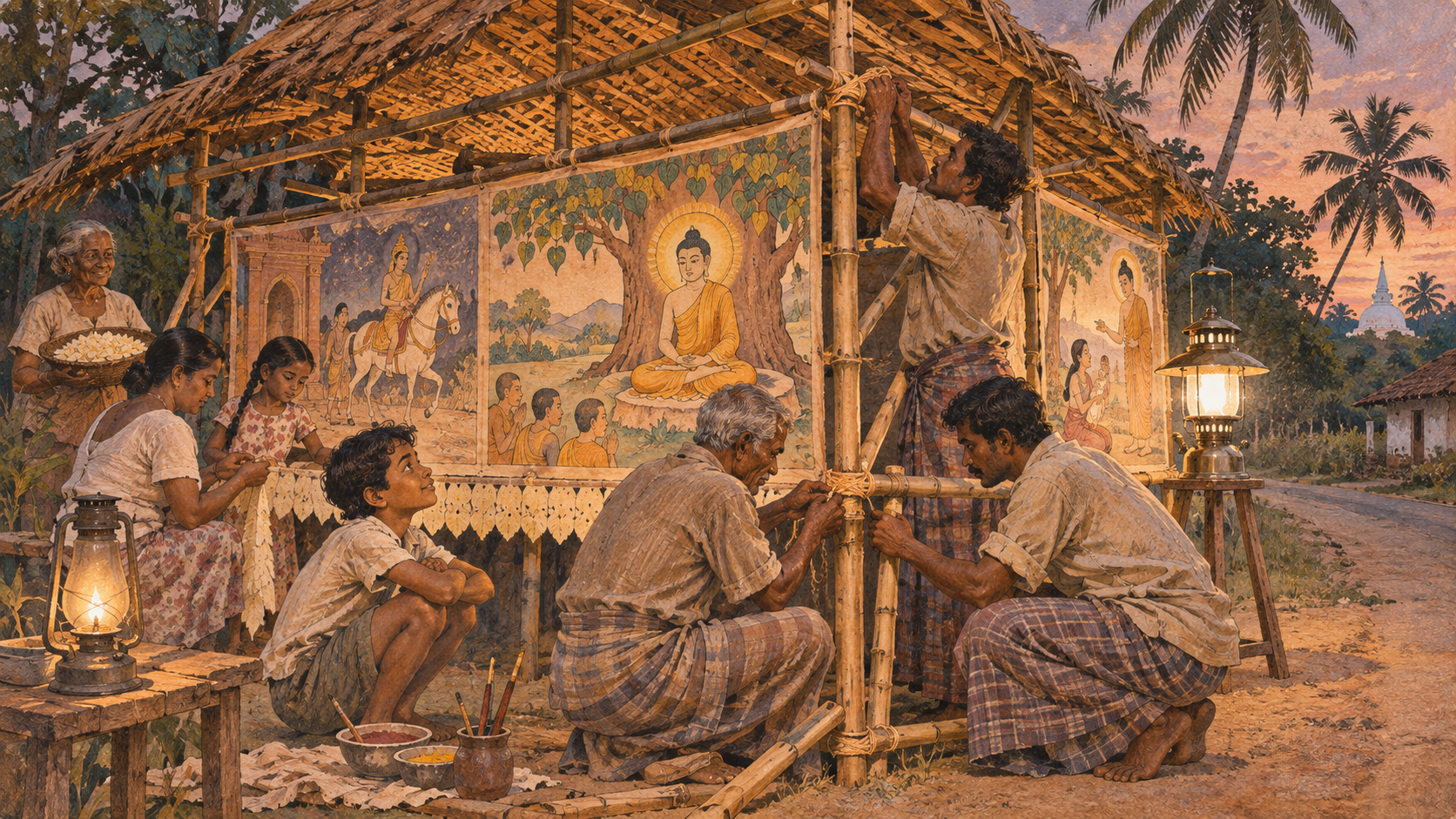
AI-generated editorial illustration inspired by the memoir; not a historical photograph.
The boy was supposed to be enjoying the pandol. Instead, he was studying how it had been made.
On Vesak outings to nearby towns, Hemasiri Wijayagunawardane watched the arrangements of paintings and lights, the bamboo frames and the curtains that concealed a display until its unveiling. Other children could admire the finished spectacle. He wanted to understand how to produce one.
In Dust to Sky, he writes: “While others enjoyed the story, I observed the technique.”
Years later, aircraft would give him plenty of reasons to examine how things fitted together. But an early lesson in turning an idea into a working undertaking arrived beside a village road, with paint, borrowed money and neighbours carrying tools.
His father asked a practical question
After the Sinhala and Tamil New Year celebrations, Hemasiri announced that he wanted to build a pandol on the family’s land beside the road. His father asked what he needed.
Money, the boy replied. He would repay it.
The exchange is small, but it establishes the character of the undertaking. This was something he intended to manage. His father initially offered to buy the materials himself; Hemasiri wanted to select them. Being trusted with that responsibility mattered.
He chose the seven weeks following the Buddha’s enlightenment as his theme. Eight large paintings would tell the story: seven scenes and a central standing image of the Buddha. That gave the ambition a manageable shape, though only a few weeks remained before Vesak.
Then the household became a workshop. His friends held frames, mixed colours, stretched fabric and cleaned brushes. His siblings helped. His father made sure essential materials were available. Of his mother, he writes simply: “My mother helped in countless unseen ways.”
That sentence deserves its place beside the more visible construction work. A project can depend on people whose contribution never becomes a photograph or a name beneath the finished piece.
A village brings its own expertise
Painting the scenes did not produce a structure capable of holding them. That required other people’s knowledge.
“Carpenters volunteered their labour. Helpers arrived carrying tools.”
Bamboo was cut, supports fixed and ropes tied. A protective roof went up because a passing shower could ruin the artwork. The concern proved sensible: rain arrived on Vesak morning, and the roof held.
There was no electricity in the village then. People brought kerosene lamps and Petromax lamps. Remembering the boy’s later career, it would be easy to make this an electrical-engineering origin story. His achievement was more grounded: he accepted the available means and brought different skills together.
The wider memoir describes neighbours renewing cadjan roofs, helping after fires and exchanging labour in paddy cultivation. Collective work was already part of the boy’s surroundings.
There was an institutional connection, too. His preschool teachers, he recalls, had trained through Sarvodaya. The movement traces its beginnings to A. T. Ariyaratne’s village work in 1958; its history describes the growth of shramadana activity and exchanges of community experience. That context helps place the preschool in a wider tradition of practical cooperation. It does not mean Sarvodaya organized this particular pandol. Sarvodaya, Our History
The distinctive contribution of Hemasiri’s account is to show that cooperation at work, with particular jobs to do. Enthusiasm needed carpenters. Paintings needed weather protection. An opening night needed light.
The work was not finished when the curtain opened
His parents unveiled the display. For seven nights, visitors came. Donations accumulated in a till.
Afterwards came a quieter obligation.
“The first thing I did was to repay the money I had borrowed from my father.”
The remaining money went to the temple. The chief monk then asked for the pandol to be displayed again for Poson. This time, the temple hired a generator and professional electricians. The work found another audience; its proceeds later helped colour-wash temple buildings.
It is a satisfying ending because the boy’s responsibility extends beyond applause. Money is accounted for. A promise is kept. Something useful remains for other people.
This is one way to read Dust to Sky: follow the habits as well as the appointments. Observe carefully. Ask for help. Give a difficult task a workable shape. Recognize the people whose skills make your idea possible.
The village had begun teaching those lessons well before Hemasiri entered a hangar.
Selected excerpts from Dust to Sky are reproduced with Hemasiri Wijayagunawardane’s permission. The full memoir follows the much larger journey from village childhood into engineering, service and family life.
References
- Hemasiri Wijayagunawardane, Dust to Sky. “The Vesak Pandol in Our Village,” with context from the village-work and Montessori chapters. Primary memoir account; recollections are the author’s.
- Sarvodaya, “Our History”. Undated organizational history, accessed 3 November 2026. Supplies institutional context, not independent confirmation of the pandol.