Leaving the Air Force Meant Leaving a Family
A second application form opened a new future. Saying goodbye to twenty-four years of belonging proved harder.
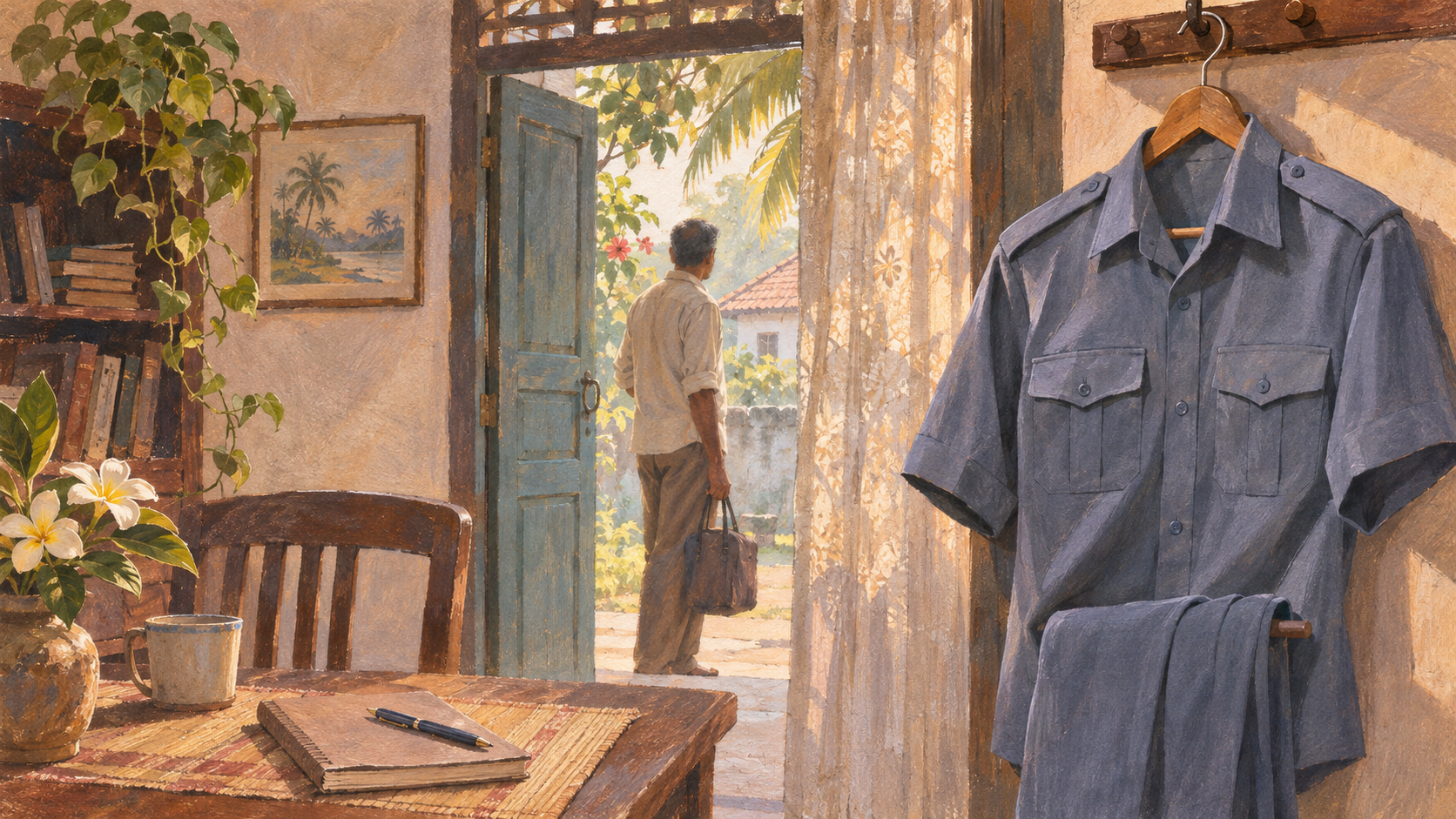
AI-generated symbolic illustration of career transition; not a portrait or an actual farewell scene.
Hemasiri Wijayagunawardane went to collect an MBA application form for somebody else. His director was approaching retirement and considering further study.
“I returned with two. One was for him. The other was for me.”
In Dust to Sky, the second form becomes the beginning of a change he had not planned. The officer who knew how to solve problems inside the Air Force would begin discovering how that experience might travel beyond it.
It did not begin with certainty. It began with enough curiosity to bring home another form.
Becoming a student around the duties of an officer
There was an entrance examination. There were evening classes. There was also a service timetable that could interrupt either without much warning.
Hemasiri recalls finding a colleague to cover his duties for an introductory session. During the session, a call about a possible security incident forced him to leave the auditorium and investigate. The report proved mistaken. On another occasion, a real air attack interrupted an evening spent working with his MBA group.
The contrast explains why education could not be managed through personal determination alone. Other people helped him remain a student when his work required him elsewhere.
“My classmates became my lifeline. They shared notes and even recorded lectures for me.”
His classmates also brought experience from different sectors. Finance, markets, human resources and business strategy entered conversations with someone accustomed to aircraft, maintenance and operational responsibility.
The new vocabulary did not make his existing knowledge obsolete. It offered other ways to use it.
A familiar problem in a different language
For his final project, Hemasiri examined the layout of an aircraft maintenance facility. He studied movements of aircraft, people, equipment and materials, then applied management ideas to redesign the arrangement with efficiency in mind.
The memoir reports that his lecturer later invited him to present the work to junior MBA groups. A problem from his professional life had become material for teaching outside it.
This is a particularly useful scene for anyone wondering whether a career change requires starting from nothing. Hemasiri could bring experience to a new setting and let that setting change how he understood it.
Research on professional identity offers a related perspective. Herminia Ibarra’s 1999 study examined junior consultants and investment bankers moving into more senior roles. It described experimentation with possible professional identities, including learning from role models. Those participants were not military leavers; the connection here is interpretive. It helps explain why entering a different professional setting can be part of finding out who one might become. Ibarra, Provisional Selves
For Hemasiri, the possibility became concrete through classmates, assignments and the experience of making a useful contribution beyond his familiar role.
A decision with something to lose
By then, the Air Force had invested years in his development. He believed he was being prepared for greater leadership. Leaving meant giving up a future he could already see in order to investigate one he could not.
His requests for release met resistance. He persisted. Eventually, the Commander discussed the decision with him and gave him two more weeks to reconsider. Hemasiri returned with his mind unchanged, and release was approved through the subsequent process.
He also agreed to remain long enough to complete a responsibility connected with Colours Night.
The details give the departure its weight. He was attached to the institution and understood why it valued retaining him. Wanting something new did not require pretending that the old life had become worthless.
The quiet after the farewell
At the farewell gathering, colleagues spoke and cried. Hemasiri struggled to control his own emotions.
The people in that room had shared the ordinary days as well as the difficult ones: work, jokes, frustrations and responsibilities. A career had accumulated into relationships.
Then came the first weeks outside.
“The corporate world was waiting for me, but my heart was still somewhere behind those familiar gates.”
A wanted departure can still bring a sense of loss. That observation does not diagnose an illness or predict how every service member will feel. It describes the emotional complexity Hemasiri gives his own decision.
For a reader considering change, it makes room for a useful question: apart from the job itself, what does the present life provide? Colleagues, routine, purpose and belonging may each need attention when the work changes.
The second application form had opened a door. Walking through it meant carrying gratitude as well as ambition.
Near the memoir’s close, Hemasiri writes: “I had said goodbye to a family.”
The sentence makes the new beginning more believable. He knew what it had cost.
Selected excerpts from Dust to Sky are reproduced with Hemasiri Wijayagunawardane’s permission. The full memoir follows the relationships and experiences that made that farewell matter.
References
- Hemasiri Wijayagunawardane, Dust to Sky. “Beyond the Uniform” and “The Day I Left the Air Force.” Primary account of education and departure; no later corporate outcomes are inferred.
- Herminia Ibarra, “Provisional Selves: Experimenting with Image and Identity in Professional Adaptation”, Administrative Science Quarterly 44(4), December 1999, pp. 764–791. Qualitative research on consulting and investment banking; its application here is an analogy, not evidence about military leavers.