The Small Connections That Keep Aircraft Flying
A helmet, an unreliable microphone and the engineering hidden between two impressive pieces of equipment.
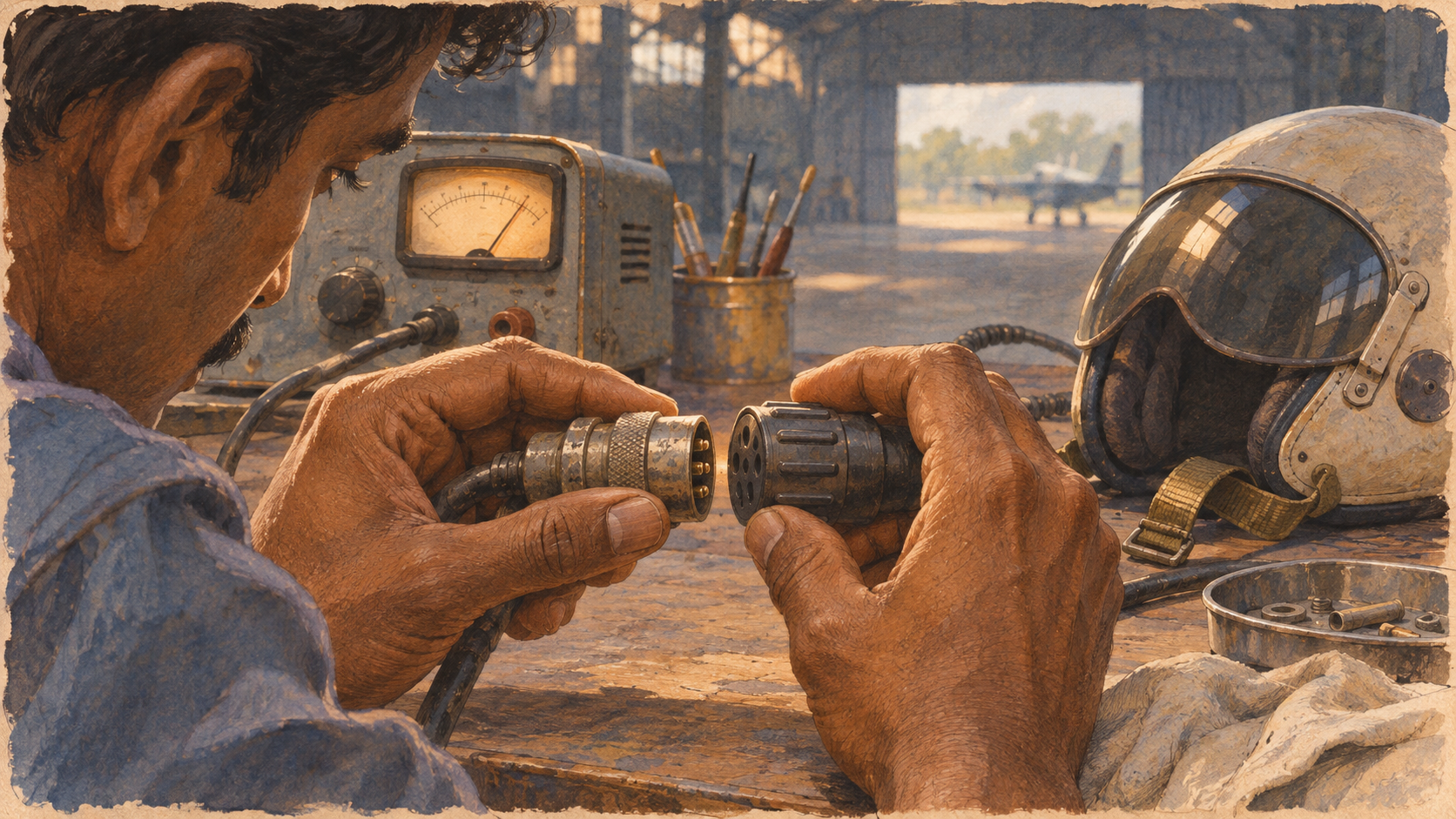
AI-generated conceptual illustration; equipment is illustrative, not a technical reconstruction.
The request sounded straightforward: equip the pilots with a Western-type helmet and microphone.
The aircraft, a Chinese-built F-7, had other ideas.
In Dust to Sky, Hemasiri Wijayagunawardane recalls finding that the connectors did not match. Then came the more troublesome discovery. The microphone could transmit a voice, but not dependably. Sometimes the signal was clear. Sometimes it disappeared.
“A communication system that worked only sometimes was, in reality, a system that could not be trusted.”
There is an entire engineering discipline inside that sentence. A successful demonstration is encouraging. Dependable performance is what the person using the equipment needs.
The problem lived between the components
Hemasiri and his colleagues explored adapting the pilot’s equipment rather than undertaking major changes to the aircraft. Their investigation identified a compatibility problem requiring an impedance-matching unit. Suppliers provided samples. The team tested configurations until communication became clear and consistent.
The memoir describes the work at the level of an engineer remembering a stubborn assignment. It is not a repair manual, and its value does not depend on reproducing one.
What matters is the sequence of judgment. The team noticed unreliable behaviour, investigated it, found a technical explanation and tested possible remedies. A connector that physically fits would not, by itself, settle the question of whether the complete communication system works.
For anyone purchasing technology, that is an expensive distinction to miss. The important performance may exist between items on a procurement list.
Working correctly—and working for the user
NASA’s Systems Engineering Handbook makes a distinction useful here. Verification establishes whether a product meets its requirements. Validation establishes whether it serves its intended purpose in its intended environment. The handbook also emphasizes testing with realistic conditions and typical users. These are complementary questions, rather than interchangeable approvals. NASA, section 2.4
A later project in Hemasiri’s account makes the distinction tangible. Installing GPS equipment required attention to cockpit arrangement: where the pilot could see and use it, and whether it interfered with other tasks. Pilots assessed an initial arrangement and provided feedback. Adjustments and evaluation flights preceded wider use.
The comparison with NASA is ours. It does not establish that the squadron followed NASA procedures or independently certify these modifications. It gives a reader a clearer way to examine the work: did the equipment function, and did the complete arrangement suit the person flying?
That second question belongs near the beginning of a design, while changes are still possible. A beautifully functioning display in an awkward position can leave its user with a new problem.
The people behind the flight
Hemasiri’s recollection returns repeatedly to colleagues. Structural work required assistance from another engineering unit. Pilots supplied operational feedback. Technicians worked through the trials. Suppliers and local agents helped obtain suitable components.
“The modification was never the work of one person.”
That acknowledgment prevents a good technical story from becoming a misleading lone-genius story. The officer had responsibility, but responsibility included coordinating expertise he did not personally embody.
The memoir later follows the development of local maintenance and repair capability. Here again, the interesting achievement extends beyond acquiring equipment. People have to learn enough to diagnose faults, restore service and support the next person who needs to understand the system.
We do not need an unverified dollar-saving figure to recognize what is at stake. A machine can be purchased once. Its usefulness has to be sustained repeatedly.
A lesson small enough to overlook
Technical progress is often pictured at the scale of the finished aircraft. Hemasiri brings it down to something a person can hold: a connector, a microphone, a component that almost works.
“And sometimes, the difference between almost working and working perfectly was simply the patience to keep testing until the right connection was found.”
Read as a reflection on his particular assignment, the sentence carries quiet satisfaction. Applied elsewhere, it asks for care: each system needs appropriate requirements, competent assessment and evidence of dependable operation. Persistence cannot substitute for those things. It gives people time to obtain them.
The finished flight is visible. The work that made it possible is easier to miss. Dust to Sky lets the people in the workshop tell their part of the story.
Selected excerpts from Dust to Sky are reproduced with Hemasiri Wijayagunawardane’s permission. The memoir contains the fuller account of the squadron, its people and the technical assignments.
References
- Hemasiri Wijayagunawardane, Dust to Sky. “Challenges at No-05 Squadron,” “From China Bay to Tel Aviv” and “Kfirs in Operation.” Primary recollections of integration, teamwork and maintenance development.
- NASA, “2.4 Distinctions between Product Verification and Product Validation”, Systems Engineering Handbook. Undated web section, accessed 3 November 2026. General engineering framework, not evidence that NASA assessed the squadron’s work.