Wendover Predicted New York's Congestion Pricing Future. The First-Year Evidence Is More Complicated.
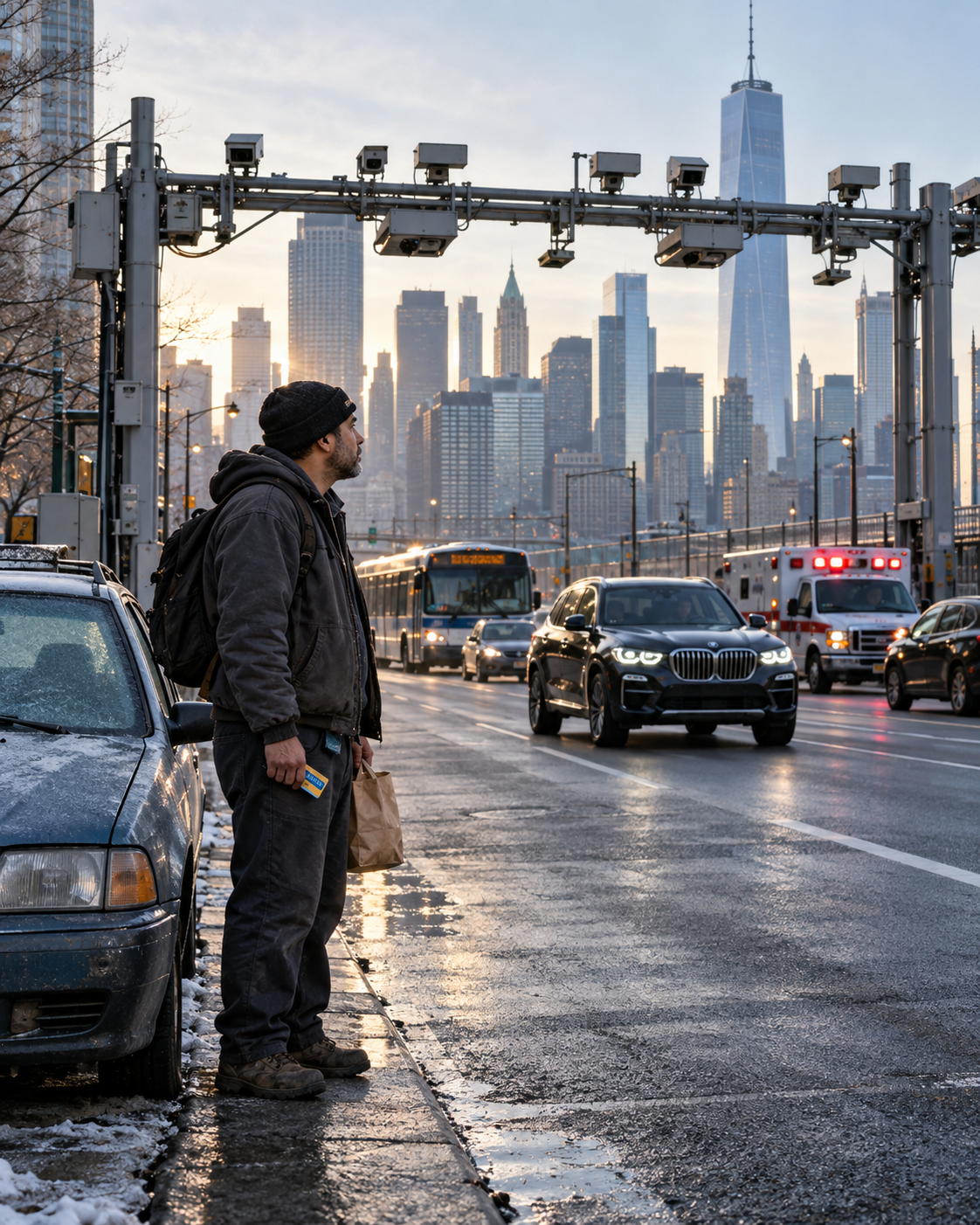
Wendover Productions made a confident prediction: charge drivers $9 to enter Lower Manhattan, and New York would eventually enjoy faster journeys, cleaner air, better public transportation and quicker ambulances. The programme began on January 5, 2025. By its first anniversary, traffic entering the zone had fallen 11%, and toll revenue exceeded $550 million.
That is not a failed policy. But it is not permission to treat every promised benefit as proven, either. The most important question is whether the improvements can be independently attributed to congestion pricing, whether they reach the people paying for it, and whether the money is producing the promised transportation improvements.
The traffic gains went to many people who never paid the toll
The most interesting independent finding actually complicates Wendover's economic explanation. An August 2026 Yale working paper found that average toll-paying trips saved approximately 2.3 minutes, while the $9 charge would require a driver's time to be worth roughly $207 an hour to break even on those savings alone.
Tobin Center for Economic Policy+1
The same researchers found that untolled journeys saved an average of just nine seconds, but there were more than 100 times as many of them. Consequently, most of the aggregate driving-time benefit went to motorists who never paid the congestion charge. This is a genuine public benefit, but it is not the simple exchange of a high-value driver's money for a low-value driver's improved journey that the video describes.
Tobin Center for Economic Policy
The study is a working paper, not a final peer-reviewed finding. Its importance is that it examines the entire road network rather than treating Manhattan's toll boundary as the whole transportation system.
The ambulance minute is not a minute sooner to treatment
Wendover makes emergency response one of its strongest arguments. It cites deteriorating EMS response times, then explains that cardiac-arrest survival chances fall by 7–10% for every additional minute before medical intervention. As the video puts it, "Minutes matter during life-threatening emergencies."
But the actual measurements require a distinction the argument does not adequately make.
A 2026 National Bureau of Economic Research working paper examined approximately half a million EMS incidents. It estimated that congestion pricing reduced total ambulance travel time by 63–70 seconds. However, 54–59 seconds of that improvement occurred during transportation from the incident scene to hospital; the estimated improvement in reaching the patient was only 7–9 seconds, or approximately 2%, and was less precisely estimated.
NBER
Those are different medical events. An ambulance reaching a cardiac-arrest patient nine seconds sooner is not equivalent to an ambulance completing its subsequent hospital journey a minute sooner. The survival statistics Wendover cites concern delays before medical intervention; they cannot simply be applied to the entire ambulance journey.
There is another uncomfortable result. In July 2026, ABC7 reported that FDNY figures showed EMS response times increased by 57 seconds in the central business district between 2024 and 2025. Firefighter response times improved by just one second. An FDNY spokesperson said there was no evidence that congestion pricing had affected those responses.
ABC7 New York
The wider emergency system is deteriorating. New York City Comptroller Mark Levine's October 2026 report found that life-threatening ambulance response times increased by 3 minutes and 50 seconds between fiscal years 2015 and 2026, a 41.2% deterioration. It identified insufficient ambulance availability, dispatch delays, hospital turnaround times and staffing shortages among the contributing problems. More than 500 EMTs left their positions in FY2026.
comptroller.nyc.gov
Congestion pricing can make roads easier to navigate. It cannot manufacture ambulances, retain exhausted paramedics or repair a broken dispatch system. Wendover's emergency argument turns one important component of response time into something approaching a solution to the entire emergency-care problem.
The cleaner-air promise remains scientifically unsettled
The video predicts that clearer streets will mean cleaner air. That is plausible, but the first-year evidence is considerably less decisive.
The New York City Health Department published a comprehensive evaluation on August 14, 2026. It found no statistically significant pollution changes attributable to congestion pricing within the Congestion Relief Zone or in the monitored environmental-justice communities outside it. Pollution generally remained stable or improved slightly, continuing a longer-term decline.
Environment & Health Data Portal
A peer-reviewed study published in Environmental Science & Technology Letters on October 7, 2026, reached a different conclusion. Researchers associated with Columbia University's Lamont-Doherty Earth Observatory estimated that fine particulate pollution inside the tolling zone fell approximately 13% because of congestion pricing. However, the study could not attribute the metropolitan region's greater-than-20% decline in nitrogen dioxide to the programme.
Lamont-Doherty Earth Observatory
These studies use different monitoring approaches. The Health Department relies heavily on integrated monitors designed to measure long-term neighborhood exposure, while the Columbia research uses real-time monitoring data and satellite observations. The Health Department considers its integrated monitors the more reliable measure of neighborhood-level pollution.
Environment & Health Data Portal+1
The distinction matters. A reduction in one pollutant inside Manhattan does not establish a general improvement in air quality across the metropolitan region. Nor does it establish that every community near the surrounding highways benefited.
Wendover's prediction may ultimately prove correct across more measures and over a longer period. The available evidence does not justify presenting that outcome as already established.
The money does not go directly to the people priced out
Wendover's economic explanation contains a particularly convenient assumption: drivers who value their time less will stop driving, while their toll payments will improve public transportation and compensate them indirectly.
The actual financial arrangement is less immediate.
New York law dedicates congestion-pricing revenue to the MTA's capital programme. The New York State Comptroller has explicitly explained that these funds are not available for ordinary operating expenses under the existing legal framework.
Office of the New York State Comptroller
The MTA's first-year evaluation provides an unusually revealing financial breakdown. Between January and October 2025, the programme generated $467.8 million in net revenue. Of that amount:
- $145.7 million was used to retire infrastructure financing notes.
- $15.8 million paid interest on those notes.
- $20 million was reserved for mitigation expenses.
- $276.2 million was held as collateral for a $500 million loan financing eligible transit and commuter capital projects.
The programme also incurred $1 billion in short-term debt during 2025 to finance eligible transit projects, to be retired through future bonds backed by toll revenue.
Railway Age
The $15 billion headline is therefore a capital-financing commitment supported by future revenue, not $15 billion already collected and spent on improving passengers' daily journeys.
There are genuine projects underway, including the Second Avenue Subway extension, signal upgrades, station accessibility improvements and replacement railcars. But these investments take time to reach passengers. Toll revenue cannot simply be redirected to lower fares or pay for everyday operating services.
The MTA reported that bus speeds increased 2.3%, bus ridership increased 8%, and subway trips into the congestion zone increased 9% during the first nine months of 2025. Crucially, its own report acknowledged that the wider post-pandemic recovery was also contributing to ridership growth.
Railway Age
The distinction is simple: financing future transit improvements is not the same as compensating someone who cannot afford to drive into Manhattan today.
The working-class discount is narrower than its name suggests
The video revisits the 2008 argument that congestion pricing disproportionately burdens working-class commuters. But it does not examine the practical details of the final programme's low-income discount.
The MTA's Low-Income Discount Plan is available to qualifying registered vehicle owners with annual federal adjusted gross income of $50,000 or less, or enrollment in SNAP, TANF or WIC. Applicants must have a New York E-ZPass account and provide supporting documentation.
The advertised 50% discount only begins after the first ten trips in a calendar month.
lidp.mta.info
Consider a qualifying worker entering Manhattan on 20 peak-period workdays:
- First ten entries: $90.
- Next ten entries: $45.
- Total monthly toll: $135.
Without the discount, the same commuter would pay $180. The actual saving is 25% across the month, not 50%.
There is also a revealing uptake figure. A March 2026 presentation by the MTA's Chief Operating Officer to the Washington State Transportation Commission recorded just 1,505 low-income discount plan enrollees as of January 31, 2026, representing 0.2% of all trips. The presentation does not provide the total number of eligible drivers, so this figure cannot establish the programme's overall coverage or failure. It does, however, show how limited enrollment was at that point.
wstc.wa.gov
The actual toll structure is also more complicated than the video's closing shorthand of paying $9. Passenger vehicles pay $9 during peak periods and $2.25 overnight, while trucks and buses pay between $14.40 and $21.60 during peak periods. Taxi and app-based vehicle passengers face separate per-trip charges.
NYC311
The video spends considerable time explaining why the original proposal was called elitist. It spends far less time examining how the final system distributes its costs and whether its protections reach the people they are supposed to help.
New Yorkers have not yet demonstrated that they love paying the toll
Wendover ends with a prediction that, once the benefits become visible, New Yorkers will gradually accept the charge.
There is some evidence of acceptance, but the promised transformation in public opinion has not been demonstrated.
A peer-reviewed study published in npj Sustainable Mobility and Transport in December 2025 followed New Yorkers before implementation, during the launch and six months afterwards. Initial support was 57.1%. Researchers found no statistically significant change in support across those six months, although supporters' attitudes strengthened and opponents' attitudes also became more entrenched.
npj Sustainable Mobility and Transport
The study's sample declined from 1,417 participants before implementation to 603 after six months, and it was recruited through an online research platform rather than a representative population survey. It cannot settle the question of long-term public acceptance.
But it does not establish Wendover's prediction either.
Closing verdict
Wendover understood the fundamental transportation problem. Manhattan has limited road capacity, excessive vehicle demand and a public transportation system that desperately needs investment. Congestion pricing has produced measurable improvements in traffic speeds and substantial revenue.
The failure is the leap from those results to a much larger promise.
A faster road is not automatically a faster emergency response. A reduction in vehicle traffic is not proof of cleaner air across every affected neighborhood. A capital-financing programme is not immediate compensation for a commuter who has been priced out. And a plausible prediction of public acceptance is not evidence that acceptance has happened.
I would not attack congestion pricing simply because it charges drivers. I would attack the habit of treating one successful transportation intervention as proof that every social benefit attached to it has arrived.
New York deserves better than a convincing economic parable. It deserves evidence showing who gets faster journeys, who pays for them, which communities breathe cleaner air, and whether the promised improvements actually reach the people who need them.
Wendover made the case for the toll. It did not establish the entire case for the city it promised would emerge afterwards.
References
1. The Battle Over NYC Congestion Pricing — Wendover Productions. Original video and primary account of the creator's argument and predictions.
2. Congestion Relief Zone Tolling First Evaluation Report — MTA Bridges & Tunnels, January 2026. First-year traffic, transit, revenue, financing and mitigation figures.
3. The Network-Wide Effects of Congestion Pricing: Evidence from New York City — Yale Tobin Center for Economic Policy, August 2026. Working paper examining traffic speeds, economic effects and the distribution of benefits across priced and unpriced journeys.
4. Urban Congestion Pricing and the Response Times of Emergency Medical Services — National Bureau of Economic Research, September 1, 2026. Summarizes the research distinguishing ambulance response-to-scene improvements from hospital transport improvements.
5. Has Congestion Pricing Reduced 911 Response Times? — WABC-TV, July 9, 2026. Reports FDNY's actual response-time figures and the department's reservations about attributing improvements to congestion pricing.
6. A System Under Strain: FDNY EMS Operations and Fiscal Pressures — New York City Comptroller, October 16, 2026. Documents emergency response deterioration, ambulance shortages, staffing attrition and operational constraints.
7. Air Quality Impacts of Congestion Relief Zone Tolling — New York City Department of Health, August 14, 2026. Full-year assessment finding no statistically significant pollution changes attributable to tolling in monitored communities.
8. Study Links NYC Congestion Pricing Policy to Cleaner Air in Lower Manhattan — Columbia Climate School, October 7, 2026. Explains the peer-reviewed study estimating a 13% reduction in fine particulate pollution inside the toll zone.
9. New York's Congestion Relief Zone — Washington State Transportation Commission, March 25, 2026. Contains the MTA's presentation of toll design, discount eligibility and low-income plan enrollment.
10. Congestion Pricing Program — NYC311, current programme information. Establishes actual toll rates, payment periods, vehicle categories and crossing credits.
11. Financial Outlook for the Metropolitan Transportation Authority — Office of the New York State Comptroller, October 2022. Explains the legal separation between congestion-pricing capital funding and the MTA's operating budget.
12. Public Attitude, Behavior, and Social Norm Changes over Six Months with the NYC Congestion Charge — npj Sustainable Mobility and Transport, December 16, 2025. Longitudinal research testing whether public support changed following implementation.