Anduril Has Built a Battlefield Network. Wendover Mistakes It for an Autonomous Killing Machine.
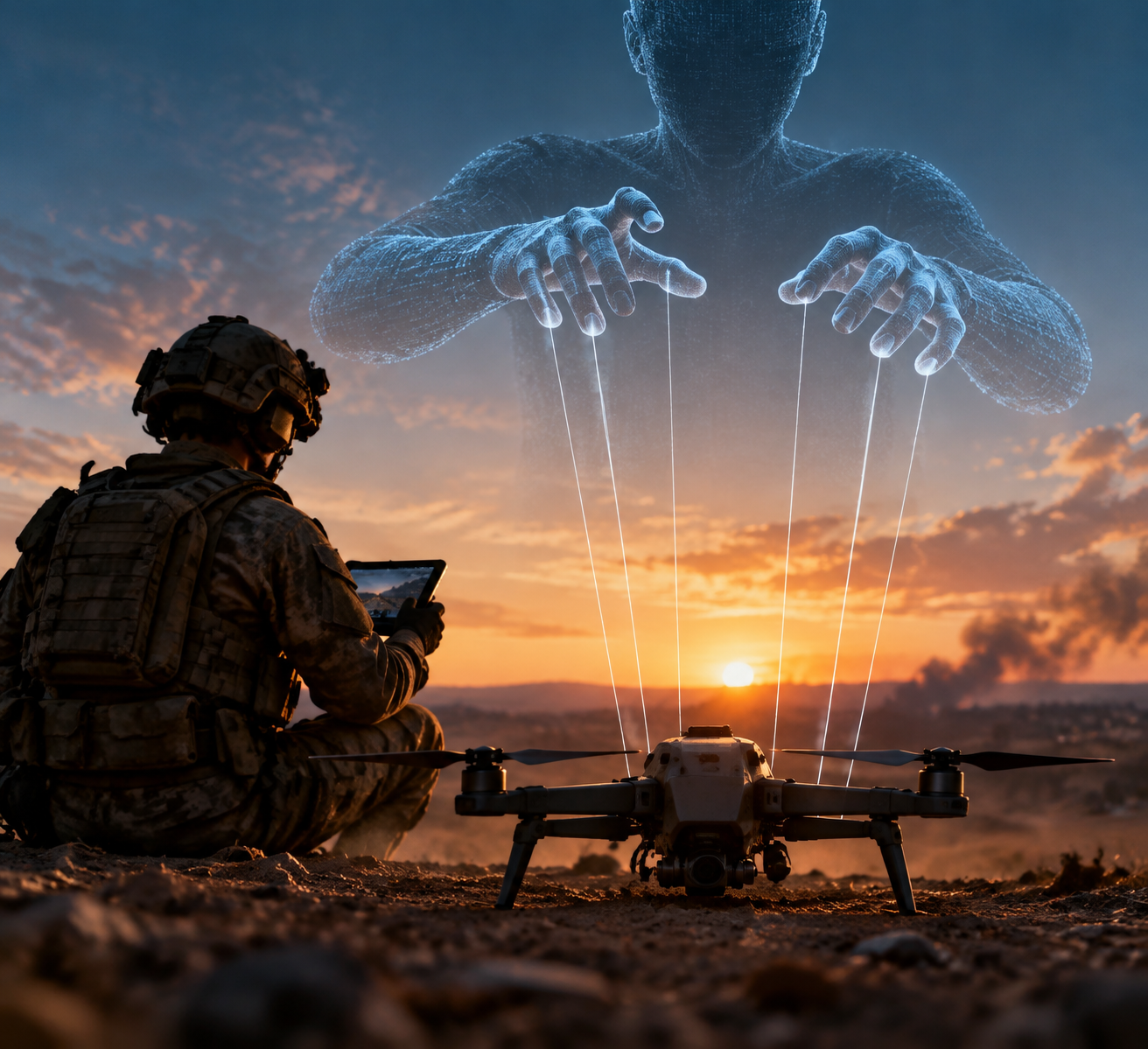
Wendover Productions identifies a genuine military revolution: inexpensive drones have changed the economics of warfare. But its most consequential argument makes a leap the evidence does not justify. It moves from autonomous detection and coordinated weapons to machines independently deciding who dies, without establishing that Anduril's Lattice system can do that.
That distinction matters. A system that helps a soldier identify a hostile aircraft and authorize an interception is not the same thing as a machine independently selecting a human target and deciding to kill.
Anvil does not decide who deserves to die
The distinction is documented in the US Army's own counter-drone manual. Anvil can navigate autonomously toward an incoming drone, use artificial intelligence and computer vision to identify it, and deliver its lethal effect only after authorization. Its designated target is an unmanned aircraft, not an independently selected human target.
This is not a trivial capability. It is a meaningful reduction in the work required of a human operator. But it is not the same thing as delegating the decision to kill a person to an algorithm.
The Pentagon itself distinguishes these categories. Its definition of a lethal autonomous weapon covers systems that can select and engage targets without further human intervention. Semi-autonomous systems instead engage targets selected by a human operator. The Pentagon requires appropriate human judgment over the use of force, although that requirement does not necessarily mean a person must manually control every engagement.
Wendover collapses these distinctions into a single frightening progression. The ethical concern is legitimate. The technical evidence presented does not establish that progression has already happened.
Lattice is real, but its actual achievement is different
There is another important distinction: Lattice is not simply an artificial intelligence deciding what to attack.
Anduril describes Lattice as a command-and-control platform. It collects information from sensors, builds a shared operational picture, provides AI-generated recommendations to operators, and translates their decisions into instructions for connected equipment. Its own product description explicitly places operator decisions between AI recommendations and action.
That is an ambitious military capability. It also has genuine government backing.
In June 2026, the US Army established the common data layer for its Next Generation Command and Control (NGC2) programme, following operational validations involving the 4th and 25th Infantry Divisions.
Anduril leads the common data layer for the 4th Division, working alongside Palantir's Foundry and Raft. Lockheed Martin leads the corresponding implementation for the 25th Division. The Army tested the wider architecture across ten months of training events, including exercises involving cyber and electromagnetic attacks.
In October 2026, the Army awarded Anduril a five-year contract worth up to $1.8 billion to expand the system, beginning with I Corps.
There is an important qualification: the initial contract period is worth $162.8 million. The remaining value depends on contractual options. This is a command-and-control infrastructure contract, not a $1.8 billion purchase of autonomous killing drones.
Anduril also received a separate three-year, $86 million Special Operations Command contract in March 2025 to develop and deploy mission-autonomy software for multiple types of uncrewed systems. This is genuine progress toward coordinated autonomy, not proof that machines independently decide whom to kill.
The preliminary criticism that Anduril's technology is merely promotional therefore needs correcting. It is not. The Army is testing and expanding real capabilities.
But the distinction between a functioning battlefield network and an autonomous lethal decision-maker remains enormous.
The Pentagon's own auditors cannot yet price the network
Here is a much more consequential omission.
In August 2026, the Government Accountability Office published an assessment of the Army's NGC2 modernization programme. Its findings were uncomfortable.
The Army had identified approximately $3.3 billion in requested NGC2 funding through fiscal year 2026, but had not completed an initial estimate of the programme's full life-cycle costs.
It also lacked a detailed schedule identifying which military units would receive the new technology and when. Its tentative objective was to equip 11 divisions and four corps by the end of fiscal year 2032.
These figures concern the wider Army NGC2 programme, not Anduril's individual contract.
The distinction matters because the video makes a powerful economic argument: autonomous coordination will make the operation of drones cheap.
But the infrastructure required to achieve that coordination includes software, communications, computing equipment, sensors, integration, training and ongoing support.
The Army is committing billions to the wider architecture without yet having a complete life-cycle cost estimate.
Calling the aircraft cheap is not the same as demonstrating that the military system operating them is cheap.
GAO did not conclude that NGC2 would fail. It concluded that the Army lacked essential information to assess its affordability and ability to scale. That is precisely the kind of evidence a serious discussion of military efficiency should include.
A $400 drone is not a $400 successful attack
Wendover compares a roughly $400 FPV drone with a Russian tank worth hundreds of thousands or millions of dollars.
The comparison is visually persuasive. It is also incomplete.
The video acknowledges that drone success rates have declined as Russia improves its electronic warfare capabilities. Yet it does not build a proper cost-per-successful-attack calculation.
Research by the Center for Strategic and International Studies provides useful context. Interviews with Ukrainian drone operators indicated that ordinary low-cost FPV missions succeeded approximately 10–15% of the time, while even highly skilled operators achieved roughly 30–50%.
CSIS also found that autonomous last-mile navigation could substantially improve success rates, potentially reaching 70–80%. These figures are interview-derived estimates, not a comprehensive independently audited battlefield dataset.
Consider the implications. A $400 drone that repeatedly fails before completing its mission does not deliver a $400 successful attack.
If unsuccessful one-way missions consume their aircraft, a 10–15% success rate would imply approximately $2,700–$4,000 in drone hardware per successful mission, before paying for personnel, communications, training, payloads and logistical support. This is an illustrative calculation, not a verified cost-per-kill figure.
Autonomy could improve that equation. But improved navigation is not the same as autonomous target selection, and neither automatically produces a coordinated swarm capable of independently conducting lethal operations.
Wendover's example of a drone destroying an average of one-tenth of a tank is explicitly hypothetical. It is an illustration, not a measured battlefield statistic.
The distinction between a weapon's purchase price and the actual cost of producing a successful military effect deserves considerably more attention.
Sentry's border deployment deserves more scrutiny
The video introduces Anduril's Sentry system through its original deployment along the US-Mexico border.
That is a meaningful commercial and government deployment. But it is surveillance technology, not evidence of autonomous battlefield killing.
A 2026 GAO report describes Autonomous Surveillance Towers capable of detecting, identifying and tracking cross-border activity. Their software can distinguish people from vehicles and send alerts to Border Patrol agents, reducing the need for continuous manual monitoring. GAO identifies Anduril as the prime contractor for these autonomous towers.
The wider Integrated Surveillance Towers programme includes multiple generations of equipment from four different systems. It is not an exclusively Anduril installation.
GAO's June 2026 assessment identified several unresolved procurement issues:
- The programme had operated without an approved acquisition cost and schedule baseline since its establishment in 2022.
- Its recorded cost estimate, dating from January 2023, was approximately $1.368 billion.
- The intended programme scale had grown to approximately 2,300 towers by 2034.
- Testing for future integrated surveillance deployments had not begun, although three of three performance parameters had been met for legacy towers.
This does not establish that Anduril's equipment failed. GAO did not isolate Sentry's accuracy or attribute the entire programme's costs to Anduril.
It does establish something important: the real-world deployment of autonomous surveillance technology deserves more than a passing mention as evidence of technological progress.
Who measures its accuracy? What does it cost to operate? How well does it perform over time? What happens when its classifications are wrong?
Those questions matter when governments increasingly rely on automated surveillance and threat detection.
The Ukrainian evidence is more complicated than either extreme
To be fair, Wendover's discussion of Saker is not invented.
In October 2023, Forbes reported that a Saker representative had confirmed small-scale use of the company's drones in autonomous attack mode. The same report acknowledged that the AI was imperfect and that the available demonstration footage did not establish whether the attack shown was autonomous.
Subsequent research by CSIS found that Ukraine was making substantial progress in individual autonomous functions, including image recognition, target tracking and navigation. But these functions had not yet combined into a consistently autonomous end-to-end battlefield process. Human oversight remained important in engagement decisions.
There have also been more serious developments.
In June 2026, Ars Technica reported an account of a one-time Ukrainian battlefield test involving drones allegedly operating without human intervention and killing Russian soldiers. The account came from a drone manufacturer's chief executive describing an earlier experiment. There was no video evidence showing what the drones had actually targeted, and their effectiveness could not be independently established.
By October 2026, the distinction remained important. The Konrad Adenauer Foundation's Ukraine Air War Monitor reported that autonomous terminal guidance was already being used, while automatic target selection remained at an early testing stage in Ukraine and Russia as of spring 2026.
The evidence supports a serious conclusion: military autonomy is advancing, but its components are developing at different speeds.
Recognition, navigation, target selection, engagement authorization and coordinated swarm behaviour are separate capabilities.
Treating them as interchangeable makes the technology appear more mature than it is.
The moral cost does not disappear because software is involved
Wendover's most unsettling argument is that autonomous weapons remove the moral burden of killing.
The video says:
“Nobody has to bear the weight of pulling the trigger that ends a life.”
I find that conclusion too convenient.
Removing an operator from the immediate act of firing does not remove the humans who design the system, select its objectives, authorize its deployment, establish its rules and decide where it can be used.
Responsibility can become more dispersed and harder to investigate. That is a genuine danger. But it is not the same as responsibility disappearing.
The Pentagon's Directive 3000.09 establishes requirements for human judgment, realistic testing, reliability and senior-level review of covered autonomous weapons. The rules are not an absolute prohibition on autonomous weapons, and their interpretation leaves room for different levels of human involvement.
That flexibility deserves scrutiny. Who decides what level of human judgment is appropriate? How is it assessed? What happens when an algorithm misidentifies a civilian, friendly soldier or surrendered combatant?
These are questions about institutional accountability, not just artificial intelligence.
A machine cannot be held politically responsible for a government's decision to deploy it. The people and institutions making that decision remain accountable.
Closing verdict
Wendover explains the economics of inexpensive drones convincingly. Its account of Ukraine's adaptation, Russia's countermeasures and the growing importance of autonomous navigation contains substantial educational value.
But the video makes its most frightening argument by moving too quickly between different technological achievements.
A drone that navigates autonomously is not necessarily a drone that selects its own target. A system that recommends an action is not necessarily a system that authorizes it. A network coordinating autonomous equipment is not necessarily a machine deciding which human life to take.
Anduril is building something important. The US Army is investing heavily in it, and the technology is moving from experimentation toward operational deployment.
That makes independent scrutiny more important, not less.
The real story is not that an autonomous killing machine has already arrived. It is that governments are investing billions in the infrastructure that could make increasingly autonomous warfare possible, while the technical limits, full costs and accountability arrangements remain incompletely understood.
Wendover has identified a dangerous direction of travel. It has not established that the destination has been reached.
The difference is not academic. It is the difference between reporting a military revolution and selling its most frightening possible future as an accomplished technological fact.
References
1. The original work: The Terrifying Efficiency of Drone Warfare — Wendover Productions. The source video and its original argument.
2. Counter-Unmanned Aircraft System Operations, ATP 3-01.81 — US Department of the Army, May 23, 2025. Establishes Anvil's autonomous interception capabilities and the requirement for authorization before lethal engagement.
3. Army and industry align on common data baseline — US Army Public Affairs, June 22, 2026. Documents NGC2's operational validation, Anduril's role and the integration with Palantir and Raft.
4. Anduril awarded contract to expand US Army's next-gen battlefield command system — Defense News, October 13, 2026. Establishes the $162.8 million base contract and potential $1.8 billion value, distinguishing the actual award from its maximum options.
5. Army Modernization: Better Schedule and Cost Information Needed to Support Scaling Battlefield Network — US Government Accountability Office, August 2026. Documents the Army's missing life-cycle cost estimate, incomplete fielding schedule and approximately $3.3 billion in identified NGC2 funding requests through FY2026.
6. DHS Annual Assessment: Dynamic Environment Affects Efforts to Manage Acquisition Risks — US Government Accountability Office, June 2026. Examines the broader Integrated Surveillance Towers programme, Anduril's role and unresolved acquisition and testing issues.
7. Ukraine's Future Vision and Current Capabilities for Waging AI-Enabled Autonomous Warfare — Kateryna Bondar, Center for Strategic and International Studies, March 6, 2025. Provides operator-interview evidence on drone success rates and distinguishes partial AI autonomy from fully autonomous engagement.
8. Defense Primer: U.S. Policy on Lethal Autonomous Weapon Systems — Congressional Research Service, March 26, 2026. Explains the legal and technical distinctions between autonomous, semi-autonomous and human-supervised weapons under US policy.
9. Ukraine's AI Drones Seek and Attack Russian Forces Without Human Oversight — David Hambling, Forbes, October 17, 2023. Reports Saker's small-scale autonomous attack claims while documenting their limitations.
10. Ukraine's One-Time Test Used Fully Autonomous Drones to Kill Russian Soldiers — Jeremy Hsu, Ars Technica, June 12, 2026. Examines an alleged autonomous battlefield experiment and explains why its results remain difficult to verify.