-
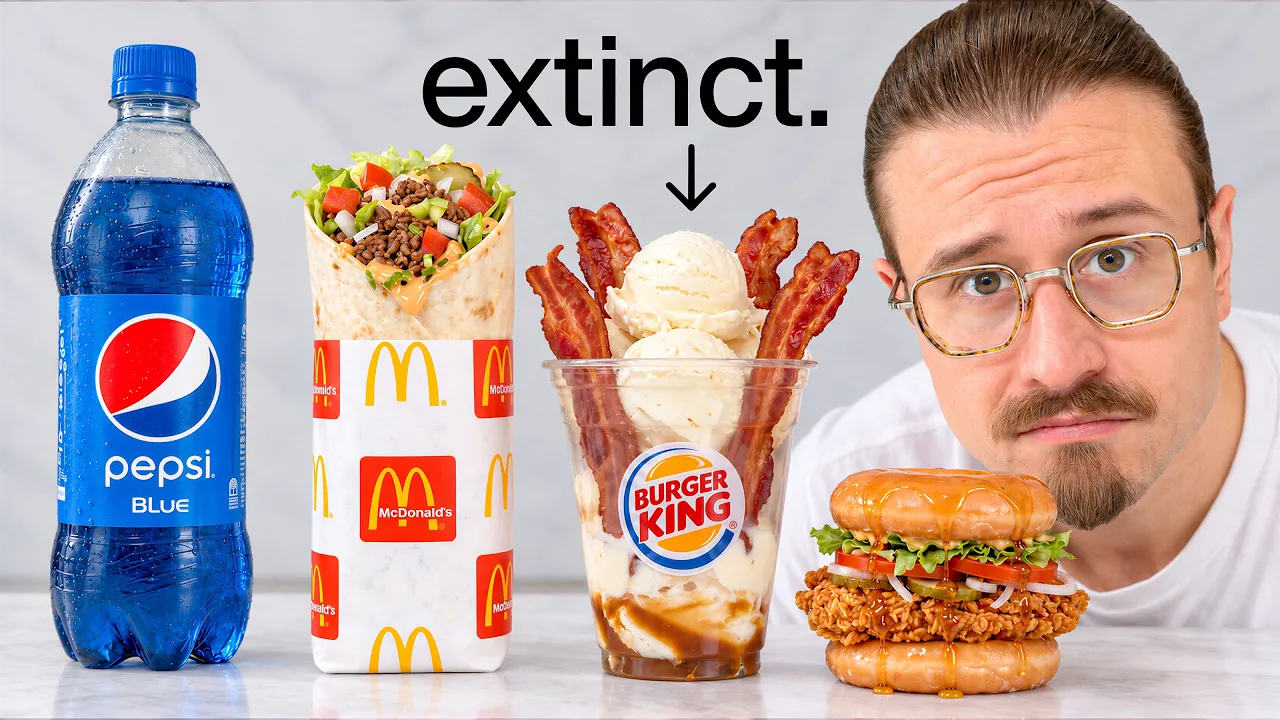
Joshua Weissman and former McDonald's corporate chef Mike tested 17 discontinued or intermittently available fast-food items, and only the Choco Taco reached S tier. Most were kitchen recreations intended to resemble the originals; McDonald's fried apple pie and Wendy's Bacon Pub Cheeseburger were tasted during temporary returns.
-
The recreations were not uniformly exact replicas, which limits how literally the ratings can be applied to the original products. Weissman used his own Hokkaido cinnamon-roll recipe for Burger King's Cini Minis, acknowledged uncertainty about Costco's churro preparation, and the tasters questioned whether their Dairy Queen recreation represented the original nonfat yogurt.
-
Taco Bell's waffle breakfast taco earned C tier despite an appealing presentation. Introduced in 2014 and discontinued the following year, the recreated taco combined a fried waffle shell, sausage, scrambled eggs, and optional maple syrup; the tasters wanted a sweeter waffle, while Weissman preferred a breakfast burrito's familiar flavors.
-
Chick-fil-A's chicken salad sandwich received F tier, although its official recipe remains available. Discontinued in 2017 after a long menu run, it was recreated using Chick-fil-A chicken, toasted wheat bread, and lettuce; Weissman found the seasoning acceptable but disliked the other elements.
-
Mike described chicken salad as a way a restaurant can repurpose already-cooked chicken rather than discard it. He linked that possibility to Chick-fil-A's system of holding prepared sandwiches for quick service, but the conversation did not establish that leftover chicken was the company's official reason for selling the sandwich.
-
Jack in the Box's ham and turkey melt was serviceable but too ordinary to justify a special trip, earning C tier. Introduced in 1990 and discontinued a few years later, it combined toasted sourdough buns, ham, cheddar, turkey, Swiss cheese, and tomato without sauce; the tasters considered it easy to reproduce at home.
-
Dairy Queen's frozen-yogurt offering received B tier, with substantial uncertainty about the recreation's authenticity. The episode dates its introduction to 1990 and disappearance roughly ten years later; Mike said it targeted frozen-yogurt competitor TCBY, while both tasters thought their chocolate-and-nut version tasted more like ice cream than nonfat yogurt.
-
Pizza Hut's Big Flavor Dipper received D tier because its elaborate presentation offered little beyond ordinary pizza. The episode places its original launch in 2011, removal a year later, and another unsuccessful return in 2020; the recreation joined two rectangular pizzas, cut them into roughly two-inch fingers, and served marinara, ranch, and remoulade-style dips.
-
Mike used the Pizza Hut dipper to describe the gap between marketing novelty and culinary value. He framed it as the kind of shareable product marketing executives might request, despite pizza already being shareable; neither taster saw a compelling reason to choose it over different pizzas or a more varied order.
-
The Choco Taco was the clear winner, combining distinctive presentation with flavors both tasters wanted to keep eating. The episode dates its creation to 1983 and discontinuation to 2022; their recreation paired a crisp waffle shell, ice cream, chocolate coating, and peanuts, earning the only S rating despite being messy to eat.
-
The Choco Taco's main practical weakness was structural rather than flavor. Its shell broke during eating, and extending the chocolate coating farther down the shell was proposed to hold it together; both praised the chocolate, ice cream texture, peanut flavor, and retained waffle crunch.
-
Burger King's Cini Minis earned a strong A tier, but the test used Weissman's own cinnamon-roll recipe. The episode dates the product's debut to 1998, removal to 2012, and temporary return to 2025; Weissman remembered enjoying it as a child and considered it excellent but less distinctive than the Choco Taco.
-
McDonald's temporarily revived fried apple pie earned B tier for excellent texture but weak filling flavor. The episode dates the original's introduction to 1968 and replacement to 1992, which Mike associated with promoting a baked alternative as healthier; both wanted more sweetness and filling, while Weissman also wanted stronger apple flavor and salt.
-
Mike had promoted Wendy's Bacon Pub Cheeseburger after leaving McDonald's, but explicitly said he did not create it. He knew the product from a social-media marketing relationship and identified bacon fat in the bun as a distinctive ingredient; the episode dates the burger's introduction to 2020 and describes repeated removals and returns.
-
Wendy's Bacon Pub Cheeseburger received B tier, with its bun outperforming the beef. Both tasters singled out the bun as the best component, while Weissman criticized the patty's lack of seasoning and suggested the bun would work well with egg, cheese, and Canadian bacon in a breakfast sandwich.
-
Domino's baked apple oven dip earned C tier because its format made the apple filling difficult to eat with the accompanying bread. Introduced in 2021 and discontinued in under a year according to the episode, the recreation paired buttered cinnamon-sugar pizza-dough twists with heated canned apple-pie filling; the tasters preferred the twists alone.
-
Arby's Ar-B-Q sandwich received F tier because barbecue sauce overwhelmed the meat and made the sandwich unpleasantly messy. The episode dates its launch to 1977 and describes repeated revivals; the recreation used purchased Arby's roast beef and buns with Sweet Baby Ray's barbecue sauce.
-
Mike said sticky barbecue products can create an operational burden on a fast-food assembly line. He explained that sauce spreads across the work area as sandwiches move through it, offering a practical reason employees might dislike preparing the Ar-B-Q beyond whether customers enjoy its flavor.
-
Mike argued that McDonald's onion nuggets would compete with its more profitable fries. He described this as menu cannibalization: customers switching from fries to a new side could reduce profit even if the new item sold; his explanation was an assessment of McDonald's incentives rather than a documented current company decision.
-
McDonald's onion nuggets received C tier, with the tasters seeing room for better seasoning and texture. The episode places their launch in the 1970s and removal in the early 1980s and attributes them to the McRib's inventor; the recreation used diced onion, batter, freezing, a second coating, and frying, while Mike suggested thinner nuggets.
-
The Arch Deluxe illustrated the difficulty of selling an upscale adult burger to McDonald's family audience. Launched in 1996 and gone around the start of the 2000s according to the episode, it was backed by a stated $200 million in advertising; Mike argued that the more expensive positioning did not match what those customers wanted.
-
The Arch Deluxe recreation earned C tier because its extra ingredients did not overcome its familiar McDonald's flavor. It combined a quarter-pound cheeseburger, round bacon, lettuce, tomato, onion, ketchup, and a mustard-mayonnaise sauce on a potato bun; Mike liked Dijon but would remove several other toppings, while Weissman especially disliked the ketchup.
-
Burger King's Mac n' Cheetos earned C tier because the combination sounded more appealing than it tasted. The episode dates its run to 2016-2017; the recreation deep-fried shaped, chilled macaroni and cheese and dusted it with crushed Cheetos, but the tasters found it overly rich and noted that powder alone lacked a Cheeto's crisp corn-puff experience.
-
Costco's twisted churro earned B tier for its custardy interior, although Weissman wanted more crispness. The episode dates its introduction to 2021 and replacement by the chocolate chunk cookie to 2024; Weissman explicitly said he did not know whether the team's twisted, frozen, then fried pastry matched Costco's method.
-
The discussion framed Costco's food court as a way to encourage shopping visits rather than maximize food profit alone. The example was that an inexpensive hot dog could be worthwhile if it brought someone back to buy household goods, explaining why food-court economics can differ from those of a dedicated restaurant.
-
KFC's Double Down received B tier for enjoyable flavor weighed down by excessive richness. Introduced in 2010 with intermittent returns, the recreated sandwich used two fried chicken breasts instead of bread, cheese, bacon, and sauce; the tasters wanted acidity to balance the fat and loosely estimated 750-1,000 calories rather than measuring its nutritional content.
-
Mike showed how a product such as the Double Down could acquire a healthier image through selective emphasis on protein and reduced bread. Weissman challenged that framing because the sandwich still combined fried chicken, bacon, cheese, and fatty sauce; the exchange concerned marketing language, not evidence that the product was healthy.
-
Taco Bell's Quesarito earned C tier despite being better than Weissman expected. The episode dates its run to 2014-2023; the recreation layered nacho cheese between two tortillas around rice, beef, chipotle sauce, and sour cream, then toasted it, producing a filling but unexceptional burrito Weissman rated five out of ten.
-
Mike and Weissman concluded that nostalgia does not substitute for repeat purchases. They argued that people may demand discontinued products they rarely ordered, while items that taste good and sell reliably have a better chance of staying; their strongest request for a revival was the Choco Taco, but the episode supplied no sales data proving why individual products disappeared.
-
Mike also claimed Arby's roast beef starts as a liquid product in a bag that becomes solid when heated. This was his description during the tasting, not a manufacturing process independently established by the episode.
-
Mike brought a McDonald's promotional utensil from his time at the company into the discussion of the Arch Deluxe. The device used French fries as fork-like prongs, illustrating a separate novelty that he said worked only imperfectly.
 5,672,022
 52,758