What happened
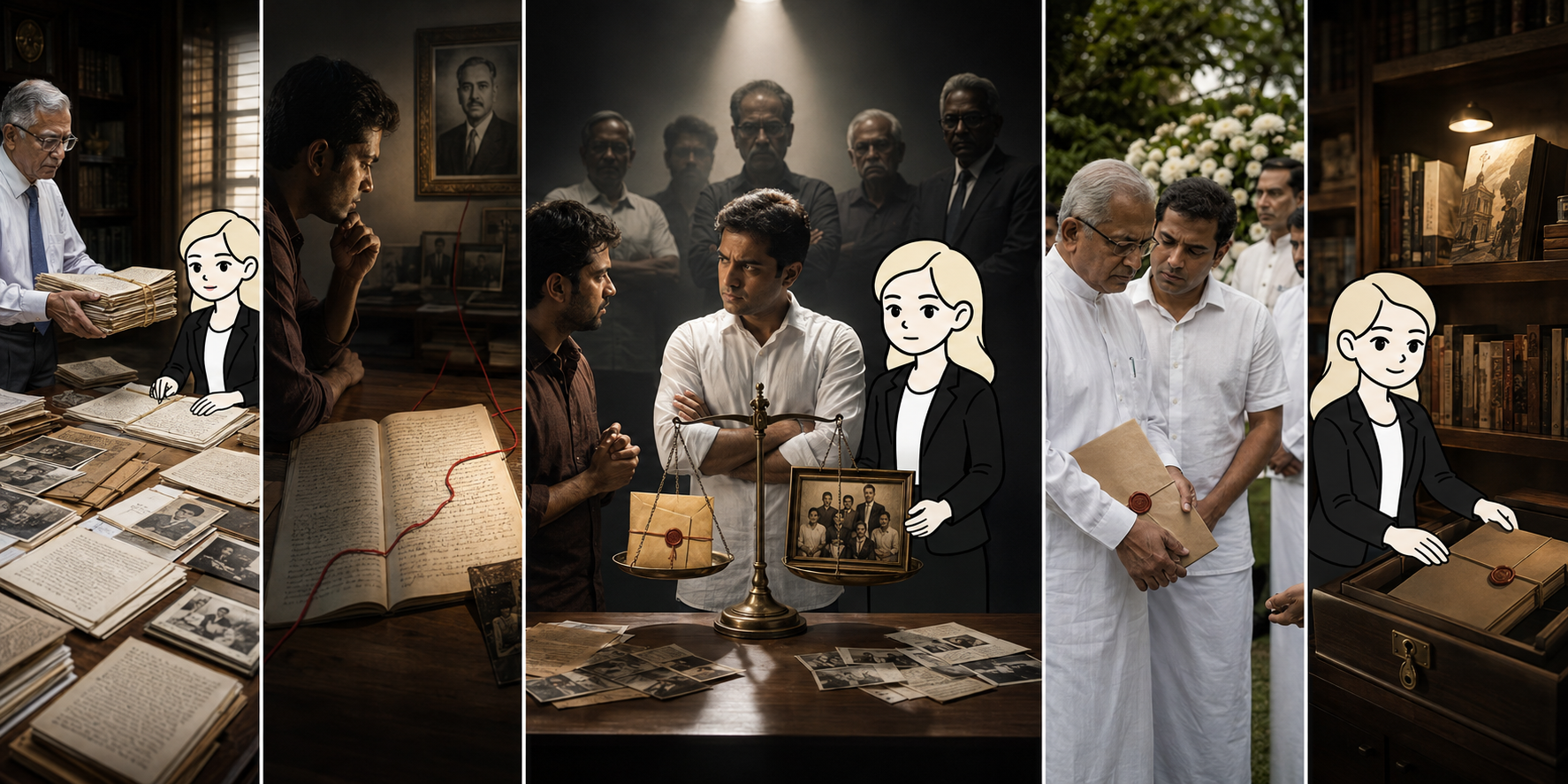
A retired senior civil servant submitted a memoir criticizing Jagath Sumathipala and another figure linked to Sporting Star. Jagath is Lehan’s uncle. AngryPages reviewed the claim, protected the author’s confidence and published the book. A retired senior Sri Lankan civil servant brought AngryPages the record of his life. It covered decades inside government ministries, state broadcasting, healthcare, urban development and public administration. The manuscript wasn’t ready for upload. It arrived in more than twenty Sinhala chapters, piece by piece, with dozens of photographs, crests, corrections and missing translations. AngryPages took it on. We translated, edited, designed and prepared the work without charging him. We moved quickly because we believed the manuscript was larger than one man’s memoir. We considered it part of Sri Lanka’s public record. During the work, we found the passage about our founder’s family.
Jagath is Lehan’s uncle
Buried inside the manuscript was criticism of Jagath Sumathipala and a finance director associated with Sporting Star. Jagath is Lehan’s mother’s brother. He appears on AngryPages’ Protect list under our family. Sporting Star and Betss.com appear beside him. The author had not warned us before sending the manuscript. When Lehan found the passage, the obvious question arrived: Would AngryPages protect its founder’s uncle—or publish the author’s professional opinion? Lehan’s first answer was that the criticism could remain if the evidence supported it. That did not mean the author could write anything he wanted. Lehan wanted the decision based on the evidence rather than the family relationship.
Protection is not censorship
AngryPages keeps a Protect list. People close to our founder receive additional review when serious accusations are made against them. Public figures and others at heightened risk may receive it too. That protection is real. It does not mean they are immune from criticism. It means AngryPages will not lazily attach its name to a rumour, an implication or a political grudge simply because the target is famous. Family criticism receives a stricter evidence test because Lehan knows precisely what an unsupported allegation can cost. But stricter does not mean impossible. We require support for accusations, including those about people on the Protect list.
A famous name proves almost nothing
Jeffrey Epstein’s contact book contained famous people. That did not make every person listed inside it responsible for Epstein’s crimes. A photograph, telephone number, social encounter or email does not prove participation in everything another person has done. The Panama Papers and Paradise Papers created a similar public reflex. A person’s appearance inside offshore records does not automatically prove tax evasion, laundering or criminality. AngryPages Inc is a California operating company owned by AngryPages Holdings Inc in Delaware. Companies separate assets, operations and intellectual property across entities for legitimate business reasons. An offshore structure may deserve examination. It is not a conviction. Jagath’s name has appeared in public offshore reporting. That fact alone does not authorize an AngryPages author to build whatever criminal story he wants around it.
The author knew what “bookmaker” would imply
The disputed passage did not exist in a vacuum. It described Jagath as a famous Colombo businessman associated with betting and placed that relationship beside criticism of an accountant connected to a Buddhist university. In Sri Lanka, the words *bookie*, *bookmaker*, *casino* and *betting* carry more than their literal meaning. They invite the reader to think about laundering, prostitution, political money, addiction, crime and sleaze—even when none of those things has been proved about the person being discussed. The author understood the atmosphere surrounding those words. AngryPages understood it too. That is why we did not merely ask whether every sentence was grammatically defensible. We asked what conclusion the placement was designed to produce.
Gambling does not erase competence
Sporting Star operated hundreds of locations. AngryPages did not see experience helping run that operation as automatic evidence that its finance director was unfit to review another institution’s accounts. We saw the opposite possibility. A person who understands the real finances of a large operating business may know more about practical accounting than somebody with beautiful certificates who has never kept a complicated operation alive. Paper qualifications matter. So does surviving the real world. The author appeared to treat association with gambling as disqualification by itself. We did not accept that reasoning automatically. The allegation concerning foreign donations and financial reporting required evidence. The author later chose to remove that paragraph himself. We removed that claim as he requested and continued with the memoir.
Sri Lanka loves gambling money more quietly than gambling
Some of Sri Lanka’s wealthiest businessmen have been connected to casinos, betting or gaming. The same society that condemns those industries often celebrates the fortunes built around them. Religious institutions receive support from powerful business families. Politicians attend their events. Respectable people take their calls. The moral disgust becomes flexible when the donation is large enough. The Theravada Buddhist idea of Right Livelihood traditionally warns against several destructive trades. Gambling has still occupied a stranger social position: condemned publicly, tolerated privately and relied upon financially. That contradiction does not prove Jagath innocent or guilty of anything. It explains why calling somebody a bookmaker in Sri Lanka is never only a job description. It is a political weapon. AngryPages would not allow the weapon to substitute for evidence.
Traditional media often protects the family
Lehan has watched Sri Lankan media organizations struggle when the truth crosses an owner, advertiser, relative or political ally. His uncle Thilanga previously operated *Lakbima*. Lehan believes that reporting decisions there sometimes became weaker when the facts were commercially or personally inconvenient. The lesson was not that one newspaper was uniquely evil. The lesson was that family-controlled media eventually faces a brutal test: Will it publish the truth when the truth reaches the owner’s table? AngryPages was now facing that test. A manuscript had arrived containing criticism of Lehan’s uncle. Lehan’s mother wanted it gone. The author feared that discovering the family relationship had destroyed his chance of publication. If AngryPages simply deleted the entire discussion because Jagath was family, we would become exactly the kind of publisher we claim Sri Lankan writers need protection from. God is our witness in what AngryPages publishes. An uncle is not.
The author became frightened
When the writer discovered that Jagath was Lehan’s uncle, his confidence changed. He explained that he had known Lehan’s grandmother Milina and knew Thilanga too. He appeared to hope that these older family relationships might protect the project. Those relationships didn’t affect our decision. The author then asked in writing for the disputed comment to be removed. We respected his decision. The author withdrew his own passage. Jagath had not instructed us to remove it.
Jagath asked to see the evidence
Later, Lehan met Jagath at Upali Dharmadasa’s funeral. Lehan had barely attended a funeral in more than ten years. He was not there to collect votes, perform grief for society or parade through Colombo’s political class. Upali had previously visited Lehan at home with his son and treated him warmly. That was enough. At the funeral, Lehan told Jagath that the civil servant had already published the memoir in print before approaching AngryPages. Jagath said that the author had previously been friendly toward him and others named in the book. He asked to see the supporting material. Lehan refused. The manuscript and evidence belonged inside a confidential publishing relationship. Jagath could obtain the author’s printed edition if he wanted to read what had already been made public. Being Lehan’s uncle did not give him private access to an AngryPages author’s files. The author had already agreed to remove the disputed passage. That was all Jagath could expect from us.
Lehan would not become the family’s stooge
Former deputy foreign minister Neomal Perera once warned Lehan not to allow Thilanga to turn him into a stooge. Lehan remembered it. Family loyalty does not require intellectual surrender. It does not require threatening an elderly author, handing over his confidential material or acting as an uncle’s private enforcer. Lehan loves his family and will defend them against lazy allegations. He can still tell them no. AngryPages does not work for Jagath. Jagath does not own us.
The funeral made the whole argument visible
Thilanga sat near the front of Upali’s cremation service. People delivering eulogies named the public figures seated before them. Kamal. Mahela. Others. They repeatedly passed over Thilanga. Lehan found it funny. Here was a powerful man sitting at the front of the room while speakers behaved as though his name had disappeared. People spend their lives gathering titles, influence, allies and invitations. Then a room decides whether to say their name. AngryPages does not want to become an endless political story waiting for approval at somebody else’s funeral. We are alive now. Our authors are alive now. They should document what they believe while somebody can still hear them.
We also fired the author
Editorial independence does not mean the author controls AngryPages. The project became exhausting. More chapters arrived separately. More corrections followed work we had already completed. Translation complaints, redesign demands and accusations continued. AngryPages terminated the project and stopped the translation, editing and design work. The writer was surprised and hurt. He asked us to explain. Then he accepted our reasoning with grace. That response changed the situation. Lehan reconsidered through Buddhist compassion—*maitreya*—for an elderly man who had devoted much of his life to public service and was now trying to preserve it. The reinstatement was mercy. It was not something his friendships with Milina, Thilanga or anybody else had purchased.
One complete manuscript
AngryPages established one final rule: Send one complete manuscript. We wouldn’t keep redoing finished work as more chapters and requests arrived. The author kept his word. He sent the remaining material. AngryPages completed the corrections, finished the editorial work and published the book. We later helped him informally with difficulties he faced in retirement—help most publishers would never provide to an author who had already been demanding, accusatory and difficult. We had stopped the project and then agreed to finish it. The family disagreement didn’t prevent us from publishing him.
Why AngryPages serves Sri Lanka from California
Sri Lankan writers have spent generations learning which families, officials, religious figures and businesses cannot be criticized safely. A local publisher may know the target. The newspaper owner may share a business relationship with him. The television station may need his advertising. A relative may make one telephone call. The story disappears. AngryPages exists outside that arrangement. We are a California publisher working with writers in Sri Lanka and around the world. That distance gives us room to examine a claim without automatically kneeling before the local hierarchy surrounding it. It does not mean we publish every accusation. It means we can ask for evidence without asking for permission. If a complaint is genuine, we will review the relevant passage with the author. If the evidence fails, we may require an edit, add context, refuse the work or remove it. If the evidence survives, family discomfort does not kill it.
The book survived everybody
The book was published despite the family argument, the withdrawn paragraph, repeated corrections and our decision to terminate and later resume the project. We will publish criticism—even criticism of our founder’s own family—when it can be supported. We expect the supporting evidence regardless of who the author knows.