What happened
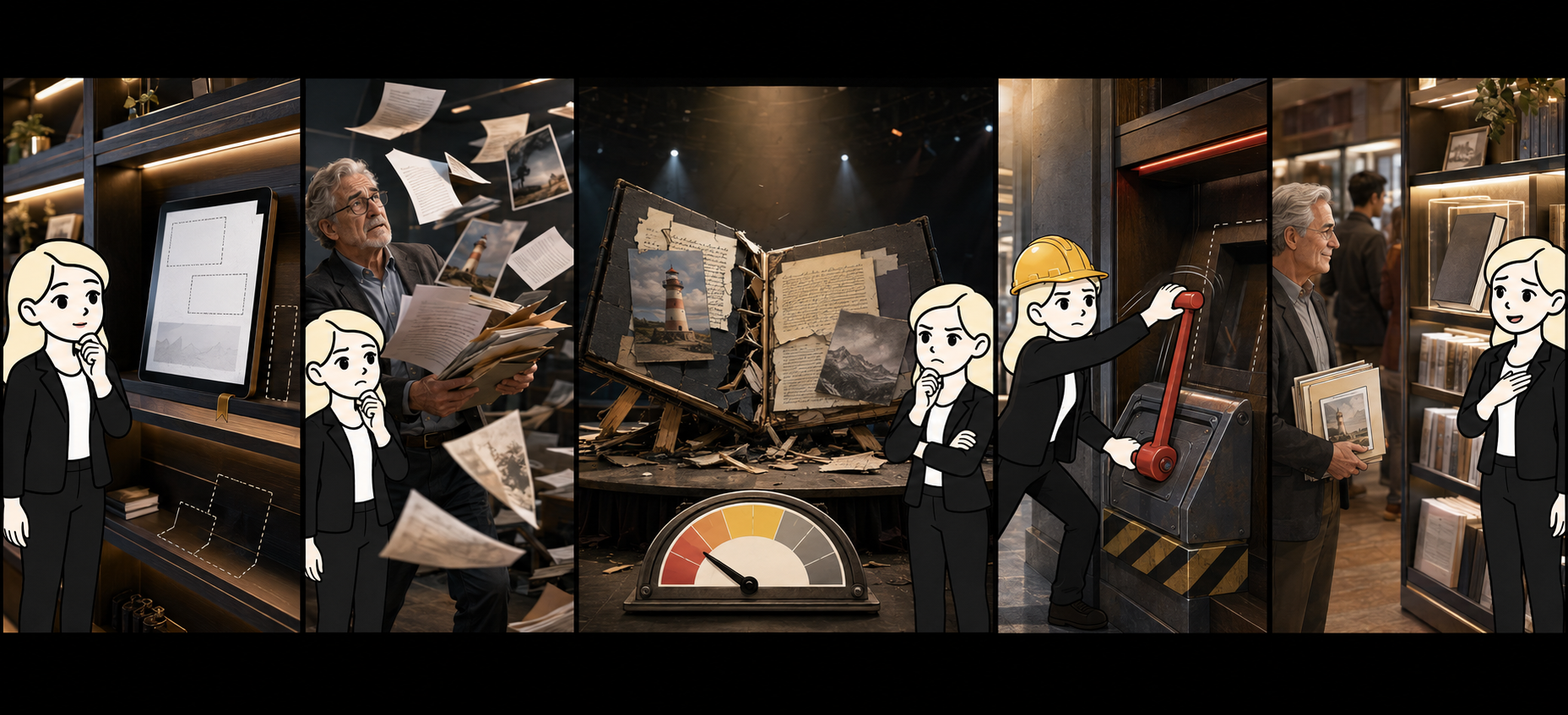
AngryPages accepted a short-story collection, agreed on a price and placed it live. When the final writing, introductions and images arrived, the completed product failed our quality standard. We pulled it. An author approached AngryPages with a collection of short stories. We accepted it. We helped create his account, discussed the chapters, agreed on a reader price and made the book available. Then the unfinished parts of the project began catching up with us. The landing page was not complete. Supporting material arrived slowly. Deadlines came and went. The stories, introductions and images did not arrive together as one properly finished publishing package. AngryPages became angry. We told the author to complete the delivery. He sent the remaining pictures and story introductions. We initially promised to conduct a full review by 17 August 2026. At 11:12 p.m. on 27 July, Lehan explicitly told him that the review was not a rejection. Nine minutes later, AngryPages reversed the decision. We had seen enough, and the book came down that night.
We published too early
AngryPages made the first mistake. The book should not have gone live before the entire package had passed final review. A manuscript may look acceptable when considered alone. Then the introductions arrive. The images arrive. The landing page takes shape. The finished product reveals whether every part belongs together. In this case, it did not. The writing, presentation, image use and overall condition failed our publishing standard. We couldn’t justify leaving it up just to avoid admitting the mistake.
The pictures were rushed
The author accepted the decision without a fight. He did point out that AngryPages had pressured him to send the pictures quickly. He said the material arrived in disarray because we had rushed him. That was fair. AngryPages contributed to the final scramble. The rushed images were part of a wider problem with the package. A strong book weakened by a few badly selected photographs can be repaired. A strong author can replace the images, reorganize the package and recover. Here, the writing, introductions, presentation, delivery and images all pointed in the same direction. The product was not ready. We were not interested in stretching a failed package into another month of explanations.
This was not about the subject matter
The author later asked whether AngryPages had removed the book because some stories were “anti-social” or critical of peace officers. No. AngryPages publishes political criticism, institutional criticism and work that makes respectable people uncomfortable. We publish impolite work. We removed this book for its quality, not its politics or a complaint from somebody powerful. The completed package received approximately four out of ten. That is a D.
How AngryPages grades work
AngryPages does not require every author to produce a literary masterpiece. If we demanded perfection, almost nobody would publish. New writers would never receive a chance, authentic voices would be polished into death and the entire platform would become a showroom for cautious professional prose. We use a practical scale: • F — 0–1: Failure. Flat rejection. • E — 2–3: Bad. Not publishable. • D — 4–5: Mediocre. Needs substantial improvement. • C — 6–7: Good enough. It reaches the reader. • B — 8–9: Good. Well written and effective. • A — 10: Great. Convincing and worth reading. • S+: Exceptional work that rises beyond the ordinary scale. AngryPages usually needs at least a C. The removed collection landed around four. There may have been worthwhile ideas inside it. That did not make the complete product worthwhile enough. We do not require genius. We require something worth the reader’s time.
Lehan initially helped because he understood
The author was older and had taught English. Lehan felt empathy for him. AngryPages provided approximately $60 worth of support without charge, hoping the work could be lifted toward publication quality. That instinct came from Lehan’s own history. Sinhala was his mother tongue. English was not the language that came naturally to him as a child. He learned it partly because he wanted Pokémon games.
Pokémon taught Lehan English
One of Lehan’s father’s Chinese friends, Martinn—whom Lehan affectionately thought of as his Chinese dad—promised to give him Pokémon games if Lehan asked for them in English. So Lehan learned to ask. The reward worked. Later, Lehan lived in Singapore for around two years and learned some basic Mandarin. Over time, American or international English became the language he used most strongly. That history matters to AngryPages. We do not believe a writer is stupid because English is not his first language. We do not mock somebody for reaching toward an international audience with imperfect grammar. People learn through need, ambition, games, work, embarrassment and repetition. A child asking for Pokémon in broken English may eventually build an American publishing company in that language. That possibility deserves encouragement. It does not require AngryPages to publish every weak book.
Sympathy can open the door
Compassion justified giving the author an opportunity. It justified extra help. It justified Lehan looking at a struggling writer and remembering what it felt like to learn. It could not turn a four into a seven. There is a point where more free support stops helping the author and starts damaging the publisher. AngryPages cannot promise readers quality and then quietly lower the standard because an author is elderly, kind, inexperienced or personally sympathetic. We can be patient with an author without agreeing to keep the book on sale.
Imperfect English can be powerful
Some of the strongest writing carries flaws. A soldier describing a battle may misspell a city. A retired public servant may write a sentence no trained editor would construct. A child may use the wrong tense while telling the most honest story in the room. Those imperfections can prove that a human being was there. AngryPages does not want to polish every author until they all sound like the same machine. We preserve authentic voices when the flaws add life rather than destroy meaning. But authenticity is not a magic word that converts carelessness into quality. A badly assembled book does not become good because it is human. A confusing story does not become moving just because the writer means it. We forgive imperfect English. We do not confuse it with a finished product.
AI can score higher and still bore us
Modern AI can produce technically immaculate writing. The grammar is clean. The structure is balanced. Every paragraph arrives safely. Every argument has a respectable transition. On a mechanical scale, sophisticated AI may appear to score S++. Then a human tries to read it. The prose is often cautious, predictable and bloodless. Popular models leave recognizable fingerprints across articles, books and websites. The sentences are correct, but nothing feels dangerous enough to remember. Perfect grammar alone doesn’t make something worth reading. A flawed human story may outperform perfect machine prose because somebody lived it. A polished AI story may fail because nobody did. We want that life in the writing, and we still expect a finished product.
Publication is not permanent approval
Some authors believe that once a book appears online, the argument is over. It is not. Publication means AngryPages approved the product based on what it had seen at that moment. If later material changes the package, new information appears or the completed work exposes problems that were not previously visible, we may review it again. That review may lead to corrections, a redesign, restrictions or removal. If we approved something we shouldn’t have, we need to admit it and act.
Nice people can make bad products
The author did not become evil because the collection failed. He did not harass us. He did not threaten AngryPages. He accepted the removal, explained the rushed material and later requested deletion of his files. We deleted them. The relationship ended cleanly. We weren’t trying to punish him. We had rejected the product. The author may be a perfectly decent man. Readers were still being asked to spend their time and money on the book. Kindness toward one author cannot become disrespect toward every reader.
The shelf belongs to the reader
The collection went live on 21 July. After late materials and missed deadlines, final introductions and pictures arrived on 26 July. AngryPages reviewed the completed package on 27 July and removed it that night. The author’s files were deleted on request on 3 August. The earlier approval didn’t prevent us from removing it. We published too soon and corrected that decision after reviewing the complete book. The content received four out of ten. If a product sucks, we do not care whether the author is a nice guy or girl. We pull it. We’re not keeping a book on sale as a favour.