What happened
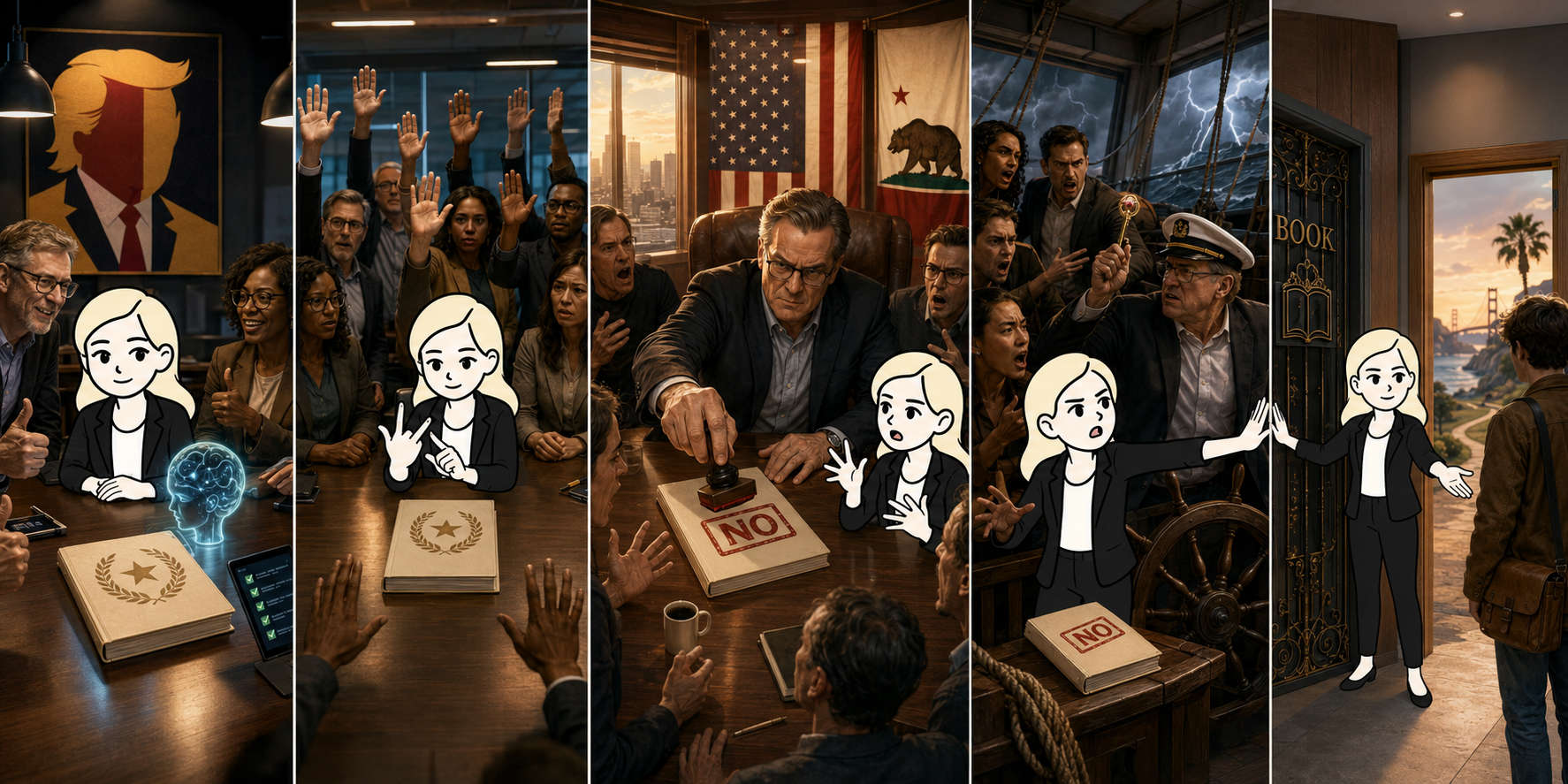
An award-winning Sri Lankan author submitted satire resembling Donald Trump. Our editorial team approved it. Our AI approved it. Ten people voted to publish it. Lehan rejected it—and then allowed the team to stop him from banning the author. An award-winning Sri Lankan author brought AngryPages a political satire built around a fictional character resembling Donald Trump. The editorial team read it. They believed fiction, satire and parody gave the manuscript a legitimate basis for publication. The material was sharp, hostile and politically loaded, but it was still presented as fiction. Our AI review reached roughly the same conclusion. Most of AngryPages wanted to publish it. Lehan did not.
AngryPages is not politically neutral
Lehan loves Donald Trump. Trump appears on AngryPages’ Protect list. That means allegations and hostile portrayals involving him receive additional scrutiny before our trademark is placed beside them. This is not everybody’s view inside AngryPages. We are a California company operating from a state that has voted Democratic in every presidential election since 1988. Many people around AngryPages are socially liberal, multicultural and politically opposed to Trump. Lehan’s best friend Mikey has personal ties to the Obama world through his sister Ronalie’s involvement with Obama for America. Mikey was one of the few people who appeared for Lehan when his father died. Politics did not erase that friendship. Nobody needs to agree with Lehan to matter to him. But friendship does not decide what Lehan signs as publisher either.
Why the editors approved it
The manuscript was not presented as a newspaper investigation. It was fiction. The editorial case was straightforward. *Family Guy* attacks public figures through parody. Comedy Central roasted Trump openly. Bookstores and Amazon carry shelves of work ridiculing, condemning and psychoanalyzing him. Political satire is allowed to exaggerate. A fictional villain may resemble a living president without becoming a sworn factual statement about that president. Our reviewers concluded that the manuscript had enough distance, humour and literary framing to survive as satire. Most of it did not trouble Lehan either. Then he reached several passages involving lewd conduct that closely paralleled the E. Jean Carroll allegations. That was where the book died.
Where fiction became an accusation
Lehan believed those scenes would cause readers to picture Trump committing particular acts. Changing the character’s name did not change the association. The author could call it fiction. Lawyers could call it parody. An AI could explain why a court might protect it. Lehan still believed AngryPages would be helping transform a disputed allegation into cultural fact. He refused to attach the AngryPages name to that. The author could write the book. AngryPages wasn’t going to publish it.
A court may allow it. We still get to say no.
Lehan rejects the public effort to use the Carroll verdict as permission to describe Trump with the most damaging possible label forever. A New York civil jury found Trump liable for sexual abuse and defamation. Trump disputed the allegations and fought the judgments. Many people regard Carroll as courageous and the verdict as accountability. Lehan does not. He saw a decades-old allegation revived through New York’s Adult Survivors Act, presented before a jury inside a media environment that had attacked Trump for years. He did not believe the result settled the moral question for him. He did not accept that a civil finding should become a publishing command imposed upon AngryPages. Lehan disagreed with the court’s judgment.
The wider Trump cases mattered to him
Lehan did not view the Carroll litigation in isolation. He watched Matthew Colangelo move from a senior position in the Biden Justice Department to Alvin Bragg’s Manhattan office and help prosecute Trump. He watched Letitia James pursue Trump after publicly promising to confront him. He watched Carroll bring her claim when a new legal window made older claims actionable. To Lehan, these separate proceedings converging during Trump’s political return looked less like ordinary coincidence and more like lawfare: opponents using courts, prosecutors, judgments and legal bills to exhaust a presidential candidate. That is Lehan’s interpretation. AngryPages cannot prove that Biden secretly directed every case. We found no evidence capable of establishing such a conspiracy. Lehan did not need to prove one to make a publishing decision. He needed to decide whether he trusted the allegation enough to finance, brand and distribute a foreign author’s fictional version of it. He did not.
“Take it to another publisher”
The author would not change the passages. Fine. Lehan’s answer was simple: > Take the project to another publisher. Staff pointed out that Amazon sold books far more hostile to Trump. Lehan answered in the style of Roy Cohn: > Then go publish it on Amazon Kindle Direct Publishing. Why do you need to break my balls? Amazon’s shelf is not AngryPages’ signature. A book being lawful does not obligate every publisher to accept it. A product being available elsewhere does not require AngryPages to finance its journey into the American market. The author specifically wanted a U.S. publisher. That made Lehan’s approval more important, not less.
Bezos understood the difference
Jeff Bezos stopped *The Washington Post* from making its traditional presidential endorsement shortly before the 2024 election. People inside and outside the newspaper were furious. The owner made that decision despite objections from editors, writers and subscribers. The person who ultimately controls the publication may still make a decision everybody else hates. AngryPages is younger, smaller and far more personal than *The Washington Post*. But the principle is the same. We are not an editor-owned republic pretending the publisher is a decorative signature at the bottom. Lehan’s name appears as Publisher on AngryPages products. His approval means something.
Then the crew mutinied
The argument inside AngryPages became vicious. Staff told Lehan that his publishing instincts were weak. Some believed Carroll completely. They argued that criticism based on widely reported allegations remained reasonable inside fiction. They brought up Trump’s old public comments, his appearances around Epstein and the cultural evidence used against him. Lehan answered that people were weaponizing a jury verdict he considered bullshit. Staff asked whether Lehan had been inside the department store to know what happened. He answered that none of the supposed witnesses had been there either. Somebody associated with the Obama world said Trump could not beat a man and mocked Lehan’s judgment. Lehan mocked back. He described some writers as washed-up people arriving only to fuck with him personally. He accused parts of his team of mutiny and compared AngryPages to a ship whose sailors had forgotten the captain. Nobody was fired. People insulted the founder’s hero, challenged the founder’s reasoning and voted against the founder. They remained part of AngryPages. That is free speech inside a company with an actual publisher.
Ten voted yes
AngryPages held an internal vote. Ten people voted to publish the manuscript. Three opposed it. Two abstained or deferred to Lehan. Inside the U.S. team, the vote was five to two in favour of publication. The vote mattered. It showed Lehan that the manuscript was not universally regarded as hateful, unlawful or editorially worthless. It proved that intelligent people inside his own company could review the same pages and reach the opposite conclusion. The vote changed one important decision. It did not change the publishing decision.
Pontius Pilate had a majority too
During the argument, Lehan reached for the King James Bible. Pontius Pilate did not believe Jesus deserved the punishment demanded by the crowd. He still surrendered the decision. Lehan had no interest in repeating that model. He would not wash his hands and claim the editors made him do it. If AngryPages harmed somebody under its name, Lehan believed the responsibility would still reach his desk. That is why a publisher exists. Not merely to celebrate successful books. To own the decision everybody else would rather distribute among a committee. Lehan compared himself to Caesar confronting the Senate, King Arthur holding Camelot for one brief shining moment, and a ship captain surrounded by sailors who had forgotten their duty. He mentioned *The Godfather*, where Sonny Corleone’s loose mouth revealed a family division and helped enemies understand how to strike Vito. Lehan listened to the team, but he wasn’t going to let the vote decide what he signed.
AngryPages is an angry mob with a publisher
Lehan described himself as a scribe for the Angry Mob—but not its subordinate. AngryPages exists to help people publish the stories that other systems bury. That does not mean the crowd controls every editorial decision. A brand cannot be assembled by public vote every morning. At some point, somebody has to know when to publish, when to say no and when to walk away. We wash our hands during COVID. We do not wash them when making decisions. If customers hate a product, they will not punish a theoretical committee. They will punish AngryPages. The publisher therefore carries authority because he carries the brand.
America made our fortune
Lehan wrote the rejection on an AngryPages email template bearing the company name and his title as founder. He initially reduced his judgment to four words: > We don’t hate America. That was deliberately brutal. The manuscript was written by a foreign author seeking American publication. Lehan believed its sharpest passages used disputed claims to convert an American president into a fictional sexual criminal. He did not want AngryPages financing that journey. America gave AngryPages its corporate home, laws, market and identity. Lehan believed loyalty mattered most when it cost something. The book was award-winning material from a respected author. The editorial team wanted it. Publishing it might have demonstrated fashionable independence. Rejecting it demonstrated something harder: AngryPages would not trade Lehan’s understanding of America for literary approval.
The team stopped the ban
Lehan initially wanted the author permanently banned. The team fought him again. They argued that the writer had not submitted CSAM, committed fraud or abused the platform. He had written political satire about a public figure. The manuscript could be rejected without treating its author as evil. Lehan eventually accepted that distinction. The book remained rejected. The author remained eligible. He could submit another manuscript. He could criticize Trump elsewhere. He could take this book to Amazon or another publisher. AngryPages would not pursue him, punish him or attempt to remove his voice from the world. That was the team’s victory. Their vote did not force Lehan to publish. Their argument stopped Lehan from turning one political disagreement into a permanent exclusion.
The founder can be restrained without being overruled
The editors, AI, staff and friends all had their say. Lehan still had the final decision, but the team persuaded him to drop the ban.
What happens after Lehan?
Lehan has said he may retire from direct control of AngryPages around the end of 2027. People who disagree with him may eventually make these decisions. A future publisher may accept the same manuscript. A Democratic leader may interpret the Protect list differently. A new editorial team may decide that the Carroll verdict provides sufficient foundation for satire. That future does not weaken Lehan’s authority now. King Arthur’s Camelot mattered partly because it did not last forever. For this brief moment, Lehan built AngryPages, carried its risk and signed its products. His rules govern the books bearing his signature. The next publisher can be judged by theirs.
Red, blue and 2028
The dispute also forced AngryPages to confront whether it should behave like a political institution. Staff rejected the idea that AngryPages should automatically endorse Trump as a company. Lehan maintained that he could make a founder endorsement while still allowing senior people to support candidates they believed in. He imagined future AngryPages support divided across competing American figures—Trump, Vance, Gavin Newsom or others—rather than forcing every person into one party line. Lehan loves Trump. A colleague may respect Obama. We can work together in a California company and argue about the next book without becoming enemies.
The book was rejected. The author was not.
On 11 July 2026, the author was invited to submit. By 17 July, AngryPages had offered digital-first terms with no publishing fee and allowed him to retain copyright. The full manuscript arrived on 20 July. It was rejected on 21 July. We rejected this book without declaring the author dishonest or prohibiting political satire and criticism of Trump. He could send us another manuscript.
The founder’s no is binding
AngryPages believes writers may publish what they wish. We believe publishers may refuse what they wish. The author does not own our trademark because he wrote a defensible book. The editorial team does not own the final signature because it won a vote. A court ruling does not force AngryPages to transform an allegation into a branded cultural product. If another publisher wants it, they can publish it. If Amazon wants it, Amazon can sell it. If our staff believe Lehan is wrong, they may tell him so. They did. Ten people voted yes, but Lehan refused to publish it. He raised a glass to the company America made possible: We stay up late, go to the movies and drink whisky. Here is to the next 300 years. Yo-ho-ho.